
The Daniel Greenleaf Family
- westmohney

- Jan 23, 2023
- 7 min read
Updated: Feb 7, 2023
A lovely Babe, who ne'er to her, An injury could intend, By Poison out of cursed Spite, She hurried to its end. . . ~ from a broadside posted in Boston

the first woman pharmacist in America
Our cousin Daniel Greenleaf (3C8X) was born in Newbury in 1679. Although he eventually moved to Boston, his roots were in Newbury where his grandfather had settled ca. 1640. In 1699, Daniel graduated from Harvard with a degree in medicine. In 1701, he married Elizabeth Gookin, whose father was also a doctor. For the next few years, Daniel made his living practicing medicine in Cambridge. Ca. 1706, he must have heard a call from above because he abandoned his medical practice and took up the mininstry. He was able to get a position as the pastor of the Congregational Church in Yarmouth.

Daniel had been in Yarmouth for about twenty years when, according to James Edward Greenleaf (8C3X), author of Geneaology of the Greenleaf Family, "some difficulties" arose in his congregation. It appears, that Daniel's wife Elizabeth wasn't about to suffer through these "difficulties." She took their nine children, between the ages of seventeen and two, and moved to Boston where she opened an apothecary and grocery shop. Having a father and husband with some knowledge of medicine had served Elizabeth well. With Daniel living on a shoestring in Yarmouth, Elizabeth was able to singlehandedly support her children and send her eldest son to college.
We learn more of Daniel's woes with his Yarmouth congregation from a letter written by Daniel and Elizabeth's great-grandaughter, Elizabeth Sewell (6C5X):
Mr. Greenleaf (Daniel) remained for a time with a remnant of his charge who were strongly attached to him, but finally, I believe, the majority quarrelled him away. I well recalled hearing my mother often say that at this juncture they brought an accusation against him 'that he talked of worldly matters on the Sabbath;' the worldly matters were that in the course of one Sabbath he received a letter from his wife, saying their eldest son appeared at the point of death with small-pox, and that unless he came on immediately he would not probably find him living. The good pastor was too poor to own a horse, and after the second service requested the loan of one from one of his deacons, that he might set off soon after midnight for Boston. He found the boy living, and he lived to be upwards of ninety years old. I well recollect, when a child, hearing this case narrated by my mother, and thinking her grandfather must have been a very good man. He afterwards removed to Boston, and joined his family...
Daniel and Elizabeth had twelve children. Their eldest son, who lived to be "upwards of ninety," followed family tradition and became a doctor. Two of their sons would become sheriffs of Boston at a critical time in the history of our nation. Their son John (4C7X), who lived with travails of his own, took over the apothecary after his parents became physically unable. We'll have more on all these men in future posts.
Great-grandaughter Elizabeth Sewell tells of the last years of Daniel's life:
The good man...was in the habit of going around once a week to see all his married children who were settled in Boston...On one of these occasions...he fell, and so injured his back that he never rose from his bed...but was confined two years, only being moved by his sons...from one bed to another on a sheet. I have often heard my mother say how many pleasant hours she passed in her grandfather's sick chamber; he was always so cheerful and so instructive, it was a privilege to be near him.
Daniel's wife, Elizabeth Gooking Greenleaf, is widely recognized today as the first female pharmacist in America. She is the only woman listed among the 32 apothecaries in New England that existed in the early 1700s. It's unknown how long she was able to continue running the shop but, according to her great-grandaughter, by the time of her husband's infirmity, Elizabeth "had become totally blind, therefore the care and expenses of the family devolved on the children."
Elizabeth, who died in 1762 at the age of 81, was one of seventeen women to be honored by the American Pharmacists Association in 2012, for "contributions to the profession and advancement of women in pharmacy."
Daniel died a year later, in 1763, at age 83. Below is a portrait of the Reverend Daniel Greenleaf painted by John Singleton Copley:

Note: Daniel and Elizabeth's grandaughter, Rebecca Greenleaf (5C6X), married noted lexicographer and textbook writer Noah Webster whose name became "synonomous with dictionary."
the John Greenleaf family
John Greenleaf (4C7X) was the ninth of Daniel and Elizabeth Gooking Greenleaf's twelve children. John took over the Greenleaf apothecary shop ca. 1763. Twenty years earlier, tragedy had visited John's family.
In 1743, John married Priscilla Brown and their first child was born two years later. Sadly, Infant Greenleaf (5C6X) did not survive long enough even to receive a name. The Greenleafs were then blessed with two daughters, Priscilla (5C6X), born in 1746 and Elizabeth (5C6X), born in 1748. Both of these little girls died sometime in 1749. The Greenleaf's last child, John, Jr. (5C6X) was born in July of 1750. This poor little boy died under suspicicious circumstances in July of 1751, when he was only a year old.
The Greenleaf family in general was fond of having their portraits painted and John's family was no different. All of the paintings below were done by John Singleton Copley.


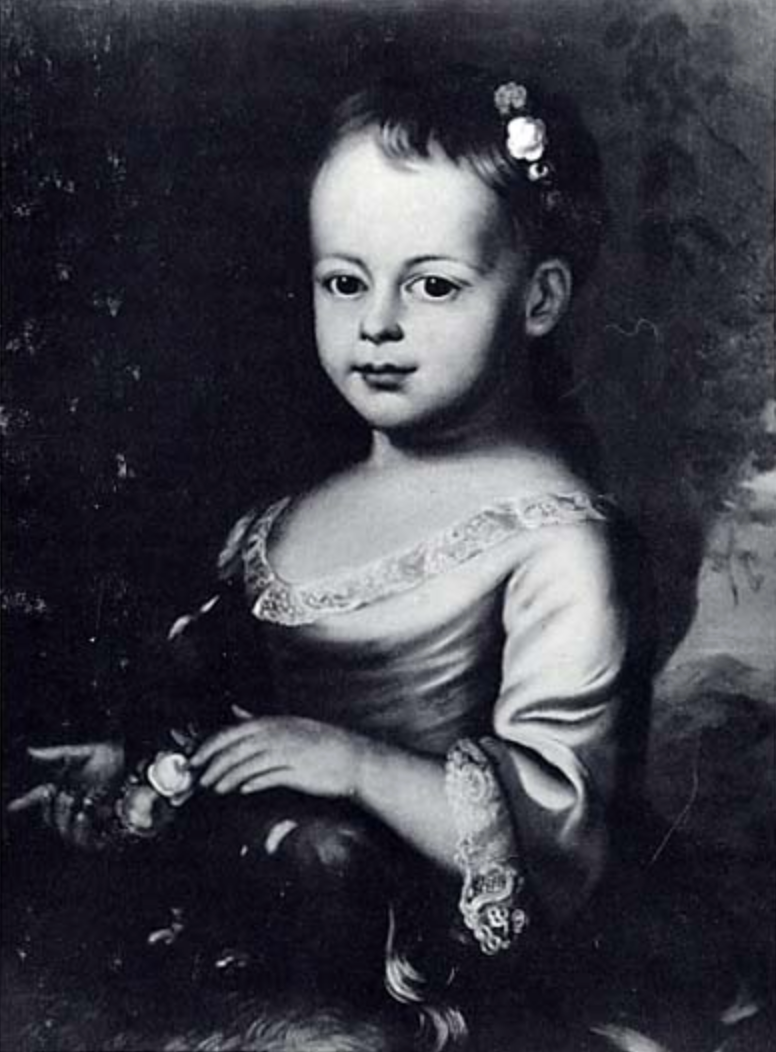

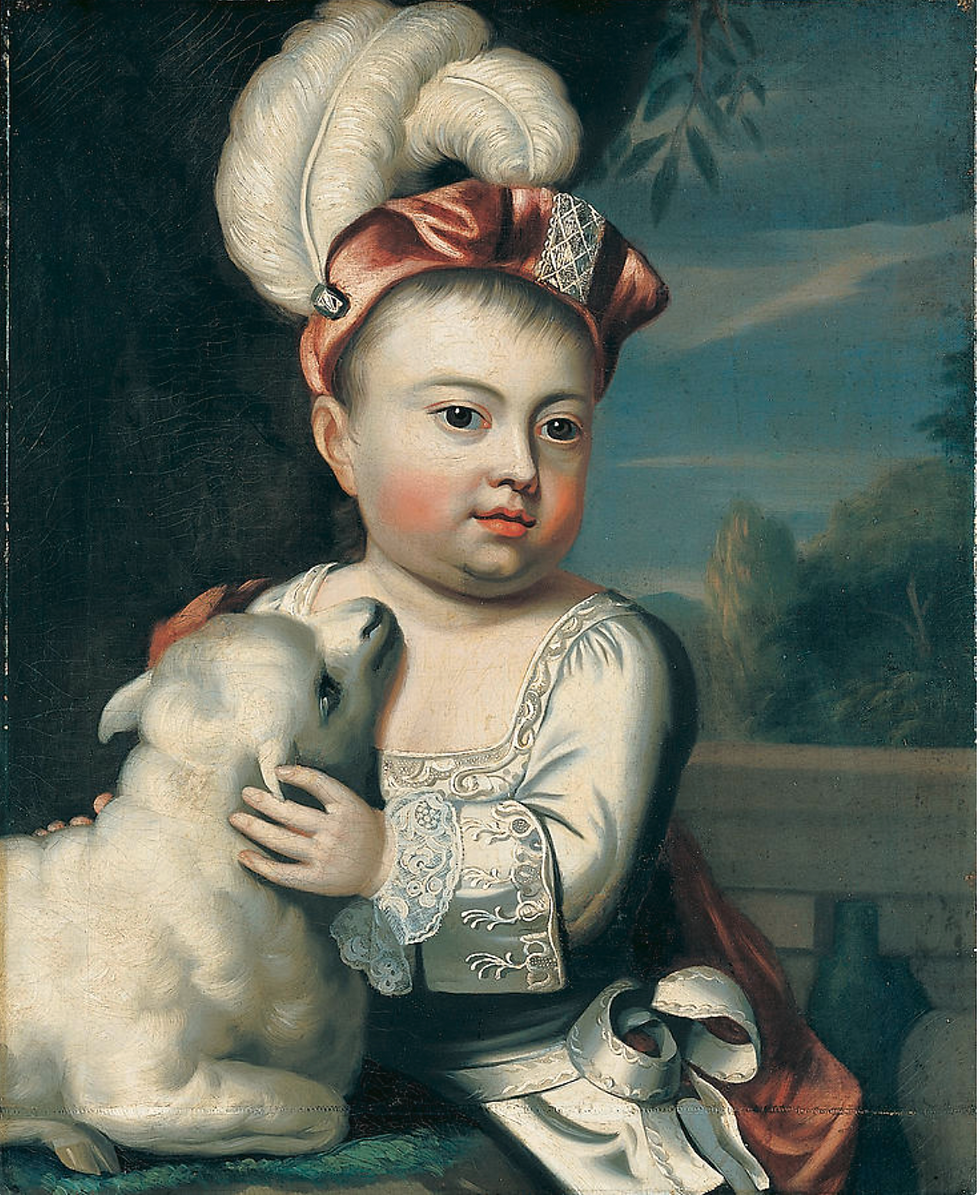
the Greenleaf murders
Many thanks to Jennifer Harris, an associate professor at the University of Waterloo in Ontario Candada, who delved deep into the Greenleaf's story. Her article, "Offering Nothing, Phillis Hammand and 'The Bitter Effects of Sin,'" sheds all the light we were able to find on this devastating episode of Cousin John Greenleaf's life. Harris, who has a PhD in literature and MA in women's studies, was particularly interested in the life of Phillis Hammand who was convicted of murdering the Greenleaf's son and suspected of murdering both of the Greenleaf daughters.
Harris introduces Phillis by writing that "[f]ew have encountered Phillis Hammond, convicted of the murder of the toddler John Greenleaf Jr. in 1751. Even her full name should be unfamiliar, preserved as it is only in 'The Bitter Effects of Sin...'
"The Bitter Effects of Sin" was a broadside that was posted around the town of Boston after the execution of Phillis Hammond. Part of the rhyme says "She soon forgot the early care, Which on her was bestow'd, She learned to lie, neglected Pray'r, Forsook the Fear of GOD...A lovely Babe, who ne'er to her, An injury could intend, By Poison out of cursed Spite, She hurried to its end."
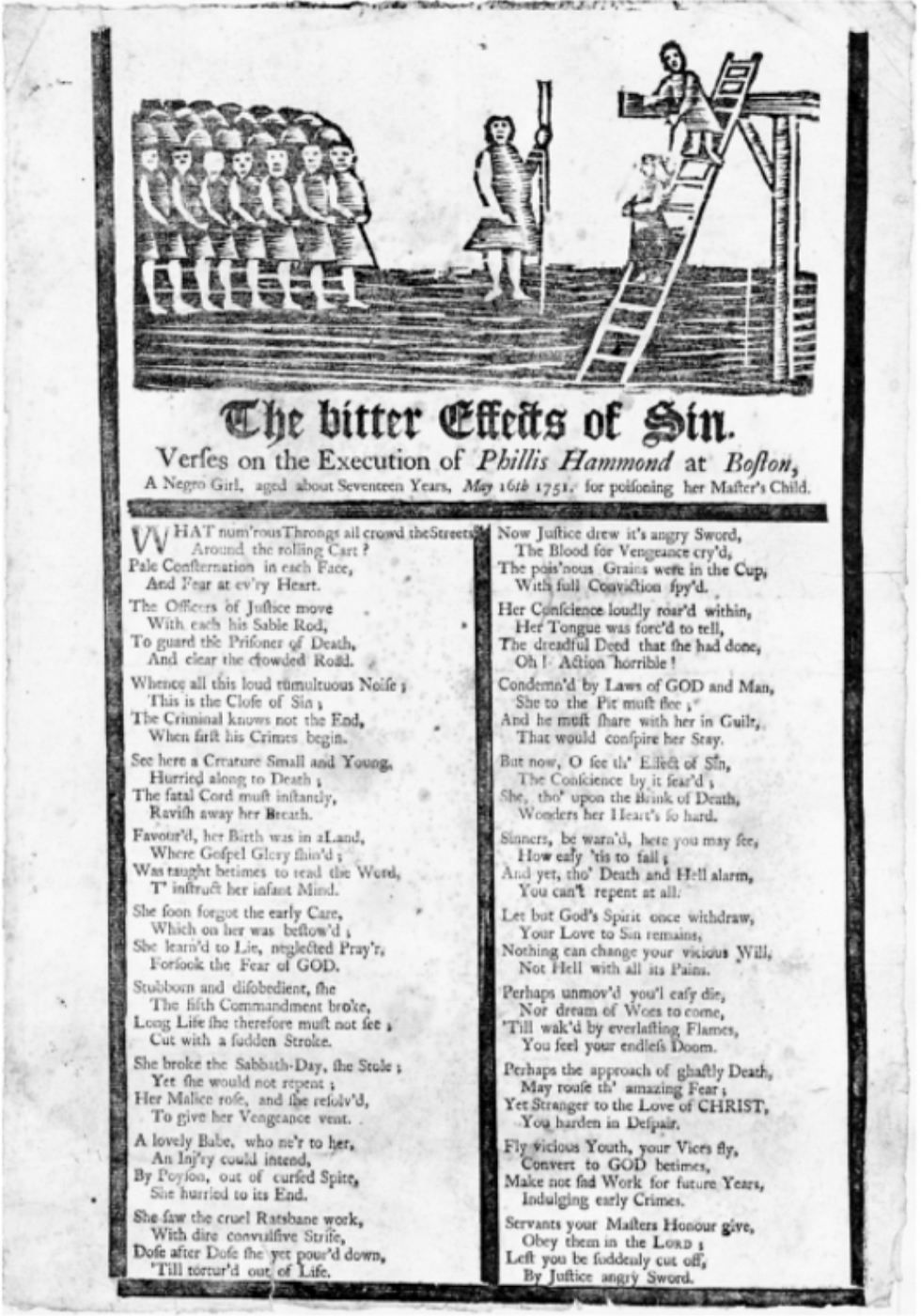
Phillis Hammond was a "Negro servant" who had been employed in the Greenleaf household for at least three years. Harris writes that John Greenleaf "was no newcomer to respectable society," meaning he hobnobbed with the elite of Boston society. Phillis, on the other hand, belonged the the dregs of society.
When John's two young daughters died as toddlers in 1749, their deaths were not seen as "exceptional." But with the death of John, Jr. in January of 1751, "attention turned to Hammond." From an article that appeared soon afterwards in the Boston Weekly News-Letter:
Yesterday morning a young Negro Wench was committed to Goal [sic] here for poisoning her Masters Child, an Infant about 11 months old, by putting Ratsbane several Times into what it drank, which was at last discover'd : The Child languish'd till this Morning and then died.--This wretched Creature has acknowledged not only the poisoning of this Child, but also another of the same Family that died very suddenly some Months ago.
On March 4, it was reported in the Boston newspapers that Hammond had pled guilty to the murder. On April 1, she was sentenced to death by Justice Stephen Sewall. Justice Sewell recorded that when "she was asked by the court what she had to offer why sentence of Death shou'd not be pronounced against her, but offering nothing sentence of Death was pronounced against her in the usual form by me."
A main focus of Harris' article is the treatment of African American women in Massachusetts society at that time. She writes that she wants "to be careful about accepting Hammond's guilt as readily as Sewell and his peers apparently did." And while Hammond may have "deliberately poisoned the Greeleaf child. . .it seems improbable she also poisoned both of his older siblings. Yet Hammond stands convicted by law of one killing, by the press of two, and by history of three."
Harris posits that the choices facing the "seventeen-year-old disenfrancished girl" were limited. She believes that contemporary scholars might well attribute Hammond's "offering nothing" to the recognition that "black guilt was always presumed. . .a sentence of death would be pronounced regardless. . .for fear of possible consequences or additional abuses..."
Whatever the truth may be in the deaths of these three children, the story is a sad and tragic one for both the Greenleaf family and for Phillis Hammond.
silver punch bowl
Ca. 1640 a silver punch bowl was crafted by silversmith John Burt. Engraved on the outside are six names along with their respective coats of arms. One of the names on the bowl is our cousin, pharmacist John Greenleaf. I have tried to find the significance of the bowl, but there appears to be no information on that remaining. I found the bowl on Sotheby's auction site where it was recently sold from the collection of Walter M. Jeffords.

more tragedy for John Greenleaf
Cousin John's family woes did not end with the deaths of his first three children. Sometime before 1759, his wife Priscilla died. As was the custom in colonial America, John soon took another wife, Ruth Walker. Their first child, another John (5C6X), was born in 1760. Their second son, born a year later, lived only a few months. Shortly afterwards, John's parents, Elizabeth and Daniel died, in 1762 and 1763 respectively.
By the time of his parents' deaths, John had most probably taken over the family apothecary business. Since John's brother Stephen (4C7X) was busy keeping order as sheriff of Boston and brother William (4C7X), a future sheriff of Boston, was a prosperous merchant at the time, it seemed natural that John would run the shop. We'll have more on the Greenleaf Apothecary in a future post.
David Greenleaf's house
Our cousin David Greenleaf (5C6X) was a grandson of Daniel and Elizabeth Gooking Greeleaf. David took up goldsmithing and moved to Norwich CT to ply his trade. In 1763, he built a house there which still stands today. In 1999, The Society of the Founders of Norwich purchased the delapidated house with the idea of a museum in mind. Since then, the ongoing restoration project has received almost $200,000 in grant funding. The Society has plans for museum displays and presentations to be held there. During the restoration project, Connecticut State Archaeologist, Sarah Sportman did "test pits" in the yard to look for artifacts. She found fragments of cookwear and pottery along with other items.
Below is a picture of David's house today in it's present state of renovation.

We'll have much more on the Greenleaf family in future posts.


Comments