
THE DEERFIELD CAPTIVES
- westmohney

- May 31, 2022
- 7 min read
It's beyond my ability, in the contents of a letter, to make you understand how ours here are besotted ~ Reverend John Williams
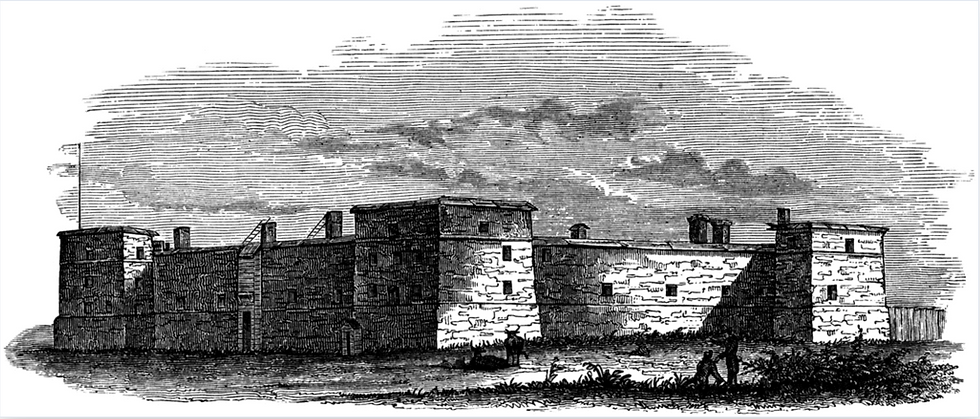
in Canada
Once the Deerfield captives arrived in Canada, the divvying up began. Because of the careful records kept by the French and later research done by Alice Baker and Emma Coleman, we know what happened to the eighty-nine captives still living when they reached Fort Chambly in Montreal. Some of the Deerfield captives, about 15, remained with various Native tribes. The rest, purchased by the French, had varying fates awaiting them. Many would remain in Canada for the rest of their lives. Even those who were eventually redeemed spent years in Montreal as their family members worked for their release. The Reverend John Williams, an important person, spent only a week in a Mohawk Village before he was purchased by the French. Still, he was held by the French in Montreal for more than two years while they negotiated his exchange for a "high-ranking French pirate."
Williams importance did not extend to all of his family, however. His wife had already been killed on the march to Canada and the French were unable to purchase his daugher Eunice, eight at the time of the raid, from the Catholic Mohawk family that had captured her. She remained with the Mohawk for the rest of her life. In 1713, nine years after her capture, a final attempt was made to bring her back. She had already married a young Native. According to Williams, when asked about return "only two words - 'Jaghte oghte' did she utter. 'May be not,' which 'amongst the Indians is a plaine denyuall.'"
Most of the captives remained with Natives families for months before being purchased by the French. The Abenaki were the most willing to negotiate. The Mohawk and Huron were harder to persuade, using captives to replace tribe members lost in battle or from disease. Within a year, all but fifteen of the Deerfield captives were in French hands. Emma Coleman called these people "a product of frontier commerce in humans that was fairly common at the time on both sides." Deerfield worked with nearby communities to raise enough money to redeem their captives.
Within three years of the attack, fifty of the eighty-nine captives had been returned to New England. Five managed to escape. Thirty-four remained in Canada for the rest of their lives, either with Natives or with the French.
the fate of the Catlins and Frenches
John Catlin, 62, his two oldest sons, Joseph (4C9X) and Jonathan (4C9X) and his four month old grandson, John (2C9X), had been killed during the raid in Deerfield. John's wife, our cousin Mary Baldwin Catlin (3C10X), 60, had been spared both death and capture during the raid. Her fate had been to watch four of her children, her son-in-law and six of her grandchildren carried away from Deerfield. Mary, sadly, died scarcely a month after the attack. While the prevailing story is that she died of a broken heart, it's also entirely possible that she was wounded in the attack and purposely left behind by the Natives as too weak to travel.
Both Catlin daughters, Mary Catlin French (4C9X), 38 and her sister Elizabeth Catlin Coarse (4C9X), 36 were killed en route to Canada. The rest of the family, nine in all, arrived in Canada after a two month journey north.
The two youngest Catlin children, Ruth, 20 (4C9X) and John, 17 (4C9X), had probably witnessed the death of their father and brothers in the raid on Deerfield. When they arrived in Canada, however, they had no way of knowing about the deaths their two sisters en route or the death of their mother in Deerfield a month before their arrival. The pair were probably sent to Fort Chambly for processing and quickly assessed as too old for religious conversion. John remained in Canada for two years before finally being redeemed in 1706. Ruth returned to Deerfield a year later, in 1707.
On the long journey north, our cousin Thomas French (1C10X) had been separated from his family and was probably crazy with worry. He must have learned of his wife's death when he reached Canada. Because the French allowed communication between family members, he probably knew that his five children had made it to Montreal alive. Sadly, only two of his children, the two oldest, would return to New England with him when Thomas was eventually redeemed in 1706.
The three youngest French children all fell within the desirable age range for religious conversion or adoption into a Native family. They all remained remained in Canada for the rest of their lives though their family continually petitioned for their release. Records for two of the girls were found by Alice C. Baker and written about in Emma Lewis' book, New England Captives Carried to Canada.
Freedom French (2C9X), 12, was purchased from the Natives by Jacques Le Ber whose wife Dame Froncoise LeMaitre de La Moille is listed on Freedom's Baptismal record. Le Ber was a wealthy merchant of Montreal. Freedom was baptised into the Catholic religion as Marie Francoise on April 6, 1706. She became a naturalized a citizen of New France in 1710. Not surprisingly, since her grandfather John Catlin had been a schoolmaster, Freedom was literate. She signed her own baptism papers "Marie francois french." Most probably, Freedom worked as a servant in the Le Ber houshold until 1713 when, at age 21, she married Jean Daveluy, ten years her senior.
Cousin Martha French (2C9X) was nine when she was taken. She spent her first two years in Canada with a Native tribe. Then in 1706, in an unusual circumstance, she was given by the Natives to the Sisters of the Congrégation of Notre Dame de Ville Marie in Montreal.
The history of the Congrégation de Notre-Dame is a long one. There have been eight different Mother Houses over a three hundred and seventy year period, beginning in 1658. The Mother House shown below was built in 1684 and was the one being used when Cousin Martha was taken there. Today it is known as la Maison sur le Haut.
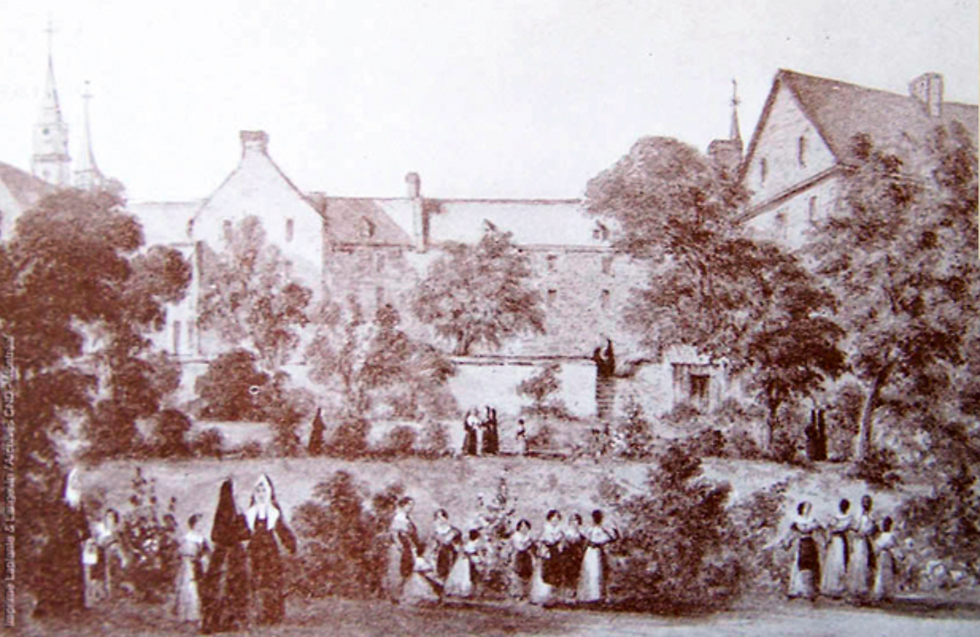
Martha was baptised in 1707 and given the name Marguerite. It appears that she did not stay long with the sisters but went to live with her godmother, Damoiselle Marguerite Bouat. Martha was naturalized in 1710. Only a year later, when she was sixteen, Martha did her duty to the French people and married Jacques Roy. Jacques Roy died in 1731 and, two years later, Martha took a second husband, Jean-Louis Mesnard. It seems these two were ahead of their time. They both signed a lengthy prenuptial agreement which provided financial security for their respective heirs.
Both Freedom and Martha did their part to help increase the population of Canada. Freedom had eight children and Martha, eleven. Their status in the cream of Canadian society is exemplified by one of Martha's grandchildren, Joseph-Octave Plessis (4C7X).
Joseph-Octave was chosen as the first archbishop of the Roman Catholic Archdiocese of Quebec. He was the highest ranking churchman to fight for Catholic rights after the British took control of Canada. The survival of the Catholic Church in British Canada is largely due to his efforts. According to Wikipedia:
...he was an ardent defender of the religious and civil rights of his co-religionists...The colleges of Nicolet and St. Hyacinth were founded through his encouragement, and schools and academies were established in every direction. He spent his time and income in searching out young men and educating them at his own expense. Some of the most eminent men of Canada owed their training to him.
The youngest of the French children taken, Abigail (2C9X), was only six at the time of her capture. Younger children were generally preferred by the Natives. Abigail was kept by a Mohawk tribe who lived in Caughnawaga (Kahnawake today) where she lived for the rest of her life.

That Abigail had at least some contact with her family is proven by an encounter her grand-nephew Bishop Joseph-Octave Plessis remembered. He said that when a group of Natives came to his church, "he could recognize his aunt, though the women's faces were hidden by their blankets, by her tall figure and gait."
the fate of the Corse family
When widow Elizabeth Catlin Corse was killed en route to Canada shortly after the attack on Deerfield, her three children Ebenezer (5C8X), 12, James (5C8X), 11 and Elizabeth (5C8X), 8, were left without parents. Ebenezer and James, spared both capture and death, were probably taken in by family members in Deerfield. Elizabeth had endured the long trek to Canada and was purchased by Pierre Roy.
Note: Pierre Roy's son, Jacques Roy was the first husband of Elizabeth's cousin Martha French.
Elizabeth was baptized in 1705. One year later, according to the priest that baptized her, Elizabeth asked "to become a citizen." When she was seventeen she married Jean Dumontel. Her marriage was witnessed by her cousin, Martha French Roy.
Elizabeth's brothers did not forget her. In 1716, when James came of age to inherit, he and his brother Ebenzer agreed "that whereas they have a sister in Canada" they would save £17 out of the estate for her. In 1730, when Elizabeth would have been 35 years old, James went to Canada "to recover her out of Captivity where she had for a long time been." Emma Coleman in English Captive Taken to Canada remarked, "How could she with five young children and a new husband wish to be recovered?" Elizabeth remained in Montreal.
John Sheldon's front door
Below is a phote of the front door of Captain John Sheldon's house in Deerfield, built in 1699. Knowing an attack might be coming, Sheldon fortified and strengthened his door. The door was so strong, Natives hatchets couldn't break it down. The effort turned out to be for naught, however. Sheldon's mother was killed by a bullet that flew right through the door. Worse, the Natives were able to easily enter the house from a door in the back that had been left open. The entire Sheldon family was taken captive.
John Sheldon's door was preserved for for three hundred years and is on display at the Memorial Hall Museum of Deerfield.



Comments