
The Founding of a College and the Betrayal of a People
- westmohney

- Jan 15, 2023
- 10 min read
Updated: Dec 18, 2024
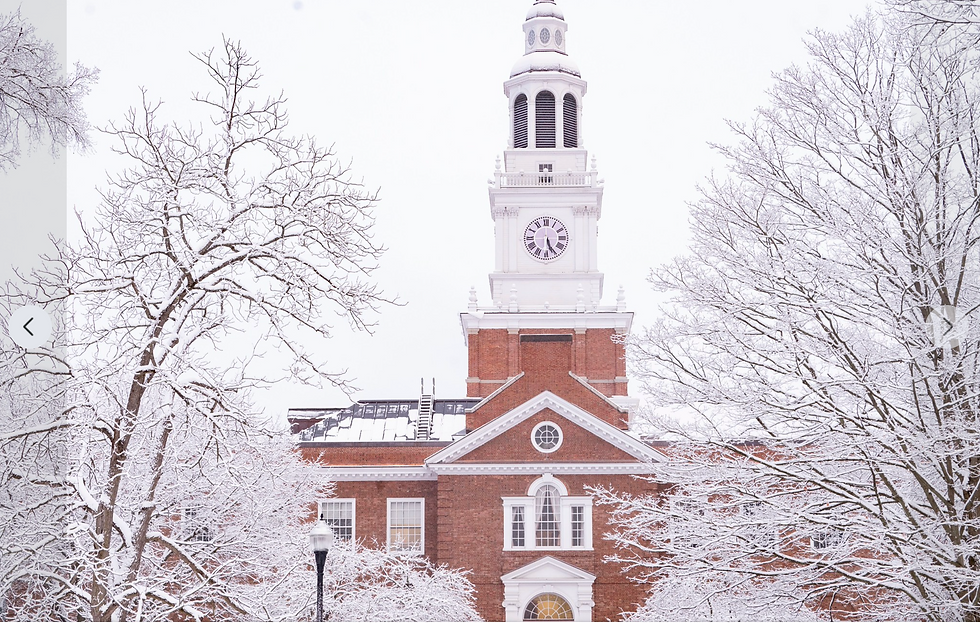
Cousin David Crosby
Our cousin David Crosby (4C9X) was born in Billerica in 1729. While we have very little information about David's early life, certain letters that he wrote to the Reverend Eleazor Wheelock have been preserved and are now housed in the Dartmouth Library. These letters tell us a little about David's life and his growing religious fervor.
Note: Reverend Wheelock was the father-in-law of our cousin William Patten (3C8X). The story of the William Patten family with all their trials and triumphs will be told in a future post.
Note: Cyrus Hubbard Wheelock, a descendent of one of Reverend Wheelock's cousins was a dedicated Mormon of high standing in the Church of Latter day Saints in the mid 19th century. Cyrus married our aunt Olive Parrish (3A), sister of our Grandfather Ezra (3GGF).
In 1756, David married his first wife, Elizabeth, probably in Billerica. The couple had three children before Elizabeth's death in 1767. It may have been his wife's death that caused David to seek solace in religion. In 1768, he wrote a letter to the well known minister, Reverend Eleazor Wheelock, asking to be admitted to the the reverend's school to be prepared as a missionary:
Reverend and honored Doctor
The last time you was pleased to honour me with your company in Your study. You was pleased to observe that you allowed your scholars, frequently to write to you. . . And although I may not as yet claim the right of a Scholar, yet i must own that the hope I cherish, and desires I feel of being some time or other, so happy as to be taken into your service and under you care and — protection, has moved me at this time to use a liberty which perhaps will not be granted. I do not mean by this to suggest as though I thought that anything I could write could be of Advantage to you, Yet as I know it is in the goodness of your Nature to do good to all Men so I am encouraged to hope, that it may be by some means or othere to give you the opportunity of doing good to me. and whatever I have writ or may write, I beg you would correct as you may see occasion, but indulge me at this time with flinging myself at your Feet and requesting the Thing of you, you was pleased to observe i stood in so much need of viz. of being in your house and to be made acquainted with good Rules, and taught to follow good Examples in order thereby to be the better fitted for future usefulness. I am so animated with desires of being made serviceable to God and useful to my fellow Men, the little time I may yet be continued in Life, as that I am impatient of Delay If you could see it in you Way to let me come into your family and serve with your meanest servants, methinks I should count no services nor nothing too dear to par with, to purchase such a favour. If it should seem good to your sir, to make use of such a Method in order to be better acquainted with my Motives and sincere desires and purposes, I can assure you there can be no Method I can think of that so much falls in with my own inclination or for which I should look on myself mor obligated to you. If it should seem good to you to make trial in this Way, as I observed: and after all you should not think fit to employ me in any furture services whereby I might make you amends for the Pains and trouble I may give you, yet I hope throught the blessing of a kind Providence, and the smiles of Heaven on an honest industry, to be enabled to make you amends som other way. But as I fear i have already been too presuming I shall only add that I beg your Prayers to Almighty God for me, that I might be kept continually in his Love Fear, and service. As also that I am, Reverend Sir In all Respects and Obedience yours to serve.
March 12, 1768.
P.S. I have purpose of advising with (so soon as opportunity shall serve) about putting myself under your pastoral care and watch of the Church.
Below is a copy of the second page of David's letter to Reverend Wheelock:

Reverend Wheelock's Indian School
Eleazor Wheelock was one of the Puritan ministers who had embraced the controversial Great Awakening movement of the mid 1700s. We wrote about our cousin Joseph Adams' (2C9X) involvement in the movement in our "In Newbury" post. The movement was begun in the 1740s by "revival style clergy who were fighting for 'the free expression of religion.'"
The colony of Connecticut was not pleased with Wheelocks' participation in the movement and had his salary confiscated. Wheelock's answer was to open a grammar school to forge out some sort of support for himself. The fortunes of Wheelock's school soared dramatically when a twenty-year-old Native American named Sampson Occom applied for admission. In Occom’s introductory letter to Wheelock he referred to himself as “your most obedient Indian son, your true tho’ unworthy servant, your worthless servant, you're good for nothing Indian servant." Just the sort of man Wheelock was looking for.
Samson Occom was a member of the Mohegan Nation. He would later became famous in his own right as a teacher, minister and writer. Occom, who believed in Wheelock's mission, turned out to be "four times as serviceable" in winning Native converts for the school as the English missionaries that Wheelock employed. Better yet, Wheelock could get away with paying the Native Samson much less. With Samsom's converts a new school was born: Moor's Indian Charity School, a grammar school specifically for Native Americans. The school, located in North Lebanon, Connecticut was named for Colonel Joshua Moor, who had donated the land and building.
trouble in paradise
Wheelock had big plans for his operation. He depended on his missionaries to bring in ever more students to help turn his school into "a model Christian Indian town that would include farms, a college, and vocational training." Not everyone in America, however, was thrilled by the idea of educating Natives. While the general public might have been skeptical, our cousin David Crosby remained ever faithful to the reverend. In his article "the Curse of God," David J. Silverman described an argument that Cousin David handily lost:
David Crosby, fell into an argument at a Middletown, Connecticut, tavern with some men he overheard saying that Indians could only be converted by ‘Powder & Ball.' These men cut short Crosby’s protest and put him on the defensive with the penetrating question, “In case I was single, could I consent to Marry an Indian Squaw?” The answer, of course, was no, which led the tavern patrons to observe that all Englishmen, even Wheelock’s own pupils, despised Indians and would continue to do so as long as the two peoples remained distinct. “For their own parts they could never respect an Indian,” Crosby’s disputants told him, “Christian or no Christian, so as to put him on a level with white people on any account especially not to eat at the same Table. Not—not with Mr. Ocham himself be he ever so much a Cristian or ever so Learned."
Samson Occom was indeed "Cristian" and "Learned" and he became vitally important to Wheelock's entire enterprise, not only as a missionary but especially as a fundraiser. Occom spent many months in England raising money he thought would go to improving the lot of his Native brothers and sisters. But Wheelock already had his sights trained in another direction. It became increasingly clear that Wheelock’s focus was on a new college and that college, Dartmouth, would be mainly for white students. And the money Occom had been raising for Wheelock would naturally be used for the new college.
In 1769, just months before Dartmouth was founded, most of the Natives took their children out of Moor's School. They cited concerns about corporal punishment, that he used them as servants, and rules against wearing clothes that Wheelock judged “too[o] good for Indians." The Natives were also expected by Wheelock to "endure their hunger and cold in silence."
Wheelock attributed the complaints of the Natives to the "insufferable Pride and Contempt of all Authority" that characterized all Indians. In spite of all this, Samson Occom did his best to remain faithful to his mentor. He continued his fundraising efforts believing in his heart that Wheelock would do right by the Natives at Dartmouth. By July of 1771, even Samson had had enough. He concluded that the Rev. Eleazar Wheelock was a "boldfaced hypocrite." and he wrote to Wheelock, letting him know exactly how he felt:
Rev'd Sir
I think your College has too much wordly Grandure for the Poor Indians they’ll never have much benefet of it, — In So Saying I Speak the general Sentiment of Indians and English. . . Your having So many white Scholars and So few or no Indian Scholars, gives me great Discouragement — I verily thought once that yourInstitution was Indtended Purely for the poor Indians with this thought I Chearfully Ventur’d my Body &Soul, left my Country my poor Young Family all my Friends and Relations, to Sail over the Boisterous Seas to England, to help forward your School, Hoping, that it may be a lasting Benefet to my poor Tawnee Brethren, with this View I went a Volunteer — I was quite willing to become a Gazing stock, Yea Even a Laughing Stock, in Strange Countries to Promote your Cause — we Loudly Proclaimd before Multitudes of People from Place to Place, that there was a most glorious Prospect of Spreading the gospel of the Lord Jesus to the furtherest Savage Nations in the wilderness, thro’ your Institution. . .But when we got Home behold all the glory had decayd and now I am afr’aid, we Shall be Deem’d as Liars and Deceivers in Europe, unless you gather Indians quickly to your College, in great Numbers and not to have So many Whites in the Charity, — I understand you have no Indians at Present except two or three Mollatoes — — this I think is quite Contrary to the Minds of the Donors, we told them, that we were Beging for poor Miserable Indians, — as for my part I went, purely for the poor Indians, and I Should be as ready as ever to promote your School according to my poor Abilities if I coud be Convinc’d by ocular Demonstration, that your pure Intention is to help, the poor helpless Indians, but as long as you have no Indians, I am full of Doubts, — Your writing to Esqr Thornton to my Disadvantage and not one word in my favour, gave me to think, that your Indian Scholars had reason to with Draw from You. . .the opinion of many white People about here is that You have been Scheeming altogather. . .this makes me think of what that great man of god Said to me, Mr Whitefield, just before I left England. . .ah, Says he, You have been a fine Tool to get Money for them, but when you get home, they won’t Regard you the’ll Set you a Drift, —I am ready to believe it Now — I am going to Say Some thing further, which is very Disagreeable. . .Many Gentlemen in England and in this Country too, Say, if you had not this Indian Bait, you woud not Collected a quarter of the Money you did. . .I think I went to England with Honest Heart, I think I have done that which I think was my Duty to Do . . .if I am under any Mistake, Please to enlighten me, — I am better in Health than I’ve been and my Family is well thro’ Divine Favour Please to give my Compts to all under your Care and Accept Duty from Your moſt unworthy Servt Samson Occom
PS I have not wrote this Sort to any one in England, I Chuse to let you know my mind first
Brothertown
In spite of Wheelock's betrayal of them, Christian Natives weren't ready to abandon their new faith. Samuel Occom was instrumental in the founding of Brothertown, a community of Natives made of up Mohegan, Eastern Pequot, Mashantucket, Pequot, Narragansett, Niantic, Montauk, and Tunxis peoples. And, as it turned out, nearly all Brothertown’s future leading men and a few of its leading women had been educated at Moors. Because of this, Wheelock ironically tried to take credit for the formation of Brothertown.
The promise of land for Natives in Connecticut had been a big draw for the tribes that would eventually form Brothertown. But promises by English settlers in America seemed made to be broken. Seneca chief Onoonghwandekha said it very well:
If we. . .receive the white man and attend to the Book which was made solely for white people, we shall become a miserable abject people. . .We shall be sunk so low as to hoe corn & squashes in the field, chop wood, stop down & milk cows like negroes among the dutch people.
The Natives in Connecticut saw their land being taken bit by bit and the "whites using every means at their disposal to make Indians disappear." Samson Occom did everything in his power to keep the Natives from disappearing. He had earlier forged strong ties in the Oneida area of New York. When he finally believed that "there was nothing left for Indians in New England except for misery and vice" he worked to insure the relocation of a number of Natives tribes to Oneida. In the new community all members would be brothers, hence Brothertown.
Almost immediately, land issues arose as speculators put constant pressure on them to sell or lease their new lands. The lands were eventually divided by the state of New York, prompting the Natives to make another move. 860,000 acres of land near Lake Winnebago, Wisconsin would now become their new home.
The tribe was hardly settled in its new location when the government of the United States began pressuring them to move to "Indian territory" in Kansas. The Brothertown community saw that the best way to protect their lands was through individual ownership which was painstakingly accomplished. Then, in 1839, the Brothertown Indians were finally granted U.S. citizenship. The future must have seemed a little rosier. But life would never be easy for Natives living in a white man's world. Over the years their private lands were lost to foreclosures and tax sales. By 1880, many of them were living with friends and relatives on reservations, providing day labor in neighboring white communities.
Native American poet Thomas Commuck was a member of the Brothertown community in Wisconsin. In 1855, he wrote a moving letter to the Wisconsin Historical Society. Below is an excerpt from that letter:
Here, then, are the Brothertown Indians on the east side of Winnebago Lake. . .trying to imitate our white brethren in all things except their vices. Here we have then our last stand . . .and are resolved to meet manfully, that overwhelming tide of fate which seems destined, in a few short years, to sweep the Red Man from the face of existence. The thought is a sad and gloomy one, but the fiat seems to have gone forth, and we must submit. Already, has intermarriage with the whites, so changed the Brothertowns, incompletion, that three-quarters of them would be readily considered as white. . .and in another generation our Indian blood will probably become so intermixed with the general mass of mankind, that if the inquiry is made, Where are the Brothertown Indians? Echo will answer, Where?
In spite of all their trials and tribulations, Brothertown has always continued to function as a tribe. Today, the Brothertown Indians live all across the Midwest and beyond. They have approximately 4,000 members on their rolls and a tribal council office in Fond du Lac, WI.


Comments