
Ann Nancy Haseltine Judson . . .a Missionary life Part II
- westmohney

- Sep 12, 2025
- 12 min read
Our hands are full, and theough our prospects in regard to the immediate conversion of the Burmans are dark, yet our trust in God is strong and our hopes animating. ~ Ann Haseltine Judson

In this post we continue the story of our cousin Ann "Nancy" Haseltine (4C6X) and her husband Adoniram Judson. Again, most of our information comes from Sharon James' research.
in Burma
When Adoniram and Ann Judson decided on a place to do their their missionary work, it was one "that all had advised them to avoid absolutely, Burma."
Now referred to as Myanmar, the country of Burma lay between India and China, isolated by mountains on both borders. It was an Empire governed by an absolute monarch who ruled by fear. Governmental corruption was endemic, and the laws were cruel. Torture and mass executions kept the population of about seventeen million in subjection. Also the religion of Burma was Buddhism. . .The Buddha taught that all appearance is characterised by transience, that there is not really a soul, and no eternal God. Such glaring rejection of Christianity fuelled the Judsons in their effort. Ann wrote bluntly in her journal of the emptiness of Buddhism:
"The religion of Burmah, then, is, in effect, atheism; and the highest reward of piety, the object of earnest desire and unwearied pursuit, is annihilation. How wretched a system is this; how devoid of adequate motives to virtue; and how vacant of consolation!"
The government was implacably opposed to any mission to convert the inhabitants from the Buddhist religion. William Carey had begun missionary work in Burma in 1793 but, by 1812, only his son Felix remained.
During his time in Burma there had been no converts. . .Carey was able to operate more or less unhindered because of his marriage to a local woman and because his pioneer efforts were directed at language work rather than direct evangelisation of the inhabitants. He left Rangoon soon after the Judsons arrived. With his departure it seemed unlikely that the government would tolerate the work of any further missionaries. Adoniram and Ann entered these foreign and unstable conditions in 1814.
The Judsons settled in the capital city of Rangoon, now Yangon. Rangoon is almost 8,000 miles from Ann's home in Bradford, MA.

starting the work
The first thing the Judson's had to do after settling in Rangoon was to learn the Burmese language well enough to communicate with their potential converts. According to James, "[t]wo years of study for twelve hours a day was needed before real Gospel work could begin." After that, Adoniron worked on translating the New Testament while Ann developed a summary of Christian teaching.
Needing a place to begin communication with their possible converts, the Judsons built a zayat. A zayat serves two purposes Burma, one as a shelter and also "for people to rest, discuss and listen to various (religious) teachings." Below is a drawing of a Burmese zayat:

Their zayat slowly began producing results. Burmese people who were reluctant to visit the mission, found the zayat welcoming. Still, three years passed before the Judsons saw their first conversion. After six years, there were still only ten baptized Burmese, "who had chosen conversion knowing that the consequence could be persecution or even death." The Judson's new converts even showed a "genuine desire to evangelise others."
Only months after their arrival in Burma, Ann "fell seriously ill." In January of 1815, she went to Madras, India to recover her health. She returned to Rangoon in April bringing with her "a little seven-year-old orphan girl to join the family." Emily would live with the Judsons for seven years and then return to Madras. In September, Ann gave birth to a little boy they named Roger William (5C5X). She wrote home to her parents:
After an absence of three months, I safely arrived at Rangoon, where I found Mr. Judson well, and labouring hard, though entirely alone. My health continued to mend, and on the 11th of September, I was made the happy mother of a little son. I had no physician or assitant whatever excepting Mr. Judson. Since the birth of our little son my health has been much better than for two years bwfore. I feel now almost in a new statee of existence. Our hands are full, and though our prospects in regard to the immediate conversion of the Burmans are dark, yet our trust in God is strong and our hopes animating.
hardships
The worst to befall the Judsons was the death of their six month old son Roger.
Before his first birthday the infant succumbed to one of the diseases so common in the native climate. The loss was the more appalling, as Ann and Adoniran were totally alone in a foreign land without the fellowship of their friends and family. Ann wrote in a letter home of their grief and enduring faith…:
"[The child] had so completely entwined himself around his parents’ hearts, that his existence seemed necessary to their own. But God has taught us by afflictions what we would not learn by mercies—that our hearts are his exclusive property, and whatever rival intrudes, he will tear it away. . .We do not feel a disposition to murmur, or to enquire of our Sovereign why he has done this. We wish, rather, to sit down submissively under the rod and bear the smart, till the end for which the affliction was sent shall be accomplished. Our hearts were bound up in this child; we felt he was an earthly all, our only source of innocent recreation in this heathen land. But God saw it was necessary to remind us of our error, and to strip us of our only little all. O may it not be in vain that he has done it."
After Roger's death, Ann suffered a period of dpression and her health began to fail again. By 1820, she was so sick that she decided to go back to Calcutta for medical help. By 1822, doctors told her that if she didn't get herself out of the Asian climate, "she would surely die." Adoniron stayed in Burma while Ann sailed to England alone. A Christian group raised money for her to return to America. In a bright note amongst her woes, Ann was "joyfully reunited with her family."
The separation between Ann and Adoniram lasted for two agonizing years. Adoniron said that the separation felt like "cutting off his right arm and gouging out his right eye." To make matters worse, the Burmese government had begun to take a closer look at Adoniron and his missionary work. He and a fellow missionary, Dr. Price "were summoned to the Emperor’s Court and detained in the capital, Ava." The situation only deteriorated as war between England and Burma loomed large.
Note: The two year war between England and Burma was the first of three wars between those two countries in the 19th century. This war, which turned out to be the most expensive in British history, was fought over control of what now comprises Northeastern India. The war ended, of course, in a "decisive British victory."
imprisonment
Ann returned to Burma in 1824. Adoniram's forced detention made it impossible for them to return to their home in Rangoon.
They built a small wooden temporary home where the heat was unbearable, reaching 180 degrees in the shade. Even here, Ann in characteristic fashion insisted on starting a girls’ school. Her reunion with her husband, though joyful, was pitifully brief. When the war began all foreigners fell under suspicion of being English spies, and Adoniram and Price were thrown into the notorious death prison from which few ever emerged alive. While in prison they awaited execution in the most filthy and sordid of conditions, weighed down with fetters so that they could not walk. Daily they observed the torture and execution of their fellow prisoners, not knowing when their time would come. Nightly they were placed in the stocks, and their legs and bodies raised so that only their head and shoulders remained on the ground. They remained incarcerated for one and a half years, during which time they were never able to wash, were often ill with no access to medical help, and had little contact with the outside world. . .Adoniram's agony was worsened by fear for what would befall Ann in his absence.
Shortly before Adoniron's imprisonment, Ann became pregnant a second time. Still, her main efforts were for her husband:
During her husband’s imprisonment, Ann petitioned tirelessly on the prisoners’ behalf with no regard for personal risk. Daily she walked the two miles from their small home to the prison in hopes of supplying them with food and drink. Sometimes she was allowed to see them, but often they were forbidden to speak. She also visited every person of influence to whom she could gain access, trying to explain that as missionaries they had nothing to do with the English war effort. She was quite alone through this ordeal. . .Eight months after Adoniram had been arrested, in February 1825, she gave birth to little Maria (5C5X), and was able to visit the prison with the infant, whom the father could only observe from afar. . .Even while nursing the baby, Ann continued her efforts to visit her husband and to secure his release. Of this terrible time she wrote:
"Sometimes for days and days together, I could not go into the prison, till after dark, when I had two miles to walk, in returning to the house. O how many, many times, have I returned from that dreary prison at nine o’clock at night, solitary and worn out with fatigue and anxiety . . . and endeavoured to invent some new scheme for the release of the prisoners. . .the acme of my distress, consisted in the awful uncertainty of our final fate. My prevailing opinion was, that my husband would suffer violent death; and that I should, of course become a slave, and languish out a miserable though short existence in the tyrannic hands of some unfeeling monster. But the consolations of religion, in these trying circumstances, were neither `few nor small.’ It taught me to look beyond this world, to that rest, that peaceful happy rest, where Jesus reigns, and oppression never enters."
Below is an uncredited woodcutting of Ann, with Maria in her arms, visiting Adoniron in prison:

Eventually Ann set up a little shelter near the prison as the daily four mile round trip proved too much to walk in the blazing heat carrying an infant. As the weather brought unbearable heat, the conditions in the prison only worsened. Of this time her memoirs record:
"The situation of the prisoners was now distressing beyond description. It was at the commencement of the hot season. There were above a hundred prisoners shut up in one room, without a breath of air excepting from the cracks in the boards. I sometimes obtained permission to go to the door for five minutes, when my heart sickened at the wretchedness exhibited. The white prisoners, from incessant perspiration and loss of appetite, looked more like the dead than the living."
When the British troops approached Ava, conditions for the men worsened. They were forced on a "death march" to a remote spot away from the capital "where rumour had it they were to be buried alive as an offering to the gods in the path of the advancing troops."
Their sufferings on the march were indescribable, their survival remarkable. Even more remarkable was the determination of Ann to follow them. With her three-month-old infant, plus two little girls she was looking after and a faithful Burmese helper, she immediately set out by boat, and then by rough cart, in pursuit of the prisoners. For the duration of their imprisonment outside of the capital she persuaded their jailer to let her and the children share his two-room hut. From there she continued to try to minister such help as she could to her husband and Price. During this appalling period she became so ill that she had no milk for the baby, and the only way Maria survived was by bribing the jailer to allow Adoniram out of prison to carry the baby round the local village, begging nursing mothers to let Maria have a little of their milk.
Ann's last days
When the Burmese realized that they were fighting a losing battle, they decided that Adoniron, who spoke both English and Burmese, would be more help to them as a negotiator. He was released into Ann's waiting arms. Their time together, however was to be tragically short. Two weeks after his release, Adoniron was sent to work on negotiations and this "was to be their final separation."
Ann’s health had been broken by the sufferings of the previous two years, and her body, past the point of exhaustion, finally broke and succumbed to cerebral meningitis. Her final sufferings were to be endured without her husband. She was thirty-seven. Adoniram was shattered not only by her death, but by the knowledge he had not been able to support her at that time.
Ann was buried in Amhurst (now Kyaikkami) near a Hopia tree.
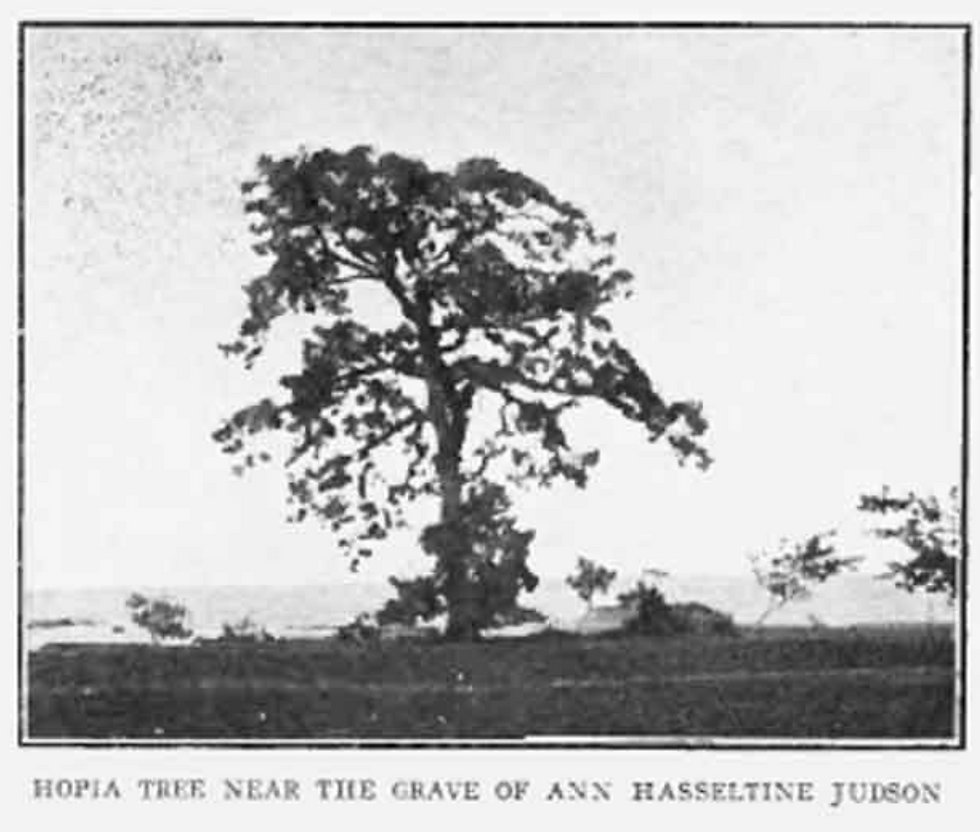
While grieving the loss of his wife, Adoniron suffered an additional tragic blow when little Maria died six months later. He wrote to Ann's family about his daughter's burial:
"The next morning we made her last bed in the small enclosure that surrounds her mother's lonely grave. Together they rest in hope, under the hope tree. . .and together, I trust, their spirits are rejoicing after a short separation of precisely six months. And I am left alone in the wide world. My own dear family I have buried; one in Rangoon, and two in Amhurst. What remains for me but to hold myself in readiness to follow the dear departed to that blessed world "Where my best friend, my kindred dwell, Where God my Savior reigns."
Ann's legacy
After the deaths of Ann and little Maria, "Adoniram was so grief-stricken at his loss that he suffered complete emotional breakdown." He went into seclusion, building a hut in the jungle. From the International Mission Board site:
He named his hut “The Hermitage” and spent forty days living in the jungle, eating little besides minimal rice rations. He dug his own grave and spent many hours contemplating death. The jungle was tiger-infested, and many locals feared Adoniram would be eaten. When he returned safely from his self-exile, everyone was surprised he had survived.
But there would be brighter days for Adoniron. Shortly after Ann's death, one of her converts became seriously ill. In her will, the woman left half of her wealth to the missionaries in Burma.
. . .before her death she wrote to Adoniram, speaking of her joy at the thought of soon being with Ann, little Maria, and above all, Christ himself: “First of all I shall hasten to where my Savour sits, and fall down, and worship him for his great love in sending me the teachers to show me the way to heaven.”
Ann's inflence could also be seen in the girls' school she had tirelessly worked to open in Amhurst. Her writings continued to inspire "multiple generations to further advance the Gospel to unreached peoples."
Ann's Burmese Catechism that she had worked on for many years was published after her death. Below is a copy of the cover of a second edition published in 1878.

Though she lived a relatively short life, Ann’s writings were a mighty force to stir up missionary interest among the Protestant population both in America and the United Kingdom. Her book, An Account of the American Baptist Mission to the Burman Empire was widely read. She also provided numerous spirited contributions for missionary magazines. In all of her writing Ann clearly stated the urgent need of proclaiming the gospel to unreached peoples and duly inspired many into involvement in missions. Even more pointedly, her life and death became an inspiration to a whole generation of American Christians. Ann’s Memoir was printed soon after her death and, because of its popularity, ran through many editions.
Ann became something of a celebrity in the United States. The letters she had written to her family were had been published in religious periodicals and, after her death, were republished as devotional writings. As many as 16 biographies of Ann were published with one described as "a book so universally known that it scarcely need be mentioned."
One person who was influenced by Ann's story was a twelve-year-old girl who worked in a factory. Emily Chubbuck later said to a friend, "I have felt, ever since I read the Memoir of Mrs. Ann H. Judson when I was a small child, that I must become a missionary.” Not only did Emily become a missionary, but she would also become the third Mrs. Adoniron Judson.
Adoniron's journey
Adoniron eventually recovered from his " paralyzing year-long siege of depression" and continued with his missionary work. His Burmese bible was finally completed in 1834 and published in 1835. That same year he married again to Sarah Boardman, widow of fellow missionary George. With Sarah, Adoniron had eight children. Sarah's health began failing in 1845, so the couple decided to return to America. Sadly, Sarah died en route and Adoniron had to continue on alone.
In America, Adoniron was greeted as a celebrity and commenced a tour of the eastern seaboard to raise money for his cause. The climate in Burma had taken its toll on him, as well. His pulminary illness made it impossible for him to speak over a whisper. During the tour, his public speaking adresses were accomplished by Adoniron speaking to an assitant who would then address the audience.
Toward the end of his tour, Adoniron married Emily Chubbuck, the woman who, as a young girl, had been so influenced by Ann. They had one child, a daughter born in 1847 after which he returned with his young family to Burma. Three years later, Adoniron contracted another of his frequent respiratory fevers and decided it was time to sail to a better climate to try and improve his health. He died on board ship in the Bay of Bengal and was buried at sea. He was 61 years of age.
The lives of Adoniron and Ann Haseltine Judson were an inspiration for many generations to come.
The brevity of Ann Judson’s life and her tragic death caught the imagination of a generation. Together, she and Adoniram gave their lives in faithful ministry to the Burmese people. Their sacrifice led to the development of native churches and schools in Burma as well as spearheaded the modern mission movement. Not only did they in their own lifetime proclaim the gospel to countless unreached peoples, but they also inspired many others to devote their lives to the same cause. Many salvations can be traced back to Ann Judson who, through a life of faithful and passionate devotion to the Gospel, serves as a lasting example to us all.




Comments