
THE THOMAS FAMILY OF MARYLAND
- westmohney

- Feb 8, 2022
- 7 min read
Updated: Dec 9, 2024
It is always a fact of some importance to know where a man is born, if, indeed, it be important to know anything about him.
~ Frederick Douglass

not born but bred in Maryland
Our grandfather Tristram Thomas, Jr. (6GGF), son of Tristram Thomas, Sr. (7GGF), wasn't born in Maryland. He was born ca. 1664 in England but came with his parents to Maryland the very next year and lived the rest of his life out there.
Tristam's father, Tristram Thomas, Sr., had amassed quite a bit of land for himself. When he died in 1686, he left 233 acres of land called Trustram to his son Tristram, Jr. who was twenty-two at the time of his father's death. It wasn't until eleven years later that Tristram, Jr. finally married. His first wife was Judith Clayland, daughter of the respected Reverend James Clayland. Around the time of their marriage in 1699, Judith's uncle willed her 260 acres of land called "Hogg Hole." That bequest doubled the acreage of Tristram's property.
From what has been gleaned from a family bible passed down through the generations, Tristram and Judith had two children together, both daughters. The eldest, Penelope (5A), was born ca. 1700. The younger, Juliana (5A), has a birth date recorded in the bible as 28 Aug 1703. We know that Judith was still alive in January of 1703 because "Tristram Thomas and wife, Judith," traded some of their acreage with Tristram's brother William (6U). By 1704, however, Judith had died, possibly in childbirth.
Shortly after Judith's death, Tristram married our grandmother, Sarah Stephens (6GGM). Their first child, our grandfather Stephen Thomas (5GGF), was born in May of 1705. I have only a few clues as to Grandma Sarah's possible releatives. A John Stephens, possibly a relative, witnessed the will of Tristram, Jr.'s father, Tristram, Sr. in 1686.

But the death of a William Stephens in 1701, which shows up in Quaker records, might be more telling. A few months after Quaker William Stephens death, Sarah Stephen's house is mentioned as a meeting place. It's possible that Grandma Sarah was married to William Stephens and was a widow when she married Tristram. The Thomas family, as we will see, touched on the Quaker faith many times.
Tristram and Sarah Stephens had seven children together. Their last child, Philemon (5U), was born December of 1720. Sarah, sadly, died just a year after Philemon's birth. At the time of her death, Tristram was left with seven children between the ages of sixteen and one year. He didn't waste any time. Within a year or two, Tristram had married again; this time to the also twice married Jane Kemp.
Grandma Jane Kemp
A quick refresher on our interesting grandmother Jane Kemp might be in order. We covered her story in a previous post, The Husbands of Jane Kemp (6GGM). She is unusual in that all three of her husbands were also our grandfathers, a true genealogical rarity. Below is a chart showing Jane, her three husbands and the intermarriages of their children. Everyone on the chart below is a grandparent of ours.

Grandma Jane, born and raised in the Quaker faith, strayed briefly when she married Robert Clothier (6GGF) outside of her Church. Disinherited by her father, Jane quickly came to rue that decision and repented. Robert converted to her religion and the two of them were happily welcomed into the fold. Jane and Robert had three children before Robert's untimely death at age 37. He died sometime before August of 1717 when Jane married for a second time.
Jane didn't make the same mistake with her second marriage. She chose fellow Quaker Thomas Eubanks (6GGF) as her next husband. The couple had only one child, daughter Jane (5GGM), born in 1721. Though a fellow Quaker, Thomas may not have been the best choice for a husband. The same year that his daughter was born, we find Robert called out in Quaker records: "Complaint being made to this meeting that Thomas Hubank, Jr who married the widow & relict of Robt Clothier hath abused sum of the orphans of the sd Robt Clothier..." Old Quaker records were notoriously vague on the transgressions of their "Friends." The Quakers were always hoping the transgressor would "condemn his outrunnings and cleere the truth" but we can find no resolution to this "complaint." Thomas died about a year and a half later at age 35.
to be or not to be...Quaker
Jane Kemp Clothier Eubanks married her third husband, Tristram Thomas, Jr., within months of Thomas Eubanks' death in October of 1723. That brings us to a Quaker question. Which one of these two gave up their religion for the other? From the register of the Wye Church (Anglican Episcopal), we can see that in September of 1723, just a few months before his marriage to Jane, Tristram had a pew assignment at that very church. I can find no listing of a Tristram Thomas in the well-kept Third Haven Record Book so it appears that Jane, once again, relinquished ties with the Quakers. Later on, however, Tristram's son Stephen (5GGF) would join the Society of Friends in 1731 with his marriage to his step-sister, Mary Jane Clothier (5GGM).
Note: Our grandfather Stephen and his sons would continue their ties to the Quaker faith even after their move to North Carolina ca. 1767.
The Wye Church that the Thomas family attended was part of St. Paul’s Parish in Queen Anne's County. It was one of three "chapels-of-ease" which were built for parishioners living far from the main church. The church the Thomas family attended was St. Luke's Chapel, Wye. The church, first constructed in 1717 still stands after a 1792 expansion.
Note: St. Luke's is where many of our Covington Ancestors worshipped as well. The Covington and Thomas families would come together in two generations when Tristram's grandaughter Mehitable Thomas married William Covington.

Hawkin's Pharsalia
Tristram Thomas Jr. must have sold the land, Trustrum, that he inherited from his father. In his will, Tristram only mentions a property called Hawkin's Pharsalia and the property he received from his first marriage, Hogg Hole. The closest we can come to discovering the location of that plantation in is from the records of a 2500 acre tract, originally owned by John Hawkins, which was subsequently divided and sold. Tristram's brother Thomas purchased 200 acres of this land which he then sold to Tristram for 9,000 pounds of tobacco. From this transaction, our grandfather Tristram is identified as a cordwainer (shoemaker). It seems reasonable to assume Tristram's plantation lay on land surrounding what is now called the Thomas House.

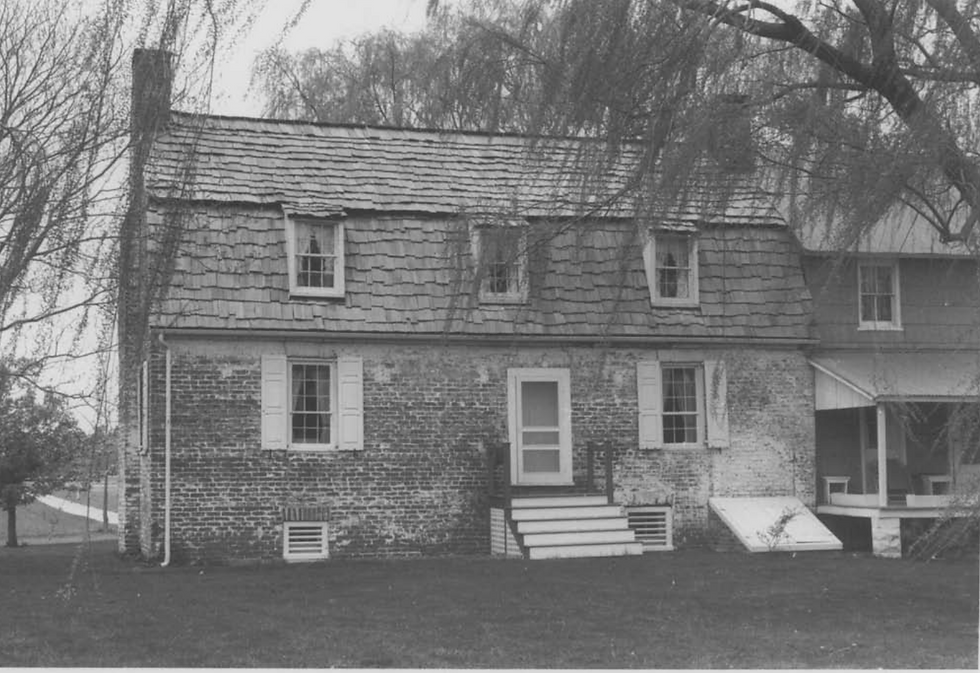
The Thomas house, listed on the Register of Historic Places, lies on a piece of property that was part of the original Hawkin's Pharsalia. The house was built by Dr. John Thomas (?C) sometime between 1798 and 1821. John Thomas was either Tristram's grandson or great-grandson but I haven't yet been able to trace his father. Below is a picture of the house taken by Michael O. Bourne in 1968.

The Thomas house is than a mile from another house that was probably built by other relatives. That one is fittingly called "Hawkin's Pharsalia."
Baynard house on Hawkin's Pharsalia
Hawkin's Pharsalia, also on the National Registry of Historic Places, lies on part the original 2500 acre tract of Hawkin's Pharsalia. According to the registry, the original ownership of the property hasn't been established, but "it is likely that the house was built for a member of the Baynard family, who had acquired part of the property before 1798." Most likely "the house was built for Robert C. Baynard... who served as town clerk of the Queen Anne's County seat of Centreville..." I have not been able to establish the exact lineage, but Robert C. Baynard is most likely decended from our grandfather John Baynard who came to Maryland ca. 1672.
According to the registry "Hawkins Pharsalia is one of the most carefully preserved small houses in Queen Anne's County. Constructed circa 1820-1840, the house has undergone only minor alterations, and remains basically intact both inside and out."

Tristam's death and will
Tristram lived a full life with his three wives and nine children. He died in 1746 at the ripe old ag of 82. He had eight children living at the time of his death: Penelope (5A), from his marriage to Judith Clayland, six children from his marriage to Sarah Stephens, including our grandfather Stephen, and one son, Benjamin (5U), with his last wife, Jane Kemp.
Tristram's father, Tristram Thomas, Sr., had been gifted land called Coursey-on-Wye from his brother-in-law William Coursey. Though most of that land had been sold, the family kept a twenty-five square foot plot graveyard. The Thomas family researchers, Betty Carson and Howard Hazlewood, speculate that this is where Tristram, Jr. was buried.

Grandma Jane and her son Benjamin (5U) were named executors of the estate even though Benjamin was Tristram's youngest son. The oldest son Stephen, our grandfather, received 85 acres of Tristram's 200 acre estate. This land was to revert to Stephen's oldest son Robert (4U) at Stephen's death. The other 120 was divided between Tristram's youngest sons Philemon (5U) and Benjamin (5U). The other five children, including the two middle sons, received 500 pounds of tobacco each.
Tristram, however, did the right thing by his daughter Penelope. He bequeathed to her the property "Hoggs's Hole" that had come to him with his marriage to Penelope's mother, Judith Clayland.
Below is the lower portion of Tristram's will. It appears that he was illiterate as the signature is obviously not his. He used the mark behind his name in place of a signature.

and lastly
Evidently, squirrels have ever been a vexing nuisance and it appears that our Thomas relatives did their part to remedy the situation. From the Queen Anne's County Levy Court records dated Tuesday 4 November 1729, we find that "Four Hundred people were paid bounty for squirrel heads..." Edmund Thomas (6U), Thomas Thomas (6U), Tristram Thomas (6GGF) and Tristram Thomas, Jr. (5U) were among those listed.


Comments