
THE VIRGINIANS
- westmohney

- Sep 5, 2022
- 10 min read
If you cannot get rid of the family skeleton you might as well make it dance ~ George Bernard Shaw

Joshua Poythress
Ca. 1687, when our grandfather John Poythress (7GGF) was 56, he took our grandmother, Christian Peebles, for his second wife. She was about 30 at the time of the marriage. John had four children with his first wife and, over the next nine years, Christian gave birth to six more. Their last child was our grandfather Joshua (6GGF), born in 1696. Joshua was only four years old when his father died in 1700 at 68 years.
When John Poythress died in 1700, he left his young son Joshua three hundred acres of land at Pamunkey Neck and "two Negroes named Betty & Beck." Pamunkey was about thirty miles north of John's plantation by the James River in a less settled region of Virginia. There is no evidence that Joshua ever lived on his inherited Pamunkey lands. Most probably, he sold the property and may have used the money for his first land purchase in 1714 when he was eighteen years old. Joshua purchased 100 acres on the southern banks of the James River in the newly formed Prince George County. Three years later "James Parham sold to Joshua Poythress 200 acres on Bailey’s Creek known as ‘High Peak.’ for £300."

Taking his place as part of the landed gentry, Joshua married into a suitable family. He took as his wife Mary Hardyman (6GGM), daughter of John (7GGF) and Mary Eppes Hardyman (7GGM). Shortly after his marriage, Joshua had amassed enough funds to transport seven people from England to Virginia. In June of 1722, these headrights entitled him to a grant of 333 acres near his existing plantation. Then, in 1725, fortune favored the twenty-nine year old. A little back story on this good fortune might be helpful.
Uncle John Hardyman
Joshua Poythress' marriage to Mary Hardyman turned out to be quite fortuitous for him. Mary's brother, John Hardyman, Jr. (6U), was the oldest son in the Hardyman family. In 1709, when John married Henrietta Maria Taylor, he acquired 150 acres of a thousand acre tract called Flowerdew Hundred which had been left to Henrietta by her father. A few years later, John was able to purchase 150 additional acres of Flowerdew from his wife's sister. Only two years after this purchase, John and Mary Hardyman Poythress' father, our grandfather John Hardyman, Sr. (7GGF). was killed by a kick in the chest from one of his race horses. John Sr.'s wife, our grandmother Mary Eppes Hardyman (7GGM) followed her husband only months later. In just two years time, John Hardyman, Jr. had come into a considerable amount of property and with it, quite a bit of wealth.
John, Jr. and his wife must have held a great deal of affection for his sister Mary and her husband Joshua Poythress. In 1724, John and Henrietta sold all 300 acres of their Flowerdew property to their brother-in-law Joshua for a token five shillings: "The above written Deed of Lease of Land (Indented and Sealed) was in Open Court acknowledged by John Hardyman and Henrietta Maria his Wife, the Subscribers thereto — to be their Act and Deed to Joshua Poythress."

In 1732, Joshua managed to purchase another 250 acres of the original Flowerdew plantation:
This indenture made this Ninth day of October in the year of our Lord Christ One thousand Seven Hundred and thirty two Between Elizabeth Duke...Widow of the one part and Joshua Poythress Merchant...of the other part WITNESSETH That the said Elizabeth Duke for in Consideration of the Sum of Four hundred pounds Current Money of Virginia... paid by the said Joshua Poythress...the said Elizabeth Duke hath Granted Bargained and Sold Aliened Enfeoffed Released and Confirmed unto the said Joshua Poythress His Heirs and Assigns forever all that Messuage Tenament Plantation and Tract of Land commonly known by the name of fflower de hundred...
Joshua Poythress now owned 750 acres of the original 1,000 acre Flowerdew Plantation tract.
Flowerdew Hundred
Flowerdew Hundred, a 1,000 acre tract of land along the James River, had been patented to Sir George Yeardley in 1619. He named the property after his wife, Temperance Flowerdew. The plantation managed to survive the Native attacks of 1622 with only six fatalities and shortly afterwards the first windmill in Virginia was built at Flowerdew.
I'm not able to find the date that Henrietta Taylor Hardyman's father, John Taylor, purchased the plantation but he may have been the next owner after Yeardely. The property then passed through Taylor's daughters to our uncle John Hardyman and finally into the hands of our grandfather Joshua Poythress. The property stayed in the Poythress family through the Revolutionary War when Joshua Poythress' grandson, Joshua Poythress III (1C6X) inherited the estate from his father. The portion of Flowerdew owned by the Poythress family was shelled in 1781 by General Benedict Arnold after his famous traitorous defection to the British during the Revolutionary War.
Shortly after war, the plantation went to Joshua III's daughter, Susan Peachy Poythress (2C5X), who married John Vaughn Willcox. John Wilcox purchased all the surrounding land that had been part of the original 1,000 acres. In 1804, he built a house on a ridge overlooking James River.

When Mary and David A. Harrison purchased the property in 1967, they were intested in sharing information about its past to the public. Thus started a series of excavations which took place from 1971-1978. According to James Deetz, an historical archaeologist working on the project, Flowerdew Hundred has become important historically with "over sixty archeological sites ranging from Archaic period Native American encampments to homesteads from the 1900s." The area had been inhabited by Natives for 11,000 years. In his book, Flowerdew Hundred: The Archaeology of a Virginia Planation, 1619-1864, Deetz desribes the excavations which yielded more than 500,000 artifacts, all currently housed at the University of Virginia. Additionally, according to Deetz, the site is particularly important as 11 to 15 of of the original 23 Africans living in Virginia in 1623 were kept at Flowerdew.
the artifacts
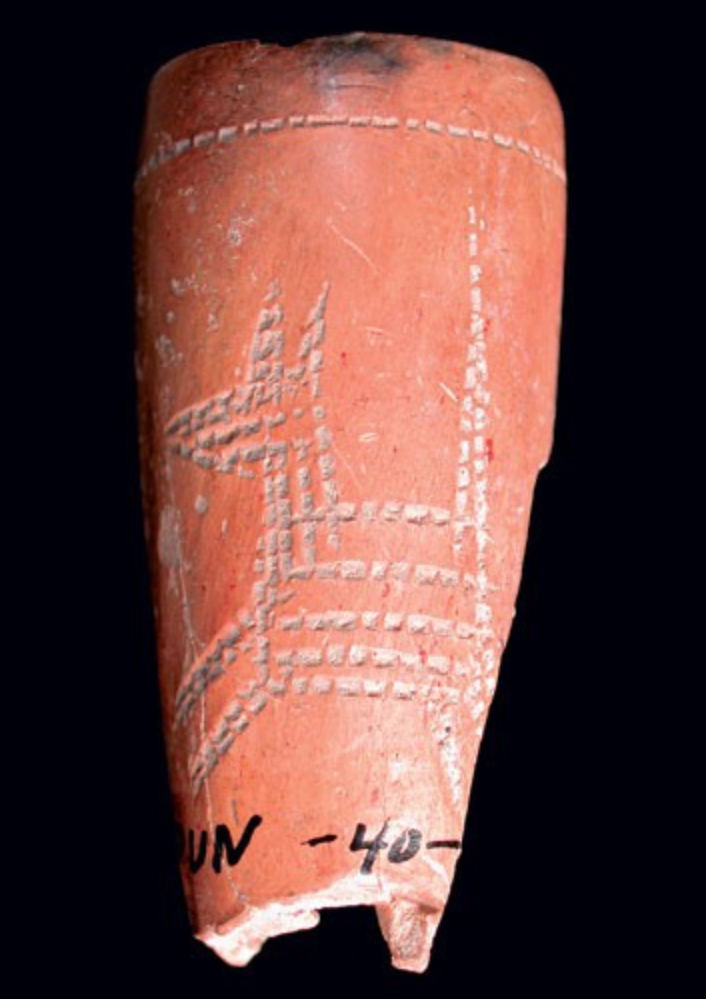
The artifacts found at Flowerdew Hundred are housed in the Mary and David Harrison Institute for American History, Literature and Culture at the University of Virginia. Two sites provide "insight into the lives of enslaved Africans, by bringing to light the pottery that they made for their own use." This pottery, named Colonware, was used by the Africans from 1680 through the last half of the eighteenth century. According to Deetz, Colonware "is handmade and sometimes burnished, with a form repertoire inspired by West African wares and relating to the consumption of starchy foods." Colonware also "suggests variability and a complex blending of traditions that complicates its production..."
Further excavations at that site have revealed one of four slave cabins that sat on the property when Susan Peachy Poythress and her husband John Vaughn Willcox lived there. These excavations have proven that living conditions for African slaves had worsened over the years as southern governments sought ever more restrictive control over the Black people living there. These efforts included the enactment of the Virginia fugitive slave law in 1657, the legalization of slavery in 1661, restrictions placed on manumission (freeing slaves) and intermarriage among the races in 1691 and, finally, the Virginia Slave Codes of 1705. This slave code transformed black indentured servants into slaves, ensuring them to a life of servitude.
According to the Flowerdew Hundred Foundation, "Flowerdew Hundred archaeology helps give voice to the African and African American slaves of the colony. The artistic ancestry of their crafts nuances our understanding of the impact and assimilation of African culture in Virginia."
Flowerdew Hundred today
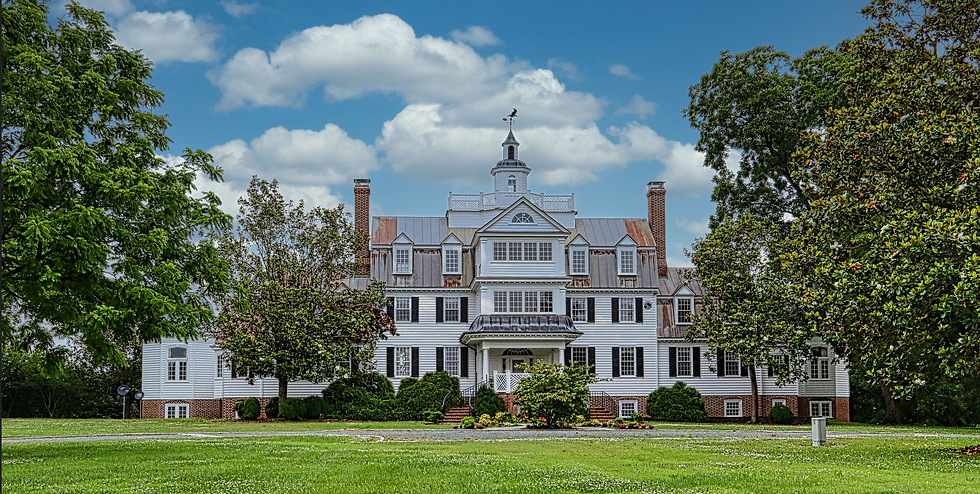
Today, Flowerdew Hundred is a National Historical Landmark and is listed on the National Register of Historic Places as well as the Virginia Landmarks Register. The house that John Wilcox built was demolished in 1955. Shown below is the front and back of the house that stands on the property today. It was on the market in 2018 for $10,300,000. The large Magnolia tree on the right is the only tree remaining from the time of Poythress ownership. Joshua Poythress and his descendents owned Flowerdew Hundred from 1725 until 1949.

Joshua Poythress' will
By the time of his death, Joshua Poythress had amassed quite a bit of property. In 1734 he received additional property in the form of a land grant: "Grant to Joshua Poythress, of Prince GC, for 382 acres in the same county, consideration 20 shillings..." Joshua obviously had friends in high places to receive that much property for a token 20 shillings.
Joshua and Mary had six children living at the time of Joshua's death. There is no record of when Mary died. Joshua's will survived the destruction of records in the Civil War and is on file in the Virginia State Library. It was written in January of 1740 and proved the following April.
Joshua left all of his property to his sons Joshua, Jr. (5U) and William (5U). The rest of his estate and personal property was to be divided equally among his wife and five of his children. He made special provision for his oldest son, Littlebury (5U), who evidently had some sort of disability: "To son Littlebury 20 shillings, and other sons are to keep him during his lifetime."
At the time of his death, none of Joshua's children had reached adulthood. He chose his brother Robert Poythress (6U) and his "cozen" (actually his nephew) Thomas Poythress (1C6X) as executors and his older sister Christian Poythress, Jr. (6A) witnessed the will.
trading with the Natives
Trade between the indigenous people of Virginia and the settlers vying for their land remained ongoing despite a strained and often volatile relationship. The practice proved so lucrative that that wealthy landowners in the South wanted to keep it all for themselves. You may recall that one of the grievances leading to Bacon's Rebellion in 1676 was that commoners were prohibited from trading with the Natives. Instead, Governor William Berkeley "privately gave comission to some of his Friendes to truck with them..."
By the early 1700s, nothing had changed and Prince George County was home to a number of wealthy and influential men who traded regularly with the Natives. Three of those men just happened to be brothers of our grandfather Joshua Poythress. The names of our uncles William (6U), Robert (6U) and Peter Poythress (6U) pop up here and there in records relating to the "Indian Trade."
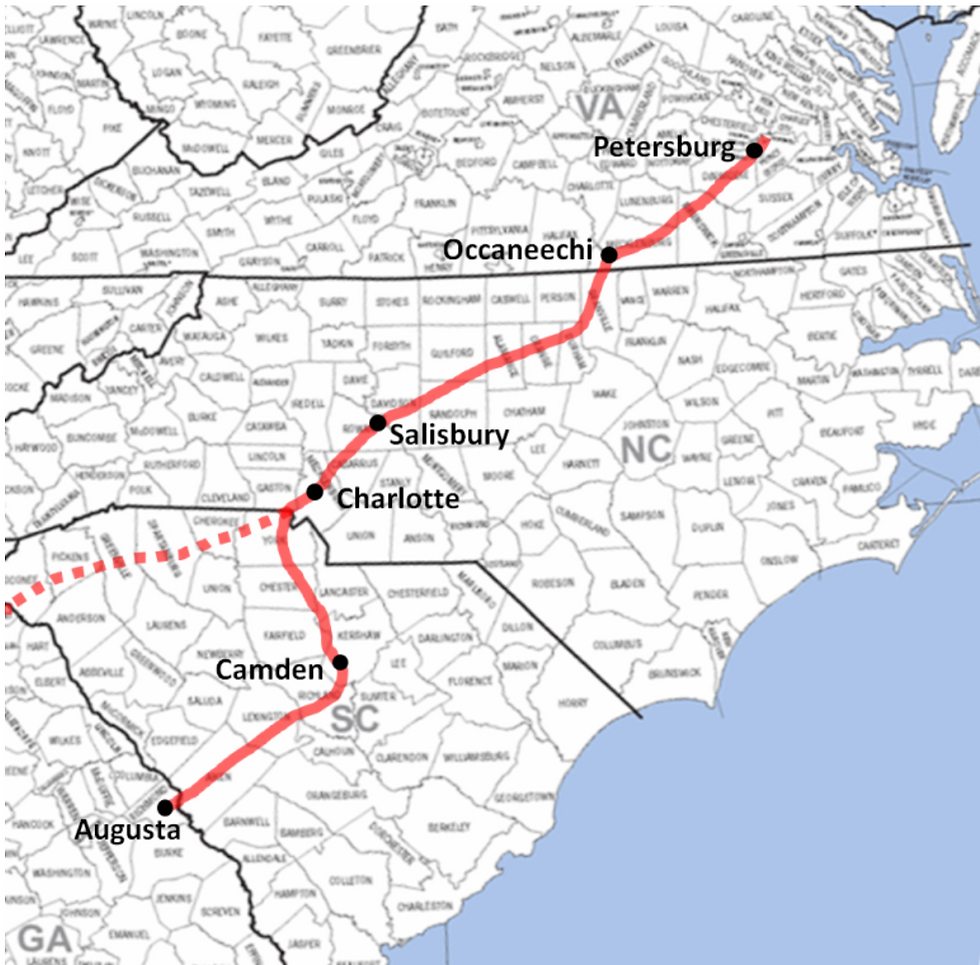
The Occaneechi Path or Trading Path became a major route which was heavily used by Virginian Indian Traders. Long pack caravans of horses carrying "loads of guns, gunpowder, knives, jewelry, blankets, and hatchets, among other goods" were taken on this route to trade for furs and deerskins. The path began in Petersburg, Va which was then a part of Prince George County and only about ten miles from the Poythress property. This trail traveled southwest through southern Virginia, North Carolina, South Carolina and all the way to Augusta, Georgia.
In the early 1700's our three Poythress uncles, special "Friendes" of the governor, had been given leave to trade with many Native tribes including the Tuscarora in North Carolina. By 1711, however, tensions between the Tuscarora and the settlers in North Carolina had reached the snapping point. A four year war broke out between the two parties which led to trade restrictions. Bonds were required of Virginia traders stating they would not "trade with the Tuscaroras or any other Indians in league or alliance with them."
The Virginians, however, didn't have the same problems with the Tuscarora. Evidently the Poythress clan retained very friendly relations with them. Uncle Peter Poythress, in particular, was often chosen to negotiate with the tribe. From an entry in fellow Indian trader William Byrd's diary on 8 Sep 1711:
After dinner we sat in council concerning the Indians and some of the Tributaries came before us who promised to be very faithful to us. It was agreed to send Peter Poythress to the Tuscaroras to treat (with) them and to demand the Baron Graffenriedt who was prisoner among the Indians.
And in 1713, our uncle Robert got into some hot water when he continued to trade with the tribe after the restrictions were in place. From Virginia Council records:
Whereas Robert Poythres of the County of Prince George being accused of Supplying the Tuscaruros with Ammunition during the prohibition of Trade with the sd Indians was this day brought before the Council, & there charged with the said Offence by the oath of Robert Lang...
Peter Poythress in William Byrd's diary
Our uncle Peter Poythress became rather well known as an Indian Trader mainly because his name is mentioned fairly frequently in the diary of William Byrd, another well known trader. According to the National Humanities Center, "William Byrd II ranks as the most well-known gentlemen-planter of pre-Revolutionary America, partly for his achievements and status...and partly for his witty and irreverent 'secret diary' of the years 1709-1712, written while he was in his late thirties. Here are a few of Byrd's entries that mention our uncle Peter:
9 Oct 1711: About 3 o’clock the Tuscarora Indians came with their guard and Mr.Poythress was with them. He told the Governor that the Baron was alive but that Mr. Lawson was killed because he had been so foolish as to threaten the Indian who had taken him.
21 Jan 1712: Mr. Peter Poythress came to our house and brought me a letter from my brother Curtis who told me the Governor was angry about what I had said concerning the
£ 20,000. He stayed and dined and I ate roast mutton for dinner.
5 Feb 1712: In the afternoon I ordered my sloop to go to Colonel [Francis] Eppes’ (7U) for some poplar trees for the Governor ... I took a walk about my plantation. When I returned I learned Peter Poythress had been there.
4 Mar 1712: About 12 o’clock Mr. Poythress and Mrs. Anne B-k-r were married and about 2 we went to dinner and I ate some boiled tongue for dinner.”
Note: Peter and his wife Anne Baker had only one child, a daughter named Anne born almost exactly nine month after the marriage on December 13, 1712.
11 Mar 1712: In the evening Peter Poythress came with 14 of the Tuscarora Indians whom he was going to conduct to the Governor. They told us the Carolina men had killed no more than about 20 old men and women of their people and had taken about 30 children prisoners when all the young men were not at home, that the Tuscaroras could (cut) them all off but that they saw some English among them which hindered them and their business with the Governor was to give the reason why they could not perform their articles and to inquire whether they might defend themselves in case they’re attacked. We were merry till about 9 o’clock and then retired. I neglected to say my prayers but had good health, good thoughts, and good humor, thank God Almighty.”
Note: The March 11 entry indicates that the Tuscarora trusted Peter Poythress and were eager to solve their differences with the English in Virginia in spite of their ongoing war with the Carolinians.
16 Mar 1712: In the afternoon Peter Poythress came over and told me the Governor received the Tuscaroras very coldly and ordered them to go and help the people of Carolina cut off Hancock town, which they all said they would.
The Tuscarora War in North Carolina raged for almost four years, from September 1711 until February 1715. It was considered the bloodiest colonial war in North Carolina history. Three years later, a treaty signed by the Tuscarora and North Carolina officials relegated the Tuscarora to a reservation in Bertie County, North Carolina.
Next up: More Virginians


Comments