
The War Begins
- westmohney

- May 11, 2023
- 8 min read
The rebels are not the despicable rabble too many have supposed them to be ~ British General Thomas Gage

the siege of Boston
Once the British had arrived back in Boston, the Americans immediately sealed off the city and thus began a year-long siege. Our cousin Artemas Ward (4C10X) arrived on April 20th to take up his duties as commander of the rag-tag army in Cambridge. When word of the fighting at Lexington and Concord spread throughout the colonies, militia companies from parts far and wide marched to Boston. It's estimated that around 20,000 rebel troops surrounded the British at various times during the siege.
While his tenure as commander in chief was brief, it was Cousin Artemas who first organized and maintained the siege that became so important to the rebel cause. Exactly one month after the siege began, on June 19, 1775, George Washington would take over as commander in chief of the newly formed Continental Army while Cousin Artemas became Washington's second in command.
Although the British still maintained control of the harbor, conditions within the city were difficult for anyone who remained. The Americans set up camp in Cambridge on the other side of the Charles River creating a see-saw effect as Patriots moved out of Boston and nearby Loyalists moved in. Musket fire and cannon balls flying across the river became a common hazard as skirmishes continually flared up during the year long siege.

Fort Ticonderoga
The war began on a high note for the Americans. With the British safely ensconsed in Boston, Ethan Allen and Benedict Arnold were able to make a swift offensive strike on the British held Fort Ticonderoga. The fort, originally built by the French ca. 1756, lay in a small pocket of land between Lake George and Lake Champlain.

The star shaped fort now known as Ticonderoga began its existence as the French Fort Carillon. In 1759, during the final French and Indian War, the British captured Fort Carillon and changed its name to Ticonderoga. The name came from the Iroquois word cheanderoga which means "between two waters." Ticonderoga remained under British control when the Revolutionary War began.
Below are two pictures of the fort as it looks today:


On May 10, 1775, Allen and Benedict's troops stole quietly across Lake Champlain and "stormed the fort in a swift, late-night attack." Two days later the Americans captured the British fort at Crown Point, ten miles north of Ticonderoga.
Our cousin Jonas Fay (5C9X), whose father owned the Catamount Tavern Inn, was in the thick of the action at Ticonderoga, serving as physician for Allen's Green Mountain Boys. Ethan Allen's "Boys" continued to occupy the fort after the capture and Cousin Jonas stayed there with them.
Note: We wrote about the Fays and the Catamount Tavern in our "Final Days Before Revolution" post
The importance of the strike was not so much the taking of the fort as the seizure of the weapons that were stored there. Colonel Henry Knox collected the artillery and organized its transfer, over frozen rivers and snow covered mountains, to Boston. This cache proved to be instrumental in forcing the British out of Boston a year after the attack on Ticonderoga.
Note: Henry Knox was soon promoted to General. He remained the Continental Army's Chief of Artillery during the Revolutionary War and became the first Secretary of War for the United State. Fort Knox in Kentucky was named after him.
shoring up Breed's Hill
The conflict which became known at the Battle of Bunker Hill actually took place on Breed's Hill. While Bunker Hill was the Continental Army's first choice for fortification, Breed's Hill which was closer to Boston proper, just across the Charles River, was later deemed more advantageous.

Many high ranking American military officers felt a fortification on a hill overlooking boston would draw out the British who were holed up in the city. Cousin Atremas Ward, commander in chief of the forces, disagreed. "Ever cautious and not willing to take a massive risk," Artemas believed that his army wasn't ready for that kind of undertaking.
On June 13th, however, inside information from a Patriot in Boston indicated that the British had an attack on Cambridge planned for the 18th of June. Aretemas finally gave the go ahead to construct a redoubt (fortification) on Breed's Hill. From a letter written after the battle, we know that our engineer cousin Jeduthan Baldwin (3C7X) went to Boston to help to set up the barricades:
By an invitation from Col. Gridley, I went as an engineer (the 16th of June) upon Bunker Hill, in Charlestown, and threw up a breastwork, and was on that hill the whole of that memorable day. Ye 17th of June, at evening, we retreated out to Prospect Hill, and worked again all that night throwing up breastworks. . .
Note: We wrote about journal writing Cousin Jeduthan in our "Cousin Jeduthan Baldwin" post. Remember his name. He will feature in many more posts to come.
the day of battle
Colonel William Prescott of Pepperill was in charge of the fortifications on Breeds's Hill. On the afternoon of the 17th, Prescott and his men were still feverishing working when British regulars began their march, in formation, up the hill. According to legend, that was when Col. Prescott made the famous "don't fire 'til you see the whites of their eyes" command. Taking up the rear of the redoubt was Colonel John Stark of New Hampshire who had recently arrived to offer the assistance of his company. General Israel Putnam was in overall command of the action. Cousin Artemas never made it to the scene of the battle for which he was harshly criticized.
Below is a map showing the placement of different companies. Our cousin Lt. Col. Isaac Wyman (4C7X) of Woburn led two companies of approximately 200 men. Cousin Josiah Crosby (4C9X) of New Hampshire led one company of approximately 100 men. Both men's companies are shown on the left side of the map.

The Americans were patient. They waited until the the British troops neared the fortifications before they fired their first volleys. The British took heavy losses in that first assault and scattered but they soon reformed for a second attempt. Though the Americans managed to hold the second attack at bay, many of the unseasoned soldiers in the newly formed Continental Army deserted their posts. The third British attack was successful but the bulk of the American army made a safe retreat with Colonel Stark's men providing cover.
Note: In August of 1777, Colonel Stark, then promoted to General, would lead the charge at Bennington, one of the battles that changed the course of the war.

Eyewitness Private Samuel Bixby described the events of the day in his journal. He was stationed at nearby Roxbury.
A heavy fire was opened at Col. Putnam from the ships, & also from the fortifications in Boston. The regulars went over in barges in great numbers and landed in Charlestown to attack Col. Putnam. Our men returned the fire smartly, and the battle appeared to rage firecely. The entrenchment was not quite completed, and our men having spent their ammunition, still defended themselves bravely, but were obiged to retreat. The regulars set houses on fire, & did all manner of mischief. Col. Putnam retreated to another hill, & went to entrenching there, while the British kept up a constant fire upon him.
About 6 o. c. [o’clock] the enemy drew in their sentries, & immediately a heavy fire was opened from the Fortification. The balls whistled over our heads, & through the houses, making the clap-boards and shingles fly in all directions.
Lieut [John] Hazeltine (4C8X) picked up a 12 lbs ball—we were anxious to get their balls as though they were gold balls.
Below is a picture of two cannonballs from the Battle of Bunker Hill. They would have been similar to the one that our cousin John Haseltine picked up.

aftermath
The British had taken the ground but at a great price: 1,054 casualties (226 dead and 828 wounded). A high number of these casualties were officers. This would be the highest casualty count for the British in a single encounter for the entire war. British General Henry Clinton wrote in his diary that "[a] few more such victories would have shortly put an end to British dominion in America."
The American casualties totaled 450, with 140 killed. Though the Contnental Army was forced to surrender the ground to the British, the Battle of Bunker hill was considered by all a moral victory for the Americans. As British General Thomas Gage later remarked to Lord Dartmouth, "The rebels are not the despicable rabble too many have supposed them to be."
the burning of Charlestown
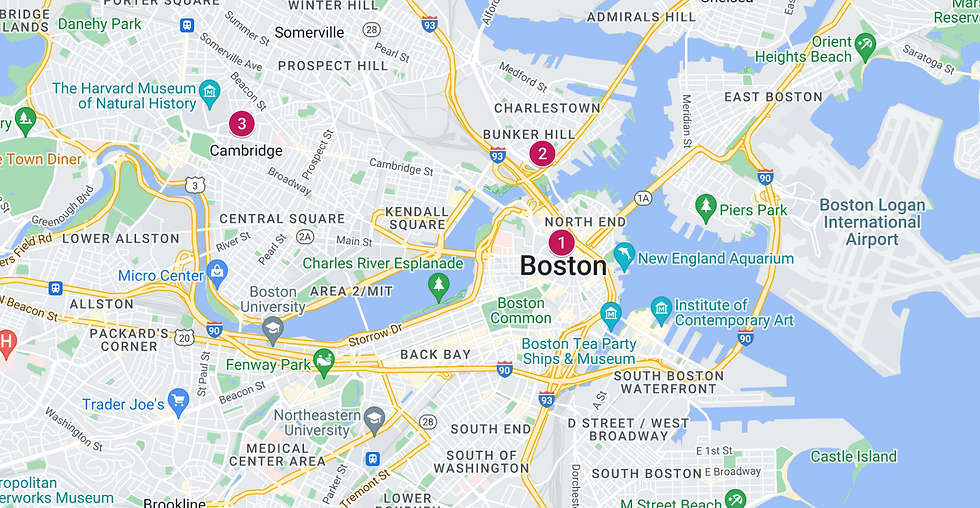
When the Revolution began, Charlestown was a small community directly across the Charles River from Boston proper. To the north of the town lay both Breed's and Bunker Hill. The map below shows the exact location of Charlestown (2) in 1775. After the Battle of Bunker Hill, the British held Boston (1) and the Charlestown Peninsula (2). The Americans were headquartered further west in Cambridge (3)
For two months, ever since the siege had begun, the residents of Charlestown had become used to the flying cannonballs and musket fire coming from across the Charles River. The poor beleaguered town also happend to be right in the path of the British troops on their way to the battle at Breed's Hill. As Patriot snipers fired at the passing Redcoats, General Howe ordered that a "combustible shell" be launched on Charlestown. The town went up in flames. As residents fled for their lives, specators from as far as fifteen miles could watch the city burn. Abigail Adams and her young son, John Quincy, watched from their home in Braintree. John Quincy would later recall living in "unintermitted danger."

Our cousin Jonas Eaton (3C8X) was born in Framingham in 1714. About two years before the start of the war, he and his three sons, Jonas, Jr. (4C7X), Daniel (4C7X) and Ebenezer (4C7X), made a fateful move to Charlestown. We wrote of Jonas and his brother Noah (3C8X) in our British Retreat post. Both had been on hand to pester the British on their march back to Boston on April 19th. At the time Charlestown burned, Jonas' three sons were all in their early thirties with families of their own. Jonas himself, possibly still serving in the army at the time, was not in Charlestown when the village was burned. His wife and sons, along with all their children, managed to escape the town. The small group made their way to Framingham, 22 miles west of Boston, where Jonas' had been born and some of his family still lived. Jonas later joined them there and made a claim to the government for loss of property sustained by him and his three sons. Jonas Eaton's claim was for his 40x21 house, a 25x18 outhouse, a 20x18 covering-shop, a 20x18 bark house, and a "good mill with 9 tanpats." The family never returned to Charlestown.

Other relatives who lived in Cambridge who also made claims:
Joseph Austin (3C10X) claimed for loss of his house and shop.
Close to Joseph Austin's property was a "long narrow estate" that Joseph's brother Timothy (3C10) had fortuitously sold in 1772. The claim on the property was for the loss of a house, barn, bakehouse, ship work and smoke house. Other Austins who made claims for destroyed property were John Austin (3C10X), home valued at £500, Ruth Austin, widow of Captain Thomas Austin (3C10X) who lost "half a House" valued at £650 and Elizabeth Austin Johnson (3C10X), who lost a £200 house destroyed "by the minterial Butchers."
Next door to Joseph Austin's property was the "large estate" owned our cousin Samuel Swan (3C8X). Samuel who had married our cousin Joanna Richardson (3C8X), bought the property in 1756. He claimed for the loss of house and barn. In 1796 he sold the property to his son Caleb (4C7X). Hunnewell writes that "The Swans were an important family, who ultimately went to New York."
Kidders who lost property were John Kidder (2C7X) who inherited a house in 1770. He lost his shop and one end of his house. Isaac Kidder (1C8X) lost the house he had purchased in 1774.
Nathan Adams (2C9X) was a carpenter and innkeeper in Charlestown. His home and inn were destroyed
Next up: Our relatives who fought at Bunker Hill


Comments