
THE WAR MOVES WEST
- westmohney

- Aug 30, 2023
- 12 min read
Our Army at Crown Point is an object of wretchedness to fill a humane mind with horrour. . . ~ John Adams

enlistment agreements
When the Revolutionary War began, the colonial militia continued running for a time much the same as it had for over a hundred years. The average service time for soldiers ran anywhere from a few days to a few months. Below is an enlistment agreement signed by a group of Chelmsford men in January of 1776. These men agreed to two months of service and they agreed to furnish their own firearms and blankets.

Three men on the above agreement are related to us. Our uncle Daniel Proctor (5U) was the brother of our grandmother Susannah Proctor Sherwin (5GGM). Cousin Benjamin Chamberlain (2C7X) was the grandson of our aunt Abigail Hill Chamberlain (7A). Cousin Roger Toothaker (3C8X) was the fifth in a long line of Roger Toothakers beginning with the husband of our grandmother Margaret Toothaker Hill (9GGM), who later married our immigrant grandfather, Ralph Hill (9GGF) .
General Washington may have criticized our cousin Artemis Ward (4C10X) for the "rag-tag" group of men he had inherited but the fact remained that, a year into the war, the American army troops remained untrained and undisciplined. A major contributing factor to this problem was the lack of an army of "regulars" such as the British had. The disastrous invasion of Quebec had been severely compromised when a large number of General Montgomery's men decided to return home when their service time expired.
The Quebec debacle had opened the Continental Congress' eyes to the need for a standing army. On June 14, 1775, the American Continental Army was established by a resolution of Congress. In the beginning, the army consisted of militia men and volunteers from all thirteen states who were formed into three divisions, six brigades and thirty-eight regiments. General George Washington was in command of the entire army. After many pleas from Washington, the enlistment time for the Continental Army was upped to a three year stint and the United States finally had companies of "regulars."
Among the regulars was our cousin Jonathan Wyman (4C7X) who was ordered "to furnish his own firearm. . .and to march with the utmost despatch to New York."
New York, New York
When we last left our cousin Jeduthan Baldwin (3C7X) and his diary, the British were finally evacuating the city of Boston. On March 7th, Jeduthan had been promoted to Captain. John Adams must have written to congratuate him because on March 14, Jeduthan wrote: "Recd. a Very friendly Letter from Mr. John Adams Esqr of the Congress at Philidelphia." Jeduthan had also received orders to travel to New York to help with the fortifications there. General Washington, anticipating a British attack, had left Cambridge and taken much of the Continental Army with him. That same day, March 14th, Jeduthan received money with which he "bought a Horse and Saddlebaggs" for his journey.
Note: Another of our relatives who went to New York with Washington was our cousin Colonel Loammi Baldwin (3C7X) who we wrote about in our "Two Friends from Woburn" posts.
By the 26th of March, Jeduthan had arrived in New York and was busy supervising the construction of a fort on Long Island.

During his short time in New York, Jeduthan "rode round the works with the generals," mucky-mucked with Lord Sterling and "wrote to Mr. John Adams." A few British ships appeared in April but didn't stay long. Jeduthan's entry for April 15:
the Asia, Man of war (two British ships) went of (off) this afternoon to the great Joy of this place. went with Genl. Washington, Putnam, & my Lord Sterling to Red hook & to Govner Island in ye forenoon. Dind with them & spent ye afternoon
money matters
General Washington, it seems, had not forgotten about the soldiers still holding down the fort at the still ongoing siege of Quebec.
Note: We wrote about the attack and siege of Quebec City in our "The War Continues" post.
On the 16th of April, Jeduthan received orders to go with General William Bond's regiment, which was being sent out to reinforce those troops. He was not to take part in any fighting, however. Jeduthan's orders from Washington were "to inspect the whole of the northward (forts) where I could do it without retarding our march. . ."
Before leaving on this venture, however, it appears that Jeduthan was less than happy with whatever Congress had promised him in payment for his services on the trek to Canada. Luckily for him, Jeduthan had friends in high places. He appealed to none other than General George Washington to put in the good word for him:
April 22 1776, New York, from Washington to John Hancock.
Mr Baldwin, is one of the Assistant Engineers ordered to Canada—He is indeed a very useful Man in his department, but declined the Service on Account of his pay, which he says is inadequate to his Support. In order to induce him to continue, I promised to represent his Case to Congress, and would recommend an increase of his pay, and that he should have the rank of Lieutinant Colonel, of which he is very deserving. I beg leave therefore to recommend him to the Congress, and that they would make provision for him accordingly.
the Canada expedition
Jeduthan must have had faith that Washington would come through for him. On April 21st, the day before Washington wrote to Hancock, Jeduthan set sail on the Hudson River for Canada with General William Thompson. On April 25th he inspected the first fort of his journey. Fort Constitution, which lay 60 miles from New York, would be captured and destroyed by the British in October of 1777.
On the 25th of April, Bond's troops reached the north end of Lake Champlain and began their long march to Quebec. Jeduthan's entry for April 28:
Col. Bonds Regt. Marched of for Canada. I rode with Genl. Thomson, Col. Sincler in a Coach in company with other officers to the Conoes, 49 crossed the Mohawk River at Lowdons ferry, went to Half mon, crosst Hudsons river & returnd by Stone Robbin to Albany. Drank Tea at Capt Lonsons, had a beautifull Day & a most agreable ride.
On the 7th of May, Jeduthan wrote "Recd a letter from Genl. Washington informing me that the Congress had advanced my Rank & pay as a Reward of Merit. I wrote a letter of thanks to Genl. Washington." On the 8th, his party reached Fort Ticonderoga and on the 10th, Crown Point.

The end of the Quebec siege
While Cousin Jeduthan made his leisurely and "most agreable" way up to Crown Point, soldiers in the far north surrounding Quebec had been suffering though an extremely cold winter. By spring they had a new problem. Smallpox was infecting the men in record numbers. It was rumored that General Guy Carleton, the British commander in Quebec, had sent infected people into the American camp. Thomas Jefferson was convinced the British were responsible for the outbreak. He later wrote: "I have been informed by officers who were on the spot, and whom I believe myself, that this disorder was sent into our army designedly by the commanding officer in Quebec."
Washington's decision to send reinforments to Quebec turned out to be a colossally bad idea. Not only did he deplete his own troop force for the upcoming Battle of Long Island, but also, for Quebec, it was a case of too little too late. By the time reinforcements arrived in the middle of May, the siege soldiers were in a full, chaotic retreat back to Crown Point.
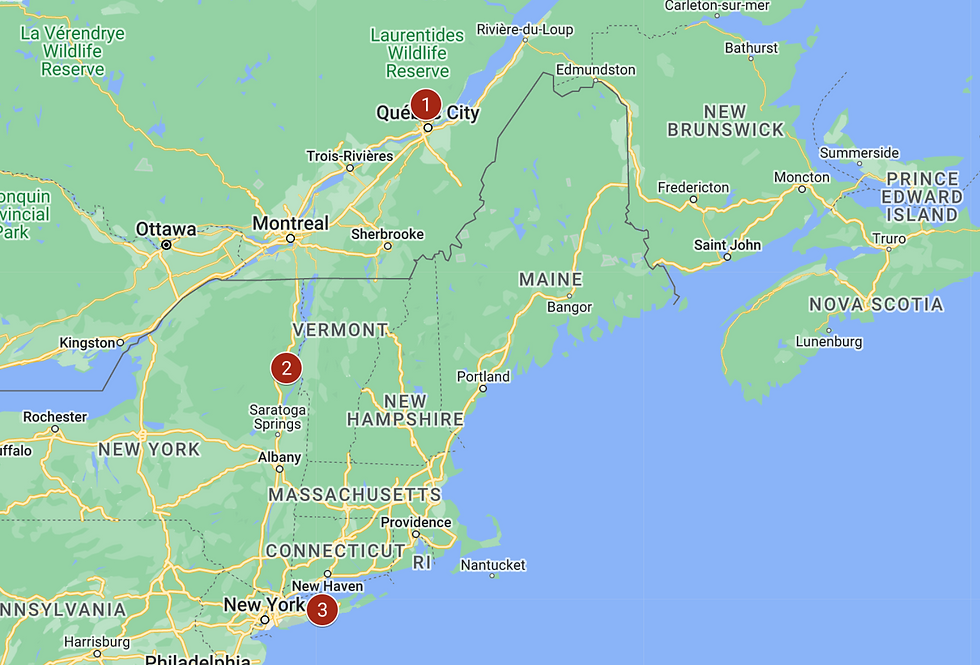
John Adams visited the men at Crown Point and wrote of what he found:
Our Army at Crown Point is an object of wretchedness to fill a humane mind with horrour; disgraced, defeated, discontented, diseased, naked, undisciplined, eaten up with vermin; no clothes, beds, blankets, no medicines; no victuals, but salt pork and flour.
Jeduthan in Canada
On the 13th of May, Jeduthan and his party learned of the American army's retreat from Quebec City. He wrote, "we have a Very Gloomey account of our army at Quebeck, the report is that about 500 of our men (chiefly Sick) are taken prisoners with the artillery & stores. . ." On the 14th, Jeduthan arrived at Fort Chambly, near Montreal, where many of our relatives had been processed after being captured by Natives in the French and Indian Wars. Montreal, which had been taken by the Americans in November of 1775, was still in American hands.

Benedict Arnold, who had been dismissed from the Quebec seige, was now in charge of Montreal. On May 16th, Jeduthan reported that he "Dined & Drank Tea with Genl. Arnold."
General Arnold may have been a little distracted at tea time with Jeduthan. Early in May, word had reached him that the British, now that they had run the Americans out of Quebec City, were planning an attempt to retake Montreal. The Americans had been working on fortifying an area known as the Cedars, thirty miles south of Montreal.
Given the grave smallpox situation facing the American army, Jeduthan was inoculated for smallpox on the 17th of May. He would suffer from the effects of the vaccination for almost a month with itchy, burning pustules and a fever that came and went. From his sickbed he wrote in his diary "I think our affairs look dark, matters don't go right."
He was right to be worried. Two days after Jeduthan's inoculation, the British attacked.
Cousin Solomon Kittredge and the Battle of Cedars
Our cousin Solomon Kittredge (3C7X) was born in Billerica in 1755. By the time the Revolutionary War started, he was living in Amherst, NH. He fought at the Battle of Bunker Hill in our cousin Captain Josiah Crosby's (4C9X) company. In December of 1775, Solomon joined a regiment under the command of Colonel Timothy Bedel, which was subsequently sent to reinforce the siege army at Quebec.
Bedel's regiment had only made it as far north as Montreal when they learned of the American retreat. The regiment's timely arrival, however, was a boon for General Arnold who sent them out to the Cedars and put Colonel Bedel in charge of the whole shebang.

It turns out that Arnold's confidence in Bedel was misplaced. With the impending battle looming large, Bedel left to take care of other business, leaving the incompetent Major Isaac Butterfield in command. On 18 May 1776, the British arrived at the Cedars. British Captain George Forster's first action was to send a demand for the Americans to surrender. The skittish Butterfield countered with a request for his army to withdraw under arms. Forster naturally refused.
A few shots were fired the first day. When the British intensified their efforts the next day, the pressure proved to be too much for Butterfield. He surrendered his entire force, including our cousin Solomon, to the British and their Native allies. The only bright side to this entire debacle was that, ten days after the "battle," General Arnold managed to arrange a prisoner exchange and most of the men were returned unharmed.
For their failure to engage the enemy in battle, Bedel and Butterfield were courtmartialed the following year. Both were dismissed from their service in the army.
Note: Bedel didn't give up the cause. He joined the volunteer army in New Hampshire and fought valiantly. The Continental Army reinstated him the year after his dismissal.
After the prisoner exchange, the remainder of Bedel's regiment was sent to Crown Point, where men were continuing to die of smallpox. So many soldiers died of this disease that pits were dug to bury the men in common graves. Our Cousin Solomon was one of the lucky ones. He continued in the army, taking part in the Battle of Bennington and the Burgoyne campaign two years later in the summer and fall of 1777. Shortly after Burgoyne's surrender, Solomon was able to return home to New Hampshire. He died there in 1845 at the ripe old age of 90.
reparation
After the surrender at the Cedars, some of the soldiers had evidently been ill-treated and robbed by the Natives who had taken charge of them. Cousin Solomon, along with twenty-eight other men, signed a petition asking for relief which they sent to the New Hampshire Council:
To the Honorable Council and House of Representatives to be convened at Exeter, in New Hampshire on the 10th day of March, 1779:
The Humble Petition and Remonstrance of the Company Commanded by Capt. Daniel Wilkins, in Col. Beedel's Regt. in Canada, humbly sheweth that on ye 19th of May, 1776, we unhappily fell into the hand of our unnatural and savage Enemy at the Cedars in Canada, when Major Butterfield, our commanding officer, capitulated with Capt. Foster of the British Army to the great grief and surprise of said company, on the following terms, viz: that we surrendered ourselves as prisoners of war, and was to deliver up our arms which accordingly we did, and we was to have our packs and Baggage - and Capt. Foster engaged not to suffer the savages to plunder or abuse us, nor suffer the British troops to do so. But contrary to Rules of War they inhumanly without regard to their promise, suffered the savages to rob and plunder us of our packs and baggage,and strip us of our clothes off our backs, and left us entirely naked. In this deplorable condition we were left in an enemy's country without money, clothing or friends that could contribute to our relief - Therefore your humble peti-
tioners humbly pray that your honors would take the matterunder consideration adequate to the loss we sustained, and your Petitioners will gratefully acknowledge the favor and as in duty bound will ever pray.
Three years later, Cousin Solomon received "an appropriation for his clothes of six pounds, sixteen shillings, sixpence."
Jeduthan at Chambly
The Battle of the Cedars was woefully close to where Jeduthan remained ensconced at Fort Chambly in Montreal. Still suffering the effects of his smallpox inoculation, he decided the fort was the safest place for him to be for the moment. On May 23, he wrote: ". . .my French friends assure me that they will take the best care, that I shall have the first notice of any danger & that they will help me off should the enemy persue that..." Jeduthan's entries for the rest of the month of May deal with his agonizing symptoms from "the pox." The doctor came to see him on the 30th and "said there is no fear you do well but you have a good deel to bear yet"
After the disaster at the Cedars, General Arnold continued the good fight. He engaged the British in minor skirmishes whenever he was able, hoping to retain the American's foothold in Montreal. On the 5th of June, Jeduthan reported that "I think our affairs Look Dark. . . but good conduct & 1 or 2 Victorys in battle may turn the face of things."
The Americans were able to score a few minor victories but, on the 6th of June, a fleet of 13,000 British troops arrived. Then Jeduthan reported that 3,000 men down with smallpox "has broak us so that we are poorly able to defend against so superior a force as we hear is coming against us..." Arnold decided the abandonment of Montreal and a tactical retreat to Crown Point was in order.
On the 14th Jeduthan "[b]reakfasted with Genl. Arnold." By then he was feeling better and was going to Fort St. John's, about 12 miles south of Montreal, "to fortify there in order to Cover our Retreat (to Crown Point), which I think must be soon without a miricle is rought in our favor..."
retreat from Montreal
The American retreat from Montreal to Crown Point, begun on the 16th of June, was not their finest hours. Still weak from his small pox injection, Jeduthan reported that he "had the most Savere fateague in Loading the Battoes (bateaus) with the Stores & Baggage. . .the Vast No of Men sick & in the most distressing condition with the Small pox is not to be described & many officers Runing off Leaving there men by the Side of the river to be taken care of by me or others."
Note: A bateau is a shallow flat-bottomed boat used extensively during the colonial period for the fur trade.
On the 18th, the Arnold's army left St. John's to continue the 100 mile trip to Crown Point. Jeduthan left "in the last Battoe with Genl. Arnold. . .but had neither Bed or blanket & lay upon the thawt of the Battoe till day light, it was cold." Jeduthan may have been less than comfortable that night, but I'm certain the suffering of the regular army men was much worse.
Jeduthan describes the rest of the journey down the river plagued with "missquetoes" and "flees." He and General Arnold finally arrived safe and sound at Crown Point on the 24th of June. Jeduthan immediately got busy with fortifications.
Declaration of Independence
On the 4th of July, the men at Crown Point had heard nothing of the Declaration of Independence signed in Philadelphia. The mucky mucks had their hands full that day with a general court martial being held for a number of officers and men who had behaved badly during the retreat.
On July 6, the news finally reached General Washington in New York. On July 9, in celebration, he had several of his brigades march onto the commons of the city to hear the Declaration read. At the end of the reading, a mob ran down to the statue of George III at the western in of Long Island. Finally done with their king, the men pulled the statue down, cut off the head, severed the nose and mounted the remains on a spike. The rest of the statue was melted down into musket balls.
By the middle of the month in Boston, the news still hadn't been formally announced. A committee of three men were appointed to decide "in what way, manner, and form the declaration of the honorable Continental Congress should be made public." On the 17th, the committee ordered that "the said declaration be proclaimed by the Sheriff of the County of Suffolk, from the balcony of the Statehouse in Boston, on Thursday next at one o'clock P.M., in presence of, and under direction of, a committee of the council to be appointed for that purpose."
The Sheriff of Boston at that time was, of course, our cousin William Greenleaf (4C7X). A high honor indeed! A week later, the Continental Journal and Weekly Advertizer of Boston noted that "At one o'clock the declaration was proclaimed by the Sheriff of Suffolk, which was received with great joy, expressed by three huzzas from a great concourse of people assembled on the occasion."
Note: We wrote about Cousin William Greenleaf in our "More Revolutionary Stories" post.
Sixty-six years later, William's son Daniel ( 6C6X) sent his recollections of the event to a Boston newspaper.
The Declaration of Independence was read by William Greenleaf (my father), the sheriff. . . My father was so proud of that proclamation that he had the paper from which he read it framed and glassed, and it hung over his parlor fireplace as long as he was a housekeeper. As his voice was rather weak, he requested Colonel [Thomas] Crafts to act as his herald; they stood together at the front of the balcony, and my father read a sentence, which was immediately repeated by Crafts, and so continued to the end, when was the huzza. . .


Comments