
William "Billy Ram" Thomas and the Roe family
- westmohney

- Dec 5, 2024
- 7 min read
. . .he acquired this nickname when he was butted by a big ram that left him with a limp the rest of his life. ~ Thomas family lore

William's move to North Carolina
Our grandfather William Thomas (4GGF) was born to Stephen (5GGF) and Mary Jane Clothier Thomas (5GGM) on 31 Jan 1741 in Queen Anne's County, Maryland. We don't know when or how William received the nickname "Billy Ram." According to family lore, "he acquired this nickname when he was butted by a big ram that left him with a limp the rest of his life."
Ca. 1761, William married his first wife, Hannah Pratt. Four of the couple's eight children were born in Maryland.
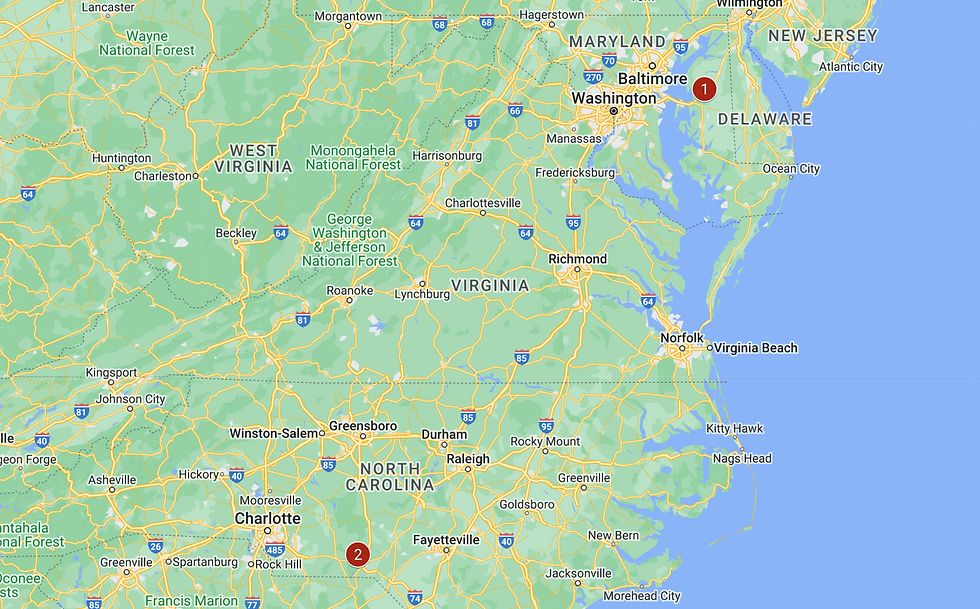
Shortly after William's marriage to Hannah, his brother Robert (4U) made a move to North Carolina. Eight years later, the rest of the Thomas clan, including father Stephen, followed Robert to make their homes in Anson County (later Richomond), NC. On 16 Dec 1769, both William and Stephen received grants of land located close to the banks of the Pee Dee River near Blewett's Falls. It appears the tracts were surveyed and the patents issued while William was still back in Maryland helping the rest of the family move.
In our "The Thomas Family" post, we gave credit to genealogical researchers Betty J. Carson and Howard S. Hazlewood for their excellent book Ancestors and Descendants of Tristram Thomas of Maryland. In the book, you can find Howard's map of William and Stephen's properties near the falls. Shown between the two properties is land belonging to Robert Jarman. Robert's son William was married to Stephen's sister, Penelope (5A).
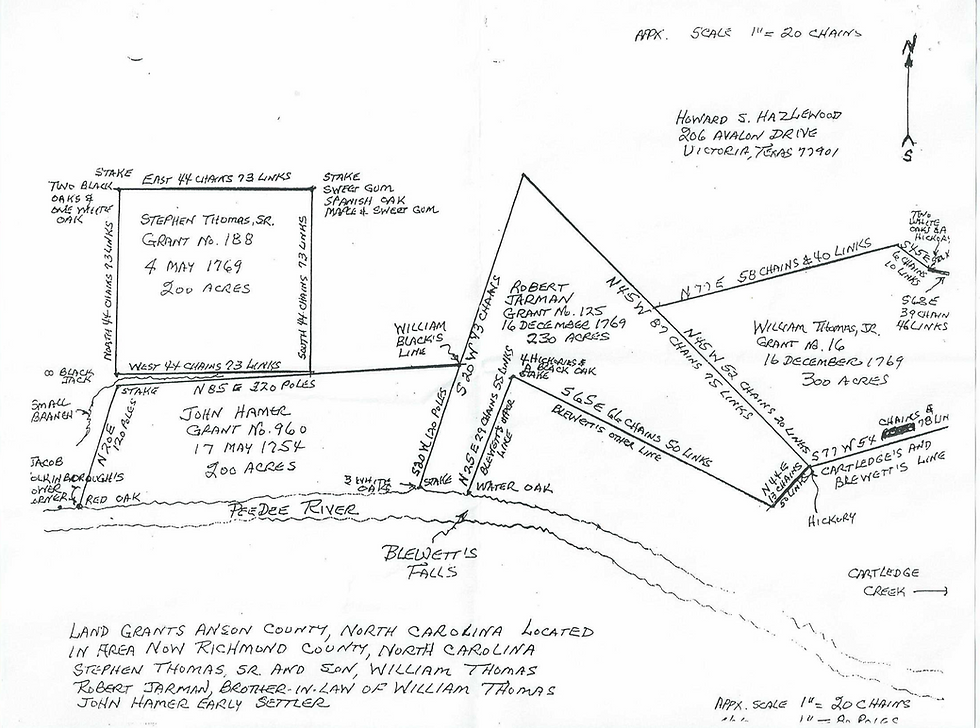
Note: Our grandfather William is shown on the map as Jr. This is an error as William was Stephen's son. This error would cause problems later when William sold the property to one of his sons.
William's 300 acres were actually closer to Cartledge Creek than the Pee Dee River and, according to George T. Thomas, a Thomas family researcher, he "likely attended Cartledge Creek Baptist Church" which was founded by some of our Thomas and Covington relatives. We wrote about the church in our "North Carolina Covingtons" post. William's nephew Daniel Thomas (1C6X) was the first minister of that church.
War years
Williams's father Stephen was only in North Carolina for five years before his death in 1774 at age 69. Since he died intestate, Stephen's property and belongings were sold at an auction held by Sheriff William Pickett, husband of our aunt Mourning Raiford (5A). We wrote about the Raiford family in our "On to North Carolina" post. Stephen's family was given first rights to purchase his household goods and William was able to buy an "old cart" belonging to his father.
At the time of Stephen's death, war was imminent. Though North Carolina was a hotly contested state with more than its fair share of Torys, William threw his lot in with the Patriots. He was a representative for Anson County at the Assembly of the state of North Carolina in both 1774 and 1775. The main function of these Assemblies was to create a "movement of the state against the oppression of the Royal government."
We wrote about the often called "civil war" between the Patriots and Loyalists in the southern states in our "The War Moves South" post. William was involved in an incident that illustrates the animosity between the two factions. In August of 1775, Loyalist James Cotton, on board His Majesty's sloop Cruizer on the Cape Fear River, made a deposition to the British authorities "concerning treatment of loyalists in Anson County." Cotton related that he was called before a committee on which our grandfather William was a member. Cotton's deposition reads in part:
That the Committee presented their Compliments to me and desired to see me. . .Mr Thos. Wade stood up with an audible voice read the Resolves of their Committee, then they demanded of me whether I could sign them and how I approved of them. I would by no means be persuaded by them, but told them, in the Court House that they would be all deemed Rebels and their Principals would be hanged; they answered me that if I did not join with them they should be under the absolute necessity of proceeding against me according to the Directions prescribed to them by the General Congress, but that they would give me two weeks to consider upon the matter.
After overhearing one of the members commenting that "if he could get me before the Court House near So. Carolina he would be my butcher" Cotton went home to deliberate. His depositon continues:
On the 2d Tuesday following. . .a certain Davd Love came into my bed-room (being admitted by one of my Servants) with a rifle gun, and all other necessary Accoutrements (firearms) and told me the Committee had sent for me. . .and was determined to carry me. . . to them at Masks ferry on Pedee that morning. I arose out of my bed from my wife, and looking out of doors I saw William Love, John Luellen, Willm Thomas, Saml Curtis, Wm Covington (5U). . .All appeared as well accoutered as the former, they immediately all rushed into the house and told me to prepare to go with them, I told them. . . I would carry my Weapons for War also, which they all forbid . . .in the meantime one of my Negroes in a fright was about to run away to alarm the neighhood of their Proceedings when one of the said Company espied him Cocked his Gun at him and swore he would kill him if he did not return. I hearing of the uproar ran out of the house and rebuked the villain sharply for daring to present a loaded Gun at any person about my house, telling him I had a great mind to send him to Gaol, the new Captain told me I must consider myself as a Prisonor and not as a Magistrate, at which I persisted no further.
Capt Love immediately turned himself about to his Company and said now you see Gentlemen that Governor Martin and his damned officers will set the Negroes on to kill us etc. . .
Cotton somehow managed to escape from his captors and returned to his house, hiding in the woods nearby. When the Patriots came to his plantation and "laid my corn field flat to the ground" Cotton finally fled to the ship on the Cape Fear River where he made his deposition.
William himself never joined the militia as a fighting man but he continued his patriotic work with assemblies, committees and, most probably, censuring the Tories living in his midst. The Thomas family, however, was well represented in the military effort. William's brother Tristram (4U) was a militia captain recognized for his leadership in the battle of Hunt's Bluff in 1780, later holding the rank of brigadier general. Another brother, Philemon (4U), served as a sergeant in the North Carolina militia. Two of William's sons were wounded in the war. William, Jr., was shot in the foot at the Battle of Beattie's Bridge and Stephen had his thigh bone broken in the Battle of Eutaw Springs. Finally, William's nephew Thomas Ratliff (1C5X) took part in the Battle of Moore's Creek which netted the Patriot victors 1,500 muskets, 300 rifles and $15,000 in Spanish gold confiscated from the Torys.
The war took its toll on the Thomas family in various ways but all they survived intact and even prospered.
The Roes
A few short years after the end of the war, ca. 1785, William's wife Hannah died. Not long afterward, he married our grandmother, Rachel Roe (4GGM). The Thomas, Roe and Covington families had been well known to each other in Queen Anne's County, MD. Rachel's father, our grandfather John Roe (5GGF) was born in Maryland in 1716. In 1735, he married Jane Eubanks (5GGM). A record of their Quaker ceremony can be found in the Kent County Cecil Meeting:
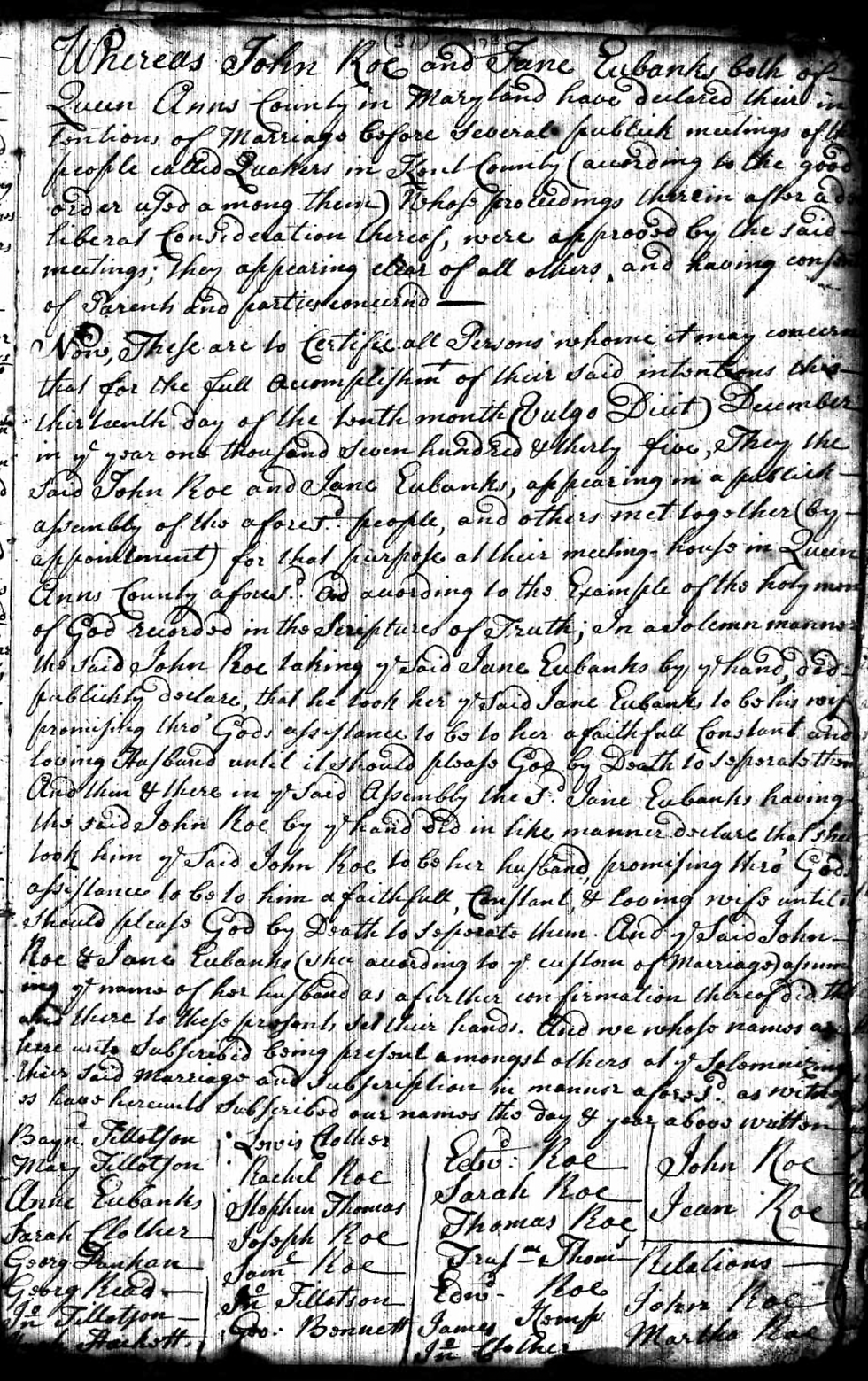
The marriage record says in part:
Whereas John Roe and Jane Eubanks both of Queen Anns County in Maryland have declared their intentions of marriage before several publick meetings of the people called Quakers in Kent County. . .after a liberal consideration therof, were approved by the said meetings. . .in a solemn manner the said John Roe taking the said Jane Eubanks by the hand, did publickly declare, that he took her the said Jane Eubanks to be his wife promising thro' Gods assistance to to be to her a faithful Constant and loving Husband until it should please God by Death to separate them.
The two were married in the company of family and friends. We wrote about Mary Jane's mother, Jane Kemp (6GGM) in our "The Three Husbands of Jane Kemp" post. In what I call a genealogical rarity, all three of our grandmother Jane's husbands, Robert Clothier (6GGF) Thomas Eubanks (6GGF) and Tristram Thomas (6GGF) were our grandfathers. Members from all three families were in attendance at John and Janes's wedding.
All of John and Jane's six children were born in Maryland. Sadly, Jane died not long after the birth of her last child, our grandmother Rachel, who was born ca. 1755. John remarried in 1757 and that same year, a Valentin Sevier patented 200 acres of land he had been granted for the importation of four men into North Carolina. One of these men was John Roe.
Though John hadn't inherited much land in Maryland from his father Edward (6GGF), it appears he did well in North Carolina, amassing about 1,000 acres. When he died in 1783, he divided his property among five of his six children. Oldest son Edward received just one shilling, the usual slap in the face for marrying outside the Quaker Church. Next oldest son John (4U) received 370 acres including the home plantation. Son Samuel (4U) received 175 acres. Daughters Jean (4A) and Rachel (4GGM) both received 200 acres and Sarah received 100 acres.
Our grandmother Rachel was 28 and still unmarried when she received her 200 acres of land in 1783. She married William Thomas, 15 years her senior, ca. 1786 and their first child was our grandmother Jane (3GGM), born in December of 1787. In about 25 years time, Jane would marry our grandfather Thomas B. Covington (3GGF).
Next up: William's later years


Comments