
William Billy Ram Thomas II
- westmohney

- Dec 13, 2024
- 7 min read
Updated: May 20
Your petitioner therefore humbly conceivith himself in some degree entitled to your Honors attention as being the first in this state who has brought the science of Astronomy to practice so as to become useful to the public ~ William Thomas

Prospering after the war
When William Thomas (4GGF) and Rachel Roe (4GGM) married, four of William's eight children with Hannah Pratt were over 18. From the first U.S. census taken for Richmond County in 1790, we see that there were six members in the William Thomas, Sr. houshold. Those would have been William, Rachel, three children from William's first marriage and their first child together, our grandmother Jane who was born in 1787.
Between his first land purchase in 1769 and his last in 1799 right before his death in 1800, William purchased 1466 acres of land but his original 300 on Cartledge Creek remained the home plantation. In 1786, just about the time of his marriage to Rachel, he sold 200 acres of his property to his son Stephen (3U), from his first marriage. Stephen was about 21 at the time.
As William's second family grew, he was still active in the affairs of his adopted town of Rockingham, NC. Shortly before our uncle Benjamin Covington (4U) left North Carolina for Kentucky, Ben deeded one acre of property to the Trustees of Richmond Academy for a Presbyterian school to be built on the land. In the deed, William was listed as one of the trustees. Other trustees in this school were Thomas Dockery, father-in-law of our grandfather, John Covington (4GGf), our uncle Matthew Covington (3U) and Thomas Crawford, husband of our aunt Rebecca Covington (4A).
William and Rachel continued living on the plantation that William had been granted in 1769. Though, he referred to himself as a "Planter," he also built and operated a profitable gristmill situated on the banks of Carledge Creek.
William's Oerery
William was accomplished as an amateur astronomer. In 1793, he completed his Orrery, which is a mechanical model of the solar system. Below is a picture of an orrery made ca. 1800. William's model may have been similar:

In November of 1793, William placed an ad In the Fayetteville Gazette letting the public know that he had completed his orrery which would be displayed in Fayetteville. He also stated that "on application" to him they could be supplied with one of their very own. He included a description:
The machine will shew to a great degree of truth, all the lunations--the solar and lunar eclipses, with the days of the moon's age, her apogees, perigees and nodes--also, the sign and degree which the sun, moon and other planets are in on every day throughout any given year--It carries the days of the month and date of the year--it shews the leap year with 366 days, and the three common years with 365 days, also, the motion of a comet; together with many other things too tedious to mention.

This advertisement targeted members of the North Carolina General Assembly, and the Board of Trustees of The University of North Carolina. Both were meeting in Fayetteville during this time period.
William's Almanac
Abraham Hodge was a printer in Fayetteville. During the Revolution, he was George Washington's press agent. After the war, he was elected State Printer by the General Assembly and was also printer for the newly founded University of North Carolina. Beginning in 1790, he printed a North Carolina Almanac that was written by "William Thomas, Astronomer." The almanacs sold for one shilling.
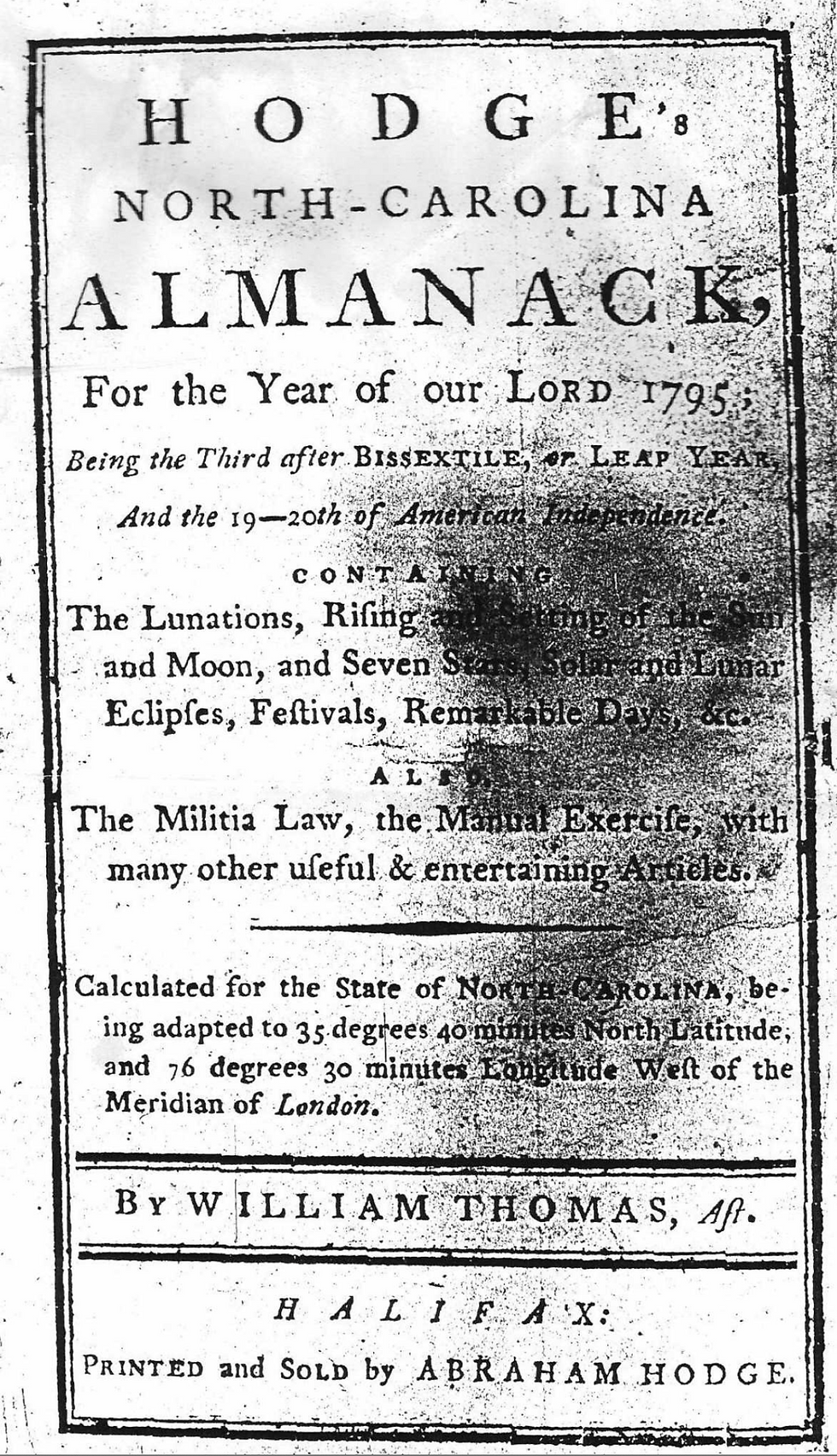
William's North Carolina Almanack was printed yearly for ten years, from 1790 until his death in 1800.
In December of 1794, William petitioned the North Carolina General Assembly to obtain a patent for his work in Astronomy:
To the Honorable General Assembly of North Carolina
The petition of William Thomas of Richmond County humbly sheweth --That wheras your petitioner humbly conceivith that your Honors zeal for promotion of literature and every species of useful knowledge; especially when reduced to practice so as to become a public utility will induce you to give proper rewards and encouragements to those who shall excell therin --Your petitioner therefore humbly conceivith himself in some degree entitled to your Honors attention as being the first in this state who has brought the science of Astronomy to practice so as to become useful to the public in respect of the Almanac which he has calculated not only in the common way by the Tables, but has also contrived a Machine which will calculate all the essentials of an Almanac in less than 10 minutes of time.
--Your petitioner therefore humbly prays that your Honors as a reward and encouragement for Sd. enterprise and undertaking may enact and ordain that no person or persons in this state shall print an Almanac for the term of 14 years without first obtaining a license from under my hand (provided I shall continue to furnish copies) under such penalty as your Honors shall think expedient -- Also that no Almanacs printed in any other state shall be vended in this state without licence as aforesaid and under like of the police of this state, and of the United Stateswill admit of such a prohibition -- And your petitioner as is duty bound will pray &c.
Wm Thomas
Richmond County
24 Demr 1794
William also advertised in the 7 Jul 1798 issues of both the Raleigh North Carolina Minerva and the Fayetteville Advertiser that "William Thomas, Ast. proposed opening a School of Natural Philosophy, Science, and Astronomy." The school was to be held at his house in Richmond County, where "he would board up to ten students."
William's death and will
William and Rachel had five children. When he died in 1800 at age 59, all the children from William's first marriage were grown and gone. Rachel was left with her five ranging in age from our grandmother Jane at age 13 to their youngest Martha (3A) at age 2.
William's passing was noted very simply in the North Carolina Minerva and the Fayetteville Advertiser: "Died lately in Richmond County in this State, much lamented, William Thomas, Esq. Astronomer."
By the time of his death, William had sold most of his property, 1229 acres, mainly to his sons by his first marriage. Since his sons all had property of their own he left them only personal items:
I give & bequeath to my sons William Thomas (3U), Nathan Thomas (3U), John Thomas (3U) & George Thomas (3U), all my wearing apparel with all my books my Bible & testament excepted & my Orrary to be equally divided among them.
William left the profits of his gristmill to Rachel, her five children and a daughter from his first marriage Mary Thomas Everett (3A) "for eight years after my death share & share alike each & every one being at equal expense in repairs & charges of all kinds whatever. . ." After the eight years the profits transferred to only Rachel and her five children.
William left the 200 acres given to Rachel by her father John Roe to three of his children by his first marriage, Stephen (3U), Elizabeth (3A) and Sarah (3A).
And last:
Item I give and bequeath my dwelling plantation with all the remainders of my real personal estate to be equally divided between my wife & my five youngest children Easter (Esther) Jane Martha Samuel & Robert share & share alike my wife to have her part laid off as to land including my dwelling house at the discretion of a majority of my executors my five youngest children to have their equal parts laid off when the oldest child comes of age but not to receive their equal part till they severally come of age. and also I will that my wife should occupy & enjoy all & every part of my five childrens last mentioned portion to enable her to school & clothe & raise Sd children and when they arrive to age to deliver up to my Sd children the equal parts as above mentioned.
'below is a copy of William's original will:

William was buried on his home plantation. According to D.D. McColl, author of Sketches of old Marlboro, the only inscription on any tombstone in this graveyard is at the head of William's grave. It reads:
William Thomas, born 1741 died 1800. There lies William Thomas, father of thirteen children, Patriot, sponsor of education and religion, and scientist/inventor (mechanical planetarium). He earned his living from a gristmill and some acreage for planting.
Rachel and Elijah
Did our grandmother Rachel marry again after Billy Ram's death? She would have been in her early forties with 5 children between the ages of 13 and 2 so it seems likely that she would remarry. Most accounts maintain that, after William's death, Rachel married Elijah Thomas (2C5X), son of Daniel Thomas (1C6X), who was the first minister of the Cartledge Creek Church. Daniel was a first cousin of William's.

Though we don't know the exact date of either of their births, Elijah would have been considerably younger than Rachel at the time of their marriage. Whether or not our cousin Elijah married our grandmother Rachel, he did indeed marry a Rachel Thomas as a marriage bond from 1802 proves. Marriage bonds were common between the years of 1741 and 1868. They were used to insure that the marriage would go ahead as promised. Elijah paid a bond of $500 before his marriage to Rachel. I have no idea who would have received the money had he defaulted. Below is is a copy of the bond:

Further proof that Elijah may have married Billy Ram's widow is a land purchase in 1802. Shortly after the marriage, Elijah bought 200 acres of land from Billy Ram's son Nathan (3U) from his first marriage. Nathan, who was Rachel's step-son, had purchased the property from his father in 1799.
Note: Nathan evidently sold the property in preparation for his upcoming move to Tennessee. In 1803 he bought 65 acres on the south side of the Cumberland River in Montgomery County, Tennessee.
It's unclear whether Elijah and Rachel had any children. One source cites Elijah's death in 1816 with Rachel "officially appointed guardian of the children in the Mar 1819 Richmond County Court of Pleas." Then, from Covington Cousins by Eurie Covington White (4C1X), we find this passage:
Elijah, son of Daniel and Sarah Covington Thomas, died In l8l6 (Will in Book M. page 1, Richmond County.) Sheriff Alexander Nicholson laid off the 458 Acre dower of the twice widowed Rachel Roe Thomas. This dower was laid off Dec. 13 l8l6. On August 24 1822, the widow Rachel Thomas sold to (our uncle) William Wall (4U), first; son of Old John Wall (5GGF) of Virginia by his 1st wife, 152 Acres which deed says "includes the dwelling house or mansion of Elijah Thomas”. On Dec. 19, 1823, Rachel Roe Thomas, widow of Ram Billy and Elijah Thomas, sold 57 Acres to William (Uncle Billy) Covington (3U), (Record Book M. page 223).
I believe that the most likely scenario is that our grandmother Rachel did, in fact, marry our cousin Elijah Thomas. In that case, she would have died sometime after 1823 when she sold the 57 acres to "Uncle Billy" Covington. She would have been close to 70 years at the time.


Comments