
A Whale of a Mutiny Story
- westmohney

- Jun 3, 2025
- 9 min read
Updated: Jun 11, 2025
Thus it appears that this more than demon, murdered with his own hand, the whole! Gladly would we wash from “memory’s waste” all remembrance of that bloody night. ~ William Lay and Cyrus Hussey
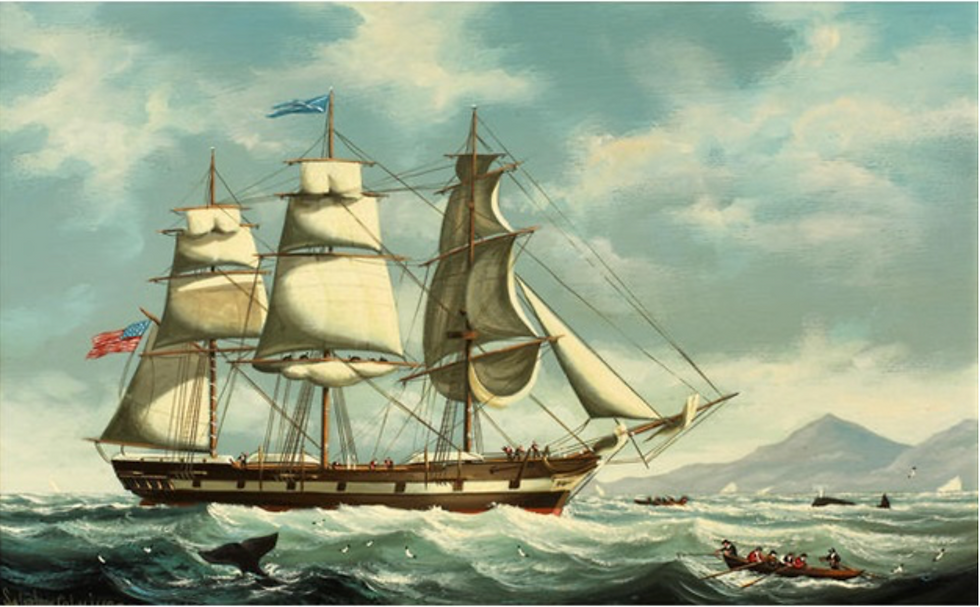
Benjamin Kidder and his sons
Our cousin Benjamin Kidder (3C6X) was born in Nantucket in 1768. Benjamin went on his first whaling voyage when he was only 14. He had a 20 year career as a whaling man, eventually graduating to sea captain. Benjamin married in Nantucket in 1798 and the couple had five sons and a daughter over the next 14 years. When he gave up the whaling life, Benjamin left Nantucket and moved across the sound to Edgartown on Martha's Vineyard where he took up the farming life.

Two of Benjamin's sons followed in their father's footsteps and ventured out into the whaling profession. In December of 1822, Peter Kidder (4C5X) was about 22 years old and his brother Stephen about 17. That month, the two young men signed on to the ship Globe, which left port at Edgartown on the 15th.
sources
The events that subsequently transpired on the Globe have been saved for by posterity by a book written by two survivors of that disastrous voyage. Most of the information I obtained for this story was from the book, A Narrative of the mutiny on board the Ship Globe by William Lay and Cyrus Hussey. Additional information came from an account of the story in the Atlantic Magazine by Boardman Hawes.
The Atlantic article begins with these paragraphs:
In the original papers of the Nantucket whaler Globe, Captain Thomas Worth, which sailed from Edgartown, Massachusetts, in December, 1822. . .you can see for yourself, if you wish, the starkly simple outline of such a story as few responsible imaginative writers would dare set down in black and white. On those authoritative, matter-of-fact pages are scrawled, in faded ink, the name of each man in the crew, a brief description of his person, an abstract of his life, and, after certain names, the significant comment, ‘Dead, killed Jany. 26, 1824.’
In the old narrative. . .there is a concrete and extreme example of such sanguinary madness as sometimes occurred on board the old whaling vessels, during their long voyages in distant seas. . .There was scarcely a voyage that had not its mutinies; there were floggings and desertions galore; and once in a long while, as on board the Globe, the monotony and loneliness and hardhanded discipline during years at sea resulted in downright mania.
the Globe sets sail
The Globe weighed anchor on December 15, 1822 with 19 crewmen aboard, eight of them under the age of 17. Two among the crewmen were our cousins, Stephen and Peter Kidder. Their voyage took them down the eastern coast of South America, around Cape Horn and, in May of 1823, they reached the Hawaiian Islands.

According to Hawes, "it was a common practice in whaling vessels so to abuse the men that they would run away, or make a show of insubordination, whereby they would forfeit their lays and help a thrifty captain to save money for himself and the owners." True to form, six men deserted and one was let go while the Globe lay at anchor in Oahu. The seven men were replaced with five, one of them a black man, William Humphries. After taking on the new crew members, the Globe continued on her journey.
In their account, Lay and Hussy wrote that immediately after setting course for the Fanning Islands, troubles aboard the ship began because ". . .the men shipped at Oahu, in the room of the deserters, were abandoned wretches, who frequently were the cause of severe reprimands from the officers, and in one instance one of them received a severe flogging."
After one such flogging inflicted on newcomer Joseph Thomas for insulting the captain, some of the crew members whispered of plans to leave the ship when they docked at the Fanning Islands, near the Falklands. Before they reached the islands, however, Samuel Comstock, the ships boatsteerer, took matters into his own hands.
the events of January 26, 1824
Lay and Hussy gave their account of the events on the night of 26 Jan, 1824:
George Comstock (Samuel's brother) took the helm, and during his trick, received orders from his brother to “keep the ship a good full,” swearing that the ship was too nigh the wind. When his time at the helm had expired he took the rattle, (an instrument used by whalemen, to announce the expiration of the hour, the watch, &c.) and began to shake it, when (Samuel) Comstock came to him, and in the most peremptory manner, ordered him to desist, saying “if you make the least damn bit of noise I’ll send you to hell!” He then lighted a lamp and went into the steerage. George becoming alarmed at this conduct of his unnatural brother, again took the rattle for the purpose of alarming some one; Comstock arrived in time to prevent him, and with threatenings dark and diabolical, so congealed the blood of his trembling brother, that even had he possessed the power of alarming the unconscious and fated victims below, his life would have been the forfeit of his temerity!
. . .In giving a detail of this chilling transaction, we shall be guided by the description given of it by the younger Comstock, who, as has been observed, was upon deck at the time, and afterwards learned several particulars from his brother, to whom alone they could have been known.
(Samuel) Comstock went down into the (captain's) cabin, accompanied by Silas Payne. . . John Oliver. . .William Humphries, (the steward). . .Comstock entered the cabin so silently as not to be perceived by the man at the helm, who was first apprised of his having begun the work of death, by the sound of a heavy blow with an axe, which he distinctly heard. . .The Captain was asleep in a hammock. . .Comstock approaching him with the axe, struck him a blow upon the head, which was nearly severed in two by the first stroke!
The first mate was, asleep in the same room, was the next to go. He woke and there was a scuffle as the mate tried to strangle Comstock who finally managed "to strike him a blow upon the head, which fractured his skull; when he fell into the pantry where he lay groaning until despatched by Comstock! The steward (Humphries) held a light at this time, while Oliver put in a blow as often as possible!"
Comstock then went after the 2nd and 3rd mates:
Comstock leaving a watch at the second mate’s door, went upon deck to light another lamp at the binnacle, it having been again accidentally extinguished. He was there asked by his terrified brother, whose agony of mind we will not attempt to portray, if he intended to hurt Smith, the other boat-steerer. He replied that he did; and inquired where he was. George fearing that Smith would be immediately pursued, said he had not seen him.—Comstock then perceiving his brother to be shedding tears, asked sternly, “What are you crying about?” “I am afraid,” replied George, “that they will hurt me!” “I will hurt you,” said he, “if you talk in that manner!”
Comstock, took his light into the cabin, and made preparations for attacking the second and third mates, Mr. Fisher, and Mr. Lumbert. After loading two muskets, he fired one through the door. . .and then inquired if either was shot! Fisher replied, “yes, I am shot in the mouth!”. . .They now opened the door, and Comstock making a pass at Mr. Lumbert, missed him, and fell into the state room. . .Mr. Fisher had got the gun, and actually presented the bayonet to the monster’s heart! But Comstock assuring him that his life should be spared if he gave it up, he did so; then Comstock immediately ran Mr. Lumbert through the body several times!!
Comstock then put the muzzle of the gun to (Fisher's) head, and fired, which instantly put an end to his existence!—Mr. Lumbert, during this time, was begging for life, although no doubt mortally wounded. Comstock, turned to him and said, “I am a bloody man! I have a bloody hand and will be avenged!” and again run him through the body with a bayonet! He then begged for a little water; “I’ll give you water,” said he, and once more plunging the weapon in his body, left him for dead!
Thus it appears that this more than demon, murdered with his own hand, the whole! Gladly would we wash from “memory’s waste” all remembrance of that bloody night. The compassionate reader, however, whose heart sickens within him, at the perusal, as does ours at the recital, of this tale of woe, will not, we hope, disapprove our publishing these melancholy facts to the world. As, through the boundless mercy of Providence, we have been restored, to the bosom of our families and homes, we deemed it a duty we owe to the world, to record our “unvarnished tale.”
the Globe with Samuel Comstock in charge
The rest of the crew, our cousins Peter and Stephen included, were now at the mercy of the obviously degranged Samuel Comstock who threw the bodies overboard and set a course for the Mulgrave Islands, halfway between the Hawaiian Islands and Australia.

Two days after the murders, George Comstock saw the former steward, Humphries, loading a pistol. Humphries had been one of the three men with Samuel Comstock on the bloody night. George told his brother who immediately called the former steward to explain.
When Comstock demanded to know what was going on, Humphreys "answered at first in a very suspicious and ambiguous manner, but at length said, that Gilbert Smith. . .and Peter Kidder, were going to re-take the ship." Comstock then summoned the two accused men who "positively denied ever having had conversation upon the subject." The next morning a trial of sorts was convened for the three men. Humphries, a black man, probably never had a chance. From the account by Lay and Hussey:
The next morning the parties were summoned, and a jury of two men called. Humphreys under a guard of six men, armed with muskets, was arraigned, and Smith and Kidder, seated upon a chest near him. . .The trial, if it may be so called, had progressed thus far, when Comstock made a speech in the following words. “It appears that William Humphreys has been accused guilty, of a treacherous and base act, in loading a pistol for the purpose of shooting Mr. Payne and myself. Having been tried the jury will now give in their verdict, whether Guilty or Not Guilty. If guilty he shall be hanged to a studding-sail boom, rigged out eight feet upon the fore-yard, but if found not guilty, Smith and Kidder, shall be hung upon the aforementioned gallows!” But the doom of Humphreys had been sealed the night before, and kept secret except from the jury, who returned a verdict of Guilty.
. . .Every man was ordered to take hold of the execution rope, to be ready to run him up when Comstock should give the signal, by ringing the ship’s bell! He was now asked if he had any thing to say, as he had but fourteen seconds to live! He began by saying, “little did I think I was born to come to this———;” the bell struck! and he was immediately swung to the yard-arm! He died without a struggle. . .
onward to the Marshall Islands
The voyage to the Mulgraves continued on with seventeen very tense and wary men. As Hawes in his Atlantic article pointed out, "the pledged mutineers were now only half a dozen men of a crew of seventeen; they had no assurance of the support of the other eleven, and much reason to doubt it." The laws, which were made by Samuel Comstock, revealed his own insecurities:
That if any one saw a sail and did not report it immediately, he should be put to death! If any one refused to fight a ship he should be put to death; and the manner of their death, this—They shall be bound hand and foot and boiled in the try pots, of boiling oil! Every man was made to seal and sign this instrument, the seals of the mutineers being black, and the remainder, blue and white.
When the Globe finally reached the Marshall Islands, about 80 miles northwest of the Mulgraves, they sent a boat ashore but changed their minds about landing as the natives appeared none too friendly. From the horrified Lay and Hussy's account:
When about to leave, a volley of musketry was discharged at them (the natives), which probably killed or wounded some of them. The boat then gave chase to a canoe, paddled by two of the natives, which were fired upon when within gunshot, when they immediately ceased paddling; and on the boat approaching them, discovered that one of the natives was wounded. In the most supplicating manner they held up a jacket, manufactured from a kind of flag, and some beads, being all they possessed, giving their inhuman pursuers to understand, that all should be theirs if they would spare their lives!. . .Here was another sacrifice; an innocent child of nature shot down, merely to gratify the most wanton and unprovoked cruelty, which could possibly possess the heart of man. . .this act of cruelty will be remembered by these Islanders, and made the pretext to slaughter every white man who may fall into their hands. . .
We'll leave the Globe mutineers in the Marshall's for now but their story will continue in our next post.


Comments