
Family of Note III
- westmohney

- Feb 11
- 12 min read
Updated: Jun 9
People will not look forward to posterity who never look backward to their ancestors.”~ Edmund Burke

the Job Hill Cemetery
Our cousin Job Hill (1C7X) was born in Billerica in 1754. He was a great-grandson of our immigrant grandfather Ralph Hill (8GGF). The Job Hill Cemetery in Billerica was established in 1828, most probably on land donated to the town by Job. According to the Billerica Public Library, "[t]his is the burial site of Job Hill, many of his family members, and some of the workers and neighbors of the Hill Machine Shop, which was established by Jonathan Hill, Esq., (son of Job)."
Job died in Billerica in 1843 at age 88. In his will he left $700 to each of his three daughters and his property and estate to his son Jonathan (2C6X). He also made a bequest of $50 to his son Daniel (2C7X), who had obviously left town, "on condition he. . .comes to Billerica personally within three years of my decease."
Below is the bottom portion of Job's will with his signature. Two of the witnesses to his will were cousins of his (and ours), John Baldwin (3C6X) and John Baldwin, Jr. (4C5X). The two Johns were great-grandsons of our immigrant grandfather John Baldwin (8GGF).

The Baldwins and Hills had been well known to one another for generations. Our two immigrant grandfathers, Ralph Hill and John Baldwin, were both living in Woburn when the new town of Billerica was established in 1654. Both were granted land in the fledgling village and moved there in 1655. Job's (and our) grandmother Susannah Baldwin Hill (7GGM) was a great-aunt to both the John Baldwins who witnessed Job's will.
Below are photos of the cemetery and Job's headstone:


The location of the Job Hill Cemetery is interesting. It is only a mile from the Ralph Hill Conservation area in Billerica which is located on land that Grandpa Ralph had purchased in 1655. The proximity of the cemetery to the Conservation area indicates that, in the early 1800s, some Hills still lived on land originally purchased by their immigrant grandfather.

And, finally, below is a postcard showing Job's son Jonathan's machine shop, established in 1822 when he was 26:

the Dalton's of Salibury, MA, Warner, NH and Coloumbus, OH
Our cousin Isaac Dalton (3C7X) was born in Salisbury, MA in 1761. After serving, while still in his teens, for two years in the Revolutionary War, Isaac married Eleanor Merrill in 1784.
The couple had six children. In 1783, Isaac moved to Warner, New Hampshire where he ran his farm and operated a tannery.
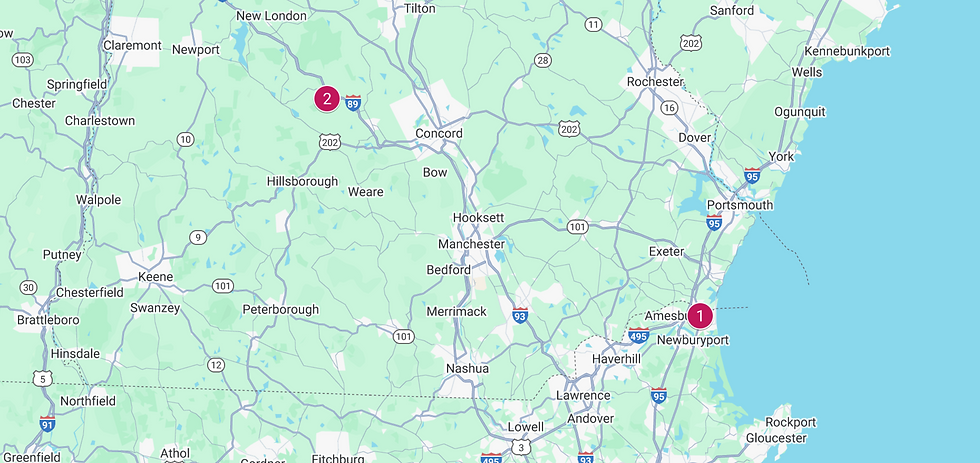
From the "Daltons in History" website, we find this story about Isaac:
Isaac Dalton was active in community affairs and after the Congregational Church was established he was among the first six deacons. Forever after he was addressed as Deacon Dalton. This story describes the strict adherence to religious rules practiced by the church and its members. In the summer of 1816, frost and snow had destroyed the corn and other crops and severe shortages existed. In the winter of 1817, Isaac Dalton approached a fellow parishioner, Enoch Merrill, at the end of the service. He asked for a spare bushel of corn and Enoch's reply was to ask on the morrow. Isaac trudged over four miles the next day to Enoch's house to obtain a bag of corn. Enoch's response was; "I have no corn to sell and I answered you as I did, that you might learn to remember the Sabbath day and keep it holy".
Isaac's wife Eleanor died in 1829 and, sometime later, he married Judith Sawyer. Possibly after his second marriage, Isaac moved to Joppa Road in Warner. That is where he was living when he died in 1838. Judith was still living in the house on Joppa Road in 1852 when the town voted to "rebuild a good bridge near Mrs. Dalton's." Because of her proximity to the new bridge, it was decided to name it after her.
The Dalton Covered Bridge, the only one in New Hampshire to be named after a woman, is one of the oldest standing covered bridges still in use today. It was listed on the National Register of Historic Places in 1976.

Isaac's house on Joppa road is still standing. It is believed that the house was built in 1794 by Jonathan Emerson who lived in the house before Isaac.

Isaac’s brother Jonathan (3C7X) was born in Salisbury in 1767. In 1793, he married our cousin Sally Stickney (4C7X) in Newburyport, MA. Little is known about him except that he was a sailor who made voyages to the Orient to bring back silks and spices. In 1802, on one of these trips, Jonathan's ship sank in a storm and he was lost at sea at age 35. The inventory of his estate shows that he was well off. He owned a mansion with furnishing valued at $3,615, interest in a ship worth $2,250, insurance money and cash of $1,500. The total value of the estate when his debts had been settled, was $6,500.
Isaac's son, Isaac Dalton, Jr., (4C6X) was born in Warner in 1801. He worked there as a carpenter until he moved to Columbus, Ohio in 1831. In Columbus, he was appointed steward of the Ohio School for the Blind. He also served as a member on a special board of health during the cholera outbreak of 1849-1850.
While not many battles were fought in Ohio during the Civil War, the state "played a key role in providing troops, military officers, and supplies to the Union army." Ohio was the third most populous state in the Union at the time and was third, after New York and Pennsylvania in supplying manpower to the military.
Tod Barracks, named after Ohio's governor, David Tod, was built in Columbus in the fall of 1863. The barracks were used "for the accommodation of sick or dsabled soldiers and recruits." Our cousin Isaac was appointed by the governor to take charge of these soldiers.
In 1880, Isaac died in Shreve, Ohio at age 79.
Isaac was buried at Green Lawn Cemetery in Columbus. A window at the cemetery was dedicated to him for his service during the Civil War.


Moses Kimball
Our cousin Moses Kimball (4C7X) was born in 1792 in Hopkinton, New Hampshire. When he was nine years old, his parents got a dose of the westward fever sweeping the country and moved to Tiltonsville, Ohio. Moses would amass quite a fortune during his lifetime in the shipping business but it was his early life that possibly forged the man he became.
Tiltonsville lay on the banks of the Ohio River and it seems that, when Moses was about 21, he and some of his cousins built a flat boat named "The Boy Boat. They loaded it with goods they hoped to sell and set off down the river to New Orleans. The "boys" must have been pretty brave because, at the time, the War of 1812 was raging.

The story of what happened next appeared in Moses' obituary as told by his granddaughter Claire Hague (6C5X):
When twenty-one years of age he went to New Orleans on a flat boat, and while there joined a provateering expedition against British (ships). When La Fitte, the pirate was bearing down upon them, part of the crew of the American privateersman mutinied, and he (la Fitte) was soon in possession of their vessel. As the custom of the pirate was to kill all who did not join them, La Fitte told that part of the crew which still remained true to the "stars and strypes" that unless they joined him they wold have to "walk the plank" and save themselves by swimming to a barren sand-bank -- which he supposed they would not reach--as it was invisible to the naked eye, being about three leagues away. The subject of this sketch, with a few others who escaped the bullets of the pirates by diving while near the vessel, reached this bank, which was off the coast of Florida, where they subsisted on clams for six days, when they were discovered and returned to New Orleans shortly after the defeat of Packingham.
Note: Major-General Edwards Packingham was fatally wounded on January 1815 in the Battle of New Orleans. That battle, an American victory, was unfortunately fought after peace had already been declared but news hadn't reached the participants in time.
After being rescued from the island, Moses hired on to a keelboat loaded with sugar bound for Pittsburgh, PA. The trip took 96 days and he received 96 Mexican dollars for his labor.
While making the trip he cut out with a penknife a pair of pantaloons, and made them with thread twisted by hand. He kept those pantaloons as a memento, until his house was swept away in the great flood of 1832, when they, with all his household good were lost.
The other particulars of Moses' life come from his obituary. After the Pittsburgh trip, it appears that he worked in the sawmill business for a time. The obituary, however, did leave out one glaring incident in Moses' life. From New Hampshire prison records we find that he, after returning to his home state for a time, was caught stealing and sentenced to two years in prison. We know it is our Moses because the age is correct and the birth place is listed as Hopinton, NH. The record shows that he was incarcerated on May 11, 1818 and served two years. He was released on May 11, 1820.

Just one month after his release from prison, Moses married Tabitha Anderson.
He married at Pine Grove (PA), and in 1825 with his wife and child and all his earthly possessions, went from there in a skiff to Tiltonsville, the scene of his early labors, where he lived for six years. During this time he traded on the Ohio river. He walked three times and rode horseback twice from New Orleans home.
It was while Moses was living and working in Tiltonsville, on the banks of the Ohio River, that the great flood of 1832 occurred. From reports in the Cincinnatti American:
The great Flood in the Ohio ~
Cincinnatti, Feb. 14 ~ The destruction of property is immense -- cellars filled with water, -- board yards swept of every stick of timber -- and some houses already on the move. . . What a scene! The water still on the rise -- people moving in every direction -- some from the first to the second story -- others from the second escaping in boats. It is undoubtedly the greatest rise ever known.
Thursday morning, Feb. 16 ~ The river. . .is undoubtedly sixty-four feet above low water mark. . .the scene presented cannot easily be described. It was painful to witness destruction on so vast a scale. . .Flat boats loaded with women and children, furniture and livestock. . .
Friday morning, Feb 17 ~ The work of desolation still continues. . .Everykind of craft is put in requisition, tubs, boxes, canoes, flats, dug-outs, skiffs, yawls, &c, &c. . .We cannot enumerate half of the bad calamities rumor is bringing in. . .Excellent frame houses float along, with haystacks, rails, leaving the farms stript of every vestige of cultivation. . .
Moses was one of the unfortunate ones to have his home swept away in the massive waves that swept through the town. Undaunted, he moved two miles upriver and built a home in Warrenton, OH, also on the banks of the Ohio River. His obituary says that "during the next thirty years [he] was engaged actively and largely in business pursuits of different kinds, at at one time had accumulated a handsome property. . ."
Note: His daughter Jemima McGrew, reported that our cousin John Chapman (4C6X), aka Johnnie Appleseed, frequently visited their home in Warrenten and that the family saved apple cores for him.
In 1861, Moses had the misfortune to have his right arm torn off in a threshing machine but still lived, firm and undaunted, though all the vicissitudes of trials, troubles and ravenges of fortune to the ripe old age of eight-five years. . .It is said that he had as much as $100,000 at one time. Much of it he lost when the railroad was put thru.
It may not have been long after losing his arm that Moses moved with his daughter Josephine (5C5X) to Thorton, West Virginia where he had a lumber business for a short time. He then moved to Bartlett, Ohio where he bought a home on 14 acres that he left to Josephine when he died in 1876. Moses died at the ripe old age of 85 after an unusually evenful life.
Alvah Kittredge's house
Our cousin Alvah Kittredge (4C6X) was born in Mont Vernon, New Hampshire in 1798. His fortune was made as he went from humble beginnings as a cabinet maker to a furniture entrepreneur. Aiding in his path to wealth was a move to Roxbury, MA, a suburb of Boston. There, in addition to his thriving furniture business, he was involved in the founding of the Eliot Congregational Church and the Forest Hill Cemetery in Roxbury. Alvah died in 1876 at age 78. Thanks to some digging by Historic Boston Inc., a photograph of him was found buried in the archives of the Congregational Church he helped to found.

In spite of all his accomplishments, Alvah's main claim to fame was the house he built on an old fort site in 1836.

Over the years, the section of town where Alvah's house stood "developed from a suburb into a teeming section of the city." The house fell into disrepair with "white block peeling paint and rotting columns."
In the early 2000s, however, the property was taken over by the city of Boston by eminent domain and turned over to Histoic Boston, Inc, a "nonprofit group that preserves culturally significan buildings." Restoration of Alvah's former home began in 2011. The 6,400 square foot building was divided into five residential units, two of which were designated for affordable housing. Below is a picture of the grand opening celebration by Historic Boston:

Below is a picture of the house today. Note how the city has encroached on either side of Alvah's home which, in the past, boasted spacious grounds.

transforming the Aberjona River
Our cousin Jeduthan Richardson (5C6X) was born in 1738 in Winchester, MA, an offshoot of Woburn. He built his house on land that was originally owned by the powerful Richardson brothers, Ezekial (9U), Samuel (9U) and our grandfather Thomas (9GGF). The brothers came to Woburn in the early 1830s and were instrumental in founding the town. Jeduthan descends from our uncle Samuel.
Below is a photograph of Jeduthan's house before it burned down in the early 1900s:

The stretch of land owned by the Richardson brothers, then known as Richardson Row, ran along the banks of the Aberjona River. According to Winchester historian Ellen Knight, "[n]o landscape in Winchester could be more historic than the Aberjona River and it tributaries." Below is a ca. 1880 painting of the river by Joseph Foxcroft Cole:

Winchester was originally called Waterfield due to its "abundance of marshes and ponds." In the map below we see some of the many lakes in the area. Most of the land between Highland Avenue and Horn Pond was owned by the Richardsons.
(1) Richardson Street next to Horn Pond, where our grandfather Thomas owned land.
(2) Washington Street, which used to be called Richardson Row.
(3) Winchester Center, which used to be called the Richardson Industrial Area.

From Eileen Knight's account of the Aberjona River:
The Aberjona River originates in Reading, flows south through Woburn and Winchester, and
empties into the Mystic Lakes. That has not changed over the centuries. But maps of Winchester from the second half of the nineteenth century show a river with many more branches and bends, with a succession of little islands, and often with wider banks than known today.
Perhaps some features were natural, perhaps not, for the first structures built along the river,
besides bridges, were dams. These caused the river to pond and spread into marshes, changing the adjacent landscape.
Our cousin Jeduthan was one who had a hand in changing the course of the river. Though the settlement in Winchester remained small, only 35 homes in 1798, the Richardson stretch of the Aberjona River "offered a source of power for mills to operate in the area which became Winchester." In 1751, Jeduthan established a mill along the banks of the river and, in the late 1700s, in just one of many attempts to control the river, he was allowed to dig a canal to divert the waters which created an island in the river.
The area where Jeduthan had his mills was known for many years as the Richardson Industrial Area. From an AI overview:
The historical "Richardson industrial area" refers to the early manufacturing and milling district established by the Richardson family along the Aberjona River in Winchester, Massachusetts, during the 18th and 19th centuries. Today, this area has transformed into a residential, suburban, and civic hub in Winchester Center.
Eileen Knight wrote about other problems with the river for residents:
It has also seen tragedy. The last Native American known to live here, Hannah Shiner, fell in near Main Street and drowned in 1820. Six years later, unhappy newlywed Tufts Richardson chose to throw himself into the river and drown rather than eat his wife’s bread.
The river has been trouble. It often proved an obstacle to travel. It became a breeding place for mosquitoes and a dump for refuse.
It seems there was only more trouble for the river itself as the years passed:
As the leather business in Woburn boomed with the opening of the Middlesex Canal in 1803, South Woburn also contributed to that industry not only with tanneries but also with a mill producing tanning equipment.
Note: Our cousin Loammi Baldwin (3C7X) was the chief engineer on the Middlesex Canal project.
With the advent of the railroad in 1835, offering transportation in the same general area as the river, Winchester developed even more as an industrial site. In addition to leather, products included furniture, sashes and blinds, cotton batting, piano cases, and felt. Early 20th century factories manufactured shoe fasteners and soda fountain works.
Note: Many of our Wyman family members owned shoe factories in Woburn.
Sadly, the contamination of the Aberjona has only increased over the years. Despite efforts by the Mystic River Watershed Association and local town conservation commissions to improve the ecological health of the river, it is still classified "as one of the most polluted water bodies in Massachusetts, holding a High Stress basin designation by the state's Water Resources Commission."


Comments