
Baldwin Family of Note ~ Part II
- westmohney

- Apr 8, 2025
- 11 min read
Baldwin's engine was not only the most powerful of its day but also incorporated mechanical innovation to power rotary motion. . . ~ Malcolm Clark

Matthias Baldwin and his locomotive
Matthias (7C6X) was born in Elizabeth, NJ in 1795. His father, William (6C7X) died in 1799 when Matthias was only 4 years old. Unfortunately, the executors of William's will made off with the bulk of the families assets and they were left in "difficult financial circumstances." In 1811, when he turned 16, Matthias was apprenticed to the Woolworth brothers, jewelers in Philadelphia, PA. Malcolm C. Clark, a professor at the College of Charleston, maintains that "[f]ine craftsmanship and exquisite detail rapidly became his hallmarks."
By 1819, Matthias had worked his way to master jeweler but, when the recession of 1825 destroyed the market, he decided to change his profession. Still living in Philadelphia, he went into partnership with another man to manufacture printing machines. For Matthias, necessity truly was the mother of invention. He was unable to find a steam engine powerful enough for his factory work so he simply designed and built one of his own.
From Malcolm Clark's article "The Birth of an enterprise: Baldwin locomotive:"
In 1828 Baldwin devised and constructed his first steam engine, a stationary device that produced 5 horsepower of output and remained in use in the shop for four decades. Baldwin's engine was not only the most powerful of its day but also incorporated mechanical innovation to power rotary motion, which ultimately came to have application in transport, including marine engine design. The original engine still survives in the Smithsonian Institution in Washington, DC.
Below is Matthias' first stationery steam engine:
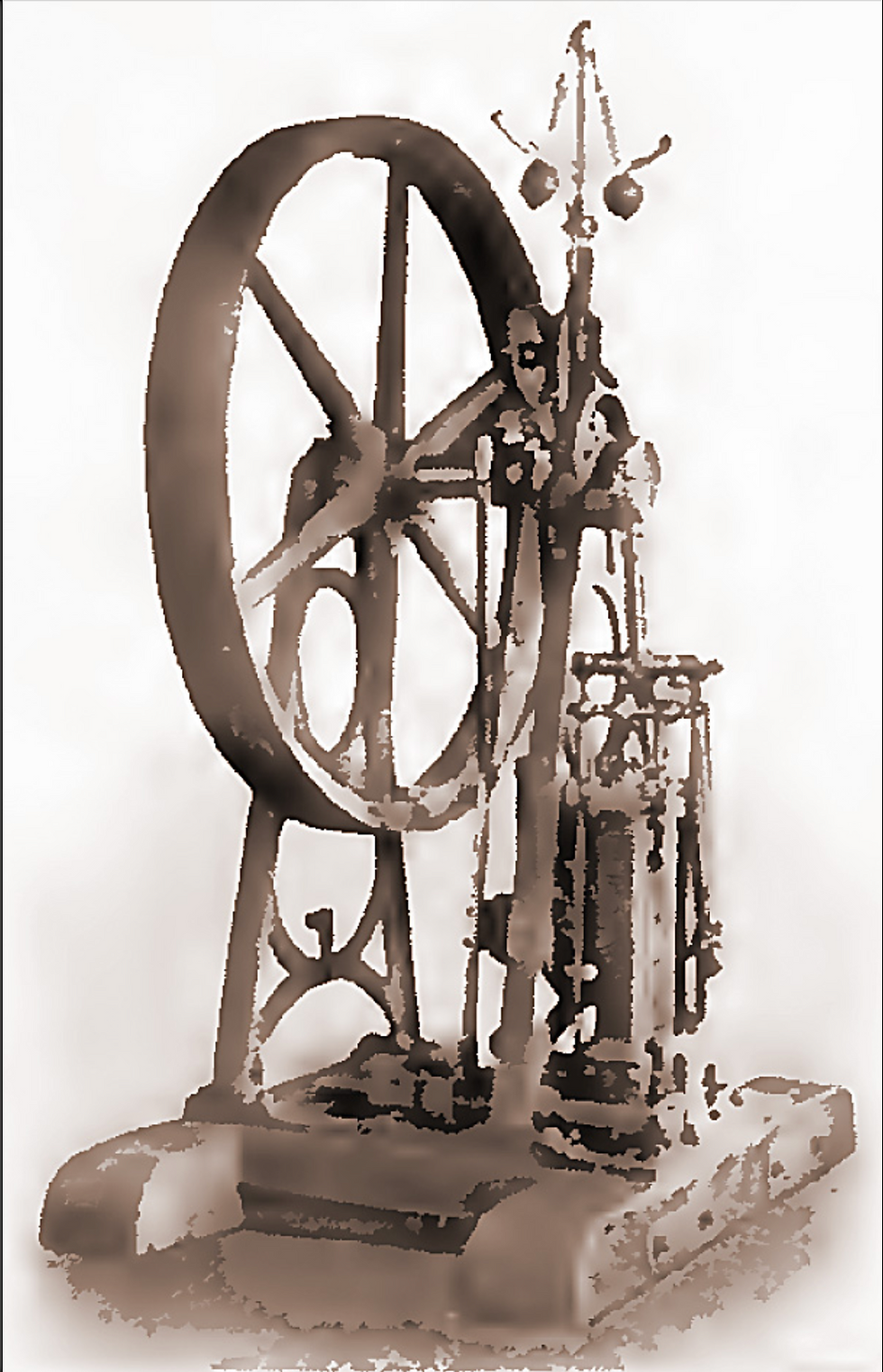
According to The National Railroad Hall of Fame, "[t]his early stationary engine was so successful that other businesses contacted him to order their own machines on his design."
Those were the early days of what would eventually become the Baldwin Locomotive Works, one of the largest and most successful locomotive manufacturing firms in the United States. The most famous of all the early locomotives were the Old Ironsides which Matthias first built in 1832.

Old Ironsides initially traveled at the rate of only 1 mile per hour. Refinements to the machine managed to improve that to a peak speed of 28 mph. Further improvements led to the Baldwin Locomotive which was in use from 1834 until 1840.

It wasn't until 1836 that Matthias was issued his first U.S. patent. This was for a method of "managing and supplying fire for generating steam in locomotive-engines." In his patent application Matthias explained the method to his madness:
The intention of this new mode of managing the fire is to enable me, at each water station, or any convenient place to have a clear coal fire waiting the arrival of the engine so that the grate or fire-place which has been in use, may be detached or slid out, and that containing the clear fire, made to occupy its place.
Matthias' new system was a resounding success. Clark wrote that "[t]he cascade of orders which nearly overwhelmed the factory at the beginning of 1836 assured Baldwin that there would be plenty of work for the coming year." Over the years, various railroads purchased "1,500 engines which bore his name."
In addition to his locomotive business, Matthias was also a staunch abolitionist, "a position that was used against him and his firm by competitors eager to sell locomotives to railroads based in the slaveholding South." Nonetheless, he persevered. In 1835, he donated money to establish a school for African-American children in Philadelphia and he continued to pay the teachers' salaries out of his own pocket for many years. As a member of the 1837 Pennsylvania Constitutional Convention, he "emerged as a defender of voting rights for the state's black male citizens."
In the early 1860s, as "one of his last philanthropic efforts," Matthias donated 10% of his company's income to the Civil War Christian Mission in the early 1860s. The Christian Mission provided "spiritual and physical assistance to soldiers in both the Union and Confederate armies."
Matthias died in 1866 at age 71. From the Friends of Matthias Baldwin Park site:
The tolling of church bells announced the death of a prominent Philadelphian, the year 1866. In the funeral procession City dignitaries stood shoulder-to-shoulder with 1,000 workers. They proceeded on foot from center city to Laurel Hill Cemetery. Along the way, the funeral cortege came to a large factory at Broad and Spring Garden Street. As they circled the factory, the bell in its cupola rang out the death of its owner. That man was Matthias Baldwin.
He made certain that upon his death his company would continue to provide employment for his workers. At its peak in 1907, 41 years after the death of its founder, the Baldwin Locomotive Works employed 18,500 people. The Works grew to 39 buildings covering 17 urban acres in this area. During its heyday 2,000 steam locomotives were manufactured a year.
In 1906, the city of Philadelphia honored Matthias with a statue which now stands in front of the Philadelphia City Hall.

In an ironic twist, Matthias' statue was defaced in June of 2020 during the George Floyd protests in Philadelphia. The words "colonizer" and "murderer" were spray painted on the pedestal by people who obviously didn't know Matthias' history as an abolitionist.
Matthias was further honored In 2011 when a park originally commissioned by the city of Philadelphia in 1981 was officially changed to Matthias Baldwin Park.

We'll leave the last words on our accomplished Cousin Matthias to Malcolm Clark:
. . .he remained primarily the artist, the craftsman, the inventor. His contemporaries sensed this. What Henry Ford represented to a later age, Matthias Baldwin epitomized for his own. Both created the means to overcome the ancient limitations of time and space. Both rose to preeminence in keenly competitive fields and each transformed the world for his generation.

Statesman Eli Baldwin
Our cousin Eli Baldwin (5C6X) was born in New Milford, Connecticut in 1777. When he was 24, he was appointed general land agent for the Connecticut Land Company. We learn a little about him from a bio in the History of Youngstown and the Mahoning Valley, Ohio by Joseph Butler, Jr.
He left New Milford on April 15, 1801 and arrived in Boardman, Ohio, on May 1st. He superintended the survey of both land and many of the roads in Mahoning and other counties and laid out the Town of Medina, Ohio. He was also employed by Elijah Boardman. . .in his store and mill as manager or superintendent.
In 1805, Eli married Mary Newport. . .Eli Baldwin held many offices. He was the first justice of the peace, the first postmaster, military captain and county commissioner. His appointment as postmaster, written and signed by Andrew Jackson, is still in possession of his descendants.
Eli was a member of the Ohio State House of Representaves and the Ohio Senate. In 1836 he ran as a Democrat for governor of the state of Ohio. On 9 Feb 1836, the Huron Reflector ran a "press debate" that featured both a pro and a con for Eli:
Give even old Nick his due - The Cincinnati Whig asks,
(Con) Who is Eli Baldwin? Can any body tell what there is about him, or what he has ever done, that should entitle him to the distinction of being Governor? Has any man ever been able to discover in him any of the qualifications necessary to a crdditable discharge of that office? We should like to have these questions honestly answered. All that we have ever heard of him, designates him as an inefficeint county Judge, and a stupid member of the legislature.
(Pro) Eli Baldwin is a substantial farmer of Trumbull county, Ohio. He is a man of good, plain, common sense; of respectable information; an early settler in the state, conversant with her public affairs, and full as competent to conduct them well, as half the younger lawyers that aspire to take the lead, in the present day. There is no wisdom in undervaluing the qualifications of Mr Baldwin. Let us oppose him as the candidate of the party, as though personally we knew nothing about him. There let us stop.
Now we perfectly agree with the Editor of the Cincinnati Gazette. "give the Devil his due."

The Huron Reflector of 19 Jan 1836 noted Eli's nomination for the office of governor.

The Democrat and Herald of 5 Aug 1836 featured a snippet of support for Eli.

Finally, an unflattering article in the Republican Argus just before the election may have sealed Eli's fate:
Judge Baldwin's Consistency
The utter disregard for truth which the Van Buren papers evince, in their anxiety to procure the election of Eli Baldwin to the office of Governor is truly astonishing. How unblushingly do they assert that Judge Baldwin is entitled to the support of the people on account of his consistent and unchanging political course. . ."Judge Baldwin a consistent politician"! - How false. In 1824 Judge Baldwin was a supporter of Adams for the presidency; and as a pretended friend to Adams. . .was afterwards elected to the legislature of Ohio, where (still acting as an "Adams man") he procured himself to be elected an associate judge for Trubull county, over Judge Rayen. . .the opposing Jackson candidate. Who would then have thought of Eli Baldwin ever being the Jackson candidate for any office whatever - no one, certainly. How then happens it, that he is now the Jackson candidate for governor?
Strange as it may be, there is a how, and here it is - Though holding the office of judge, he had his eye on promotion to a seat in congress, but was unable to get support, from the party with which he then identified himself. . .this being the case, the pliant judge whipped over the fence, and huzzaed for Jackson. . .he found to his discomfiture, that he had espoused much the weaker side. . .he could not obtan their suffrage. . .Such being the situation . . .the consistent judge was again seen wavering; tailing off the prospects of entire new parties coming into vogue, and rather inclining towards the flag of Harrision, when the Vanites, to retain him in their party, boosted him up as a candidate for governor; and by false pretences as to his strength at home, procured his nomination. . .This had quieted the judge for the present. How long he will remain so no one can tell. ---The above facts are know to most of the people of Trubull county, and knowing, can they support a man of as inferior qualifications as Eli Baldwin, for governor? I think not: certainly not for his consistance. TIPPECANOE.
As it turned out, the majority of Ohioans did not support poor Cousin Eli and he lost his bid for the governorship. After the election, he devoted his time to business ventures which included various mills on the banks of Mill Creek. This property now belongs to Mill Creek Park in Youngstown.
Eli died in 1841 at age 64, five years after his run for governor. His death was noted in the Lorain Republican:

We'll leave the last word on Eli to Joseph Butler, Jr.:
He was a public spirited man, being always ready to serve the people who were in need of his services as well as the community at large
Like many other persons Eli Baldwin had his eccentricities, on of these being extreme absentmindedness
He was a staunch Presbyterian and used to ride into Youngstown to church on Sunday morning, putting up his horse in the stables belong to the McCoy Taver. . .As a warm friend of the family he always dropped into the tavern to exchange greeting and enquire the news of the day where frequently a copy of a Pittsburgh paper would be handed to him. Very soon he would become so absorbed in its contens that before he would come to himself it would be about noon and past the hour of service, when he would sadly mount his horse and ride home to make the best excuses he could to his wife and family.
town founder Benjamin Gordon Baldwin
Our cousin Benjamin G. Baldwin (5C5X) was born in Bradford, Vermont in 1800. From the book Bradford, Vermont by the Reverend Silas McKeen we learn of an life-changing incident early in Ben's life:
When about eight years of age he met with a sad disaster. One winter day, when going to the village, he joined a lumberman's team, moving in the same direction, and, full of boyish animation to catch a ride, mounted a heavy timber, the hind end of which was dragging on the ground. By some mishap one of his feet was caught between the log and frozen ground, and became horribly crushed. It was supposed at first that amputation must be the result, but the conclusion of the surgeons was to make an effort to save it, which proved successful, though the youthful sufferer ever after carried with him an effectual memento of the disaster. This event, it is believed, contributed an influence to change his whole course of subsequent life and to make him a more distinguished and useful man than he otherwise might have been.
In his younger years, Benjamin studied with Reverend McKeen and later graduated from Dartmouth in 1827. One of his classmates at Dartmouth was our cousin Alpheus Crosby. (6C7X) who became a Professor Emeritus of the Greek lanuguage and literature at Dartmouth.
Benjamin had studied law at Dartmouth and after graduation he made his way to Potsdam, New York where he found a position in the office of Horace Allen, a "widely known" lawyer there. While Ben eventually became a partner in Allen's firm, the main source of his wealth came from property ventures. By 1841 he owned over 400 acres of fertile farm land in and around Potsdam

Benjamin used a portion of his land for his own farm, a village green and a school. The rest he divided into lots that he sold to the settlers. His idea was to establish a suburb of Potsdam on the Raquet River which he called Raquetteville though there is no town of Raquettville in that area today.
Another suburb of Potsdam founded by Benjamin and our cousin James Symonds (5C5X) was the town of Norwood, six miles north of Potsdam. As an inducement for the Northern Railroad to bring their railway to his new town, Benjamin donated the land for the depot there.
Our cousin James Symonds was born in Burlington, Vermont in 1790. He married in 1816 and, that same year, moved to the "northern New York wilderness" (near Potsdam) and built a log farmhouse. The couple had seven children. Two of their sons became millwrights and helped build many of the mills in the community. Shortly before he died in 1862, James deeded a plot of land on Prospect Street in Norwood for the building of the Methodist Church.
Benjamin died in 1873 at age 67. The Reverend Edward Furbish provided the following eulogy:
Benjamin G. Baldwin united with the Congregational church in Pottsdam July 5, 1835. He realized that he was not his own, but had been bought with a price, and consecrated freely his unusual powers, of mind, heart and Avill to the Redeemer's service. . .From this consecration resulted his rare example of Christian benevolence. He did not save his wealth for the purpose of giving it away in the hour of death; but extraordinary benevolence, directed by great wisdom, characterized his entire life. . .He was a diligent man, and felt that he had work to perform while God continued him here; work, not only for himself, but others; and up to the hour of his last sickness he willingly spent, and spared not himself. May his piety, his rectitude, his patience and well-doing, be emulated by us all, and our town shall never cease to bless him. . .The memory of such a man is indeed precious.

Below is a photograph of Benjamin's house in Norwood. Now called Baldwin Heights, it is on the National Register of Historic Places.

Below is a drawing of Benjamin's house, drawn after his death when it belonged to his second wife and her sister.



Comments