
Benjamin Franklin Stickney and the Ohio treaties
- westmohney

- Mar 2, 2025
- 12 min read
Updated: Mar 10, 2025
Benjamin Franklin Stickney was a prominent figure involved in the "Treaty of Fort Meigs," a treaty signed in 1817 where several Native American tribes ceded large tracts of land in present-day Ohio to the United States government. . . ~ J. B. Griswold

in Ohio
After the siege at Fort Wayne ended, Benjamin was taken to Governor Harrison's headquaters at Piqua, Ohio to further recover from his illness. The agency at Fort Wayne was suspended until his return. It wasn't until the end of September that he was able to resume his duties. His first letter after his illness was written on September 29 to Governor Harrison. Ben wrote that:
. . .a message had been sent to the Miamies by Tecumseh from Detroit, that he was coming onto the Wabash with an army of 7000 Indians and great number of English, that he should put his foot on Fort Wayne as he came along, and crush it.
In an October 1st letter to Secretary Eustis, Benjamin admitted that he was "yet quite weak." By January, 1813, however, it appears that he had fully recovered and had recently been ordered by Governor Harrison "to take charge of all the Indians in the State of Ohio . . .and support them so far as to keep them from suffering." He was now stationed in Upper Sandusky but, as his various letters show, he did quite a bit of traveling throughout Ohio in the first months of 1813.
At the end of March, While Ben was away from Upper Sandusky on one of his trips, a complaint was made by one of his sub-agents to Governor Harrison about the "destitute situation of the Indians." Another sub-agent, John Shaw, mildly defended Ben's methods:
Whatever may have been said against the Agent by the officers her I am sensible he has not erred intentionally, but thro' a system of economy has not been quite as liberal as would have been best.
Benjamin's letters through the year dealt principally with money matters regarding the expenses for Natives in his care. Then, in early September, he was ordered by Harrison to act as Indian Agent on and upcoming invasion of Canada.
The Battle of the Thames
Harrison had been heartened after the Battle of Lake Erie on September 10, when the Americans had once more secured control of Lake Erie. He decided to initiate a campaign to not only recover Fort Detroit but to also capture the British Fort Malden in Canada. In the campaign, Benjamin was in command of about 400 hundred Delaware, Shawnee, Wyandot, Seneca and Mingo, as well as 111 warriors from his own agency.
Harrison arrived in Detroit on September 29 and his army immediately went in pursuit of the retreating British forces and a large contingency of Natives including Tecumseh. The Battle of the Thames took place on October 5 in what is now Chatham, Ontario, 50 miles east of Detroit. The end result was a decisive American victory with the British and their Native allies suffering heavy losses.
While the battle effectively ended the British resistance in the northwest and hastened the end of the war, the aftermath was particularly devastating for the Natives. The death of Shawnee leader Tecumseh, killed on the battlefield, led to the complete "disintegration" of his once powerful confederacy.
By November 21, Benjmain was back at his duties in Upper Sandusky.
trouble back at Fort Wayne
The war between the United States and Britain ended with the Treaty of Ghent signed on December 24, 1814. By March of 1815 Benjamin was back at Fort Wayne in Indiana. He wrote to the new Secretary of War William Crawford that "[d]uring the Siege of this place all the buildings, belonging to the Indian Department. . .were necessarily burned for the safety of the fort." He had already asked former Secretary of War James Monroe if the Agency buildings were to be restored. Since Fort Wayne would officially close in four years time, it's doubtful that anything much was done in the way of repair.
It appears that, about that time, Benjmain began having problems with not only his superiors and colleagues, but also one of the tribes under his care. According to J.B. Griswold:
At that point, he was at odds with most of his colleagues, who tried to get him removed from office by raising bogus charges against him involving fraud and deceit. Mr. Stickney was exonerated at a court hearing and retained his position - but not for long.
. . .General Duncan McArthur, writing from Chillicothe, Ohio, as early as March, 1815, informed the secretary of war, James Monroe, that Colonel Lewis, a Shawnee chief, had placed before him severe criticisms of Stickney's methods. "The Indians are generally displeased with Mr. Stickney as an agent," added General McArthur, "and several of them have requested me to make it known to the president and solicit his removal. He is certainly not well qualified to discharge the duties of an Indian agent."
With complaints about Benjamin coming in from all sides, Governor Cass of Michigan felt the need to defend him in a letter to James Monroe:
I am aware that complaints have been preferred against him, but I am strongly inclined to think they originated in private and personal quarrels. . .I have reason to think that Mr. Stickney is a zealous and faithful agent with some notions perhaps more speculative than practical and with manners not the most conciliatory. The whole powers of his mind are directed toward his Agency. . .Even if they are chimericaland unattainable,they detract nothing from the qualities of the heart.
Cass also added sympathetically that Benjamin had "removed with a family to a great distance upon a very inadequate salary, and his removal from office I fear will produce to him more injury than advantage to the Government.."
Cass' remarks didn't exactly appease Indian Agent John Johnston at Piqua. He wrote to Cass about Benjamin's problems with his colleagues at Fort Wayne.
(He) has had the singular misfortune to make them almost all his enemies in a very short time. . .The good will of the White people in the Indian Country is as necessary as that of the natives. . .I scarcely ever knew a man more truly unfortunate in conciliating the good will of the people around him than Mr. S. and this, too, I am satisfied without any evil inherent qualities in the man.
It got worse. Lt. Curtis and William Turner preferred charges against him to the Secretary of War:
They alleged that he had issued trading licenses to British subjects; that he had converted articles given by the Government to the Indians to his own us; and that he had given presents to two Indian women in return for their favors; and finally, they observed, "But these violations of the nuptial faith are little to be wondered at in him whose deistical priciples are so well known. . .he uniformly expresses a disbelief in the existence of God and of a soul in man."
Thankfully for Benjamin, an inquiry into the charges was made by Judge Charles Larned of the Michigan Territory who wrote to Cass that:
. . .a full and impartial examination of all testimony. . .has resulted in a most firm conviction that the accusations are unfounded and untenable. . .I am constrained to believe that few men are more entitled to the patronage of the Government and few more deserving a character [of] uncorrupted and incurruptible integrity than B. F. Stickney, Esq.
the Treaty of Fort Meigs
Thomas Jefferson's Louisiana Purchase of 1803 had extended United States Territory as far west as Oklahoma, Colorado, Wyoming and Montana. Two areas of special interest in 1817 were the states of Ohio and Indiana. With homesteaders pushing ever farther westward, Ohio had been made a state in March of 1803 and Indiana in April of 1816. The biggest problem for white settlement in these lands was, of course, the Native Americans already living there. The conundrum for the government of the United States at the time was "how to provide land for its surging population while seeking to maintain the appearance of appropriateness in dealing and negotiating with the Native Nations as sovereign entities."
The use of bribes offered to tribal leaders to negotiate lucrative deals was a proven winning tactic and one that was utilized by our cousin Benjamin in his dealings with the Natives though the Agency. These deals often led to treaties that were, more often than not, profitable for a handful of chiefs but exceedingly unfair to the majority of tribal members. From an article titled "On Anishinaabe Land: Treaties with Indigenous Nations and the Founding of Ann Arbor" which was written by various scholars, writers, and consultants:
In an 1811 letter to the President of the United States, members of the Ojibwe, Potawatomi, Wyandot, and Miami tribes explained the coercive nature of treaties through prior experience: “[We] cannot make known our mind and complaint by writing, not having acquired that art nor have we the Information necessary to understand what white people put upon paper, we are therefore easily duped and imposed upon by the white people.” Six years later, another Treaty signed in Fort Meigs would “grant” land for a University, which ultimately became the University of Michigan, with the provision that Indigenous children would be educated at that university. It would take over 100 years before the first Indigenous students enrolled at the University of Michigan in 1908.
The Fort Meigs Treaty mentioned in the article above was largely orchestrated by our cousin Benjamin. Griswold wrote that:
Benjamin Franklin Stickney was a prominent figure involved in the "Treaty of Fort Meigs," a treaty signed in 1817 where several Native American tribes ceded large tracts of land in present-day Ohio to the United States government, with Stickney acting as a key negotiator on behalf of the U.S. government; essentially, he played a crucial role in securing this land deal from the Native American tribes present at the negotiation.
The over four million acres of land acquired by this treaty, however, didn't prove to be enough. The very next year, the U.S. government was looking to ways to gain even more Indian land. From the article "The Lost Treaty of Fort Meigs" by Isaac Stephani and Cam Shriver:
In late September of 1817, the Treaty of Fort Meigs. . .was signed. In it, six Native nations collectively ceded over 4.5 million acres of territory to the United States. . .Once the Treaty of Fort Meigs was signed, news quickly traveled to Fort Wayne, causing “considerable commotion among the Indians". . .the U.S. Indian Department, spurred by clamoring American citizens and politicians in Indiana, spared no time planning the next land purchase. Attention turned to Myaamia land in Western Ohio and Indiana. This territory was within the agency of Fort Wayne, led by Major Benjamin Franklin Stickney. In a letter written just fifteen days after the signing of the Treaty of Fort Meigs, Stickney asked Cass for power to start negotiations with the Miami tribe. “I have sounded the Miamies,” Stickney wrote, “in relation to the sale of the remaining piece of Land in Ohio. I think the purchase can be affected [sic]. If you vest me with sufficient powers, I am ready to make [an] attempt.
The Treaty of St. Mary's
In December of 1817, Benjamin received a letter from Jonathan Jennings, governor of Indiana laying out the necessity for further land acquisition:
. . .for want of further [Indian title] extinguishment, our Seat of Government cannot be located where it will ultimately rest. The Good People of the state are extremely desirous on the subject and aware that you can be of essential service. . .
Chief Richardville of the Miami tribe, whose personal greed was well known, was seen a key figure in the negotiations. Fellow Indian agent John Johnston advised Benjamin to bribe Richardville, promising him "something handsome if he would induce the Miamis to sell us the White River Country. . .” Johnston further wrote to Lewis Cass, governor of Indiana, that
"I have ventured to tell Mr. Stickney that he might promise him either Money or Land or an annuity personal"
When Richardville complained about not being involved in the negotiations for the Fort Meigs Treaty, Benjamin maintained that the Miami tribe had been invited to attend and "it was of their own accord they refused." He used this information to his advantage. From "The Lost Treaty of Fort Meigs:"
"But I think I shall succeed, in proving to [the Miamis], that it was their own fault that they did not attend the treaty. And that they must open their ears, that they should not be so deaf in the future, or they will loose [sic] all their land. Many have already acknowledged that the blame is not to be attached to the United States, but to their own deafness. Richardville has made the acknowledgement today to Bondie. Those circumstances, in my opinion, will prepare the minds of the Miamies to be more yielding about next Spring, than at any other period."
Stickney’s explanation highlights the unrelenting pressure mounting on the communities in the Midwest to sell their land before losing it by other means. “However great is the odium attached to the sale of land,” Stickney detailed, “[the Miami’s] avarice will prompt them in the future to embrace the first opportunity the U.S. may offer to any tribe of a bargain, least some other tribe shall stand ready to sell for them. . . The Indians are throwing all of the blame of their not attending the treaty unto Richardville. This excites his fears, and renders him quite plastick. By Spring, I think he will be ready for the mold."
In May of 1818, as negotiations for the new treaty were underway, Benjamin got some bad news. The Indian Agencies at Piqua and Fort Wayne were being combined. John Johnston would be the Agent over both and Ben would be out of a job. Governor Cass once again fought for him stating that "Fort Wayne is an important point in our Indian relations and it is indispensibly necessary that some person should reside there charged with their management." In light of this recommendation, Benjamin was appointed sub-agent working under Johnston. When Johnston objected Cass "cited two witnesses, Chiefs Richardville and Godfroy, important Miami, to Stickney's popularity among that tribe, and reiterated the request of the Potawatomi that he be continued."
In spite of the humiliation of his demotion, Benjamin continued with negotiations. It was decided that the treaty meeting would be held at St. Mary's in Ohio. Benjamin approved of the location. He wrote that "[i]t will be within the Indian Country, and entirely within our control, and so far removed from the White settlements that it will be much more easy to control spirituous liquors.”
Richardville wasn't the only chief willing to deal for personal gain. When Chief Anderson of the Delaware got cold feet about signing the treaty, Johnston "secretly arranged, therefore, to pay Anderson and sub-chief Big Bear private annuities of $360 and $140 as long as they lived. No record of this payment was kept in the official records because 'the personal safety of the Chiefs required the utmost secrecy.'”
From the "Anatomy of the 1818 Treaties of St. Marys:"
The scene was set at St. Marys. Benjamin Parke, treaty commissioner, described it: “...there were about five thousand Indians assembled. Some of the Tribes were on the ground five or six weeks, and although the business with several was dispatched as early as the 15th or 18th of September, it was necessary to detain them until the conferences with all were finally concluded...the issue of provisions was therefore very large, & also the expenses of our table; for as a means of conciliation, we dined the chiefs and principal warriors by Tribes.
The U.S. government was well aware of the weak position the tribes were in. Governor Cass wrote:
For the Miamies, Weas and Potawatomies reservations will be made, wherever the places of their immediate residence are effected by the cessions...They see that our settlements are fast gaining upon them and they feel the necessity of making some permanent provision for themselves and their children. Reservations of land are becoming very desirable to them, and will I trust, constitute the cornerstone of their improvement.
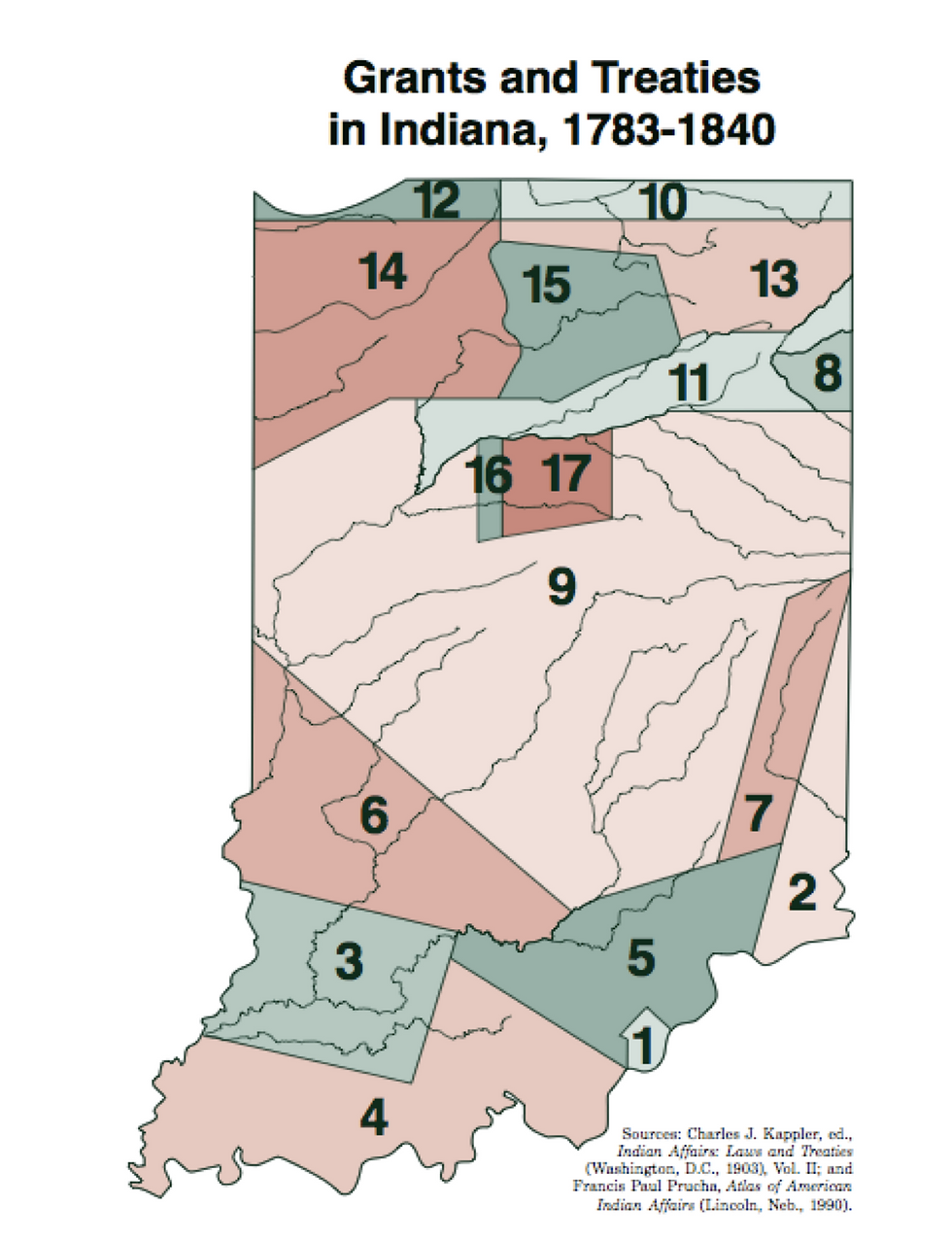
Six separate treaties were signed at St. Marys in September and October of 1818. The map below shows Indian lands ceded between 1783 and 1840. Number 8 represents the over 4 millian acres land ceded in the Fort Meigs Treaty. Number 9 represents the much larger swath of land ceded in the St. Mary's Treaty.
All that remaned after the treaties were signed was the removal of the Native tribes to designated reservations. In hindsight, many tribal leaders felt they had been duped. Chief Anderson, ruing his decision, spoke for many when he said “I think that the men who made the bargain with us have done wrong, and that they had not been authorized to purchase our country; and I hope the transaction will not be approved by Congress.” By 1819, Anderson recognized the futility of this hope and announced that “...we are soon to leave this country."
One treaty negotiator, Benjamin Parke astutely reconized the impact these treaties would have on Native Americans in the future :
To the Indians the reservations will be an evident disadvantage; they will promote neither their civilization, nor their comfort, and in half a century will probably occasion their total extinction. The object of civilizing the Indians is a pretty theme for the speculative philanthropists; but sounder conclusions may be drawn from a little personal observation, than the theory of closet declaimers.
In the wake of the St Marys Treaty, the settlement of interior Indiana exploded. Within the next decade, land offices were opened in Terre Haute , Brookville, Fort Wayne, La Porte and Crawfordsville.
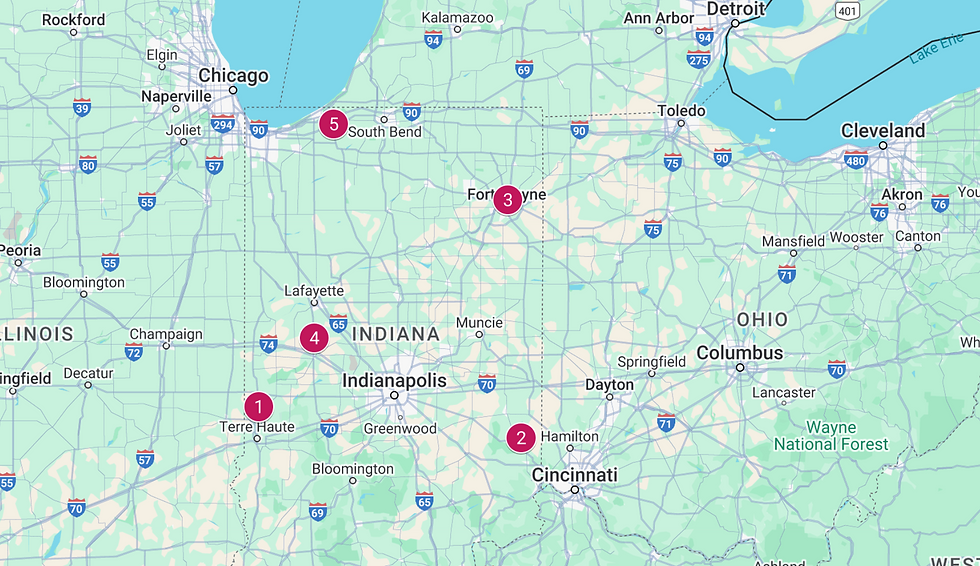
Through these offices, millions of acres of newly acquired land comprising what was called “The New Purchase” passed into private hands. The former Native lands were soon carved into twenty-two counties. By 1829, an estimated 100,000 white settlers had moved into the area.
After the signing of the Treaty of St. Mary's Benjamin's days at Fort Wayne were numbered. We'll have more on that in our next post.


Comments