
Erastus Granger, Indian Agent ~ Part II
- westmohney

- Jul 6, 2025
- 10 min read
As the sun came up in the morning the judge ordered his famous sorrel mare brought out and saddled, and led his red warriors, headed by their chief, then 90 years old, through the woods. . .to the little town of Black Rock ~ James Granger

staying out of the conflict
When the War of 1812 began in June of that year, President James Madison gave orders to our cousin Erastus Granger (4C7X) our that the tribes of the Six Nations were to remain neutral in the conflict. On July 6, Erastus informed the heads of the various tribes of the president's wishes:
Red Jacket, Cornplanter, Farmer’s Brother and other brilliant chiefs of the Seneca, Onondaga, Cayuga, Tuscarora and Oneida tribes were present on July 6, 1812, just days after word of war had reached Buffalo, when Judge Granger first offered a message of goodwill and friendship to the Indians, then spoke these words to the assembled council of Native Chiefs:
Your great father, the president of the 17 fires, now gives his red children the same advice which he gave you at the beginning of the last war (the Revolution); that is you take no part in the quarrels of the white people. He stands in no need of your assistance. His warriors are numerous, like sands on the shore of the great lake which cannot be counted. He is able to fight his own battles, and requests you stay home.
Flint Hill Encampment
While the tribes of the Six Nation's did as they were asked them and stayed home, Erastus offered the property on his farm for use by the U.S. Army. In November of 1812, General Alexander Smyth and his men set up camp at Flint Hill to prepare for an invasion of Canada.
The campaign turned out to be a huge boondoggle. Over three hundred soldiers died from the freezing weather and unhealthy conditions in the camp.
The bigger problem, however, turned out to be Smyth's ineptness as a military leader. After a tactical victory for the Americans in the Battle of Frenchman's Creek, Smyth's further invasion plans dissolved into chaos. The plan to invade Canada was eventually abandoned.
Below is a plaque erected at the site of Smyth's encampment:

the Seneca enter the fray
For a year, the Seneca managed to remain neutral. By July of 1813, however, the tribes felt that that their lands were being threatened by the Mohawk who had thrown their lot in with the British. A declaration of war was drawn up:
We, the chiefs and councilors of the Six Nations of Indians residing in the State of New York, do hereby proclaim to all the war chiefs and warriors of the Six Nations, that war is declared on our part against the provinces of Upper and Lower Canada. Therefore we hereby command all war chiefs of the Six Nations to call forth immediately the warriors under them and put them in motion to protect their rights and liberties, which our brethren, the Americans, are now defending.
Erastus, knowing that a British attack on Buffalo was now imminent, finally agreed. He summoned the Seneca Chiefs and their warriors to his home to prepare for battle. Erastus' grandson James (6C5X), who published a genealogy of the family, wrote about the event, probably from stories handed down in the family:
On the evening of 10 July, 1813, Judge Granger received word from his faithful scouts that the British had crossed the river and were preparing to attack Buffalo. He also found that his house was especially marked for destruction. He sent messengers to the old chief Farmer’s Brother, who was in his hut at the Indian village, across the Buffalo Creek, summoning him and such Indians as could be mustered to report to the agent’s house.
In his book, James included a photograph of Buffalo Creek:

. . .the night was spent in preparing for the coming fray. Bullets were molded by the great fire in the kitchen, messengers hurried into the neighboring village for arms and ammunition, and the Indians were banqueted on unlimited salt pork prepared by Mrs. Granger’s own hands.
The American Fort Tompkins, about five miles from Buffalo, was the largest fortification in the area and the site of the upcoming battle. On July 11, the British raided the fort to seize supplies and equipment housed there. Thirty Seneca warriors took part in the ensuing battle.
As the sun came up in the morning the judge ordered his famous sorrel mare brought out and saddled, and led his red warriors, headed by their chief, then 90 years old, through the woods. . .to the little town of Black Rock. . .At once the Indians prepared for battle. This was a simple operation, and consisted in divesting themselves of all clothing save their breechcloths and hanging about their necks the maturnip, a long cord with which they bound their prisoners. Gen. Porter decided to assume the offensive, and at tlie command the Indians sprang forward with a yell which startled both foe and friend alike.
While, the British managed to get away with a considerable amount of booty, their prize came with a price. Three British soldiers were killed, 24 wounded, and 17 captured. On the American side the casualties were 3 killed and 6 wounded. The Seneca suffered two wounded warriors.
At a council held on Erastus' property on August 4th, Little Billy, a wise councilor of the Senecas, gave a speech outlining the Senecas' position on their part in the war:
Brother! I have spoken of the pains we have taken to preserve peace. Your agents have done the same, but in vain. . .The path of peace is broken in every part. We find no place to flee to, where there is peace now.
Brother! I have said we have come with all the others to seek the path of peace. We find that there is no path left for us, but between us and the United States.
Agreeable to your communication we, the Senecas, shall now prepare to defend ourselves against the common enemy. . .
We know of no other way to preserve peace but to rise fromour seats and defend our own firesides, our wives and our children. We hope you will not ask us to cross over. Those
who go must go voluntarily. . .
We volunteer: We must act under our own chiefs, according to our own customs; be at liberty to take our own course in fighting; we cannot conform to your discipline in camp. So far as we can we will conform with your customs. We volunteer for this service. We wish you not to place us in forts, where we can not act. You know what took place at Detroit; an army was sold. We wish not to be sold
Four months later, another battle took place in Buffalo, this time much worse. In December of 1813, the Americans attacked and burned the town of Newark (now Niagrga-on-the-Lake) in Canada. In retaliation, the British set their sights on Buffalo. On December 10, British General Phineas Riall's army of 1,400 soldiers made their way to Black Rock. On the American side, General Amos Hall had 2,000 men, all of them volunteers or militia. Erastus, who was a lieutenant colonel in the milita, had a force consisting of 83 Seneca warriors. From the account in Wikipedia:
Although the Americans fought with considerable obstinacy, according to Riall, after half an hour of fighting the American right wing broke into a rout. In order to avoid being outflanked, Hall ordered a general retreat. The British pursued all the way to Buffalo, two miles away. Once in Buffalo, the British and Indians sacked it, burning down all but four of its buildings. Riall's troops also destroyed the navy yard and three armed schooners.
Miraculously, Erastus' home was one of the four building not destroyed in the rout. The Seneca would fight only one more battle in the war. The battle of Chippewa, an American victory, was fought on July 14, 1814. After the battle "the Seneca would recross the Niagara River and return to their homes never to fight again during the War."
Erastus' final days
Erastus continued his duties as Indian Agent and Postmaster for four more years, traveling back and forth from Buffalo to Washington. In 1806, his father Abner (3C8X) had moved from Suffield, CT to Buffalo to help Erastus with his large farm. Abner died in 1816 and was buried in the family burial lot known to Granger descendants as the “turnip patch.” That same year, Erastus was elected supervisor of Buffalo, then the highest town office. He held that office for two years.
Possibly due to ill health, Erastus retired from all his public offices in 1818 at age 53. He spent his final years "enjoying his beautiful estate and entertaining many friends and dignitaries." His homestead "was a charming spot of nearly 800 acres, covered in part by a noble grove and watered by a babbling brook or creek."
Erastus died intestate in 1826 at age 60 and was buried in the turnip patch.
Forest Lawn Cemetery
In 1849, Buffalo attorney Charles Clarke purchased 80 acres of land from Erastus' widow and two sons for use as a cemetery. Those 80 acres would expand into what is today the 269 acre Forest Lawn cemetery. The Granger family lot – the “turnip patch” – remains in what is now Section J.
In 1860, Erastus' home was torn down to further expand the cemetery. In 2012, a historical marker was erected in his memory at the approximate location of the house:

In 2013, a cast aluminum marker was placed near the site of Erastus' grave. Joseph P. Dispenza, Forest Lawn president at the time, spoke at the ceremony:
We are grateful to The William G. Pomeroy Foundation for recognizing the significance of Erastus Granger to our area’s history. Mr. Granger’s role in the War of 1812 and his successful friendship with the Seneca Indians were significant, and this beautiful new marker will forever remind visitors to Forest Lawn of the origins of our area as well as the origins of Forest Lawn


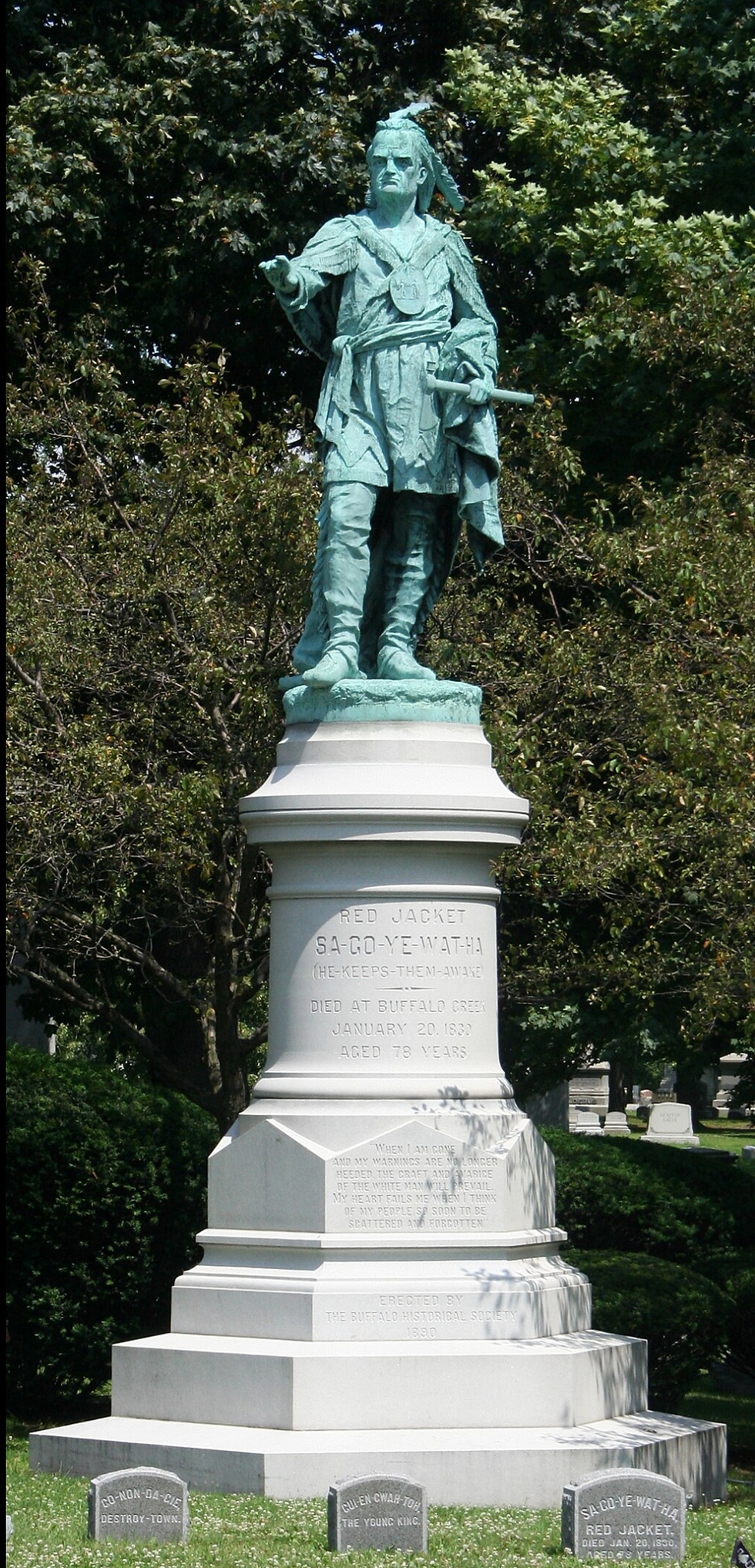
Erastus' good friend Red Jacket would eventually join him at Forest Lawn. From the Forest Lawn website:
A prophecy fulfilled
Erastus would pass on December 21, 1826. His second wife Elizabeth and sons James (5C6X) and Warren (5C6X) survived him. It was on Christmas Day that family and friends gathered to say their last good bye to Erastus. At this time his dear friend Red Jacket stepped forward and gave a eulogy in the Seneca tongue. This tribute was a very high honor from one friend to another. Also, it was written that one time an elder Seneca maiden prophesized that because of their friendship, trust, respect and honor each man had for the other both would be buried in the same cemetery. Erastus rests in the family “Turnip Patch” and although Red Jacket passed in 1830 and his remains, after being removed from the old Reservation Cemetery to a secret location on the Cattaraugus, would be brought here and interred at Forest Lawn, on October 9, 1884. Thus fulfilling the prophecy.
In 1890, a bronze statue of Red Jacket was placed in the cemetery by the Buffalo Historical Society:
Warren's "castle"
Erastus' son Warren built a beautiful home on his father's property, now known as Parkside neighborhood of Buffalo. Steve Cichon wrote about Warren's house in his book The Complete History of Parkside:
Later (in 1845), his son Warren built a magnificent home, what generations of Parksiders called “The Castle,” on the spot where native chiefs had met long before the scribes of modern history were there to record them.
Today, the area is Forest Lawn Cemetery, and this specific plot is marked with a large sundial, easily visible from Main Street. Warren’s daughter Anna Granger wrote of it:
"When Warren Granger selected the situation to build his home, he fixed upon the spot where the 'Six Nations' held their counsels, the elevation was crowned by a grand old oak. This part of Flint Hill was sacred to the Indians, for here many, many, many moons beyond the memory of the oldest chief, a fierce battle had been fought. The plow shares continually turned up skulls, arrow heads and tomahawks of ancient design. . ."
The Gothic Structure was designed by Calvin Otis, built by John Ambrose, and made of stone quarried from the estate. It was destined to become the center of the Buffalo social scene, despite it’s out of the way location. Like his father before him, Warren was a staunch Republican. His home saw parties during the Hard Cider campaign of William Henry Harrison, and actually played host to then-former President John Quincy Adams in 1848. And there is scarcely a doubt that Granger was in attendance when Abraham Lincoln stopped in Buffalo in February 1861 on his way to Washington to take the oath of office as President.
The Granger’s property was considered among the most beautiful on the Niagara Frontier, and, in 1850, the Granger Family sold most of its vast tracts of rolling green acreage to the City of Buffalo. Some of it, 80 acres worth, was destined to become Forest Lawn Cemetery. But the rest of the land, including Granger’s quarry and his meadow, would be reserved by the City for future use as a park. It would be over a quarter of a century, however, before Frederick Law Olmsted would unveil plans to transform the areas raw, natural beauty into the Delaware Park we know today.

The building no longer exists. The Sundial at Forest Lawn sits on the location the house used to be.

Gideon Granger
Our cousin Gideon Granger (4C7X) was Erastus' 3rd cousin. We wrote a little about him in our last post. He, along with Erastus, was lucky enough to have made the acquaintance of Thomas Jefferson when Jefferson was running for president. Gideon's work on Jefferson's behalf gained him the position of Postmaster General during two administrations. He has the distinction of being the longest serving Postmaster General in United States history.
According to Wikipedia:
Granger was considered a brilliant political essayist. Using the pseudonyms Algernon Sydney and Epaminondas many of his writings, defending Jeffersonian principles, were published in many pamphlets.
After leaving Washington, D.C., Granger settled in Canandaigua, New York, where he built a homestead that would be "unrivaled in all the nation" from which he could administer the many land tracts he had acquired farther to the west. Today his home is a museum. He became a member of the New York Senate and continued to be influential in politics and law including being a key figure in the Erie Canal project.
Below is a picture of Gideon's home which is now the Granger Homestead and Carriage Museum in Canandaigua, NY

In the early months of 1821, Gideon was forced to retire from office due to his failing health. He died in December of 1822 at age 55.



Comments