
Family of Note
- westmohney

- Jan 26
- 10 min read
If you don't know history, you don't know anything. You are a leaf that dowsn't know it is part of a tree. ~ Michael Crichton

William Bedlow Crosby
Our cousin William Bedlow Crosby (4C9X) was born in New York City in 1786, the son of Dr. Ebenezer Crosby (3C10X). We wrote about Ebenezer in our "Military Doctors" post. After serving as physician to George Washington's guards throughout the war, Ebenezer married Catherine Bedlow in 1781. Catherine was a niece of Henry Rutgers, a famed Revolutionary War colonel and later philanthropist. The future seemed bright as two sons were born to the couple in quick order and Ebenezer was appointed Professor of Obstetrics at Columbia College in New York.
Tragedy for the family began in early 1787 when Ebenezer's health began to fail him. In May of that year a third son, Henry Rutgers (4C9X), named after his great-uncle, was born. By November, however, Ebenezer's illness had deteriorated to the point that he sailed to the West Indies in order to escape the cold New York winter. In May of 1788, shortly after his return to New York, Ebenezer's young son Henry died at only 11 months. Sadly, 34 year old Ebenezer followed only a month later. On Friday July 18th The New York Packet ran the following obituary:
On Wednesday afternoon, 16th instant, departed this life, greatly lamented by his friends and acquaintances, Dr. Ebenezer Crosby, after a lingering consumptive illness wich he sustained with Christian fortitude, patience and resignation.
The final blow to the family came seven months later when Catherine died "after a long and painful illness," possibly from consumtion as well. On a happier note, Ebenezer and Catherine's two sons, John (4C9X), 4 and William, 2, were taken in by their great-uncle Henry, reported to be the richest man in the state of New York. In his Crosby Family of New York, William's grandson Ernest H. Crosby (6C7X) wrote that "[i]n the family Colonel Rutgers has left the kindliest traditions, and the name of "Uncle Rutgers" is synonymous with all that is honorable and endearing."
When William's older brother John went to Jamaica to claim property left to him by his godfather, Henry Rutgers decided that his younger nephew should take over managment of the family estates. Young William made his mistakes in the beginning. David J. Fowler in his article "Benevolent Patriot: Henry Rutgers" wrote:
In 1802, Rutgers gently chided his adopted grand-nephew William B. Crosby, who at age sixteen had been entrusted with managing his uncle's real estate, for leasing a sawpit and lumberyard at too favorable a rate: "Should I now give in to the measure of lowering my Rents to suit individuals, I may give up the Idea of your making a permanent bargain for any of my property." He could not resist closing with avuncular advice: "do not get wet feet … wet feet promote disorders."
In the end, William leaned to excel at managing the large estate and became quite wealthy in his own right. In 1807, he married and built "a commodious house at 18 Rutgers Street. Below is a portrait of William painted at about the time he built his house:

At some point, William also came into possession of land he inherited from his mother. That property contained the "old Rutgers estate, which included the greater portion of the Seventh Ward in New York City. " The 7th Ward today is the portion of lower Manhattan that contains Soho and Chinatown. A street just outside that area was named after William. According to the Soho Broadway site:
Crosby Street was named after the 19th century millionaire and philanthropist William Bedloe Crosby, a man who devoted a considerable amount of his time and money to charity and performed good deeds throughout the neighborhood.
On the map of Lower Manhattan below, 1 thruough 4 shows the area of the Rugers farm William manged for his uncle. Just above that is land he inherited from his mother. 5 marks the spot where he built his "commodious home." 6 marks Crosby St., named for him but outside lands that he owned.

In 1830, when Henry Rutgers died, William inherited the old man's estate. The New York Genealogical and Biographical Record said William remodeled the house “after the pattern of a house in Regent Park, London. . .The grounds occupied the entire block with lawns, garden, and stable.” William lived in that home until his death in 1865.

William also followed his uncle's lead in his philanthopic works during his lifetime. According to his grandson:
William was a man of great benevolence, and devoted much of his time and fortune to charitable objects, such as the Bible Society, the Seaman's Friend Society, the various boards of the Dutch Church, and innumerable private charities.
The pastor of his church said of him, ". . .those of us who knew him best, knew well that a more genial, humble, devout, and benevolent heart could not be found in a Sabbath day's journey."
On February 7, 1857, William and his wife celebrated their 50th wedding anniversary. She died two years after that celebration. William died in 1865 at age 79.

Lucy Eppe's sampler
Our grandfather Francis Eppes (9GGF) came to Virginia in 1624 and settled on his Hopewell plantation. Our branch of the Eppes family ended two generations later with the marriage of our grandmother Mary Eppes (7GGM) to John Hardiman (7GGF).
Our cousin Peter Eppes (3C5X) descended from Mary's brother Francis Eppes III (7U). Peter's daughter, Lucy Ballard Eppes (4C4X), was born in Richmond, VA in 1804. Lucy's claim to fame is a sampler made in 1816 when she was about twelve years old. Today the sampler is housed in the Museum of Early Southern Decorative Arts in Winston-Salem, North Carolina.
The museum description of the sampler:
This sampler stitched by Lucy Ballard Eppes includes cross, eyelet, queen, four-sided, and rice stitches in silk on a linen ground. The composition features alphabet and numerical sequences including the inscription “Lucy Ballard Eppes 1816” and further documentation of “Richmond Virginia”
Lucy also included family members, which was a common element of early samplers. She lists first her mother and father, Peter and Lucy, then her siblings, John T., Peter T, Littlebury R, Mary, Elizabeth, Lucy B, Sarah T and Angelica, all our 4th cousins 4 times removed.
Note: The Littlebury name, used prolifically in the Eppes family, stems from our grandmother, Elizabeth Littlebury (8GGM) who, ca. 1625, married our grandfather Francis Eppes (8GGF).
Below is Lucy's sampler:

William Heywood
Our cousin William Heywood (3C6X) was born in Concord, MA in 1766. William was first cousin one time removed to our cousin Abiel Heywood (3C7X) who we wrote about in our "Abiel Heywood" post. Both William and Abiel were members of the Concord Social Circle, a prestigious men's club.
The "stated purpose" of the Concord Social Circle, which limited its members to "not more than twenty-five," was "to strengthen the Social affections and disseminate useful communications among its members." The meetings were held at members homes on Tuesday evenings between the months of October and March. "In addition, members of the Circle prepared biographies of those among their number who have died."
Everything we know about William comes from a fairly unflattering memoir written by fellow Social Circle member William Whiting, who served in the U.S. House of Representatives.
William Heywood was born in the year 1766, in the old house, then owned and occupied by his father, Jonas Heywood (2C7X), which now stands a few rods west of the railroad depot in this town. He lived with his parents until he was old enough to learn a trade; he then served his time with Mr. Ammi White, a cabinetmaker. . .
After Mr. Heywood was of age, he went to New Ipswich and worked a year as a journeyman. He then came back to Concord to live. He married, for his first wife, the daughter of Deacon George Minott; she lived but ten months after her marriage, and died September 30, 1794. On the 29th of October, 1795, he married Hepzibeth, daughter of Lieutenant Reuben Brown, who lived with him nineteen years. She died September 20,1814, in the forty-first year of her age.
They had eleven children, five sons and six daughters. In the year 1815 he married the widow Sarah Jones, with whom he lived until the year of his death, which occurred in 1848. They had one daughter. Mr. Heywood was an honest and industrious man; he was, however, very penurious, which may fairly be accounted for by the fact of his having so large a family to maintain. He had the misfortune to have a son who was deranged throughout his whole life, who lived until he was fifty-two years of age. Mr. Heywood had been in the habit, through all the former part of his life, of using all kinds of ardent spirits and cider as a beverage, very temperately, however, until, to his sorrow, he found one of his own sons fast going to destruction from the indulgence in the same practices. He felt it his duty to go and talk with his son and try to reclaim him, but his son turned upon him with the most scathing rebuke: "Father, you are the last man who should talk to me; you have been in the constant habit of using intoxicating liquors every day since I can remember; first cast the beam out of thine own eye before you attempt to pull the mote out of mine." Mr. Heywood could not deny the fact: he was convicted; he felt mortified, and went home with a determination never to use another drop of intoxicating liquors as a beverage so long as life should last, and he carried that resolution into effect, and never polluted his lips with another drop until ordered by his physician to take it as a medicine, in his last sickness.
Mr. Heywood became a member of the Club in 1813, and remained so until he resigned in 1823. He united with the church in 1845. He died 1848, in the eighty-second year of his age, of dropsy and consumption. He left property to the amount of about $2,000 in the hands of his widow, to use and improve during her life, with the right to sell and appropriate, if she should find it necessary, for her support. In this provision he appeared thoughtful and kind. He was an agreeable and intelligent man in conversation, but of an irritable temper and very passionate when excited, yet his anger was soon over, and he harbored no ill will against anyone. He was an honest man, a kind neighbor, and a good citizen.
January, 1857.
Jonas Heywood
Jonas Heywood (3C6X), born in 1759 in Concord, was the brother of fellow Concord Social Circle member William Heywood. His, also fairly unflattering, memoir was written by Ebenezer Hoar, a justice of the Massachusetts Supreme Judicial Court.
[Jonas] was three times married: first, to Ruth Barrett, on the 25th of February, 1786, by whom he had two daughters, Eliza (4C5X) and Rebecca (4C5X); secondly, to Mary Soper, on the 5th of October, 1797, by whom he had a son, Humphrey Barrett (4C5X); and, thirdly, to the widow Sophia Dakin, on the 11th of September, 1825, by whom he had no children, and who survived him.
He joined the First Church on the l0th of June, 1827, and died on the 19th of March, 1831, in the seventy-second year of his age. He was born, passed his life, and died in the old house, which is still standing, between the railway station and the Main street. He was a plain farmer, who never was employed in the public service, and had nothing remarkable about him.
He inherited a pretty large farm, and left at his death about the same amount of property that he had always owned, with no increase or diminution. He was a good-natured and generally well-meaning man, rather coarse in his language, and in the last years of his life used spirituous liquors rather too freely. The most stirring incident respecting him which came under my personal observation was when a parcel of boys had carried off his boat, in which he used to cross the river to his meadow in haying time, and he drove us into the river with a pitchfork, and pitched our clothes, which were lying on the bank, in after us.
He let his farm to Silas Flint, at the halves, and when he came for his share, Flint told him that "there wasn't more than a fair half of the whole on 't;" which was pretty much the case generally with the product of the farm for some years before Mr. Heywood died.
He joined the Social Circle in 1814 (in place of Peter Wheeler, as it appears), and continued a member till 1823, when be was succeeded by Samuel Burr.
March 8, 1853
Phineas Heywood
Our cousin Phineas Heywood (3C6X) was born in 1778 in Westminster, MA. Sometime between the years of 1800 and 1824, he moved to Bucksport, Maine.

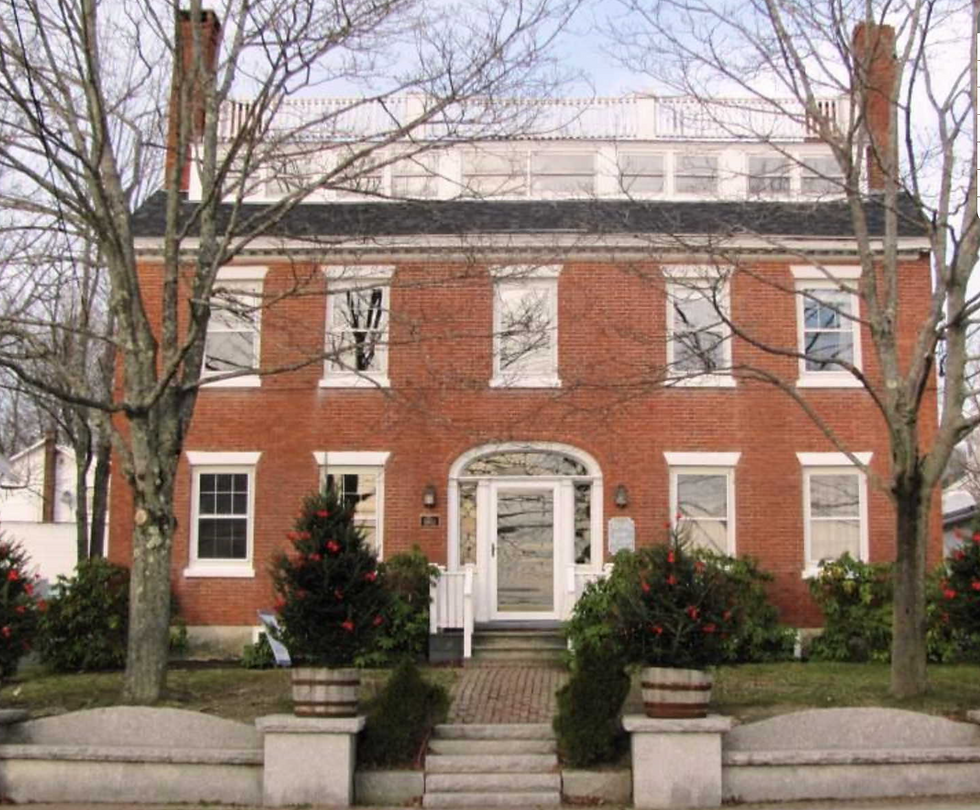
Phineas was a harness maker who had his shop on Maine Street in Bucksport. In 1824, he built a Federal style house house across from his shop. In 1988, the house, which still stands today on Maine Street, was added to the National Register of Historic places.
Phineas' house is a two and a half story brick building that overlooks the Penobscot River. According to Wikipedia, "it is one of the finest Federal style brick houses in the regoin, and was probably the first brick building erected in Bucksport and its surrounding towns."
The house, which was built with bricks made from clay on the site, stayed in the Heywood family until the mid-20th century. Today, the building houses a variety of small businesses. The sidelights surrounding the door, shown in the photograph below, have thirteen panes of glass that represent the 13 original colonies.
A placque at the house notes the Heywood House's place on the National Register of Historic Places:

A sign in front of the Heywood House commemorates the Bucksport downtown area and a fire in 1915 which destroyed 17 businesses. The top picture shows a house of another cousin of ours who lived in Bucksport, Nathaniel Patten (4C7X).

The picture at the bottom of the sign shows the Heywood House, on the right, still standing after the fire.

Cousin Nathaniel Patten's house and business were destroyed in the fire. Nathaniel was born in Townsend, MA in 1760. After the Revolutionary War, he moved with his father to Penebscot, Maine, about 13 miles from Bucksport. Nathaniel died in Penebscot in 1846 at the age of 86. Below is a postcard ca. 1910 of downtown Bucksport and the Patten House three years before the fire.



Comments