
Fierce Fighting, Surrender and the Fate of a Fort
- westmohney

- Nov 24, 2023
- 12 min read
Updated: Oct 19, 2024
About 11 o clock A.M. the enemy laid down there arms & Marched out thro our Army the most agreeable sight that ever my eyes beheld. ~ Jeduthan Baldwin

the occupation of Philadelphia and Germantown
All of George Washington's efforts to defend his nation's capitol at Philadelphia had been in vain. On September 26, 1777, the British began an eight month occupation of the city. Sarah Logan Fisher, who was the wife of a prominent Philadelphia merchant, described the scene as “wagons rattling, horses galloping, women running, children crying, delegates flying, & altogether the greatest consternation, fright & terror that can be imagined.”
Howe left a small force of 3,000 men in Philadelphia and moved the bulk of his army to Germantown, about ten miles north of the city. A humiliated Washington, hoping for another Trentonesque success, decided to try his luck with Howe's forces in Germantown. With an army of 8,000 Continental soldiers and 3,000 militia against the British 9,000, Washington felt his chances were good.
Unfortunately, fog delayed the attack and took away the American's element of surprise. The fog also contributed to mass confusion which led to a confrontation between two of Washington's own companies. Realizing the futility of his effort, Washington had his men retreat. Casualties in the battle for the Americans was 700 to the British 500.
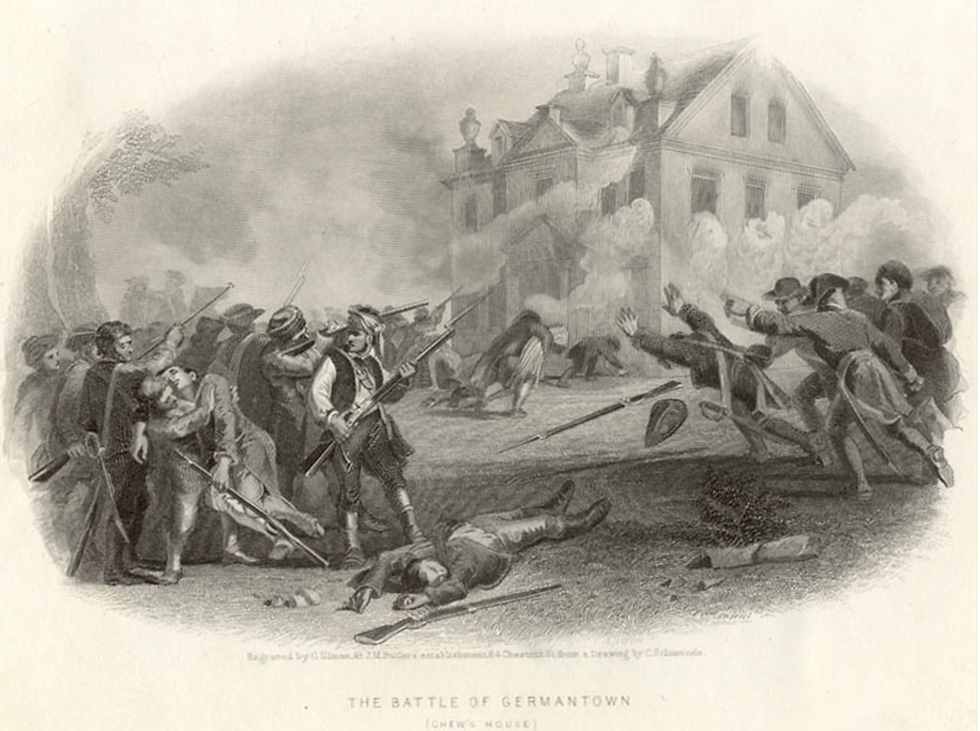
Luckily, Washington managed to get away with most of his army intact. Though the defeat brought up the question of replacing Washington once again, two things saved him. One was the overwhelming respect his men held for him and the other was the decisive victory to come at Bemis Heights which would persuaded the French to finally join the American cause with military force as well as their pocketbook.
In spite of the defeats on the western front and the loss of their Capitol, things were actually looking up for the Americans.
the Battle of Bemis Heights
As Washington retreated on his way to winter quarters in Valley Forge, the eastern front wasn't without drama. The beleaguered Benedict Arnold was an extremely unhappy camper. In his report to Congress, General Horatio Gates failed to mention that Arnold had actually been the catalyst for the victory at Freeman's Farm. Arnold received another slap when he was replaced as second in command to Gates with General Benjamin Lincoln. For the second time, Arnold threatened to resign but some of his officers convinced him to stay.
By early October, British General John Burgoyne's army was running out of supplies and could wait no longer for reinforcements from the south. On October 7, Burgoyne initiated battle with the Americans a little after 2:00 in the afternoon. General Gates sent his troops out to meet the British on the battlefield but chose to remain in camp with his all of his major generals. Arnold, antsy to get into the thick of it, finally convinced his commander to allow him out into the action. According to the American Battlefield Trust's account of the battle, "[c]heers went up along the American lines as Arnold rode into the fight."
Shortly after Arnold's arrival, the Americans managed to break through both of the British flanks and the British began a disorganized retreat. In the melee, British general Simon Fraser was shot and killed. With the loss of their general, the bulk of the British forces made a mad dash for the safety of their camp at Freeman's Farm.
Though the British were in obvious retreat, Arnold's combative nature got the best of him. He encouraged his American forces to give chase. As the Americans approached the redoubt of German Lt. Col Heinreich Von Breymann, some of Breymann's men made a run for it. Breymann shot four of his own men before he was killed himself by one of his German soldiers. Almost at the same time, Arnold was struck in the leg by a musket ball. His horse was shot as well and fell, pinning Arnold underneath.

After the dust settled, Arnold was carried back to Bemis Heights for medical treatment. He would survive to fight another day though his recovery took months.
The battle had been a stunning success for the Americans. Burgoyne, recognizing defeat, began a slow, painful retreat to Saratoga, now called Schuylerville. There, the American army surrounded the British forces and Burgoyne was compelled to surrender.

Gates, once again, took full credit for the victory, ignoring Arnold's fierce rallying of the troops on the field. This snub was just one of many that Arnold had and would suffer in his dealings with his superiors and with Congress. This treatment certainly had something to do with his final decision to join the British in 1780.
Jeduthan's journal entry for that glorious day:
About 11 o clock A.M. the enemy laid down there arms & Marched out thro our Army the most agreeable sight that ever my eyes beheld. Burgoyns Army that capitulated were 6000 & of them 2448 were British.
the surrender
Immediately after the battle ended, General Gates called for Burgoyne's surrender. Our cousin Daniel Granger (4C7X), who wrote a memoir of his time in the army when he was 80, described the event. We wrote about Daniel in our "More Revolutinary Stories" and "Preparing for Battle" posts.
The World seemed to be full of Troops, and all in motion. We took an ellivated piece of Ground, where we could very plainly see Burgoy[n]e’s encampment. . .There was a Bridge placed across the River, of buoyant logs, and Planks laid on them, and each end fastened to the Shores (Jeduthan's bridge). Gen’ Gates’s headquarters was directly opposite to us. . .It was noticed that a Man mounted a white Horse at Gates’ Markee & rode off on a full canter up the Road toward Burgoynes Encampment, we could see him as he rose over the undulating Ground at a considerable distance, and it was rumered that Gen’ Gates had sent in his Ultimatum, to Gen’ Burgoyn, That if the Articles were not immediately signed & returned to him, He would fall upon him on all quarters, The troops on the West side were all in commotion, but it was not long before we saw the white Horse returning upon a full run, and as soon as the Messenger reached Gates’s Markee, the News flew that the Capitulation was signed, and that the Troops were laying down their Armes to come out, and soon we saw them coming. Gen’ Gates’ Troops were arranged on both sides of the Road, Drums & Fifes playing Yankee doodle, Cannon roaring in all quarters, the whol World seemed to be in motion, Officers lost all command over the Soldiers, if they attempted it, we ran across the Bridge. I got as near to Gen’ Gates’ Markee as I could for the Crowd, and saw Gen’ Burgoyne & Suit ride up, and dismount and go into. . .Gen’ Gates’ Markee, and soon the Van of the Prisoners made their appearance, The Hesson Troops came first with their Baggage on Horses that were mere Skelletins, not able apparently to bear the wait of their own Carkeses. These Troops had some Women, who wore short Petty coats, bare footed, & bare Leged, with huge Packs on their backs, some carrying a child & leading an other or two, They were silent, civil, and looked quite subdued. The English Troops followed, and were cross and impudent enough, they crossed the River that Night and encamped on a level Ground near the River, where they drew Rations and Cooked their suppers, they were very hungry, it was said that they had not drawn full Rations for several days, before the surrender, they had been cooped up in close quarters without Forrage for their Horses or Rations for the Troops.
The prisoners
Almost 6,000 British, German and Canadian soldiers surrendered at Saratoga. Cousin Daniel Granger described the conditions he saw for the prisoners:
. . .& just at Night I took a walk down to the River, when there came in a small Guard with about thirty Prisoners taken from the Enemy that afternoon. they were mostly miserable looking Canadians, and not having any proper Guard-house, they were stowed into a small dirty Room, Straw was given them, but there was not room enough for them to lie down, they swore bitterly & wanted something to eat. . .The next Morning I went again down to the Guardhouse, where there was brought in two Prisoners taken that Morning, they were Officers Servants. . .One of them was an Irish Man, and as cross as a Bear, & swore bitterly, and said that if any one had told him, that he would be a Prisoner this Morning, he would have spit in his face by jesus. The other was a Son of one of the Officers, about 14 Year of age, had a Lieutenants Commission, dressed in the British Uniform, and appeared much greived. . . I talked with him a good deal. I could but pitty him, but could not release him. They were soon taken before the Officers for examination, and I saw them not afterwards. And this shows how closely Burgoyne’s Armey were penned up at Saratoga at that time. They had no Forrage for their Horses, nor Rations for themselves. The last Battles had been fought at Bemises Heights a day or two before we had reached our station, and were fought by Gen’ Burgoy[n]e in person, where he lost many Men, and several valuable Officers. . .My Brother Jacob (4C7X) was in that battle and received a wound by a musket ball in his left Shoulder, which loged und[er] the Shoulder blade & never was extracted, an other Man near him was shot through the Body at the same time and were left on the field.
I went into the British Camp that Eve’, & because acquainted with several young Lads of about my Age, pleased with them, and they seemed to be pleased with me, & said that we were no longer Enemies. I traded with them.
The soldiers, their wives and children were all marched, under guard, to Cambridge. Cousin Daniel, part of the guard, describes the journey:
We sleaped on the Ground that Night without any covering other than our Blankets. We marched the next Morning as soon as the Troops could be arranged. I was in the Section that formed the Van Guard, another Section followed the Prisoners to drive them all forward, and on the third or fourth day at Night we were in a new & wild country, where there was but few houses & very small, we could git no quarters to cover us, the Wether cold, and a Storm approaching. A Gent, told me that he had a Cutdown about 20 rods East of the Road where there was large Piles of Logs & Stuff, which we might set fire too & be comfortable through the Night, we went there, set fire to many of those huge Piles which made a tremendous heat, had no supper, rolled ourselves up in our Blankets and lie down on the Ground, feet toward the fire, and it began to snow, I was soon fast asleep, and in the Morning when I awoke I was covered with snow five or six inches deep, the fires had principaly gon down, but was set to other piles & we breakfasted on raw Pork, cold Beef & Bread. . .
We reached Northhampton just at Night, There was quite a Row got up there, between the British troops and the american Guard, the americans not having their Arms were about on a par with the British, and fought with clubs brickbats and fists, but the American Officers rushed into the thickest of them, with their Swords & Cutlasses & some of the british were badly wounded, some were nocked down by the Cutlasses Some of the british Officers took an active part in quelling the Riot. but the Guard soon were there with Arms & Bayonets fixed & pushed the british back over the line, beyond which they had no right to advance, some of them were obstinate & were wounded by the bayonets. . .
The next day was fair & we crossed the River over to Hadley, which took up most of the day, the rear Guard did not pass over until near Night. These two Towns were very beautiful. I recollected them on our march up. was highly pleased with them, and with the arbanity of the People, which was accorded to us again on our return, more fully than before, having accomplished so compleatly the object for which we went up, and this was accorded to us, generally throw the Country. . .We marched on to Cambridge Commons near the collages, and were there dismissed. The Prisoners went into the old Barracks on Prospect and Winter Hills, which had formerly been erected for the Yankee Troops, while the British hild Boston. I now find, that we reached Battenkilns the 29th of September marched to Stillwater on the 17th of October the day on which Gen’ Burgoyne surrendered, marched with the Prisoner Troops on the 18th and arrived at Cambridge on the 6th of Novr and were 20 Days on the march down.
These Prisoners were distributed abought. the country, several of them came to Andover, & worked with old Eqr Phillips, and were very sedate, sober, & temperate Men, attended Meeting every Sabbath, dressed in their Uniforms with their huge cocked up hats, They had a seat assigned them, & when they went in, all Kneald down in the attitude of Prayer, for a few moments, and were attentive and devotional throug out.
Daniel completes his story with a victorious homecoming where he could at last tell his neighbors and friends about the amazing victory at Saratoga:
reached home the next day, to relate to our friends the whol Story. And a good one we had to relate. Having seen a large & well equiped British Armey of about eight thousand, surrender as prisoners of War and leaving on the field the finest & largest park of Artilery that ever was seen in America, with all their Carts Timbrels & Veicles for the conveyance of their Amonition was a great & pleasing novelty in deed. And the first Britislh Armey that ever had surrendered to any Nation, as it was said.
As the ragtag group of prisoners marched into Boston, Hannah Winthrop, the wife of a Harvard College Professor, described what she saw:
To be sure the sight was truly Astonishing, I never had the least Idea, that the Creation producd such a Sordid Set of Creatures in human Figure—poor dirty emaciated men, great numbers of women, who seemd to be the beasts of burthen, having a bushel basket on their back, by which they were bent double, the contents seemd to be Pots & kettles, various sorts of Furniture, children peeping thro gridirons & other utensils. Some very young Infants who were born on the road, the women barefoot, cloathd in dirty raggs. . .
Such Effluvia filld the air while they were passing, had they not been smoaking all the time, I should have been apprehensive of being Contaminated by them.
The bulk of the prisoners were housed in barracks that had been built in 1775 by the American during the siege of Boston. Officers were quartered in houses. It took about year for negotiations between the two countries to decide the fate of the British soldiers. According to Wikipedia, during the year "about 1,300 prisoners escaped, often because they became involved with local women while working on farms in the area."
American soldiers were tapped as guards during the year the Saratoga prisoners remained in Cambridge. Below is a list of our family members who, according to Massachusetts Soldiers and Sailors, served as guards for the "convention prisoners," as they were known.
Abijah Hildreth (3C7X)
Francis Kittredge (3C7X)
William Kittredge (3C7X)
Abijah Richardson (5C6X)
Bartholomew Richardson (4C7X)
Jeduthan Richardson (5C6X)
Stephen Richardson (6C5X) Jeduthan's son
Abraham Stickney (5U)
Benjamin Stickney (6U)
Peter Stickney (4C7X)
David Wyman (3C7X)
Ezra Wyman (4C7X)
Captain Jesse Wyman (4C7X)
Nathaniel Wyman (4C7X)
Samuel Wyman (3C7X)
Samuel Wyman (4C7X)
Family members who served as guards that I can't place exactly in our family tree:
John Baldwin
Stephen Greenleaf
Benjamin Richardson
Isaac Richardson
John Richardson
Jonathan Richardson, service record says he was 14 years old
Benjamin Swan
Charles Wyman
Nathaniel Wyman
the fate of Fort Ticonderoga
After Burgoyne's defeat at Saratoga, the British decided to also withdraw from Ticonderoga where Cousin Jeduthans's ill-fated bridge had been built. They destroyed the fort and dumped the artillery into the lake. For over 100 years the ruined remains of the fort were nothing more than a tourist attraction. In 1865, W. H. Bartlett made a drawing, shown below, of Ticonderoga's ruins.

By the early 20th century, the American government had purchased the lands where the former fort stood. Ca. 1707, Ticonderoga was restored and formally opened to the public in 1909 as an historic site.

Ticonderoga museum
The Fort Ticonderoga museum has an exhibit devoted to the our Baldwin family's contribution to the Revolutionary War. From the exhibit:
The Fort Ticonderoga Museum holds a copy of the 1779 Philadelphia edition of Muller’s Treatise. The engravings depict artillery carriages and related vehicles which are accurately reproduced from the London original. These have been invaluable as a resource for our exhibition and interpretive departments to recreate the material culture of Anglo-American artillery during the Revolution. Hand written above the title in dark ink is the word “Northampton 1841.” The name of the owner evidently written above has been torn away. This inscription was added after an earlier owner’s name was crossed out. Partially obscured through the tear in the paper but still visible is the name “Colo Jeduthan Baldwin, Engineer.”

It might be added that the Baldwin family contributed mightily to the American cause. Jeduthan served nearly the entire war, retiring in 1782. His brother Isaac (3C7X) had been killed at the Battle of Bunker Hill in 1775. His cousin Loammi Baldwin (3C7X) was given command as Colonel of a regiment of Massachusetts men designated as the 26th Continental Regiment that served during the New York campaign and crossed the Delaware prior to the attack on Trenton, New Jersey under Washington’s command. Loammi is also the namesake of the Baldwin apple which he propagated. Loammi’s brother Cyrus (3C7X), another cousin of Jeduthan, was the owner of the only surviving Boston Company of Cadet’s uniform, now part of Fort Ticonderoga’s collections and perhaps the oldest surviving American made military uniform in existence.

The Baldwins testify to the depth of service and sacrifice one family was capable of during the tumultuous period the American Revolution, which is well represented and preserved in the Fort Ticonderoga Museum’s collection.
The late historian Richard Ketchum gave the keynote address at the grand opening ceremonies for the Mount Independence visitor center museum in 1996. Ketchum, author of the wonderful book Saratoga, spoke of Jeduthan Baldwin:
He was the solid stuff stuff of which the Revolution was made. The rebellion had it's rabble-rousers and firebrands, of course, but Baldwin and his like were essentially moderate men who stuck it out thorugh good times and bad (mostly bad) and provided the leadership and stability the Revolution had to have in order to survive.


Comments