
From Chelmsford to Vermont
- westmohney

- Jul 2, 2024
- 7 min read
Updated: Jul 7, 2025
He was an honest man and posessed a strong mind ~ From Leonard Proctor's obituary

Leonard Proctor in Proctorsville
Our cousin Leonard Proctor (1C7X) was born in Westford in 1734. He was 41 and the father of seven children when he fought in the Revolutionary War. He was commissioned lieutenant in 1776.
Leonard had four children with his first wife Lydia Nutting who died in 1768. He married Mary Keep shortly afterwards and, by 1780, six more children were born. His first two sons were evidently seamen who died young overseas, Philip (2C6X) in Liberia and Abel (2C6X) in the West Indies.
In 1783, Leonard left his family in Westfield to scout out property in Vermont. He settled on an area near a town called Duttonsville, founded by an old friend of his from Westfield. Duttonsville, today known as Cavendish, lies in the middle of Vermont 110 miles northwest of Westfield. Leonard's property was about four miles outside the town proper. There, he built a log cabin and went back to Massachusetts for the winter. In the spring of 1784, he returned to the cabin with the rest of his family.

With his small family cozy in the cabin, Leonard now had time to build a larger structure which became not only the family home but a tavern as well. The house that Leonard built on Main Street in the town that would become Proctorsville is known today as the Page House. Ca. 1840, the house was cut in half to make way for a Methodist Church. One half was moved across the street and the other still sits next to the church. Below is a picture of the house as it looks today. You can see a small portion of the St. James Methodist Church to the right.

The half of the house that was moved across the street was razed in 1959 to provide extra land for the construction of the Proctorsville Grade School, now known as the Cavendish Town Elementary School. Shown on the map below are the locations of the Page House and the elementary school in Proctorsville today. Also on the map is Wyman St., named for our cousin Samuel Wyman (4C6X) who moved to Proctorsville ca. 1800. The river that runs through the town is the Black River.

Only two years after completing his new house and tavern, Leonard built another one, this time bigger and better. What became known as the Sunset Tavern or the Jenny House is a lovely home also on Main Street not far from Page House.

After Leonard's move across Main St., he kept the Page House in the family. Twenty years down the road, his sons Jabez (2C6X) and John (2C6X) would run a tavern and store out of the building. Below is a satellite map of the Proctor land holdings in Proctorsville:

no tolls!
Salmon Dutton had been a longtime friend of Leonard's from their Westfield days. Salmon was married to our cousin Sarah Parker (3C7X). Sarah was a great-granddaughter of our aunt Abigail Hildreth Parker (8A) Ca. 1780, Dutton had settled in Vermont and founded the town of Duttonsville. When the Proctors moved into the area four years later, the two men resumed their friendship. It was the building of a road that eventually severed that friendship.
In 1784, Dutton, a tavern owner himself, helped to build a toll road which eventually became the Green Mountain Turnpike. According to an article in The Sun Community News by Margo Caulfield, Dutton's road "ran from Bellows Falls to Rutland, bringing Boston coaches north up the Duttonsville Gulf to the village and then west along the present Route 131 through Proctorsville." That meant that stages from Boston would hit Duttonsville first before traveling west to Proctorsville.

The Proctors were not happy. Not only would they have to pay a toll for the use of the road, but their own tavern would lose business. Determined to never pay a cent to Dutton, the Proctors built their own toll free "shunpike." This road took Boston traffic directly to Proctorsville, effectively bypassing Duttonsville.
The road kerfuffle caused a rift between Proctors and Duttons that, not surprisingly, even spread to the inhabitants of the towns of Proctorsville and Duttonsville. That fued lasted for 75 years. Finally, In 1858, Leonard's grandson Redfield Proctor (3C5X) married Salmon's granddaughter Emily Dutton (5C5X), officially ending the feud.
When the Redfield and Emily named their first son Fletcher Dutton Proctor (4C4X), Redfield commented that "If the old names and blood had the old inclination left to stir up strife, it would have created a fearful internal commotion."
The Proctor/Dutton merger, however, proved to be a fortuitous one. Three Vermont governors and one U.S. Senator came from that line. Below is a picture of Redfield who served as a U.S. senator, the governor of Vermont and Secretary of War under Benjamin Harrison. We'll have more on Redfield in a future post.

the Proctor Cemetery
Leonard and Mary lived in the Sunset Tavern for more than three decades. Before they died they turned the tavern over to their youngest son, John (2C6X).
Leonard died in 1827 at age 92. Below is news of his death that was posted in the National Standard of Middlebury, VT, a town about 60 miles north of Proctorsville. The obituary says:
DEATHS. In Proctorsville in Cavendish on the 3d inst Capt Leonard Proctor, one of the first settlers in that town aged 92. He was an honest man and posessed a strong mind, was an active officer during the revolution, was at Lexington and saw the first man weltering in blood, who was slain in defence of our countries rights. He was an early professor of the Christian Religion, and died in a full belief of a blessed hereafter
Leonard was buried in property that belonged to the Proctors and later came to be known as the Proctor Cemetery. Access to the cemetery is a small walkway between two houses on Main Street in Proctorsville. On the satellite map above, the location of the cemetary is shown.
Below is a sign that used to direct visitors to the cemetary:

It appears that the section of Main Street where the Proctor Cemetery lies has fallen on hard times. Below are two pictures of the entrance to the cemetary between two house. In the first the post for the sign in the lower left corner is all that remains. In the second, the post itself is now gone.


Footnote: In February of 1907, Proctorsville gave formal notice to the Town of Cavendish that it wished to be incorporated. Today Proctorsville is a village within the township of Cavendish.
Henry Proctor in Cavendish
Our cousin Leonard Proctor was not the first Proctor to settle in the Cavendish area. Henry Proctor, (2C7X), Leonard's (and our) second cousin, was an early inhabitant there. According to an article in the Vermont Quarterly by Merrill Dole Wheeler:
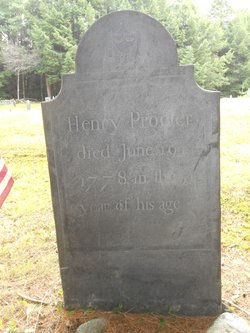
Near at hand by the eastern wall of this old [Morgan] Revolutionary cemetery in Cavendish, is a grave of much interest, if not of mystery. It stands alone, the only gravestone facing eastward. The inscription reads. "Henry Procter, died June 19 1778 age 51", thus indicating that it marks the first burial in Cavendish, earlier by eight years than any death of record. Who was this lone man of mature years, and what brought him into the wilderness when only three families were living in town? A little research has grown some light on this subject, taking us away form the seclusion of the little cemetery, away from Vermont, then back again to the stone of one of the oldest, best known farms in town.
Cousin Henry was the son of Gershom Proctor (1C8X) of Chelmsford. Gershom had something of a checkered past. He was a slave owner, had participated in the land bank bond scheme that was later declared of "unsound principle" and even dabbled in the Baptist faith. Gerhom's wife Rebecca had quite a reputation as well. According to Chelmsford Church records, outspoken Rebecca and "Diverse female members" had acted in a "Very Audacious manner. . .(and) Justified their Conduct!" For their transgressions, both Rebecca and Gershom were dismissed from the church.
When the Baptist church, with Gershom one of its leaders, tried to get a foothold in Westford in 1773, "the building was robbed of its pews and furnishings." The Baptists then
"came in the night with ox sleds and hauled the building on the snow crust directly to its new site in Chelmsford, on or near the farm and home of Gershom Proctor."
Merrill Dole Wheeler continues his story with news of the rabble rousing Gershom's son Henry:
In January of 1778 after the death of his parents, Henry Proctor sold his home and land in Chelmsford for £2,376. This was a large sum in those days, sufficient to insure a good living in such a well-settled community in which he was raised. But Henry chose to forego the comforts of his home at the age of fifty years and subject himself and family to the hardships of pioneer life in an undeveloped section of Vermont. . .Henry bought 1,076 acres of wild land from the original grantee for £600. . .In coming to Vermont, Henry Proctor made a fateful decision and must have been moved by compelling motives, probably a strong desire to get away from a scene of religious strife. . . It is significant that a number of those like-minded Baptists and neighbors from Westford and Chelmsford later followed him to Cavendish.
One person that followed Henry to Cavendish was our cousin, Dr. Asaph Fletcher (4C7X) who became the first physician in Cavendish. Asaph's grandmother was Mary Richardson Fletcher (2C9X). Below is Asaph's certificate giving him the right to practice medicine:

In addition to his medical practice, Asaph was active in civic affairs. In 1780, he was elected to the convention that formed the constitution of Massachussets. After moving to Vermont, he was part of the contingency that applied to congress for Vermont's admission into the Union. He was also one of the presidential electors for James Monroe.
Henry's death
The troubles of his parents in Chelmsford may have taken their toll on poor Henry. He died at age 51 only six months after his arrival in Cavendish. Linda Welch of the Cavendish Historical Society has done research on early families living there. She says that "[it] is strange that no record can be found of the administration of his rather large estate, either in Massachusetts or Vermont. A deed to his land in Cavendish was signed in Massachusetts a year after his death. . ." Ten years later, Henry's daughter Rebecca (3C6X), who was living in Woburn, sold two thirds of "the property of my father Henry Proctor, deceased" that he had owned in Cavendish.
Though, "[m]embers of Henry's family lingered in Cavendish for a number of years after his death," all of his children evenutally moved from the area to other parts of New Hampshire and Massachusetts.


Comments