
Grandfather John Covington
- westmohney

- Dec 28, 2024
- 12 min read
Updated: Jun 20
my will and desire is that my negro man, Moses should be sold to the highest bidder and the money arising from the sale should be equally divided between my three daughters. . . ~ from John Covington's will

John Covington
Our grandfather John Covington was born in Queen Anne's County, MD ca. 1733. In 1758, he married his first wife, Hannah Dockery in at St. Paul's Church in Centreville, MD. They had four children before Hannah's death about a decade later. We have never been able to pinpoint the exact location of the Covington property in Maryland but it was probably close to their own parish of St. Luke's in Church Hill. The distance between Centreville and Church Hill is about 12 miles.

Our cousin Rebecca Eurie Covington White (4C1X) wrote a book called Covington Cousins which was published in 1956. In this book, Eurie wrote that John Covington “was a mute.” Two other publications on the Covington family, Elbert Covington's (5C1X) Covington and Kin and DaCosta E. Covington's (5C) Covingtons Remembered maintain that it was wife Hannah Dockery who was the “mute.” According to Lou Poole (5C), who has found a multitude of errors in all three books, it is "more probable" that Hannah was the mute. It is also probable that Hannah died in Maryland.
With or without Hannah, John made the 400 mile journey to North Carolina in 1769 with four young children in tow, Matthew, 10 (3U), Hannah, 8 (3A) and twins Sarah (4A) and Mary, 4 (4A). He went as part of the Dockery party which included his father-in-law Thomas Dockery and our cousin Daniel Thomas, (1C5X) nephew of our grandfather William "Billy Ram" Thomas (4GGF). Lou Poole surmises it was around the month of September when the group left Maryland.

In January of 1770, John purchased his first piece of property on Cartledge Creek where his brother Henry (4U), his uncle William (5U) and our grandfather William "Billy Ram" Thomas (4GGF) had also settled.
THIS INDENTURE Made the thirtieth day January A.D. seventeen hundred and seventy between John Cole and Jane his wife. . .of the one part and John Covington. . .of the other part WITNESSETH that the sd John Cole and Jane his wife for and in consideration of the sum of one hundred and fifty pounds Proclamation money to him. . . in hand paid. . .they the sd John Cole and Jane his wife hath given bargained and sold. . .unto the sd John Covington. . .part of a tract of land. . .lying and being in the County aforesd on the North side of Great Pee Dee River and on the South fork of Carledges Creek. . .containing two hundred and fifty acres of land. . .
The indenture was witnessed by John's brother Benjamin (4U).
Note: John's daughter Elizabeth (3C) married John Cole's son, John, Jr.
On the map below we can see the town of Rockingham (1), the approximate location of John's land on the south fork of Cartledge Creek (2) and Blewitt's Falls on the Great Pee Dee (3) where our grandfather Stephen Thomas (5GGF), settled.
Note: Stephen was the patriarch of the entire Thomas family of 12 children that came to North Carolina. Many members of the Covington and Thomas families settled in the area immediately surrounding Stephen and John Covington.

second marriage
About the time of his land purchase, John married our grandmother Nancy Wall (4GGM) who was born ca. 1748 in Virginia. We don't know when her mother, Ann Poythress Wall (5GGM), died but Lou Poole speculates that it was ca. 1750 after she gave birth to three children. Nancy, the youngest, would have been only 2 when her mother died. Nancy was 10 when her father John Wall (5GGF) died in 1758. We wrote about the Wall family in our "On to North Carolina" post.
Our Covington and Wall family researcher Lou Poole (5C) surmises that, after John Wall's death, the three Wall children went to live with the John Crawford family.
I think it is entirely possible that John, William and Ann (Nancy) Wall might have been living with, or at least under the wing of, John Crawford, father of Thomas Crawford (H4A). . .after the deaths of their father and grandfather. That explanation could easily account for the close relationship the two families obviously had, and why the Wall children moved to Richmond County at about the same time that the Crawford family did. And it should be noted that (Nancy) Ann Covington (née Wall) witnessed the 1789 will of Thomas Crawford. . .
Note: Thomas Crawford married out aunt Rebecca Covington (4A), sister of our grandfather John (4GGF).
At the time of their marriage ca. 1770, John, who was 15 years Nancy's senior, had four children, including the twin girls who were only 3-4 years old.
life in North Carolina
According to Lou Poole, who did an exhaustive search for records involving his (and our) grandfather John Covington, "[s]oon after his arrival and remarriage, our John Covington began frequently appearing in the court records while serving on one jury after the other. And he continued doing so – unusually so, I think – for the remainder of his life." I won't list them all, but I counted 77 different records and documents involving John Covington in Anson (later Richmond) County) that Lou had located. Most of them were for jury duty to settle one lawsuit or another that seemed to endlessly plague these early Americans. Most of the others were land entries for properties bought and sold.
Road work seemed to be a very big deal in Richmond County in the 1780s. Many records that Lou dug up had to do with who was overseeing road work. Our grandfather John took his stints as well as his brother Henry and his sons Matthew and John, Jr. Below is one such record:
January 1790 ... Ordered that Wm. Thomas (4GGF) be appointed overseer of the road in room of Thomas Blewitt from Blewitt Ferry to the Lick Branch and that the following hands work thereon to wit, Moreheads hands, Edward Williams hands, Wm. thomas’s (3U) hands, Laurance Everitt (H4A) hands, John Clemons, James Hunter (FIL3U), Benj. Everitt & John Covington (4GGF) work thereon &c.
creating a new county
In October of 1779, the inhabitants of Anson County began to find the size of the county they were living in cumbersome, especially as it was split down the middle by the Pee Dee River. The following petition requesting that it be divided had a very long list of signatures, including those of our relatives named.
Petition of Inhabitants of Anson County who think that notwithstanding the said county was divided the last Assembly, yet the inhabitants labour under the greatest hardships by reason of great distance from the Court House; the sd County being 90 miles in length and 38 in breath and the River running through near the middle, which seldom can be crossed without expense of ferriages and sometimes not at all passable; pray to have the county divided into two counties with the Peedee River the dividing line. Oct. 1779.
John Covington (4GGF)
John Wall (4U). John Covington's brother-in-law
Mathew Covington (3U John Covington's son
Benjamin Covington (4U) John Covington's brother
Wm. Covington (5U). John Covington's uncle
John Covington, Jr. (3U). John Covington's son
Donald M. Covington (?)
Note: We have no idea who Donald Covington is.
The petition was granted and any of our Covington, Thomas or Wall relatives living on the east side of the Pee Dee River were from then on members of Richmond County. Those on the west side remained Anson County.
Thomas Dockery's gift
John and his family remained close to his former father-in-law, Thomas Dockery. In 1780, John's three daughters, Hannah, Mary and Sarah, were given gifts of land by their grandfather Thomas. Lou was only able to find the complete record of the gift to Sarah:
Be it Known to all persons before Whom these presents may come Greeting, that I Thomas Dockery of the State of N. Carolina in the County of Richmond, planter, for & in Consideration of the natural affection I have to my Grand Daughter Sarah Covington, Daughter of John Covington and for her better maintenance do give & Grant unto the Said Sarah Covington her heirs & assigns forever all that tract of land lying & being in the Said County the formerly in Anson County Begining at a Stake in the north fork of Cartlidges Creek on William Blewetts first line. . .Containing 34 acres as by pattent dated the 18th of April 1779. . .(except a path way as it now leads from the meeting house near the Creek to the Great road). . .In Witness Whereof the said Thomas Dockery hath hereunto Set his hand and seal this 29th day of March Anno Dom 1780.
Signed Sealed & Delivered } Thos Dockery
The deeds for all three girls, however, were recorded in open court. At the time of these gifts, Hannah was 18, Mary and Sarah 14.
death and will
John and Nancy had nine children together making a grand total of 13 for John. When John died in 1808, his youngest child, James (3U), was 15. As in most southern wills for plantation owners the dispersing of slaves was a key component. In the 1800 census John was listed with 12 slaves. He had obviously increased that number by the time he died because in his will he names 14 slaves and his inventory names 19.
According to Lou Poole: "A document is on file in Matthew Covington’s D.A.R. papers stating that his father, John Covington, died as a result of fighting in the Indian Wars." The Cherokee Wars in North Carolina began during the Revolutionary War and lasted about 20 years with the last one fought in 1794. John could have joined these battles at any time in this period. Matthew evidently thought that his father's wounds from this fighting plagued him for years and finally killed him at age 75.
John's will was written in 1803 and proven in court in 1809. The first portion names his wife Nancy and his nine children with her. These are all our 3rd aunts and uncles.
First, I give and bequeath to my beloved wife, Nancy Covington fifty acres of land adjoining the Bell field, and fresh field during her natural life, and at her death to be equally divided between my sons John and Benjamin Covington. and I also give to my wife . . .three negroes namely Judy, Harry & Polly together with all their increase. . .and at her death to be divided between my nine children, namely, John, Elizabeth, Benjamin, Ann, William, Rebecca, Henry, Thomas and James, as to my wife Nancy Covington should think best and entirely at her discretion.
The next section deals with the children from his first marriage:
Item, I give and bequeath to my son Matthew Covington the tract of land whereon I now live that is to say all the land I own on the north side of the south fork
Item, my will and desire is that my negro man, Moses should be sold to the highest bidder and the money arising from the sale should be equally divided between my three daughters, namely: Hannah Covington, Molly Thomas and Sally McDowell.
Note: Molly had married our uncle Stephen Thomas (3U), son of our grandfather William "Billy Ram" Thomas.
Item, I give and bequeath to my son John Covington (3U) a tract of land adjoining the Bell field and the fresh field then up to the said branch to the head then with a direct course to the beginning line.
Son Benjamin received a tract of land and "one negro boy named Sam.
In spite of the four property bequests, John Covington was relatively land poor at the time of his death. Lou Poole mentions John's lack of land and expounds on that point:
The alert reader will have noticed that John Covington did not buy and sell much land, and had very little at the time of his death. Yet, in the inventory. . .are listed 21 slaves. That many slaves with so little land suggests to me that he was engaged in some sort of labor-intensive business that required little to no land. I have no clue, however, as to what earned him his relative prominent (translation: wealthy) status in the community. One possibility is that he was engaged in the tapping and preparation of pine tar to be shipped to the coast; North Carolina is not known as the “Tar Heel State” for nothing.
The rest of the John's will consisted mainly in the doling out of slaves:
Item, I give and bequeath to my daughter, Elizabeth Cole (3A) one negro woman named Lucy to her and her heirs forever, also one cow and one calf.
Item, I give and bequeath to my son William Covington (3GGF) one negro boy Jesse.
Item, I give and bequeath to my daughter, Ann Thomas, one negro boy named Charles and one feather bed and furniture, also one cow and one calf.
Item, I lend to my daughter, Rebecca Smith one negro girl named Betty during her natural life and at her death to be equally divided with all her increase if any there should be between all the children of her body legally begotten also one feather bed and furniture and one cow and calf.
Item, I give and bequeath to my son, Henry Covington one negro boy named Bob.
Item, I give and bequeath to my son, Thomas Covington, one negro boy named George, also one horse, saddle and bridle."
And lastly, I hereby appoint, make and ordain my trusty friends, John Wall, Sr. (4U), (Nancy's brother,) John Wall, Jr. (1C5X), (Nancy's nephew) and John Snead, Executors of this my last will and testament to act with all their discretionary which to them in their judgement seems best.
The inventory of John's slaves has five more that weren't mentioned in his will, Richmond, Jim, Patty, Martin and Frank.
Our grandfather was evidently illiterate as he signed his will with his mark.
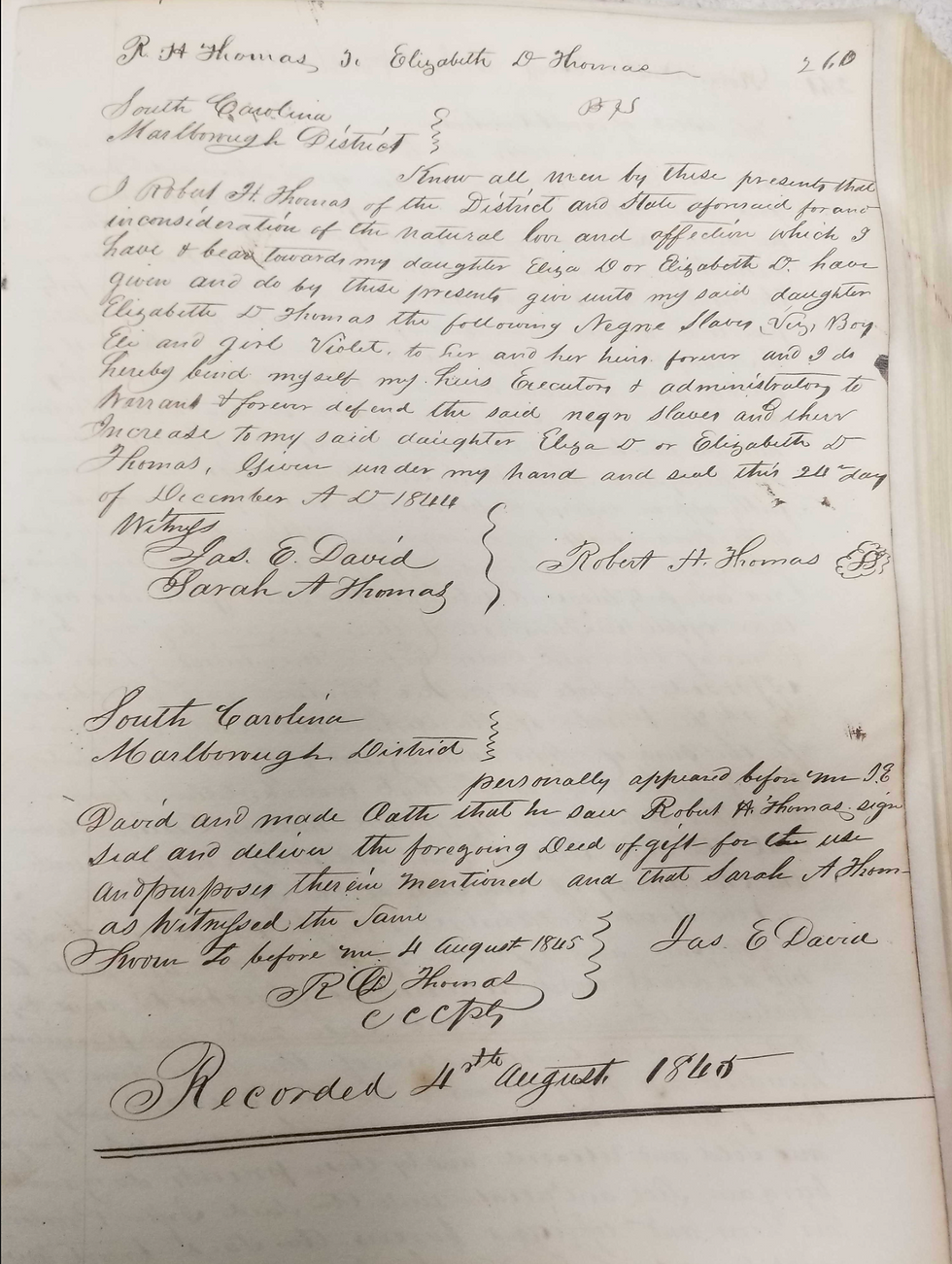
John's nephew Henry Covington (1C5X) and our cousin Robert H. Thomas (1C5X), put up the bond for John's will.
Note: Robert H. Thomas was the husband of John's daughter Ann (4A)
It appears that three slaves were to be held by Henry and Robert to be sold if the estate "should be indebted in any manner."
Know all men by these presents that we Robert Thomas and Henry Covington both of the State of South Carolina. . .are held and firmly bound unto John Wall, Jun. a acting executor to the last will and testament of John Covington, dec’d, the just and full sum of two thousand dollars lawful money to which. . .we bind ourselves our heirs, executors or administrators jointly or severally. . .dated this 21st day of Feb’y 1809. . .Now at anytime after this date if it should be made appear to the said John Wall that the said estate should be indebted in any manner so as to require any part of said estate so delivered to be given up in order to pay off and discharge all debts due by said estate. . .Robert Thomas, Henry Covington their heirs executors or administrators should refund back again and deliver the said negroes to him the said John Wall. . . (signed) Robert H. Thomas and Henry Covington in presence of Wm. Covington (3U) (John's son).
Nancy
Our grandmother Nancy lived for quite a few years after John's death. Lou Poole did some research with census records to try and figure out approximately when she died.
Nancy (Wall) Covington has been stated to have died in 1826. I have seen no record or basis on which to make the assertion that she died in 1826. Instead, I think she continued to live through the 1830 census, as I will attempt to show.
Living with her son James (Nancy,the 45+ female)

Living with a grandson:

Living on her own with the same number of slaves as she had in 1820:

Our best estimate of when Nancy Wall was born is 1748. So in 1830 she would have been 82 years old, which is precisely where the above Nancy Covington was counted. Therefore I think she probably died soon after the 1830 census, but before the 1840 census.
a possible cousin
One bequest in particular stands out from John Covington's will. He left to his son John, Jr. a slave named Tamar along with her children. It's apparent that Tamar's situation is different from the rest of John's slaves.
Also one negro woman named Tamar. And my will and desire is that my son John Covington shall have Tamar’s three children namely, Lucy, Rachel and Isabell together with all other increase if any there should be, in order that the family of negroes should not be separated provided that he would pay to the different legates, that is to say, pay to the children of my last and present wife, Nancy, their proportionable share of whatever sum of money my Executors hereafter named should think Tamar’s children to be worth and in order to make the value of their difference equal and if my son John Covington should think proper not to do so, I wish my Executors to sell all the children Tamar now has or will have until my death to the highest bidder among the children of my last and present wife Nancy Covington, and not to sell them out of the family of children by my last wife, and my will and desire is that my Executors hereafter named should have full power to make such and all contracts as they my think proper in the management of all my affairs.
It is obvious from this bequest that John did not want Tamar or her children to be sold outside the family. From this, one might deduce that it's entirely possible that Tamar's children were fathered by John.
The Covington family, beginning with John Covington's generation would own hundreds of slaves that carried the Covington name for generations. Some of these, as in many slave families, were sons and daughters of white Covington slave owners. From a discussion forum on Ancestry, I came across Ron Green. Ron is a Black man living in North Carolina who believes that he directly descends from our grandfather.
The following discussion began with a query about what happened to John's slave Tamar who was mentioned in John's will:


No further comment was made by either lstrouse1 or Ron Green. Their DNA results would not have been conclusive in any case. After 3rd generation, DNA results are unreliable.

Note: Ron Green referred to our grandfather as John C. Covington. John has been referred to as John Coulter Covington in many books and on-line sites but there is no proof anywhere that his name was anything other than John Covington.


Comments