
Kittredges of Nelson NH
- westmohney

- Oct 30, 2025
- 6 min read
We are all the product of people we've never seen and people we've never met. ~ Melanie Johnston

The Kittredges of Nelson, New Hampshire
Our cousin Joshua Kittredge (2C7X) was born in Tewksbury in 1761. He was probably named after his uncle Joshua (1C8X) who was killed "in ye service at Fort Wm. Henry" during the final French and Indian War. In 1775, when the younger Joshua was fifteen, the Revolutionary War began. He enlisted in the Massachusetts militia two years later Joshua's first assignment was in Cambridge guarding British troops that had been taken prisoner after Burgoyne's surrender at Saratoga. In 1779, he served for one month at the fort at Cobble Hill in Boston. In 1880, he moved from Tewksbury to Packersfield (now Nelson), New Hampshire where he lived with his (and our) cousin Solomon Kittredge (2C8X).
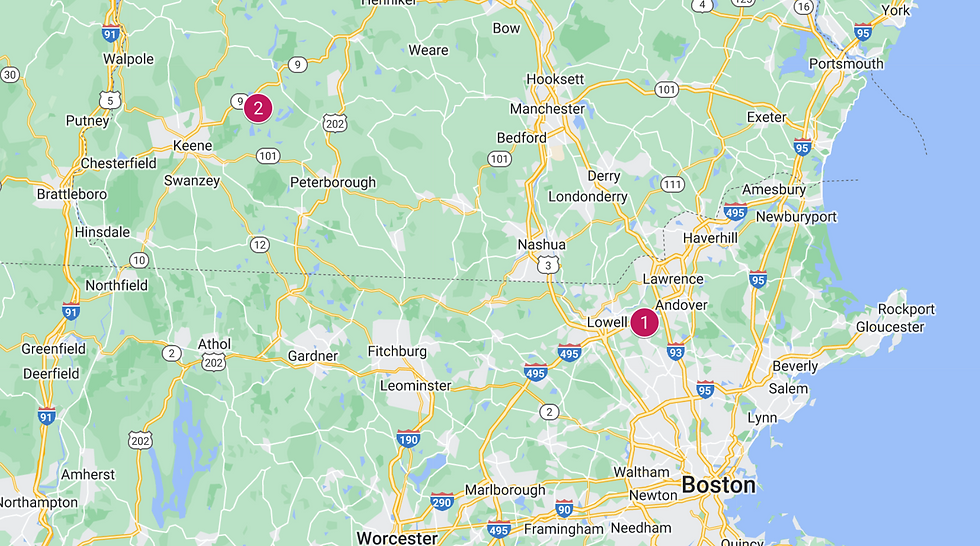
After moving in with Solomon, Joshua enlisted for a third time, this time serving at West Point in the same year that Benedict Arnold tried to turn the fort over to the British. He also served in the light infantry under the Marquis de Lafayette. He was finally discharged for the last time in November of 1780.
With his war service completed, Joshua returned to Packersfield where he purchased a sawmill. In 1787, he married his cousin Solomon's daughter, Lydia (3C7X). Joshua made improvements to increase the size of the house near the sawmill for his growing family. He and Lydia had three children before her death in 1795. A year later Joshua married Beulah Baker and, with her, had eight more children.
In 1824, Joshua and Beulah transferred ownership of the house and mill to their second oldest son Herbert (3C6X). It's a mystery why ownership wasn't transferred to their oldest son Abel (3C6X), though Abel continued living on the property for most of his life. It's possible that Joshua, who was 63 at the time, felt Herbert was better insurance for his old age. He and Beulah stayed with Herbert for the rest of their lives.
On August 16, 1832, at the age of 73, Joshua testified before the court in Nelson about his service in the Revolution as part of his application for a pension. The pamphlet “Celebration by the town of Nelson, NH …” records that Joshua received an annual pension of some $30 for his service in the Revolution. He died just a year and a half later on February 18, 1834 at the age of 73. He, Beulah, and several of their children now rest in the Nelson Cemetery.
Herbert continued living on the homestead where he ran a turning mill on Center Pond.
In 1828, he married Sarah Livermore and the couple had seven children.
Also living on the property was Herbert's older brother Abel. In 1824, Abel married Sophia Lyman. Sophia's health deteriorated after the birth of their third child in 1830. Their fourth child, Charles (4C5X) died at only a year and Sophia followed her son a year later. The story handed down in the family is that Sophia made Abel promise to marry her sister Anne. Whatever the story, Abel did marry Anne and, with her, had three more children, their third another Charles (4C5X). Sadly, the second Charles only lived for four years.
In 1846, Abel began constructing a house of his own on the property. A letter he wrote that year said, "…the chimney is up so [the family] can use the oven, but the shed has to answer for the kitchen, parlor and sitting room." The letter also said that Abel had worked hard in "haying" season with only one of his grown sons available to help with the labor.
Over the years, Abel's children would spread far and wide. Sons Edward (4C5X) and Samuel (4C5X) left in 1849 for the California gold rush, and daughter Sophia (4C5X) married a minister from Maine the same year. The very interesting story of Abel and his children, particularly his daughter Sophia, will continue in future post.
Below is a daguerreotype that is believed to be of Abel and his second wife Anne. It was known to have belong to Abel's daughter Sophia.

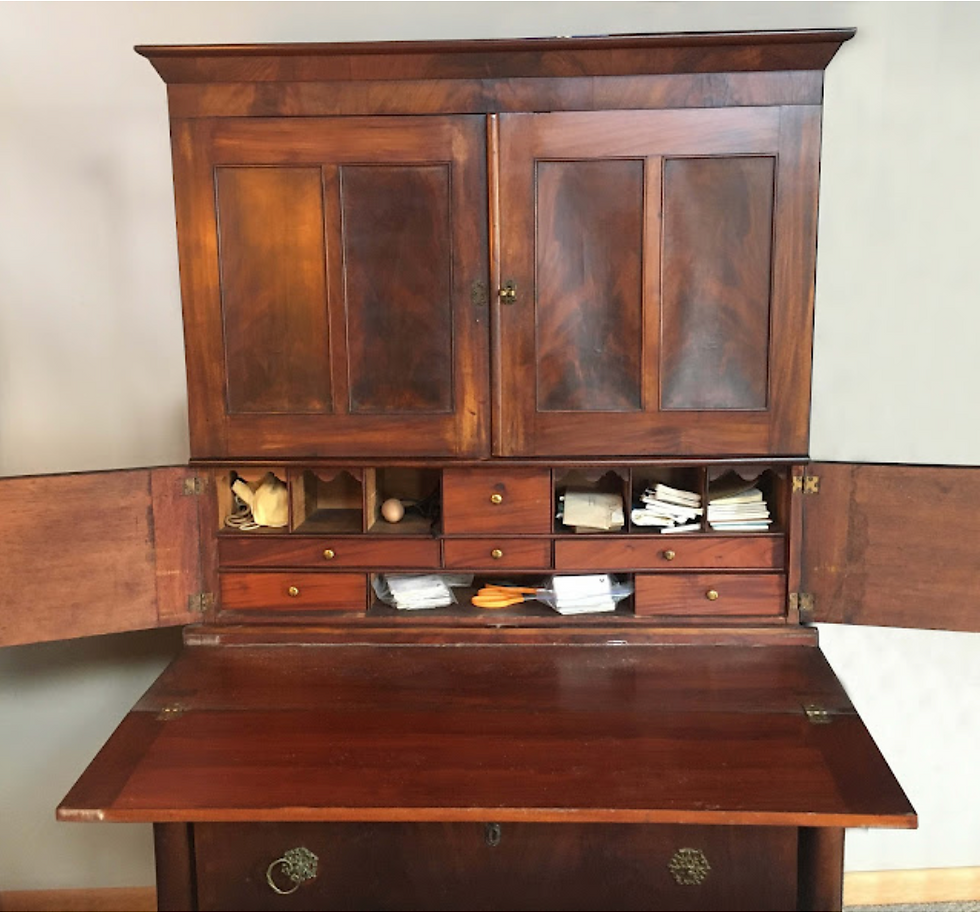
Abel was evidently something of a cabinetmaker. Below is a secretary made by him that was passed down through his son George (4C5X) to his grandson Henry (5C4X).

When Herbert died in 1855 the estate went to his son Russell (4C5X) who allowed his uncle Abel to continue living on the property. Ca. 1882, Russell sold the property to James Ruffle and the house has stayed in that family until today. Below is a photo of the house the house that Joshua built, probably taken sometime in the mid 1900s:

Below is a photo of the house as it looks today:

Joshua Kittredge's house in works of art
Emily Ann Kittredge (3C6X) was Joshua Kittredge's youngest daughter. She was born in 1815 to Joshua and his second wife Buelah Baker. A sampler she made in 1826 is now housed in the Metropolitan Museum of Art in New York. Below is the museum's description of the sampler:
Eleven-year-old Emily Ann Kittredge completed her sampler on September 5, 1826, two months following the July 4th celebration of the 50th anniversary of the signing of the Declaration of Independence. John Quincy Adams was president of the United States and his father, John Adams, America’s second president died on that same July 4th anniversary, as did Thomas Jefferson, the nation’s third president. Even in the quiet bucolic farming community of Nelson, New Hampshire, where Emily lived and stitched her sampler, these historic events would have been celebrated and acknowledged.
In its finely executed, spare classic design, Emily’s carefully stitched sampler addressed this time and her community. Emily used a variety of stitches and includes a beautifully developed floral three-sided border of scrolling vines and open-blossomed pink roses. A second sawtooth border surrounds two alphabets and a four-line verse. Below that is a five-bay white clapboard Federal house with double chimneys, a fanlight over the front door, and a decorative balustrade. The house is flanked by leafy trees with a bird perched on the top branches. At the bottom of the sampler Emily signed and dated her sampler: "Emily Kittredge aged 11 years Nelson NH Sept. 5, 1826."
The verse Emily stitched is common to many New England samplers. The last sentence admonishes young women to divide their "youthful years" between "the book, the needle and the pen" and reflects the importance of educating young girls. . .When Emily was of school age the area around Nelson had several schools, but her teacher and her school remain unknown.
Emily was born on February 2, 1815, the youngest of four daughters and four sons born to Joshua Kittredge (1761-1834) and his second wife Beulah Baker Kittredge (1768-1827). Her father ran a sawmill in Nelson, in southwestern New Hampshire and homesteaded a large farm on Center Pond Road where a culture of self-sufficiency engaged all the family members. Three years before Emily’s birth her father built a five-bay clapboard Federal house on this property using lumber he milled himself. The house is nearly identical to the one depicted on Emily’s sampler and is still lived in today.

When she was twenty-four, Emily married John Hopkins Ramsey (1815-1896) on November 19, 1839 in a ceremony conducted by the Rev. Josiah Ballard who served as the minister of Nelson’s Congregational Church from 1836 to 1839.
Note: Reverend Josiah Ballard (4C5X) was a cousin of ours descended from our Andover Ballards.
By the time of the birth of their only child in 1844, Emily and John lived in Rockingham, Vermont, where John was a joiner and house carpenter. The 1870 U.S. Census records that John had retired and their son Alvah K. Ramsey (4C5X) (1844-1871) was living with them and employed at a woolen factory. Alvah died the following year at age 26 and Emily and John continued to live in their house, later attended to by a servant, Sarah Rand. John died in 1896 and Emily died nine years later at age 89.
Emily’s Will records the value her estate at $2,072.75. Both her home and personal property were auctioned off and Emily’s sampler was likely one of the lots sold with her personal property. The provenance or line of ownership of her sampler is unrecorded until it was purchased by the noted sampler collector, Barbara Schiff Sinauer. A twentieth-century New York City sampler collector, in 1984 Barbara Sinauer loaned three samplers to the American Wing’s exhibition, Rhode Island Needlework, and soon after donated her entire American and European sampler collection to the Metropolitan Museum.
Below is a painting that includes the Kittredge house in the distance. It was painted sometime in the early to mid-1900s by Albert Duval Quigley, a longtime Neslon resident. The painting was included in a 2017 calendar published by the Nelson Historical Society.



Comments