
Maneuvering in the South
- westmohney

- Feb 28, 2024
- 8 min read
Updated: Nov 19, 2024
. . .a little known footnote in the history of the Revolutionary War . . .The battle (of Green Spring) was fierce and bloody, and part of a chain of events that ultimately resulted in the George Washington’s victory at Yorktown. ~ Mark Maloy
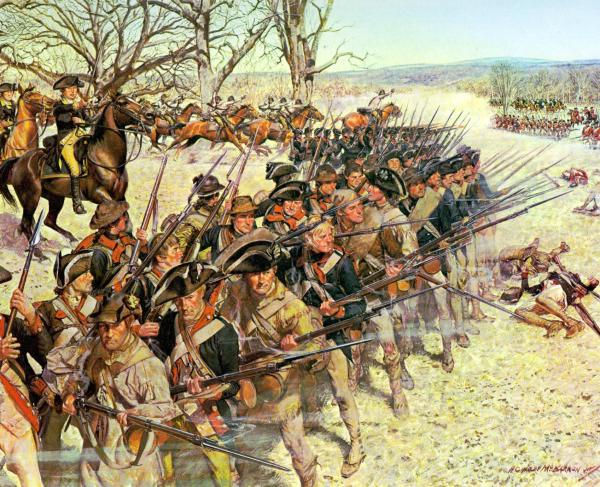
The first burning of Richmond, VA
In October of 1780, while the new commander of southern operations, General Nathaniel Greene, traveled south to his new post, he was heartened by news of the American Victory at King's Mountain. Greene, who had been with Washington at Boston, Trenton, Valley Forge and Brandywine, arrived in Charlotte, NC in December. Before he could ready his troops for battle, however, a new thorn in the side of the Americans was on the move.
Benedict Arnold had been lucky enough to escape with his life after his traitorous act at West Point. Throwing his lot thoroughly in with his former enemies, the newly appointed British general would fight the Americans with the same fury he once reserved for America's foes. On the 1st of January, 1781, Arnold "sailed up the James River, laying waste to plantations and settlements along the way." Included in Arnold's swath of destruction was Flowerdew Hundred Plantation which was owned at the time by our uncle, Joshua Poythress, Jr. (5U). The property was shelled but, fortunately, not completely destroyed.
Arnold's ultimate target, however, was Richmond, only recently designated the capital of Virginia by governor Thomas Jefferson.

Arnold was chosen for this mission because of his unique ability as a former American to draw in Virginia Loyalists to the British cause. On January 5th, Arnold's troops, 1,600 strong, descended on Richmond. The 200 militia troops defending the city, proving to be no match, broke and ran. The outcome for the city of Richmond was dire. According to Wikipedia:
Jefferson, seeing his militiamen dispersed, and no other plausible way to defend Richmond, quickly ordered the mass evacuation of most military supplies from the city, and promptly fled in his carriage, along with the rest of Virginia's government officials and his family. . . Arnold wrote a letter to Jefferson, offering to spare the capital if he was allowed to seize tobacco unmolested. Jefferson refused the terms, and the city suffered the consequences.
Arnold. . .ordered Richmond to be set to the torch. Arnold's men then started a rampage across the city, burning government buildings as well as private homes, ransacking the city of its valuables and supplies.
Note: Thomas Jefferson's wife at the time of Richmond's evacuation was our cousin Martha Wayles Jefferson (3C7X)

George Washington, who had gone to great lengths to support Arnold in the past, put an immediate 5,000 guinea reward on Arnold's head. He also gave orders for the former American general to be hanged if ever captured. Arnold, however, managed to elude capture and would continue fighting for the British until the end of the war.
the tides turn
Upon his arrival in the South, General Nathaniel Greene had decided to use a divide and conquer method of warfare. He took the main body of his army southeast to Charlotte and sent another smaller contingent, under the command of General Daniel Morgan, southwest. Cornwallis followed suit, sending Lieutenant Colonel Banastre Tarleton after Morgan.
Both Carolinas, where Cornwallis hoped to win the war, were problematic for the British. The population in both states was split pretty evenly between patriots and loyalists. The territory was essentially engaged in civil war, with neighbor pitted in bitter enmity against neighbor. When Morgan and Tarleton met at Cowpens, SC on 17 Jan 1781, the resulting clash of Patriots against Loyalists would prove to be a major turning point in the southern war.
The forces at Cowpens were fairly equal with 1,065 Americans to 1150 British and Loyalists. Morgan used the now familiar American guerrilla strategy while the British stuck to their usual "linear assault." The resulting battle was over in less than an hour, a complete victory for the Americans. British losses were devastating with 110 dead, 200 wounded and 500 captured to the American 12 killed and 60 wounded.

As Cornwallis regrouped after the South Carolina setback, General Greene sent out a call for more volunteers. Two that answered that call in the weeks after Cowpens were our cousins Joseph Terry Williams (2C6X) and his brother James M. Williams (2C6X). Joseph and James were the sons of our cousin Lucy Terry Williams (1C7X).
James would later re-enlist as a substitute for his sixteen-year-old brother, John (2C6X) who had been drafted into the army. Substitution was common at the time. Though only 18 himself, James probably felt that his little brother was too young to go to war.
Both Williams brothers were part of General Greene's army when the Battle of Guilford Courthouse was fought on March 15. This battle pitted Greene against the might of Cornwallis' army. Though Guilford Courthouse was technically a loss for the Americans, the British suffered such high casualties, 25%, that Cornwallis marched his army to the North Carolina coast at Wilmington, to lick his wounds and resupply. Greene decided not to give chase.

After the battle, the Williams brothers were assigned a company commanded by Captain Morgan, the hero of the Cowpens victory. The company took six week to escort the British prisoners captured at Guilford Courthouse to Halifax, a trip of 150 miles.
the British set their sights on Virginia
On April 20, our cousin Robert Poythress (1C7X) was with General Greene as he began a siege of Camden, SC. The company established a camp at nearby Hobkirk Hill. Five days later, the British ended the short-lived siege with a surprise attack on the Americans. Even though they were outnumbered, the British ploy actually worked. The surprised Americans fought valiantly but were eventually forced to retreat. Quick thinking and action by Lt. Col. William Washington's company of Light Dragoons managed to save not only the most of Greene's men but his artillery as well.

Though technically a victory, the battle at Hobkirk Hill had once again been costly for the British as Greene's "guerrilla" tactics began to slowly wear them down.
The very day of the Hobkirk Hill battle, Green got word that Cornwallis had, in essence, given up on the Carolinas and was moving his troops north to Yorktown, VA. British Major General William Philips had already arrived in Portsmouth at the mouth of the James River with 3,000 soldiers and had his sights set on Petersburg. That city was deemed important to the British because it was a major tobacco trading center and also strategically placed as a supply depot for Greene's army.
Phillips began moving his army up the James River toward Petersburg and arrived in City Point (now Hopewell) on April 24. American General John Muhlenberg, along with his cohort Prussian general Friedrich von Steuben, arrived in Petersburg the same day to defend the city.
Note: City Point is where our grandfather Francis Eppes (9GGF) built his plantation, called Hopewell, in 1635. At the time of the Revolution the property, now called Appomattox Manor, was owned by Richard Eppes (3C7X), great-great-grandson of Francis. 80 years later, Appomattox Manor would also play a major role in the Civil War.

Though outnumbered, the Americans' plan was to put up a good fight, then retreat across the Appomattox River with their army still fairly intact. The battle took place on the 25th of April. Our cousin Richard Harris (3C6X), son of Anne Eppes Harris (2C6X), was there for the action. After three hours of intense battle, von Steuben "ordered a general retreat across the Pocahontas Bridge." The Americans' effort at Petersburg bought French General Lafayette time to mount a defense of nearby Richmond which prevented further damage to the Virginian Capitol city.
As the British continued their assault on Virginia, Richard Harris was also on hand to help Lafayette in the Battle of Green Spring, near Jamestown, VA. According to Mark Maloy author of "Madness! The Battle of Green Spring," this confrontation, which took place on July 6 is "a little known footnote in the history of the Revolutionary War. . .The battle was fierce and bloody, and part of a chain of events that ultimately resulted in George Washington’s victory at Yorktown."
Green Spring pitted Lafayette and General "Mad" Antohny Wayne's Pennsylvania troops against Cornwallis' army of 7,000. Though again technically a British victory, the Americans had gone "toe to toe" with their enemy and further stymied Cornwallis' progress through Virginia.
further adventures of the Williams brothers
Four months after doing their part in the Battle of Guilford Courthouse, James and Joseph Williams re-enlisted for service, specifically to work for their neighbor, William McCraw. McCraw, the local Postmaster Deputy Quartermaster for the southern army at Peytonsburg, was in charge of getting out mail and supplies to various armies. McCraw did his best to exempt the men working for him from battle duty. From a letter McCraw wrote to the governor of Virginia:
I have a number of men in the Public Service at this Post as wagoners, express riders, canteen makers, and etc., for whom I have promised to procure a tour of duty provided they work faithfully; otherwise it would be impossible to carry on the work of the department. The Court Martial of Pittsylvania has threatened to declare these men liable to six months service in the army. The southern army is suffering for horseshoes and canteens and can not supply them if deprived of these men.
McCraw's appeal was successful. James then worked as a "carrier of public dispatches" for the rest of the war. He "travelled widely in the course of his duties, on one occasion participating in the delivery of 56 horses from Cumberland County, Virginia to the Southern Army at Ashley Hill, South Carolina."
"civil war" heats up in North Carolina
While the main front of the war had moved into Virginia, the Americans had scored two major coups, in May and June, when Fort Ganby in South Carolina and Augusta, Georgia were brought back into American hands. The numerous Loyalists in North Carolina, however, decided it was time to step up to the plate for their king, which only accelerated the Whig/Tory conflict in that state.
In July of 1781, a group of Loyalists captured a company of militia men near Fayetteville, NC. Included in that group was our cousin William Kinchen.
Note: With a plethora of William Kinchens to choose from, it's impossible for me to exactly place this William. He is probably our 1st or 2nd cousin.
General Herndon Ramsey wrote a letter to Governor Thomas Burke apprising him of their situation:
Camp at McFall's Mill, Raft Swamp, 22nd of July, 1781.
Sir:- On Tuesday last we were captured at Chatham Court House by a party under the Command of Col. David Fanning, which party we found consisted of persons who complained of the greatest cruelties, either to their persons or property. . .Notwithstanding the Cruel treatment these people have received, We have been treated with the greatest Civility and with the utmost respect and politeness by our Commanding Officer, Col Fanning, to whom we are under the greatest Obligations. . .We expect to be delivered to Major Craig at Wilmington in two or three days, entirely destitute of Money or Cloathes. How long we shall remain so, God only Knows. All we have to ask is that the perpetrators of such horrid Deeds may be brought to tryall, that prisoners may be well treated in future, and we are Your Excellency's most obedient Servts., Gen'l Herndon Ramsey, Joseph Hine, Matt. Ramsey, W. Kinchin, John Birdsong, James Williams, Matthew Jones, Thos. Surlock, James Herndon, M. Gregory P.S. Simon Terril is paroled to carry this Letter and return to Wilmington.
The captured men were taken to prison ships in the Charleston Harbor. Various sources report that, after his release some months later, our cousin William Kinchen, possibly weak from his imprisonment, died on his journey home.
Major James Wall's assignment
As Cornwallis marched from Wilmington toward Yorktown, he passed through what is now the town of Emporia in Greensville County, VA.

Before Cornwallis army reached Greensville County, our uncle Major James Wall (5U) was ordered to remove the records of that county to a place of safe-keeping. From a 1793 record:
Petition of Benjamin Hicks sheweth that. . .Major James Wall of the State of Virginia was imployed to Remove the Records of this State from Rev. William Fanning of Greensville County in the State of Virginia to Burkley [sic] County in the State aforesaid, That the said James Wall imployed two wagons Teams and Drivers of your Petitioner to assist in removing the said Records, That in the year 1792 or 3 Major James Wall’s account including the amount of your Petitioner’s account was passed to an Indent, That the said Major Wall is dead. . .so the said Indent still remains in the Treasury of this State.
It appears that, in 1793, Benjamin Hicks had still not been paid for the use of his wagons. Our uncle died in 1788 so Benjamin was trying to recoup the money from the State of Virginia.
Next up: The final months of the war


Comments