
More family stories
- westmohney

- Jul 19, 2024
- 12 min read
Updated: Jul 14, 2025
If you want to understand today you have to search yesterday ~ Pearl S. Buck

The Reverend Joseph Kidder
Cousin Joseph Kidder (1C7X) was born in Billerica in 1741 to our uncle Enoch Kidder (6U) and his wife Sarah.
Note: Enoch was a common name in the Kidder family. Our 7th great-grandfather was Enoch Kidder. Our 6th great-grandfather William had a brother and a son named Enoch. Our 5th great-grandfather Isaac had a brother and a son named Enoch. Our 4th great-grandmother Susannah Kidder Sherwin had a brother named Enoch. Susannah's daughter, Susannah Sherwin (3GGM) married Ezra Parrish (3GGF) and they named their son Enoch Kidder Parrish (2GGF) after Susannah's uncle.
Joseph graduated from Yale College in 1764. Below is a photograph of his Yale dipoloma

On March 18, 1767, Joseph was ordained minister at Dunstable, New Hampshire. From Sibley's Harvard Graduates, Vol XVI, we learn that "[t]he church at Dustable had been unable to settle on a minster for a score of years before Kidder's ordination, but he was wise as well as able and pious, and he kept the peace for a generation."
Six months after begnning his ministry in Dunstable, Joseph married widow Mary White Badger of Haverhill, MA. Then, in 1768, he applied for an ad eundem, or honorary, degree from Harvard College. Below is a record of his request for the degree and the college's acceptance:

Joseph, who suffered from a slight case of stuttering, had been preaching in Dunstable for nine years when the Revolution broke out. He was evidently called on to send the soldiers out with a blessing. According to a biography on Joseph by a descendent, Clark Owen Kidder (8C), when the men of Dunstable gathered up a company to march in support of General Gates against Burgoyne, they "listened to a patriotic farewell sermon. . .and were fortified in spirit by his strong and fervent prayers. . . The pastor's stammering tongue would be loosened in the freedom and energy of his utterance as he touched their finer feelings or roused them to the dreadful onset."
Joseph continued to preach in Dunstable until June 15, 1796 when he was dismissed by the church "for inability." He was only 55 at the time. We have no way of knowing what this "inability" was but it appears that Joseph continued his ministry in Dunstable until his death in 1818. The Ecclesiastical History of Nasua, NH maintains that '"[h]is long pastorate of fifty one years was not without trials. Mr. Kidder's civil connection with the town ceased in 1796, but his relation to the church continued until his death in 1818. . ." Even though Joseph eventually sued Dunstable for back pay, it appears that he and the town were able to work out some sort of a settlement and his sermons continued.
When Joseph's health began to fail him in 1813, another paster, Ebenezer Sperry, was hired to help out. Reverend Sperry wrote about his associate:
Mr. Kidder while enjoying health was favored with a remarkably retentive memory. He had stored his mind with a vast variety of anecdotes, interesting stories and geneaologies of families, and was accurate and particular and even to a fault minute in the relation of them.
In September of 1813, Joseph was "carried off by a paralytic stroke." The Ecclesiastical History of Nasua had this to say about him:
Mr Kidder was a fine representative of a gentleman of the old school; a very slight figure always clothed in taste and scrupulously neat. His pre-eminently scriptural sermons were prepared with great care, but suffered in their delivery by an impediment in his speech. . . Prayers were his last audible utterance when his feeble tongue was stilled forever to mortal ears.
Nathaniel Kidder's bible
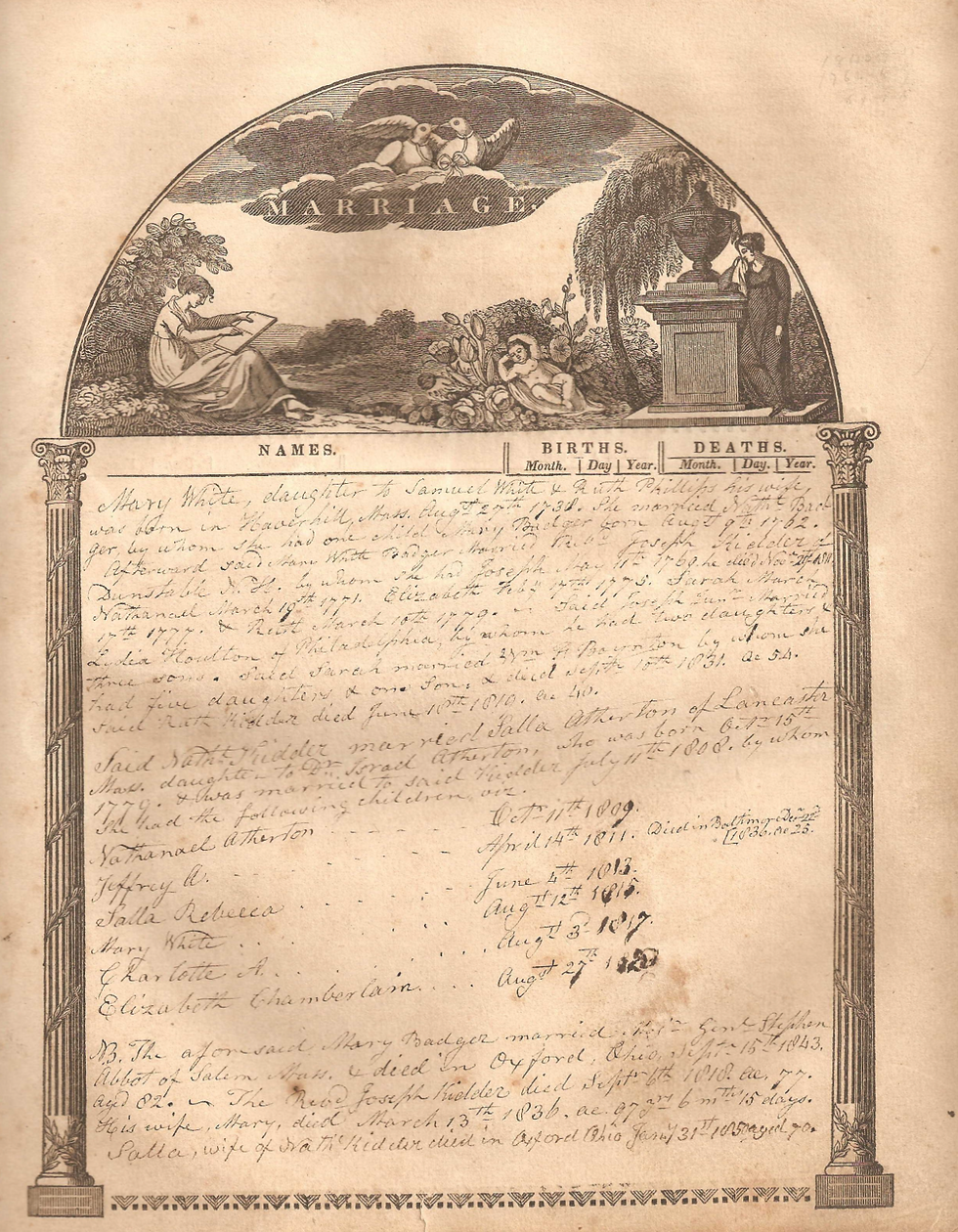
Joseph Kidder's son Nathaniel (2C6X) had a family bible that was passed down through the generations until it came into the hands of Waldo E. Julian (exact relationship to us unknown). Waldo offered Nathaniel's bible to be displayed at an exhibition in Sacramento in 1952.

Below is a page of the bible which records the marriage of Nathaniel's parents, Joseph Kidder and Mary White:
Calvin Kidder's sad end
Our cousin Calvin Kidder (3C6X) was born in New Hampshire in 1765. In 1785, he made a move to St. Andrews, New Brunswick, Canada where he was part owner of the Harmony Sawmill.

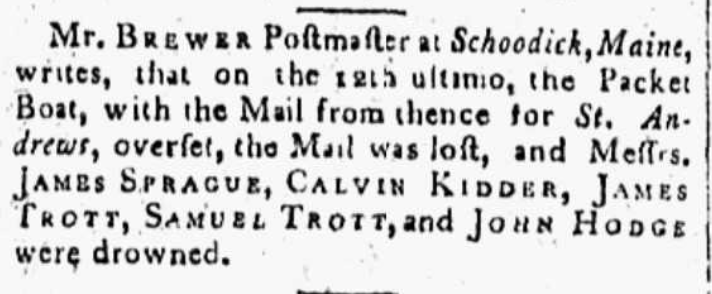
In 1798, Calvin married Mary Greelaw and the couple welcomed a son, James Calvin Kidder (4C5X) in January of 1799. Not three weeks after the birth of the child, Calvin was killed in a mailboat accident on the St. Croix River. Below is a notice of the incident in the Massachussets Mercury of Boston.
Calvin's son Joseph, who lost his father at 3 weeks, lived to the ripe old age of 92. From his obituary:
Hardy lumberman and river man, a man of marked industry and integrity. During a great fire which devastated wide stretches of territory in New Brunswick, he was in the deep woods at Miarmachi, where he narrowly escaped death from the flames, and later from starvations owing th the loss of all nearby settlements with their stores of provisions.
the music teacher
Our cousin John Stickney (1C8X) was born in Stoughton in 1741. He was the grandson of our grandparents Samuel (8GGF) and Mary Haseltine Stickney (8GGM) of Bradford, MA. When he was about 7 years old, John's father Richard (7U) apprenticed him to Isaac Davenport, a shoemaker and butcher in Milton, MA about ten miles from his hometown.

Neither butchering nor shoemaking, however, turned out to be John's first love. After seven years of his apprenticeship, he returned to Stoughton where he began lessons in "the new style of music" from William Dunbar. John took what he had learned and, according to Appletons' Cyclopedia of American Biography, "he travelled extensively through the New England states, and acquired reputation as a teacher and composer. . ."
The art of singing appeared to be one of John's main strengths. According to the Stickney Family Memorial by Matthew Adams Stickney (5C6X), "[I]n the face of considerable opposition, he persevered until he had banished the old, and introduced the new method of singing." It was evidently his "custom" to write the music out for his students, sometimes as many as sixty copies a day.
In 1774, John published The Gentleman and Ladies' Musical Companion, "a valuable collection of psalms and anthems together with explanatory rules for learning to sing."
Below are photos of an original copy of the book which sold in 2019 at the Bonhams Skinner Auction House for $1,046:


Considered "an important historical work," John's book is still being published today by Forgotten Books, a London book publisher which specializes is the restoration of old books.
Putting his musical interests aside for a year or so, John did his part in the Revolutionary War. He served as an adjutant in Captain Moses Harvey's company from August to December 1777, taking part in the Saratoga battles that led to the surrender of Burgoyne. He served again as a sergeant in 1778.
John finally settled in the town of South Hadley, MA, near the Connecticut border. There he bought a farm which he worked in the summer. The winter months were spent imparting singing lessons, a practice he continued until he was 65.
The twice married John died in 1727 at the age of 86. Below is his headstone which includes his two wives and names him "Doctor Sacrae Musicae."

Glowing epitaph for a Billerica, Massachusetts resident
In 1724, our cousin Samuel Kidder (1C7X) was born in Billerica. In 1749, he married our cousin Abigail Hill (3C7X), great-granddaughter of our immigrant ancestor Ralph Hill (9GGF). Samuel evidently led an exemplary life. When he died in 1794 at age 70, his death was noted as far away as Boston. The Boston Examiner ran the following obituary:
At Billerica, the 18th instant, Mr. Samuel Kidder, in the 70th year of his age. It is but a just tribute to his memory to say, that he was an industrious useful Citizen--an uniform Republican, and a firm supporter of the rights of his country--that he made an early profession of Religion--led a life correspondent to the precepts of the Gospel of Jesus Christ, and died in the hope of a glorious immortality.
In the newspaper article below, Samuel's obituary is the third one listed below:

Jacob Sherwin beats the clock in Sunderland, Vermont
Our cousin Jacob Sherwin (1C8X) was born in Hebron CT in 1735. He was the grandson of our immigrant ancestors John Sherwin (8GGF) and Francis Loomis (8GGM). Jacob graduated from Yale University in 1759 with a degree in thology. His first appointment as minister was in Ashland, MA where he served for 11 years. 1n 1790 he moved on to Sunderland Vermont where he was involved in an unusual lawsuit. The Reverand Theophilus Packard, Jr. wrote about this happenstance in A History of the Churches & Ministers and of Franklin Association, Franklin County, Mass:
Some singular circumstances occurred in connection with his (Jacob Sherwin's) settlement in this later place. A lot of land in the town had been given for the support of the pastor who should be first settled. Two churches had been formed in different parts of the town. Both pastors were settled on the same day, and the land was claimed for both. Suits at law were commenced. . .At length, with a discrimination which has seldom, if ever, been equaled, it was decided that the settlement of Mr. Sherwin preceded that of Dr. Lee about two minutes. This settled the matter in respect to the law, but not in respect to the Gospel. The expenses of the suit were heavy, and the alienation such as could not be healed. Some of the best men left the place. An awful declension followed, and the moral desolation remains yet to be repaired.
Poor Cousin Jacob soldiered on for a time but, due to ill health, he "was unable to officiate as pastor for several years previous to his death." He died in 1807 at 66 years of age.
the gift of Sarah Thompson, Countess Rumford
We've written extensively about our cousin Benjamin Thompson (3C7X), aka Count Rumford in our "A Loyalist and a Patriot, Two Famous Friends from Woburn," "Benjamin's Story. . . Continued," "Ben's Dragoons" "Benjamin Thompson, aka Count Rumford" posts. This story has to do with Benjamin's daughter Sarah Thompson (4C6X), Countess of Rumford.
When Benjamin fled Concord, NH in 1775 to avoid being arrested for his Loyalist views, his daughter was only a year old. He wouldn't see her again for twenty years. Ca. 1796, Sarah finally sailed to England and was reunited with her father. In spite of the time that had elapsed, the two formed a strong bond over the few years that Sarah spent in Europe with Benjamin.
On 26 Mar, 1797, when Benjamin was celebrating his forty-fourth birthday, Sarah came up with a spectacular gift for him. One of Ben's pet projects had been to set up work houses for the poor so they could begin learning to support themselves. Sarah found twelve children at the London House of Industry (poor house) and brought them to her father on his birthday. In a letter to his good friend Loammi Baldwin (3C7X), Ben gave the details of the event:
. . .choosing out half a dozen of the most industrious of the little Boys of 8 and 10 years of age and as many Girls, dressed them new, from hand to foot, in the uniform of that public Establishment at her own expense, and, dressing herself in White. . .led them into my room and presented them to me when I was at breakfast.
Benjamin was "so much affected by this proof her affection to me," that he gave Sarah a present of $2,000 that would be used "every year, forever, on her birth-day" to clothe twelve "poor and industrious Children" to be dressed in "the same form and colors as the uniforms of the poor children she had clothed on my birth-day." The town chosen to receive the honor was Sarah's birthplace, Benjamin's old home town of Concord, NH
Ben then wrote another letter to Loammi asking his aid to ensure that the town of Concord would be amenable to the plan. Loammi, in turn, wrote to the selectmen of that town. After giving details of the plan, he added the following to hopefully cement the deal:
When I contemplate the many, the very many, important improvements, institutions and establishments the Count has made which go directly to meliorate the condition of mankind, I am led with grateful pleasure, to bless his name, and glory in our country which gave his birth. And I should rest in full confidence that your proceedings and report in the concern will be such as will aid his usefulness and extend his benevolence in the world.
In spite of Loammi's best efforts, it appears that nothing was ever done to replicate the event on Ben's birthday. Sarah, however, adopted her father's philanthropic ways after his death. When Benjamin died in 1814, she became Countess Rumford and had the further distinction of being the first American woman to hold the title of countess. Sarah received, in addition to her father's estate, half of his military pension from Bavaria and the right to live in any country she wished. Part of the estate included the house where she was born in Concord, NH. For the rest of her life, Sarah maintained homes in both London and Concord.
Below is a picture of the house in Concord:

While Sarah never married or had children of her own, she showed her caring for others when he she adopted the granddaughter of one of her servants. Her charitable ways didn't end when she died in 1852 at age 78. She left a large portion of her entire estate “to a charitable purpose, namely the forming and maintaining of an institution for the poor and needy, particularly young females without mothers. . ."
The Rolfe and Rumford Home for the needy was located at the Rumford home in Concord. Sarah named the endeavor after her half-brother, Colonel Paul Rolfe, and her father. That institution, shown below, stayed in operation for 129 years.

In 2009, the home, with too few residents, was on the brink of closing. Board of directors member Paul Provost described that time as "Despair. . .It was a very emotional time.” Since they were committed to continuing with Sarah's legacy, the board decided to use the remaining assets as a fund “to benefit children and young adults of Merrimack County with particular emphasis on programs and services that serve the needy.”
By 2015, the Rolfe and Rumford new Donor-advised Fund had given away over a million dollars in grants and plans to continue "in perpetuity." Provost maintains that "[I]f the Rolfe and Rumford Fund is helping to give those kids a step up in life then that makes Concord a richer, deeper and more enjoyable place.”
The legacy of Sarah, Countess Rumford, continues to this day.

Constitution signer, Abraham Baldwin
Our cousin Abraham Baldwin (6C7X) was born in Guilford, Connecticut in 1754. He graduated from Yale University in 1772 with the intention of becoming a clergyman. Three years after graduation, he was offered a position as minister and tutor at the college. Abraham continued in that position until 1779 when he fulfilled his patriotic duty by serving as a chaplain in the Continental Army.
After the war, Abraham changed his career path to law and, encouraged by his former commanding officer, General Nathaniel Green, he made a move to territory of Georgia. Green, himself, had purchased a plantation there on the property where Eli Whitney would later invent the cotton gin. Abraham moved to Georgia in 1784 and established a law office near Augusta.
For the next few years, Abraham was busy establishing himself on the political front. In 1785 he was elected to the Georgia state legislature and in 1785, 1787 and 1788, he was a member of the Continental Congress. One of Abraham's pet projects while serving in congress was helping to implement reforms in the state's education system. He was instrumental in establishing the University of Georgia where he served as the school's president from 1786 until 1801.
During the 1787 Continental Congress, the Constitution of the United States was drawn up. Abraham played an important part in what became known as the "Great Compromise." From the U.S. Army Center of Military History site:
Baldwin was an active participant in the deliberations over representation that were at the heart of the constitutional process. He had originally supported the idea of representation in the national legislature based on property qualifications. . .When delegates from his native state convinced him that small states like Connecticut would withdraw from the Convention if the Constitution did not somehow guarantee the equality of state representation, he changed his stand. His action tied the vote on the issue and paved the way for consideration of the question by a committee. Baldwin eventually helped draw up the Great Compromise, whereby a national legislature gave equal voice to all thirteen states in a Senate composed of two representatives from each, but respected the rights of the majority in a House of Representatives based on population. His role in this compromise was widely recognized, and Baldwin himself considered his work in drafting the Constitution as his most important public service.
At that convention, Abraham was one of only two signers of the Constitution from the state of Georgia. Below are portions of copies of the original constitution annotated by him:


In 1799, Abraham was elected to the U.S. Senate and served there until his death in 1807 at age 52. In 1985, he was honored by the United States Postal Service with a Great Americans series postage stamp.

Baldwin County, Alabama, Baldwin County, Georgia, Abraham Baldwin Agricultural College in Tifton, Georgia, Abraham Baldwin Middle School in Guilford, Connecticut, and Baldwin Street in Madison, Wisconsin and Athens, Georgia are all named in his honor.
Below is a portrait of Abraham painted by Charles Frederick Naegele:

Abraham's younger half-brother, Henry Baldwin (6C7X), was an Associate Justice of the Supreme Court of the United States. Henry, from their father's second marriage, was 26 years younger than Abraham. We'll have more on Henry in a future post.


Comments