
Moses Austin
- westmohney

- Nov 6, 2025
- 11 min read
On December 8, 1796, Moses Austin and one of his workers set out on a two-thousand-mile round-trip journey through pristine wilderness to what is now southeast Missouri. ~ Historic Missourians

Moses gets his start
The first Austins in our family to come to America were our grandmother Annis Austin Littlefield (11GGM) and her brother Richard Austin (11U). Annis settled with her husband Edmund Littlefield (11GGF) in Maine while Richard stayed in the Boston area. Richard was the third great-grandfather of our cousin Moses Austin (4C9X) who was born in 1765 in Durham, Connecticut.
In 1784, Moses moved to Phildelphia and opened a dry goods store with his brother Stephen (4C9X). The next year he married Mary Brown whose affluent family owned a number of iron mines. With his business in Philadelphia propering, Moses opened another branch in Richmond, VA and moved there with his wife. Two daughters were born in Richmond but both died before reaching their first birthday.
Having been introduced to the mining business by his in-laws, Moses purchased a group of lead mines near Wytheville, VA and made yet another move. There he established the small town of Austinville which still exists today with a population of 119.

trouble in paradise
Moses' son, Stephen Fuller Austin (5C8X), now known as the father of Texas, was born in Austinville in 1793. A daughter, Emily (5C8X), followed in 1795 and, three years after her birth, Moses made yet another move, this time out of necessity. His mining operation in Virginia had incurred debts that he was unable to pay so, to avoid imprisonment, Moses began looking around for other opportunities away from Austinville. He set his sights on what would become the state of Missouri, then a part of the Spanish owned Louisiana Territory. From the "Historic Missourians" Website:
On December 8, 1796, Moses Austin and one of his workers set out on a two-thousand-mile round-trip journey through pristine wilderness to what is now southeast Missouri. As they approached the Mississippi River, they got lost in a huge snowstorm, ran out of food, and ended up sixty miles off course. In Missouri. . .Commandant François Vallé. . .led Austin to a place with exceptionally rich lead deposits called Mine á Breton. Austin soon made a formal request for this land to the Spanish government.
Below is a portrait of Moses painted about this time in his life
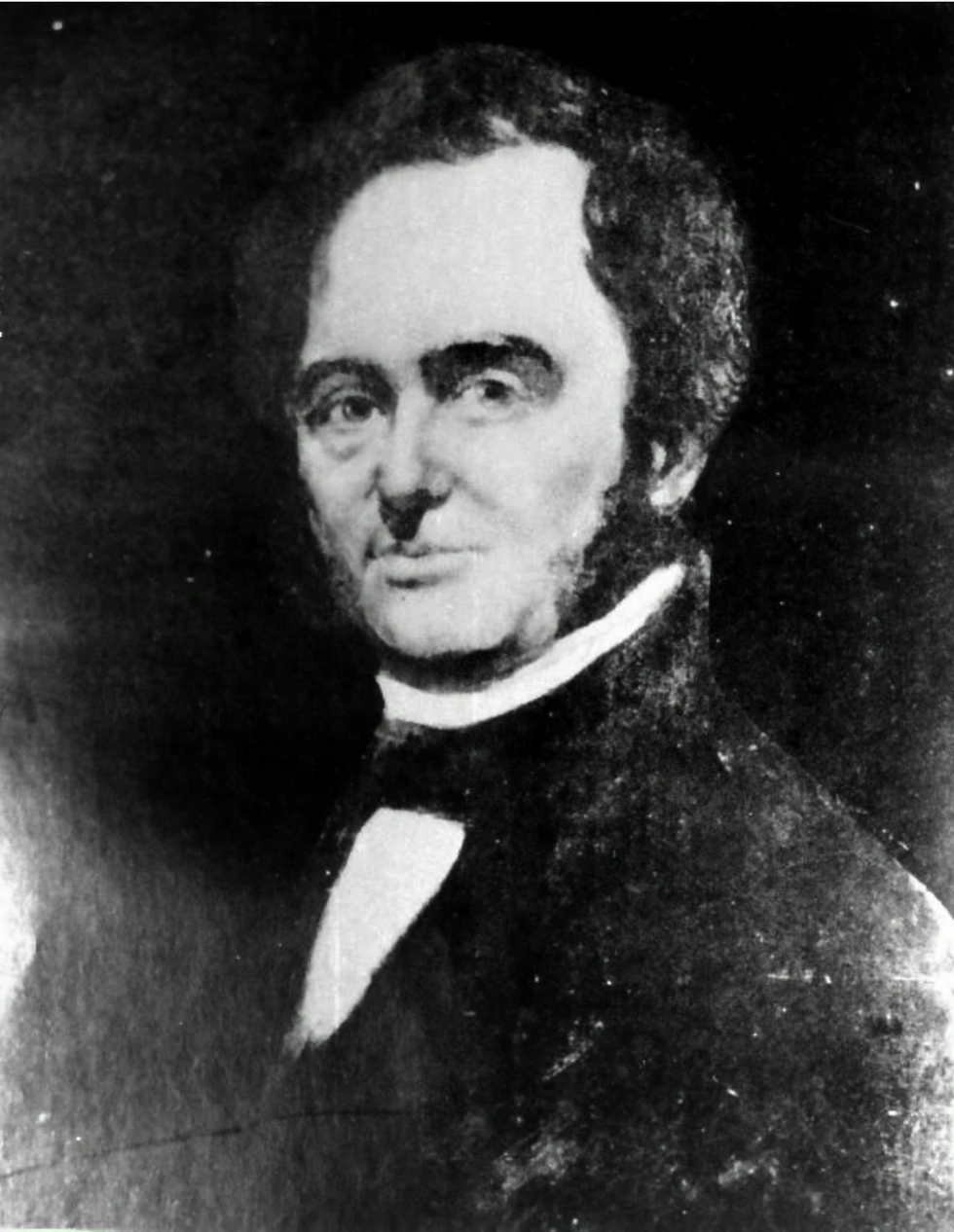
in Missouri
In his diary, Moses noted that “[n]otwithstanding the Unpleasent Situation I was in, I could not but be charmed with the Country I had pass.d." And once in Missouri, he found that he was in luck. The Spanish colonial government offered Moses over 4,000 acres near what is now the town of Potosi.

In exchange for his new lead mining operation in Spanish lands, all Moses had to do was swear his allegiance to the Spanish Crown and promise to convince other families to settle there. From "Historic Missourians":
After Moses received permission from the Spanish, he left for Missouri in June 1798 with a small group of men, women, children, and enslaved people. After a trip fraught with illness and death, they reached Mine á Breton in October.
Mine á Breton was founded by and named after François Azor, aka "the Breton" from his birthplace in Brittany, France. From "Le Grande Louisiane Francaise" website:
The mineral wealth drew many settlers, mostly French speaking, and a mining camp sprang up along the south side of the creek and up into the mining site, and later a village – the mining center (the mine, creek and village) was named “Mine au Breton” in honour of its founder, The Breton.
In 1791, a road was built to link Mine au Breton to Ste. Geneviève on the western shores of the Mississippi River, so that the lead could be shipped downstream to New Orleans. In 1798, American entrepreneur Moses Austin came to the area and transformed the village’s small-scale mining activity into a major operation which became Missouri’s first industry.
Below is an 1819 drawing of Pitosi:

While in Potosi, Moses' mining operation prospered. In his diary he wrote "No country yet known furnishes greater indications of an inexhaustible quantity of lead mineral, and so easily obtained." By 1805, the mine was producing over 800,000 pounds of lead a year. Business was booming to the point that Moses was able to build an estate he named Durham Hall after the town of his birth. Below is an undated photograph of Durham Hall:

trouble in another paradise
Life in Potosi, however, was no bed of roses. In 1802, the Osage Indians attacked his settlement and Moses' French neighbors refused to come to his aid. An ongoing rivalry with fellow mining entrepreneur John Smith resulted in "a constant war of words and a number of lawsuits." Two bright spots in 1803, however, were the birth of Moses' second son James Elijah Brown (5C8X), known as Brown, and Thomas Jefferson's historic Louisiana Purchase which made the Missouri Territory part of the United States.
By 1807, Moses' financial success began to falter. The dropping price of lead, a load of his lead being held up in New Orleans for a year, legal fees for the John Smith lawsuits and a payout to his brother Stephen all took their toll. Moses' response was to take out loans to expand his business. He created the town of Herculaneum, about 40 miles northeast of Potosi, as a port for his product on the Mississippi River. There he built a home, a store and a plant to manufacture lead shot.
Below is a drawing of Moses' settlement on the Mississippi:

Moses' business expansion so depleted his resources that, when his wife and two of his children ran out of money on a trip to Philadelphia, he couldn't afford to bring them home. Maria, Emily and Brown were forced to live off the charity of others for two years while waiting for funds.
In 1812, probably to generate some cash, Moses ended a partnership in Herculaneum and sold the merchandise associated with that business "at each Store, with a Waggon and several Horses. . ." Terms were laid out in the ad:

The final nail in the coffin came after Moses and his son Stephen, along with other men, entered into a partnership to start a new bank, the Bank of St. Louis. The bank failed during the Panic of 1819, and the Austin's finances "were utterly ruined." From the "Historic Missourians":
Austin’s inability to pay his enormous debts led to a wave of lawsuits from his creditors. He became so desperate for money that he was willing to sell Mine á Breton for less than one third of its market value, but still could not find a buyer. On March 11, 1820, Moses Austin was arrested and put in jail for failing to pay his debts. Ten days later, Mine á Breton was seized by the government; eventually it was sold to settle a portion of Austin’s debt.
Moses' wrote his reaction to his difficulties in his diary: "I have been so much taken up with my own distresses that I could say nothing on any Other subject…To remain in a Country where I had enjoyed wealth in a state of poverty I could Not submit to." Down but not out, Moses made plans to leave Missouri.
a new horizon
From Austin [Texas] Colony Pioneers by Ray Worth:
The "Austin Colony" was the idea of Moses Austin. . .As he was advancing in years and loaded down with cares, Father Austin, whose memory is revered, developed the idea of establishing a colony in the "Province" below the Red River known as "Texas. .." He dreamed that "Texas would be an earthly paradise. ..and that he could transplant hundreds of people from East of the Mississippi. . .where they could build new homes, secure cheap lands and live happily every after.
Using what little funds he had left, Moses "borrowed a horse and departed in October for Texas." On the journey, he was aided only by his son Stephen's slave Richmond.
In October of 1820, the Mexican people were in the final stages of a decade long struggle for independence from Spain. It wouldn't be until August of 1821, however, until the Spanish regime finally ended. Moses, therefore put in a petition to the Spanish territorial government for a grant of land for his colony. From the Historic Missourians:
Austin’s petition to the territorial governor was initially rejected. However, he happened to meet up with an old acquaintance, the Baron de Bastrop, a Dutch businessman who had a good relationship with the Spanish government. Bastrop was able to get Austin another meeting with the governor, who finally gave his consent to file Austin’s petition to bring three hundred families to start a settlement in Texas.
As it turned out, the Baron who helped Moses out wasn't a real baron. He was, in fact, wanted for theft back in Holland. But the meeting between the two men in San Antonio was famous enough that etcher Wall Berhardt commemorated the event in 1872.

To sway the Spanish government in his favor, Moses used the argument that Americans were inevitably going to settle in Texas, anyway. Would Spain rather have them legally as Spanish citizens or potential interlopers fighting for land. He also pointed out that settlers who were Spanish citizens would help Spain fight against the Natives and any U.S. invasion, with the last part patently untrue.
Moses' final days
So many stories have been written about Moses Austin's final days, It's been impossible to discern fact from fiction. From Historic Missourians, we get this story about his trek back to Missouri:
On the way back, Austin discovered that a fellow traveler, Jacob Kirkham, was trading in illegal livestock. Kirkham then stranded Moses and Richmond in the wilderness without horses or supplies. That night, Austin survived an attack by a wild panther, but both he and Richmond caught pneumonia during the eight days they went without food and shelter. After finding help at a frontier cabin, Austin was bedridden for weeks. He eventually recovered enough strength to travel, and arrived home on March 23, 1821. Five days later, he found out that Spain had granted his colonization petition.
Moses Austin never fully recovered from his bout with pneumonia. He overworked himself trying to settle his financial affairs and became so ill that he could not even dismount his horse by himself during a trip to Emily’s house.
The only parts of that story that we can ascertain is true is that when Moses arrived home he did find out that Spain had granted his petition.
Another prevailing story is that Moses' wife Mary wrote a letter to their son Stephen about Moses' dying words. From the Texas State Historical Society:
Two days before Moses died, he called his wife Mary to his bedside. In a now famous letter, Mary wrote to her son Stephen who was in the Texas territory, awaiting his father's arrival.
"After a considerable exertion to speak, he drew me down to him and with much distress and difficulty of speech, told me it was [too] late, that he was going...he [begged] me to tell you to take his place. 'Tell dear Stephen that it is his [dying] father’s last request to prosecute the enterprise he had commenced.'"
After a fruitless search for a copy of Mary's letter to her son, we determined that it doesn't exist.
We do find out more about Moses' last days from a letter his wife Mary wrote to her cousin after her husband's death asking for help with payment on a loan that she had planned to forgive. Below are excerpts:
[Moses] went to the province of Texas in Spain to see if he could do anything to advantage in that country. His encouragement from the government surpast his most anguine expectations and after an absence of ten months he returned home, but finding his confidence had been abused and he deceived by those in whose hands he had placed his property, he arranged his affairs in haste and intended starting to Texas in May. . .but oh my friend marck the uncertainty of everything in this vale of tears -- a few days previous to his departure he was attacked with a violent Inflammation of the Lungs and was so severe as to baffel the power of medicine and the skill of the best Physicians in the Country and terminated his life on the 10 of June.
My distress and trouble has been greater than my pen can describe. . .I am sorry to inform you my family is reduced from a state of afluence to a state of poverty. . .I am now dependent upon my son in law, my son S. F. Austin is in Texas waiting the arrival of his father and it will be long before he can know the great loss he has met with. . .It tis painful to my feelings to demand it as I once gave him reason to think I had given it up. Be assured my good friend nothing but necessity has induced me to trouble you again with this business. . .
the battle for Moses Austin
.
The territory of Texas would eventually become the 28th state in the Union and Texas holds a special place in its heart for Moses Austin. From the Texas State Cemetery Website:
The Battle For Moses Austin
During the early 1900’s, the Texas State Cemetery underwent a revitalization. . . the remains of Stephen F. Austin, Joanna Troutman, and John Wharton [were] buried here, which gave the Cemetery recognition as a true state treasure.
With the renewed interest in the Cemetery, Historian Louis Kemp fueled efforts to have distinguished Texans buried here in preparation for the Texas Centennial celebration in 1936.
Two years went by before Kemp realized he had forgotten "Moses Austin, the originator of the Mexican land grant to bring the first American families to Texas."
Kemp believed that proper recognition should be given to the elder Austin by having his remains buried alongside his son’s in the Cemetery. In 1938, Kemp requested that Thurlow Weed, an Austin mortician, go to Potosi, Missouri and have his remains brought to Texas. Upon Weed’s arrival in Missouri, he petitioned the state government for a permit to disinter Austin’s remains. He was told to gain permission from the county, despite having approval from all living Austin descendants. Having never run into any trouble before, Weed proceeded to hire a few locals to begin the disinterment. He tried to expedite the process so that he could be completed by San Jacinto Day. However, Weed was denied permission and work was stopped by a resolution passed by the City Council in an emergency meeting.
Following several verbal assaults and one confrontation from the Potosi mayor, Weed and his wife left Missouri on April 23 without Austin. The incident became well known in both Missouri and Texas. Lt. Governor Walter Woodul advised Governor James Allred to take action. After both sides threatened lawsuits, Governor Allred dispatched Secretary of State Ed Clark to Missouri to negotiate a compromise. Secretary Clark offered the town $1,000 to erect a suitable monument in exchange for Austin’s remains. Potosi City officials rejected the offer and the issue died.
Later, Potosi tried to have a memorial built, but was never able to raise sufficient funding. In 1949, the Potosi Lions Club proposed selling his remains to Texas for $50,000 to build a modest city hall. Even President Harry S. Truman, a Missouri native, proclaimed that Austin’s remains should be moved to Texas. However, Texas ignored the proposal. In 1961, Potosi officials had cleaned the cemetery and Austin’s tomb, which stood three foot tall and had the simple inscription “Moses Austin – Died 1820.” To this day, there is only his tomb to serve as a reminder of his pioneering accomplishments in Missouri.
With Moses' remains firmly entrenched in Missouri, Texas had to be content with a statue. In 1936, Waldine Tauch was commissioned to sculpt a statue of Moses Austin for the Texas centennial celebration which now stands on the northwest corner of the San Antonio City Hall grounds.

Next up: Stephen Austin's part in the "Texas Revolution."


Comments