
Of Dams and Wolves. . . . . .and the Reverend Hill
- westmohney

- Jun 8, 2024
- 13 min read
Updated: Jul 25, 2024
History remembers only the celebrated, genealogy remembers them all ~ Laurence Overmire

the dam in Ballardvale, Massachusetts
Our immigrant grandfather, William Ballard (9GGF), was one of the first settlers in the town of Andover in Massachusetts.
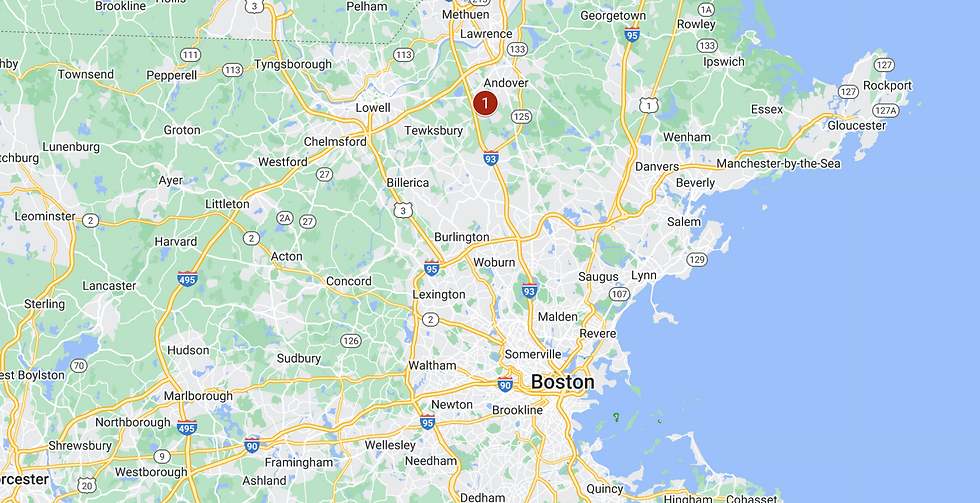
William's son Robert (8GGF)) was the man who was responsible for the devastating witch brouhaha in Andover in 1692. Grandpa William settled on the banks of the Shawsheen River in an area that became known as Ballard's Vale, eventually Ballardvale, as it's known today. The Ballards used the river's power to run grist and saw mills. The property remained in the family through five generations until finally coming into the hands of our cousin Timothy Ballard (3C6X).

The section of the Shawsheen River where our Ballard relatives lived became historically important to the town of Ballardvale because of the dam erected there. The original dam, built ca. 1753, was very close to property owned by Cousin Timothy who was born in Ballardvale in 1757. In 1768, Timothy's father, also Timothy (2C7X) died quite a wealthy man. When Timothy, Sr. died, he left his wie Sarah with five children under 12. Timothy, Jr. was 11.
Timothy married in 1783 and, though the union was not blessed with any children, Timothy and his wife Mary adopted three of his nieces and nephews. Timothy continued his grist and saw mill work until 1794 when he was granted the use of "the falls of the Shawshire River and the land adjoining" on the condition that he would build and and maintain a fulling mill. Fulling mills were used to finish and press homespun cloth.
Even though a dam had been built there before Cousin Timothy purchased the property, the Andover Historic Preservation Society says that "[w]ater power was first harnessed by Timothy Ballard, who operated grist and saw mills. . .Without the dam, this section of town would never have been developed into the industrial complex that was created by the mid 19th century.”
A portrait of Timothy's quirks was presented in Charlotte Helen Abbot's "Notes and Records of the Ballard Family of Andover:"
Tim owned 1,000 cows, according to Mrs. Gould, and he used to let them out to people, to be returned to him when the calf was 3 years old. She also tells that he was very prompt about getting to the mill on time in in the morning, and often ate his bread and milk on the way, leaving the bowl and spoon on the stone wall, to be picked up and brought back to his house. He often forgot them and where he had left them. When the walls were being torn down to build up the village, Tim's sppons were found in them. ~~ when Tim's horses were cold and wet, he used to bring them into the kitchen to get warm.
Sadly, Timothy died in 1828 when he "cut his own throat at age 70y 7m." According to Abbott, "he was very small and active. He broke his hip a few years before he died, and went insane near the end." Timothy died intestate and his entire estate, valued at more than $25,000, was divided between his widow, his siblings and his nieces and nephews.
The Ballard Vale Company takes over
After Timothy's death, Erza Abbot took over the property. In 1834 Ezra sold the property to the Ballard Vale Company. From the deed we learn that "Ezra Abbot yeoman, sells for $625. . . The right and privilege of flowing my lands in said Andover on the Shawsheen River as far and as high as the same will be flowed by raising their dam in Andover on the said river, being the same dam that was formerly owned by Timothy Ballard, deceased. . ."
Below is a picture of the dam, which was raised and improved at this time by the Ballard Vale Company.
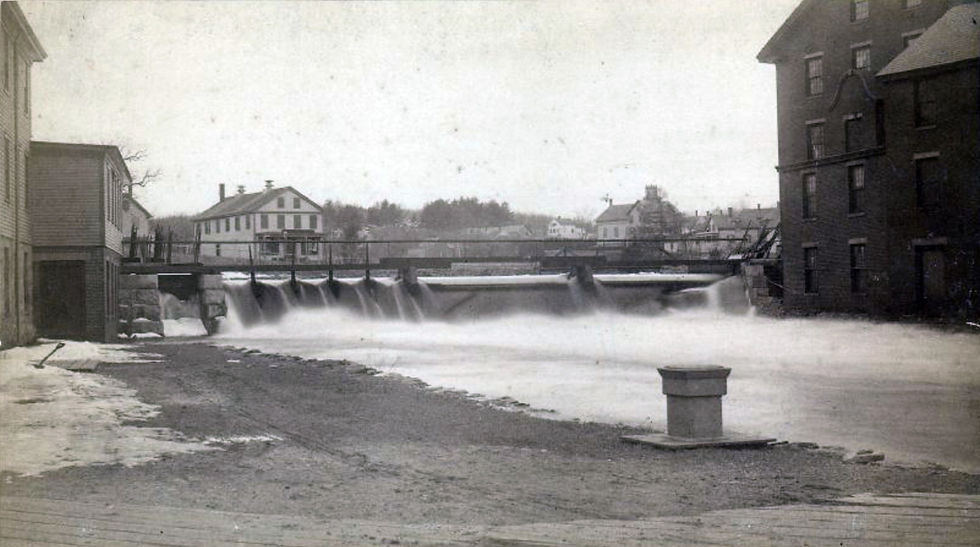
The brick manufactory building, below, was built by the company at the west end of the dam. The building still stands and today houses the Islamic Center.

Another of our Ballard relatives wasn't so thrilled with the raising of the dam by the Ballard Vale Company. Timothy's brother, Joshua Ballard (3C6X), owned property down river which regularly flooded as a result of the dam. In 1738, he, along with seven other men, were awarded compensation for damage to their meadows.
Paddling the Shawsheen
I found a story about a boat cruise on the Shawsheen River called the Ballard Line in an article called "Paddling the Shawsheen a Century Ago" By Gail Ralston of the Andover Historical Society. According to Ralston, "Shawshin"was the original Algonquin name which is translated as "Great Spring." Here is Ralston's account of the birth of the Ballard Line:
In 1910 in the area of the Abbot bridge at the end of Central Street, stood the home of the Andover Canoe Club, whose members were passionate about one thing: paddling on the Shawsheen River.
Starting with one canoe and two rowboats, by 1916 the fleet had grown to 50 canoes and six power boats, complete with silencers. There were even 12 “honeymoon canoes of interest to young people” and resulting in “many happy weddings.”
And the fun didn’t stop there. By summer of 1916 one could pack a lunch for a leisurely cruise down the river on a new motor yacht, the "William Ballard" of the Ballard Line. The name came from William Ballard of Andover, progenitor of the local family which gave Ballardvale its name.
A map of the route shows that along the way, it passed sites with fanciful names such as Lily Cove, Willow Bend, Eggemoggin Reach, Knowles Bayou, Dynamite Tree and Chowder Pond.
Advertised as the “most picturesque, scenic excursion in Eastern Massachusetts,” the five-mile round-trip ride cost .25 cents.
Below is the map from the Ballard Line brochure:

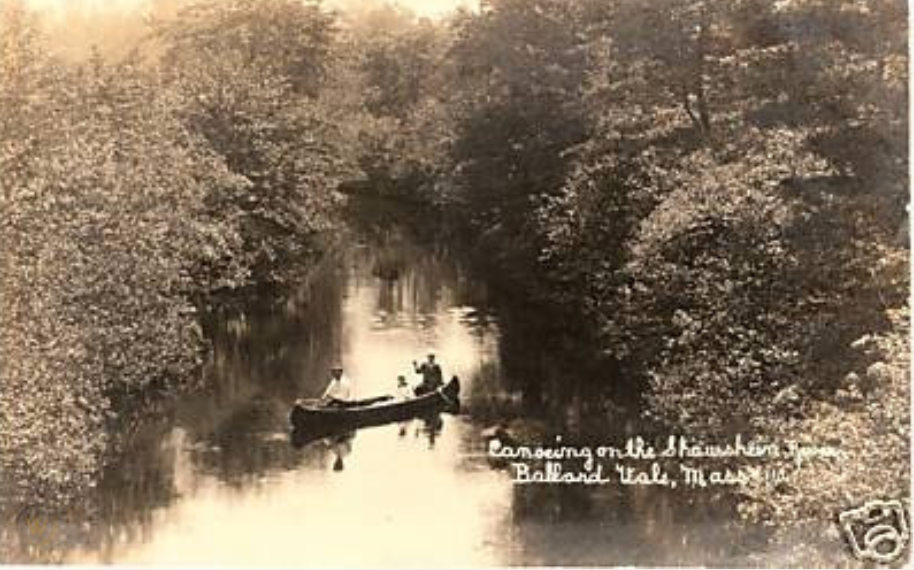
Below, a postcard with the caption "Canoeing on the Shawsheen River, Ballard Vale, Mass" shows a portion of the river about the time the Ballard Line was running.
a free flowing river
During the 19th century, the Shawsheen River, like so many others, had multiple dams built along its course to harness water power. Over the years, dams will eventually degrade the surrounding environment, includeding wetlands, forests, farms and subdivisions in the area. Not only do dams harm both the water quality and habitat for fish and wildlife, but they can also cause flooding to nearby homes. By the early 21st century, many of these dams had been removed with only three remaining on the river, all of them in Andover.
According to Gail Ralston, who also wrote the story on the Ballardvale yacht cruises, the town of Andover began discussions in 2007 "addressing dam removal." Finally, in 2016, the town began working with the Massachusetts Division of Ecological Restoration and other partners to begin restoration of the river.
The three remaining dams were, in downstream order, the Ballardvale Dam, the Marland Place Dam and Balmoral Dam. The Marland Dam, shown below, was a mill dam built in the 19th century.

The Balmoral, built for strictly ornamental purposes, was constructed in the 1920's.

The committee decided that two of the dams, Balmoral and Morland, had to go. Work began on the removal of both in 2017.


Below are pictures of the river flowing freely where the Morland, first, and the Balmoral, second, used to be.


Ralston writes: "That leaves the Ballardvale dam. Currently it has Historic Register status. It is an important part of Ballardvale’s history and voices against its removal are passionate. Some offer that a fish ladder could possibly allow fish to continue their natural path. But given environmental benefits to removal and costs to maintain, perhaps it’s time to return to pre-history – nature’s history – and the writing of a new history."
The dams built on the Shawsheen River by our Ballard relatives and others who came after them served their purpose for colonial people living on the banks of the river. Now, maybe it's time, as Ralston says, to finally let the river run free again.
Nathan Hall and the wolves
A story about our uncle by our cousin!
Wolves at the Door A Story from Early New England as told by Reverend Ebenezer Hill (3C7X)
In the early days of Township Number One (which later became Mason) wolves were so numerous that their howling−when they came down at night from the surrounding hills in search of food, especially in the autumn and winter−was so loud and constant it disturbed the sleep of the people in the scattered house who had toiled all day. It was dangerous to go out at night or to remain outside after dark. Mothers, as soon as dusk began to fall, became increasingly concerned about their children, called them in, counting each one to make sure. Families were large in those days, and the children were almost as hungry as the wolves.
It took years, working with axe, hoe and simple plough, to prepare fields for raising grain in the wilderness; and even then they did manage, at least, to harvest a small crop, there were no mills to grind the grain into flour or meal. For years grain had to be carried, sometimes many miles, to older settlements to be milled, or meal had to be purchased, together with whatever other staple provisions were needs, and carried back to Number One, where there was neither a shop nor a store.
North of the First Meeting House on Meeting House Hill lived one of the earliest settlers here, Deacon Nathan Hall (7U), with his wife, Mary, and their eight children (the ninth had not yet been born). In order to keep his family fed Deacon Hall, after laboring all day on his farm, would often travel to Pepperell on foot, making his way through the forest by lantern-light, following marked trees, returning at dawn with a big bag of meal for his hungry children. Then he would labor as usual all the next day.
One night, after the Deacon had shouldered his gun, taken a lantern and departed on such an expedition, the children were all tucked into bed, Mrs. Hall, rocking the fretful baby, Elizabeth in her cradle, heard a blood curdling howl. In a moment, she heard another and soon she knew by the sound that not only were several wolves in the vicinity, but they were approaching the house. She got up from beside the cradle and, moving with the agility of a trained juggler while using the strength of ten women, she made fast the “shuts” at the windows, drew in the latch string, secured the bolt, moved the heavy pine chest over against the door, bracing it with logs of firewood from behind the settle. The baby began to cry, which made the wolves outside howl the more. Soon they were scratching, pawing, and throwing their weight against the door. Mrs. Hall took the baby from the cradle, quieting it in her arms. The children, shivering with fear, got out of bed and busied themselves, at their mother’s suggestion, piling everything in sight on the inside of the door: chairs, iron kettles, pots, benches, the heavy crock of soft soap. . .then huddled by the fire, the frightened family watched, wide awake, all through that horrible night.
At dawn, the wolves glided away like phantoms. Mrs. Hall and the children dismantled the barricade, and little Mehitable Hall (1C8X) put out the latch-strong again, just in time for their father, back from Pepperell, to give it a pull and step in, where he was immediately surrounded by his excited, hungry, tired children. He put his gun in its place above the door, set the big sack of meal he had brought, on the hearth, kissed his white-faced wife and took the baby from her, to free her hand for the making of a great pot of good hot porridge which, when it was ready, tasted better to the family of Deacon Nathan Hall than any porridge ever made, before, or after.
Our uncle Nathan Hall, whose family was featured in the wolf story, was the grandson of our immigrant ancestor Richard Hall (9GGF) of Bradford, MA. Nathan was born in Bradford in 1715. By 1742, he was in Tewksbury where he married his wife Mary and where their first two children were born. Nathan and Mary made another move to Groton before finally settling in Mason, New Hampshire in 1751. Our cousin John Boynton Hill (4C6X), son of the Reverend Ebenezer Hill, wrote a short bio of Nathan in his History of the Town of Mason, N.H., which was originally called No. 1.
He, (Nathan) bore his full share in the labors, trials and privations attending the settlement of the new town. He began upon the farm on which Capt. Joseph Saunders now resides. In 1752, in the report made by the committee, at the proprietors' meeting, of "what each man has done in No. 1," he is entered as follows: "Nathan Hall, a house and seven acres of land, six of it broke up, and dwells there." He was frequently appointed on committees in the business of the Proprietary, and after the incorporation of the town, he was elected town treasurer, which office he held eight years in succession. He was one of the original members of the Congregational Church, and elected a deacon at the first election of those officers, and held the office till his death. He died May 7, 1807 aged 91 years, leaving behind him a reputation for spotless integrity and a useful and blameless life, which his posterity may cherish as the best legacy he could leave for them.
Reverend Ebenezer Hill
The man who wrote Wolves at the Door was our cousin Ebenezer Hill (3C7X). Since the baby in the story was born in 1765 and Cousin Ebenezer was born in 1766, the story he wrote was obviously passed down in town lore.
The information I got on Ebenezer came from a book called Ebenezer Hill: The Little Minister of Mason, New Hampshire, written by his grandson Charles Ebenezer Hill (5C5X) and two of his sons. Charles, shown below, was an attorney and a professor of history at Dartmouth College.
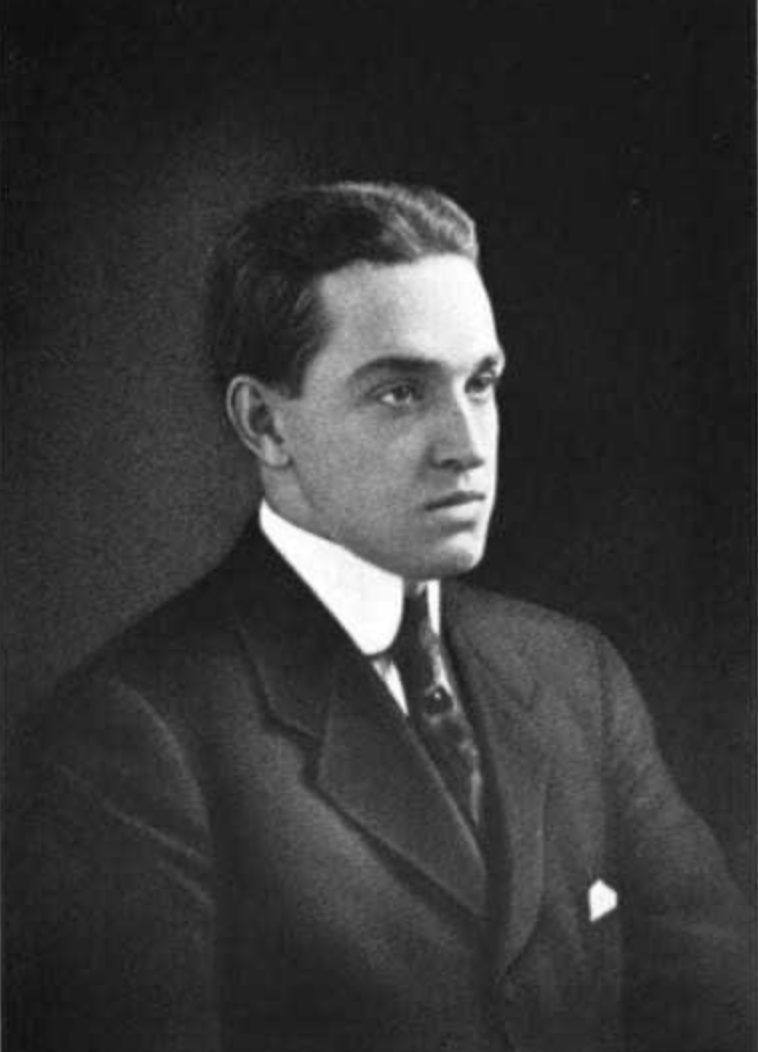
Charles begins the book about his grandfather with this passage:
THROUGHOUT the countryside he was known as “The Little Minister of Mason.” Barely five feet in stature, but of perfect proportions, with delicate, clean-shaven features, firm lips, quick eyes,—neat, sprightly, genial—he was fitted to win favor. The fact that two churches eagerly contended to secure his services (Mason and Marlboro), while a third (Ashby) withdrew from the contest as hopeless, and that within ten years he was able to win in marriage three estimable ladies, proves that the Little Minister was attractive.
Below is a picture of the "attractive" Ebenezer Hill.
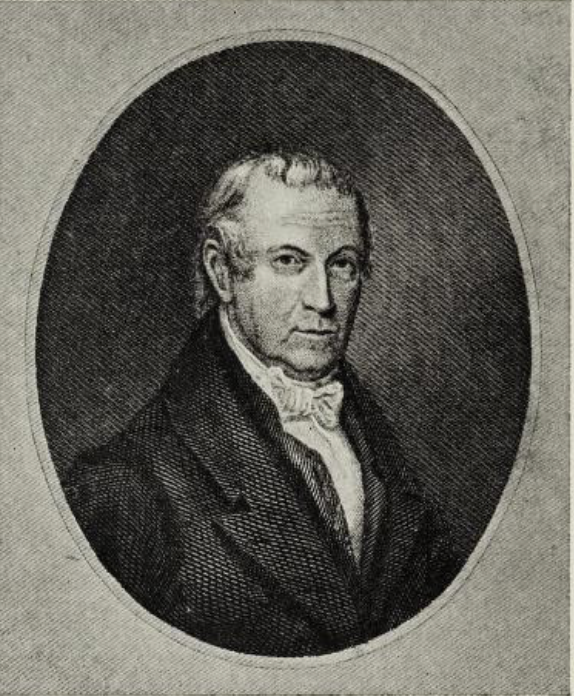
Ebenezer was born in Cambridge, MA in 1766 and, in 1784, graduated from Harvard College. He taught school in Westford, MA for six years before taking a position as minister for the town of Mason, New Hampshire.

Note: Our immigrant ancestor Grandpa Richard Hildreth (9GGF) owned property in the area of Chelmsford that became Westford. We'll have more on his descendents and their homes there in a future post.
Ebenezer married Mary Boynton, known as Polly, the next year. When the couple made the move to Mason, his brother Samuel, Jr. (3C7X) and his parents came along for the ride. Father, Samuel Hill, Sr. (2C8X) was born in 1715. He was 20 years older than his wife Sarah and in his 50s when their two sons were born. By the time of the move to Mason, Samuel, Sr. was in his 70s and went to live with Samuel, Jr. but "the mother (then in her 50s) remained with her favorite son Ebenezer."
Ebenezer and Polly had a son born in October of 1791 and twins born fifteen months later in early 1993. According to Charles Hill, "the rigors of a New England climate, and the care of those three infants, were too much for the mother. Fourteen months after the birth of the twins, the Little Minister recorded in his registry of deaths: 'March 2d, 1794, Polly, wife of Ebenezer Hill, aged 29 years.'
Ebenezer let a civilized year and three months pass before wooing another wife. Below is a letter he wrote to Rebecca Howard in June of 1795:
My dear Becky: (if I may be allowed to address you by that name, which liberty I wish for.)
I must own to a pleasure in your company which I have not lately found in any other person’s; and, different from what happens in many other cases, the reflection pleases. I was led to seek an acquaintance with you from the character given of you by persons whose judgment I esteem. . .
Ebenezer's notation for the marriage says: “November 18, 1795. Ebenezer Hill and Rebecca Howard were joined in marriage by the Rev. Mr. Kidder, of Dunstable."
Note: The Rev. Mr. Kidder who conducted the marriage ceremony for Cousin Ebenezer was our first cousin Joseph (1C7X), born in Billerica, later of Dunstable. We'll have more on Joseph in a future post.
Life continued to be a challenge for Ebenezer and his family. After two more children were born "[l]ife in that family, with five small children, the eldest barely five years old, the grandmother then about sixty-three, must have been for the Little Minister, and especially for that young mother, savored with hardship." Poor Becky "sank into consumption." She died 12 Jul 1797, only 26 years old.
Two years later, "relief came, and the clouds were dispelled." Abigail Jones Stearns, "a young, attractive widow, belonging to a wealthy and honored family" waltzed into Ebenezer's life.
With her coming, the years of trials and hardships came to an end. She brought with her an ample dower, which furnished the needed relief. A new house, the present commodious mansion, was at once started and carried rapidly to completion.

In 1822, "convinced of the evils of intemperance, the Little Minister zealously undertook a temperance reform, and banished from his cupboard the square case-bottle of Medford rum, from which he and his brethren had so often drawn cheer and comfort. And, further to set an example in the breaking off of bad habits, he gave up chewing tobacco."
The heaviest weight on Ebenezer's mind, however, concerned the spiritual welfare of his four sons. "Year after year he had preached and prayed and catechised, but not a single one had made profession of faith. . .His letters to his absent children are full of anxious entreaty, argument and regret." Ebenezer's sons had all moved on to new horizons away from Mason and most were quite successful in their lives. Happily for Ebenezer, at least one was eventually returned to the religious fold.
On July 16, 1844, when Ebenezer was 78, a family reunion was held for the first and last time at "the old mansion." His daughter Martha (4C6X) wrote about the event:
We are all here. All this side of the spirit land are now congregated under their father’s roof, to spend a few days renewing the affections and sympathies of home . . . There is something in the atmosphere of home that dissolves all formality. . . Our house resounds with the sound of the viol, the merry laugh and cheerful voices. . . When we are all gathered around the family board, my father sits like an aged patriarch at the head, and both sides are lined with his descendants to the farther end of the room.
In 1846, Ebenezer "began to fail in body and mind. There was no sudden breakdown, but he was eighty years of age. He slowly grew feebler until he reached the end. The closing years were years of quiet peace. In the summer season, children and grandchildren visited the old home."
After a visit to Mason in 1852, Ebenezer's son Bancroft (4C6X) wrote the following letter about their father to his brother Timothy (4C6X):
He passes much of his time in a dozy, rather than a lethargic condition; but his condition of mind and body partake so much of lethargy that he is spared those painful emotions that would be so unpleasant to one of his active and independent temperament, had he the power to see and contemplate the wreck of what he once was . . . Mother fails, I think, quite as rapidly as father did at her age.
Ebenezer died in 1854 at age 88. His "savior" wife Abigail died five years later in 1859.
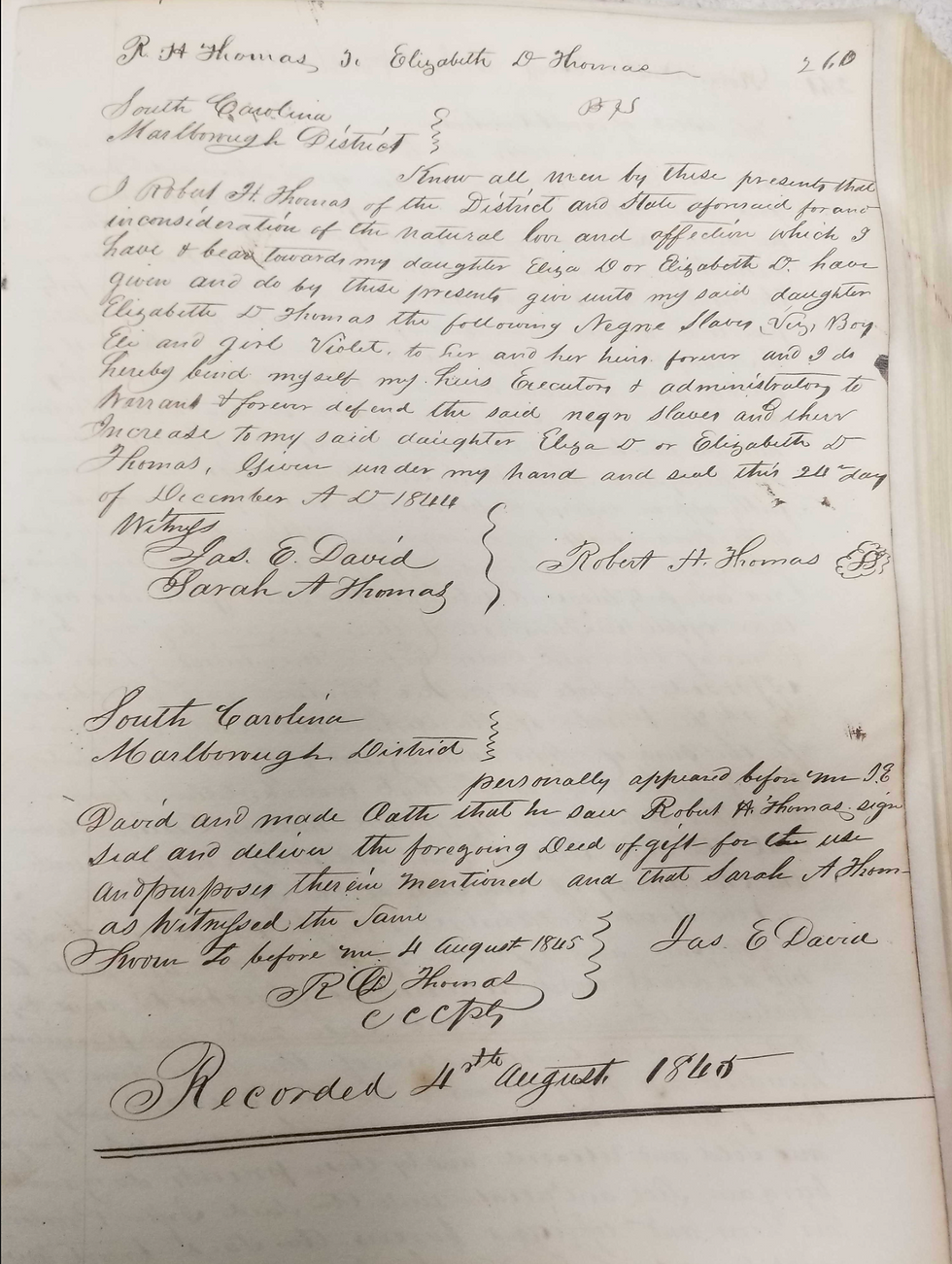
Below is the text of a tablet erected at his church in Ebenezer's honor by his parishioners:



Comments