
OUR FAMILY AT SARATOGA
- westmohney

- Dec 1, 2023
- 8 min read
Updated: Oct 20, 2024
We were now ordered to pass the river and take a position on Bemis Heights, which post we occupied till after the capitulation of Burgoyne, and witnessed the surrender. ~ Stephen Greenleaf

By the time the Battles at Saratoga had been fought, the Continental Army was something of a force to contend with. Record keeping on men in the army had also gotten a lot better. A site called Heritage Hunters of Saratoga County has a complete indexed list of men who participated in the battles at Saratoga. From this list I was able to compile the following post of our family at Saratoga.
GRANDPA JOHN PARRISH
Our grandfather John Parrish (5GGF) was grandfather to Ezra (3GGF) and great-grandfather of Enoch Kidder (2GGF), a pioneer of apple growing in Oak Glen. Grandpa John, who lived in the state of New York, participated in both the first and second battles at Saratoga. In 1832, he detailed his military service in order to receive a pension. His service mostly included supplying the army with needed stores and supplies. After the battles, he helped to collect and prepare the confiscated weapons and artillery that became important to the Americans for the last phase of the war. We'll have more about Grandpa John in a future post.
STEPHEN GREENLEAF
Cousin Stephen Greenleaf (6C5X) was a grandson of our apothecary cousin Daniel Greenleaf (4C7X). We wrote about Daniel and his wife in our "The Greenleafs" post. At the time of the Saratoga campaign, Stephen was only 16 years old. When he was 80, like many older men hoping for a pension, he wrote an account of his service as a soldier during the Revolutionary War. Stephen explains how he was working in the fields with his father when the two of them were drafted. His service probably began around late July 1777.
My father being very infirm, I performed the service for us both. . .Our first march was a short one. . .Its object was to intercept a division of Burgoyne's Army, said to be advancing toward Boston by crossing the Green Mountains. . .Here we were joined by troops from NH. . .but not being in sufficient force to withstand a formidable enemy, our officers held a council and ordered a countermarch. After a very short respite from our fatigue we returned home the second time, only to be again called put to Join Gen. Stark at Bennington. We marched, and arrived there the day after the battle; from whence we, with a detachment from Mass, were ordered to occupy as an outpost Van Ness buildings. . .After guarding this post a few weeks the military were dismissed, but hardly returned home before an express came, and a new levy was ordered; and again I was on the march for Saratoga, where we arrived, and were annexed to Col. Schuyler's Reg of Militia. Here, I was, with several other Green Mountain boys. . .detached to make up a scout for observation and discovery. Two days afterwards commenced the decisive battle near Stillwater, which terminated in the capture of Burgoyne and his army. Our company was selected and ordered to attempt the raising and floating several batteries scuttled and sunk, by the enemy, in the river during their retreat, which we successfully accomplished. Our way to the river led us by a redoubt erected by the British, where it was reported the remains of Gen. Fraser, of the British Army, were interred. . . . We were now ordered to pass the river and take a position on Bemis Heights, which post we occupied till after the capitulation of Burgoyne, and witnessed the surrender.
Stephen eventually received a major's commission in the New Hampshire State militia and his picture, shown below, hangs with others in the Brattleboro, NH town hall.

Later in life, Stephen "became a man of letters and numbers." His daughter said that her father "educated himself, long winter evenings, by light from the kitchen fireplace." A poem that he wrote titled "A Poem of the American Revolution" is housed in the Brooks Memorial Library:
You free Born Americans Stan By your Wrights
And Drive the Damd islanders all to their Kites
Nor Let them get foothold But Quickly with Stand
with Sulfur & Ball their Piratical Band.
What Cannot Americans Doo when we See
at our head Hancock Washington Putnam and Lee
Those Boogers Came over from Blunder Shire Land
with guns on their Sholders & Swords in their hands
to hold A grand Ball it was their intent
to Plunder and Rifle the whole Continent
But Dansing to Concord they had their Supply
of Balls in their Asses the Yankees let fly. . .
These Booger Love Dancing & Dancing is their traid
But to Dans with those yankeys they have Sense Bin Afraid...
Tis o you old islanders what think you now
of your Gage or your Clinton your Burgoyne or Howe
those generals Brave have Maid their Retreat
Now more with Americans Darst they to meat...
Go home to Poor George & tell him your Plite
and how difficut tis without fingers to fight.
SAMUEL HILDRETH
Cousin Samuel Hildreth (3C7X) was born in Townsend, MA in 1750. When he was 20, Samuel decided he wanted to study medicine. He became a cooper in order to earn the money for his studies with Dr. John Brown in Wilmington, MA. Two years later, he was able set up his own practice in Methuen.
In October of 1777, Stephen volunteered for a position as army surgeon and was at Saratoga treating not only American soldiers, but also wounded Hessian soldiers. Later in the war, he took a position as ship's surgeon on a privateer. In 1780, he had the misfortune to be captured by the British and taken to Quebec. In the spring of 1781, he was sent to Trois-Rivières, about 80 miles southwest of Quebec City, where he learned to speak French, and was asked by the British to treat the residents there. Stephen was so successful that he soon established his own medical practice serving the surrounding settlements as well.
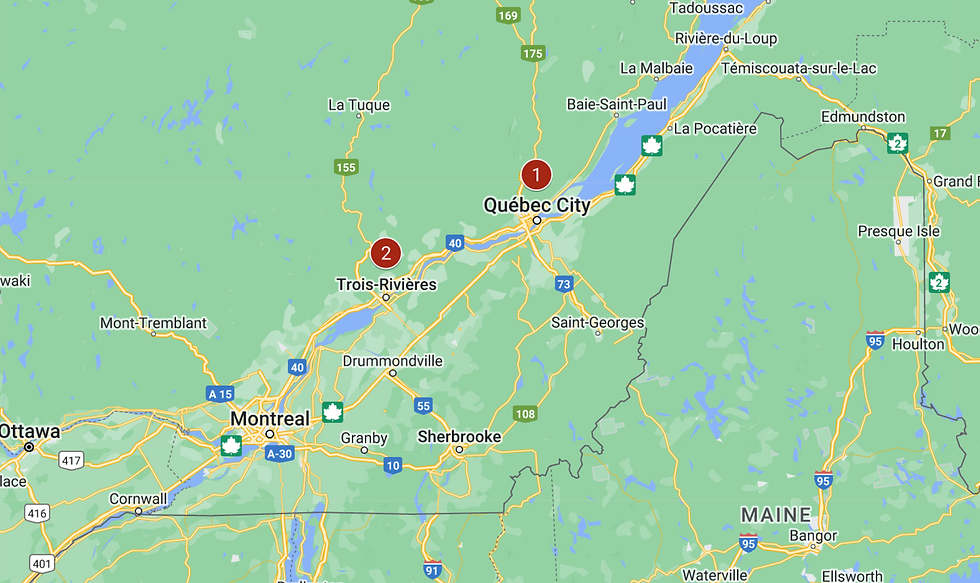
Though Stephen was doing quite well, other prisoners weren't quite so happy. When some of his fellow soldiers decided to escape, Stephen decided to throw his lot in with them. That turned out to be a bad decision. When the prisoners were recaptured, they were sent to "close confinement" in a Montreal prison, possibly the infamous Chambly where many of our captured relatives had spent time. In prison, Stephen contracted "jail fever" but luckily recovered "due to the ministrations of the Sisters of Charity." In November of 1782, as the war was winding down, Stephen was released and sailed for Boston.
After the war, Stephen became a shareholder in the Ohio Company of Associates which was a land speculation organization. Samuel, himself, did not make a move to Ohio but his son, Samuel Prescott Hildreth (4C6X) settled in Marietta, Ohio where he set up his own medical practice. We'll hear more about Samuel Prescott in a future post.
Samuel, Sr. died during a visit to his son in Ohio in 1823. He was 73 years of age. Samuel Prescott had his father buried at Mound Cemetery in Marietta which has the distinction, according to Wikipedia, of reportedly containing "the largest number of Revolutionary War officers buried in one location."
RELATIVES FROM TOWNSEND, MA
Townsend is where our grandfather Daniel Ebenzer Sherwin (5GGF) made his home. Two of his sons answered the call for volunteers in the Burgoyne Campaign, Daniel Ebenezer Sherwin, Jr. (4U) and John Sherwin (4U).
Note: Daniel Sherwin, Sr.'s granddaughter was Susannah Sherwin (3GGM) who married our grandfather Ezra Parrish and made the long trek across the United States, finally settling in San Bernardino.
We found other relatives who also signed up from Townsend town records:
Capt. James Hosley's Muster Roll of Volunteers, who turned out of the towns of Townsend. Pepperell and Ashby, and marched with him to the assistance of Major-General Gates, agreeable to a Resolve of the General Court of said State, upon September 22d, 1777:
Sergt. Elijah Wyman (4C7X), Corpl. Abel Richardson (4C7X), James Hildreth (3C7X) Abel Hlldreth (3C7X), Joseph Baldwin (3C6X), Jonas Baldwin (3C7X).
These volunteers were in the service one month and fifteen days, aud the pay of the privates
was £3,
JOSEPH FAY
Our cousin Joseph Fay (5C9X) descended from our Brigham family in Marlborough. He was born in Walpole, NH in 1738. In the spring of 1777, Joseph was stationed at Ticonderoga just months before the British attack there. His son, Joseph, Jr. (6C8X), only 14 at the time, was with him. When Ticonderoga was evacuated by the Americans, Joseph and his son marched with his company to take part in the battles against Burgoyne at Saratoga. Joseph, Sr. was wounded in his thigh in the Battle of Freeman's Farm. From the Saratoga National Historical Park site:
He was "shortly after carried to Albany." It was in Albany's General Hospital that Joseph's leg was deemed unsavable and had to be amputated. Many people who endured the pain and trauma of this type of surgery survived and indeed, Joseph "was thought to be recovering" after the surgery. However, his condition took a terrifying turn in the dark hours of November 2, when his "ligatures slipped off the stump, and he bled to death."
Joseph, Jr. returned home after his father's horrifying ordeal, but later enlisted in his father's place and served until 1780. Records also show that Joseph, Sr's widow received a pension after her husband's death.
JOHN COLE
Our cousin John Cole (1C7X) was born in Boxford, MA in 1741. He served as a sergeant in the Battle of Bunker Hill. By the Burgoyne Campaign, he was a captain who commanded a company that fought in both battles at Saratoga. After the war, he settled in Windham, VT where he was "several time surveyor, fence viewer, and committeeman." He died in Westmoreland, NH while visiting his son. He lived to the ripe old age of 88. His grandson, Benjamin (3C5X) proudly laid claim to John's "bullet-moulds."
JOSIAH CUMMINGS
Cousin Josiah Cummings (4C6X) was only 14 when he joined the army in 1777. It's unclear whether he fought at Saratoga but he did serve as one of the guards that watched over the British prisoners after the surrender.
ELIPHALET ADAMS
Cousin Eliphalet Adams was born in Suffield, CT. in 1756. He served under General Stark at the Battle of Bunker hIll, was at the evacuation of Boston and fought in both battles at Saratoga.
Sometime before 1798, Eliphalet lost his house and all his furnishings in a fire. Since easterly townships in Lower Canada were offering opportunities for immigrants to obtain land, he pulled up stakes and moved his family to what is now Sherbrooke, Canada, near Montreal. We'll have more about Eliphalet's children's adventures there in a future post.
THE BALDWIN BROTHERS OF MILFORD, CT
This story comes from the Baldwin Memorial by Charles Candee Baldwin (6C5X). The tale that was passed down in family lore is that brothers Jared (5C6X) and Joel Baldwin (5C6X) took part in the Battle of Bemis Heights and were there for the surrender of Burgoyne. From Charles Candee's account:
Just before the surrender, their mother (Experience) went on horseback from Saybrook to the American camp, laden with stockings, shirts and other articles of comfort for her children. Jared, her son, says "A few days after her departure, the battle was fought, during which our guns became so heated by repeated firing, that they were unfit for use, and the guns of the killed were picked up and used instead.
The tale already seems a tad unbelievable given that Saybrook, CT is 177 miles from Saratoga. What probably is true is that "Mother Experience survived many years, to be nearly a hundred years old, never used glasses, and retained her faculties very completely."
Joshua Kittredge
Our cousin Joshua (1C8X) was born in Tewksbury, MA in 1762. From his pension application, we know that he served three months guarding the "troops of convention" after Burgoyne's surrender. He was also at West Point "the same year that Arnold escaped." After the war, Joshua married his (and our) cousin Lydia Kittredge (3C8X).
Note: Burgoyne's army was known as the Convention Army.
OTHER FAMILY AT THE BATTLES
56 Richardsons
53 Hills, probably about half ours
41 Eatons, probably half ours
34 Frenches, probably half ours
20 Holmes, probably about half ours
21 Baldwins
19 Stickneys
17 Brighams
16 Wymans
12 Ballards
12 Grangers
12 Proctors, about half ours
11 Kidders
9 Crosbys
8 Pattens
6 Swans
5 Greenleafs
5 Haseltines
5 Littlefields
4 Symonds
3 Daltons
3 Kittredges
2 Heywoods
2 Sherwins, one our uncle
2 Hildreths
1 Cole
1 Adams


Comments