
Patten family of note
- westmohney

- May 2, 2025
- 8 min read
Every man is a quotation from all his ancestors ~ Ralph Waldo Emerson
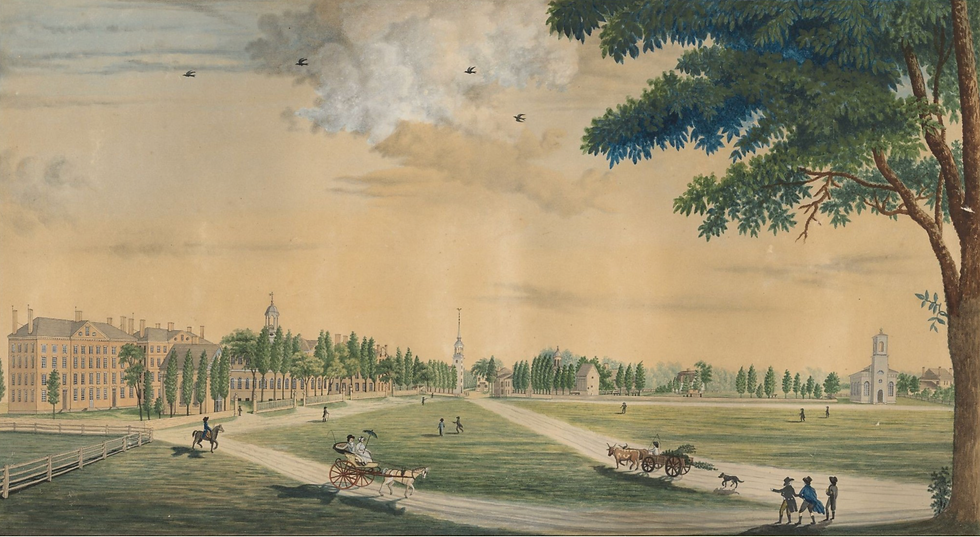
In 1735, our grandfather William Patten (10GGF) settled in Cambridge. In 1652, when the town of Cambridge was granted a large parcel of land about 20 miles to the northwest William receved 80 acres of land there. That property would eventually become the town of Billerica. While William never moved to his newly acquired land, his son Thomas (9GGF) did. Our branch of the Patten family lived in Billerica for many generations. Our Patten line ended with the marriage of Thomas' granddaughter Rebecca (7GGM), to Joseph Davis (7GGF) in 1691.
Francis Bernard Patten and the Aroostook War
In September of 1783, the Treaty of Paris ended the Revolutionary War. The treaty, however, didn't end the ongoing hostility still felt between the British and Americans. The three year War of 1812 had been fought over trade and expansion issues. The Treaty of Ghent ended that war, but neither treaty had made clear the exact border between the state of Maine and British held New Brunswick.

Minor skirmishes, mostly over timber rights, were ongoing between the Acadians in the Madawaska River Basin and the Americans in the Aroostook Valley. More problems arose in the 1820s when both Maine and Massachusetts began issuing land and timber grants in areas the New Brunswickers felt belonged to them. By 1831, tensions were so high that King William I of the Netherlands was called in to arbitrate. Calling treaty guidlines "inexplicable and impractical," William I drew his own boundary line which gave the Americans 7,908 square miles and Britain 4,119. Britain accepted the King's decision. Maine rejected it.
All efforts to resolve the issue failed over the next eight years. Matter came to a head when, in 1839, the Maine legislature decided to authorize the Penobscot County sheriff to round up a posse and arrest New Brunwickers found in the disputed area. The New Brunswickers retaliated by gathering their own posse and seizing the Maine land agent and his assistants. They held these men in Woodstock, New Brunswick for "interviews."
At this period of the dispute, our cousin Francis Bernard Patten (4C6X), along with other U.S. militiamen, finally got involved. Francis was born in Cherryfield, ME in 1811. In 1839, he was part of a contingent of over 1,000 American Maine militia men enlisted to either keep the peace or fight if necessary. Francis, a member of the Cherryfield Light Infantry, was sent to the town of Calais which, today, sits right inside the American side of the border. Even as the Americans prepared for possible battle, the Mohawk Nation then offered their services to the British Canadians.
Luckily, matters never came to that. Having already fought two wars in the space of 40 years, neither side was willing to let the altercation balloon into yet another. Daniel Webster to the rescue. He, with the the help of the British Baron of Asburton, found a map in the Paris Archives on which "Benjamin Franklin had supposedly marked with a red line." As ridiculous as it might seem, both parties accepted Ben's line and the Americans received 900 square miles less than if they had just accepted King William's proposal in 1831.
Cousin Francis remained in Calais until the end of hostilities when he returned home. He was listed as a clothier in the 1850 census of Franklin, ME, 17 miles west of Cherryfield. Francis died in Franklin in 1891 at age 80.
General George Patten
George Waynflete Patten (5C6X) was born in 1808 in Newport RI, the son of Reverend William Patten, Jr. (4C7X). We wrote about Willam, Jr. in our "The Patten Family" post. There has been some confusion about George's middle name. Sometimes, mostly in military records, he is referred to at George Washington Patten. George graduated from Brown University in 1825 and from the U.S. Military Academy at West Point in 1830. He served at various times against the Seminole Tribe in Florida during the second Seminole War. The first Seminole War in 1818 was caused by Britain's animosity toward the United States. Even though Florida was a Spanish Province at the time, the British encouraged the Seminole to attack Americans wanting to settle there. That war ended with the Spanish ceding their Florida territory to the U.S.
The second Seminole War, 1835-42, which has been called "the fiercest war waged by the U.S. government against American Indians," was triggered when the Seminole living in Florida refused to leave as agreed to in a 1932 treaty that was signed by only a small number of tribe members. According to the Florida Department of State website:
The campaigns of the Second Seminole War were an outstanding demonstration of guerrilla warfare by the Seminole. The Micos Jumper, Alligator, Micanopy and Osceola, leading less than 3,000 warriors, were pitted against four U.S. generals and more than 30,000 troops. The war left more than 1,500 soldiers and uncounted American civilians dead. And the obvious duplicity of the U.S. government's tactics marred Indian-white relations throughout the country for future generations.
Even after Seminole leader Chief Osceola was captured in 1838, his people soldiered on. The war didn't end officialy until 1842. By that time most of the Natives had been relocated to "Indian Territory" in Oklahoma.
Over the years, our cousin George became very well known for poems and verses that he wrote. One of his poems makes it clear that George had respect for the grit of Seminole that he fought against. Here are a two stanzas from "The Seminole's Reply:"
I've scared ye in the city
I've scalped ye on the plain;
Go, count your chosen, where they fell
Beneath my leaden rain!
I scorn your proffered treaty!
The pale-face I defy!
Revenge is stamped upon my spear,
And blood my battle-cry
I loath ye in my bosom,.
I scorn ye with mine eye;
And I'll taunt ye with my latest breath
And fight ye till I die!
I ne'er will ask ye quarter,
And I ne'er will be your slave;
But I'll swim the sea of slaughter,
Till I sink beneath its wave.
After fighting in the Seminole Wars, George remained in the military and reached the rank of captain in 1846. The next major conflict he was involved in was the Mexican American War. Mexico had severed relations with the United State in 1745 when the U.S. annexed Texas. In April of 1746, skirmishes began at the Mexican/Texas territory border. Battles began in earnest in Texas and California and by August had spread into Mexico and other Mexican territories that are now part of the U.S.
The war raged on with multiple battles every month for two years. George was at the "vicious" 20 day Siege of Veracruz in March of 1747. The Mexican surrender there paved the way for U.S. army to advance to Mexico City. The Battle of Cerro Gordo took place in April en route to the Mexican capital. While storming Atalaya Hill in that battle, Cousin George lost his left hand. For his "gallant conduct" at Cerro Gordo, he was brevetted major, a temporary position.
Despite the loss of his hand, George continued his service in the war. The U.S. army fought their way through Mexico on their way to the capital. When they finally arrived on September 15th, Mexican general Santa Anna had already withdrawn most of his troops. Occupation of the capital, however, didn't end the war which continued for another six months. The Treaty of Guadalupe Hidalgo was signed on February 2, 1848. We'll have more on the Mexican American War and its implications in a future post.
The war had evidently taken its toll on George. He asked for and received a leave of absence which lasted for two years. He returned to duty in 1850, serving on the American frontier. In 1861, he was commissioned a full major and, in 1862, promoted to lieutenant colonel. Though his disability made him ineligible to serve on the battlefield in the Civil War, he did his service on various commissions in California and Washington state. In 1865, George retired "for disability resulting from long and faithful service, and from wound and exposure in the line of duty."
For his various writing projects and poetry, George has been called the "poet laureate of the army." From his obituary:
Col. G. W. Patten, whose death was announced in The Times a few days since, was very well known to our readers as a verse writer, although war was his profession. Not many men have wooed the poetic muse while they have followed Mars.
Jesse's Patten's bridge
Our cousin Jesse Patten (3C7X) was born in Temple, New Hampshire. A stonemason by trade, he was commissioned in 1817 to build a replacement bridge over the Souhegan River in New Ipswich, NH. The previous bridge, built only two years earlier had "suffered from shoddy work and very soon after its completion it fell down."
New Ipswich was about seven miles north of Temple.

Jesse's bridge, which rests "on a single arch," is about 157 feet long and 55 feet high. According to the New Hampshire Preservation Alliance, the cost for the bridge was "$2,400 (including $100 for rum), and took just 132 days to construct." Known today as High Bridge,
it is the oldest masonry bridge in New Hampshire.
In 1957, the Department of Transportation (DOT) built a steel and concrete highway bridge over Jesse's historic stone work. When the 1957 project had to recently be updated, the Department "took a careful look at how to best reduce impacts to the historic masonry." The DOT's conscientious work in refurbishing the bridge garnered it a 2018 Preservation Achievement Award from the NH Preservation Alliance. Below is a photograph of the bridge after the renovation with Jesse's beautiful stone work still intact:

unique bequests in the Patten family
The unique bequests begin with our cousin John Patten (2C9X), a hatter who, in 1736, was lucky enough to marry into the wealthy Loring family of Boston. John and his wife Priscilla Loring had three children, Sarah (3C8X), Mary (3C8X) and William (3C8X). Mary died young at only 13 and Sarah never married. William married Mary Russell ca. 1770 and they had only one son, Nathaniel, named after William's uncle, Nathaniel Loring.
In 1784, Cousin John died and his brother-in-law Nathaniel Loring followed a few months later. Nathaniel had inherited the bulk of his wealthy father's estate, a home, orchard, malt-house, millhouse and wharf on Beach St. in the heart of downtown Boston.

When Nathaniel Loring died, he, in turn, left the bulk of his estate to his sister Priscilla's only son, William Patten. Unfortunately, three years later, it was William's inherited malthouse that set off the great fire of Boston in 1787. We wrote about that that unhappy event in our "Patten Family" post. The blaze destroyed 100 buildings in Boston, including all of William's Beach Street holdings.
When William died, whatever was left of his estate after the fire went to his son, Nathaniel, who had taken up the profession of ropemaking. Nathaniel married in 1792 and had four children.
William's sister Sarah never married. When she died in 1808, her only remaining kin was her nephew Nathaniel. It appears, however, that Sarah didn't trust Nathaniel with her estate. In her will, she left him only a pittance. The rest she left to her "trusty friend Robert Lamb of Boston . . .all my Real Estate situate in Boston. . .To have and to hold to him . . .for and during the Life of my nephew Nathaniel Patten and after his decease to descend to the four after named Children of the said Nathaniel. . .in equal and undivided shares."
In the will she did attempt to make amends to her shortchanged nephew:
I give and bequeath to my kinsman Nathaniel Patten, late of Roxbury, Ropemaker but now residing in Boston, twenty dollars and hope the he will consider the manner in which I remember his children in the same light of affection as if I had bestowed my worldly substance on him.
Let's hope Nathaniel was able to see being passed over for his children"in the same light of affection" as if he himself had inherited.


Comments