
Patten Family Stories
- westmohney

- May 23, 2024
- 9 min read
Updated: Mar 28, 2025
The Patten School occupies a pivotal position in the history of Connecticut's needle arts and women's education.
~ Susan P. Schoelwer

the William Patten family
Our cousin William Patten (3C8X) was born 1738. His father was Nathaniel Patten (2C9X) who was driven out of his home in Roxbury when the British took over Boston in 1775. We wrote of Nathaniel in our "Revolutionary Stories" post.
William's interest in the ministry began early in life. At the tender age of five, he composed a sermon on the first verse in the Bible. Recognizing their son's talents, Nathaniel and his wife Mary moved to Cambridge where William was admitted to Harvard College when he was 12. William graduated from Harvard in 1754 and taught school in Dedham, MA for a brief period.
In 1757, before he turned nineteen, William was hired as a minister in Halifax, MA. The next year, he married Ruth Wheelock, daughter of the famed minister Eleazor Wheelock who was the founder and president of Dartmouth College. We wrote of Eleazor in our post, "The Founding of a College and the Betrayal of a People."
William and Ruth had eight children born over the course of fifteen years. The first five were born in Halifax. By 1766, however, William's health began to fail and he asked for a dismissal from the church. A year later, his health had improved enough for him to begin a new ministry in Hartford, CT. There, three more children were born.
From a memoir written by Ruth and William's son, William Jr. (4C7X), we learn that shortly after arriving in Hartford, a "calamity befell the eldest son." Young Eleazor Patten (4C7X) "in attempting to save himself from a dangerous fall, wrenched his back, which disabled him from walking, and brought on a rapid decline." Poor Eleazor died in 1769 at age 10.
There were more hard times in store for the Pattens. In 1773, the church dismissed William from his post "from the want of harmony in the Society, of his being more useful elsewhere." For a while he served as a roving minister until, according to his son's memoir, "he experienced a sudden failure of the voice." After that, William, Sr. never went back to the ministry.
The supremely Christian Pattens owned "a colored lad, given to (Ruth) by her father at her marriage, and who had been obedient and useful. . ." One morning Ruth found poor Obed "lying on his bed, speechless, with his eyes fixed, senseless, and just expiring." Mrs. Patten was particularly upset because she had labored "to bring him to a knowledge of the way of salvation without apparent successs."
After Obed's death a larger grief was just around the corner for Ruth. From William Jr's memoir:
Her lovely son, Nathaniel Wheelock (4C7X), a year and nine months old, had, for several days, been sick. Its pains were occasionally violent. . .In one of these paroxysms it expired, July 18, 1773.
To add to the family's problems, William, Sr. was not doing well. William, Jr. wrote of his father's decline: ". . .finding no relief for his voice, he despaired of resuming the ministry; and from his feebleness and infirmity, he was induced to conclude, that his course in life was nearly ended."
When his doctors decided a change of scenery might do him good, William decided to make a trip back to his hometown of Roxbury. The trip proved extremely difficult. "By short stages, and at intervening days of rest, it was more than three weeks before they arrived within thirty miles of Roxbury. The resolution of Mr. Patten then failed; and it seem to him cruelty to urge him to proceed." A carriage with a bed was procured and William finally made it to the house of his mother in Roxbury.
Ruth stayed with William for two weeks then returned to Hartford to be with her children. Sadly, William didn't survive long. Ruth received word of her husband's "departure from the world" on 16 Jan 1775. He was only 37 years of age. His tombstone inscription read: Reverend William Patten, who after a life of peculiar trials Died in great peace."
According to William Jr., "[t]he situation of Mrs. Patten was at this time peculiarly hopeless and wretched. She had a family of six children, the eldest fourteen years, the youngest sixteen months." But Ruth wasn't afraid to "live by faith" and "in methods not foreseen, provision was made for her, so that her family did not suffer." William, Jr., fourteen at the time went to live with his grandfather, Reverend Wheelock, to study for the ministry.
Hard times weren't over for the Patten family, however. Three months after William, Sr.'s death, seven year old daughter Charlotte (4C7X) died from a prolonged battle with whooping cough.
the Patten School of Hartford Connecticut
Ruth "continued several years after this time in a state comparatively obscure, attending to her family, instructing her children, and promoting their usefulness." Ca. 1785, Ruth's three daughters, Sarah (4C7X), 24, Ruth (4C7X), 21 and Mary (4C7X), 19 "established a female academy that would be a significant presence in Hartford for 100 years." A year later, in May of 1786, son William was "ordained pastor of a church in Newport, R.I." Ruth had done well with her children, raising them all to be productive members of society.
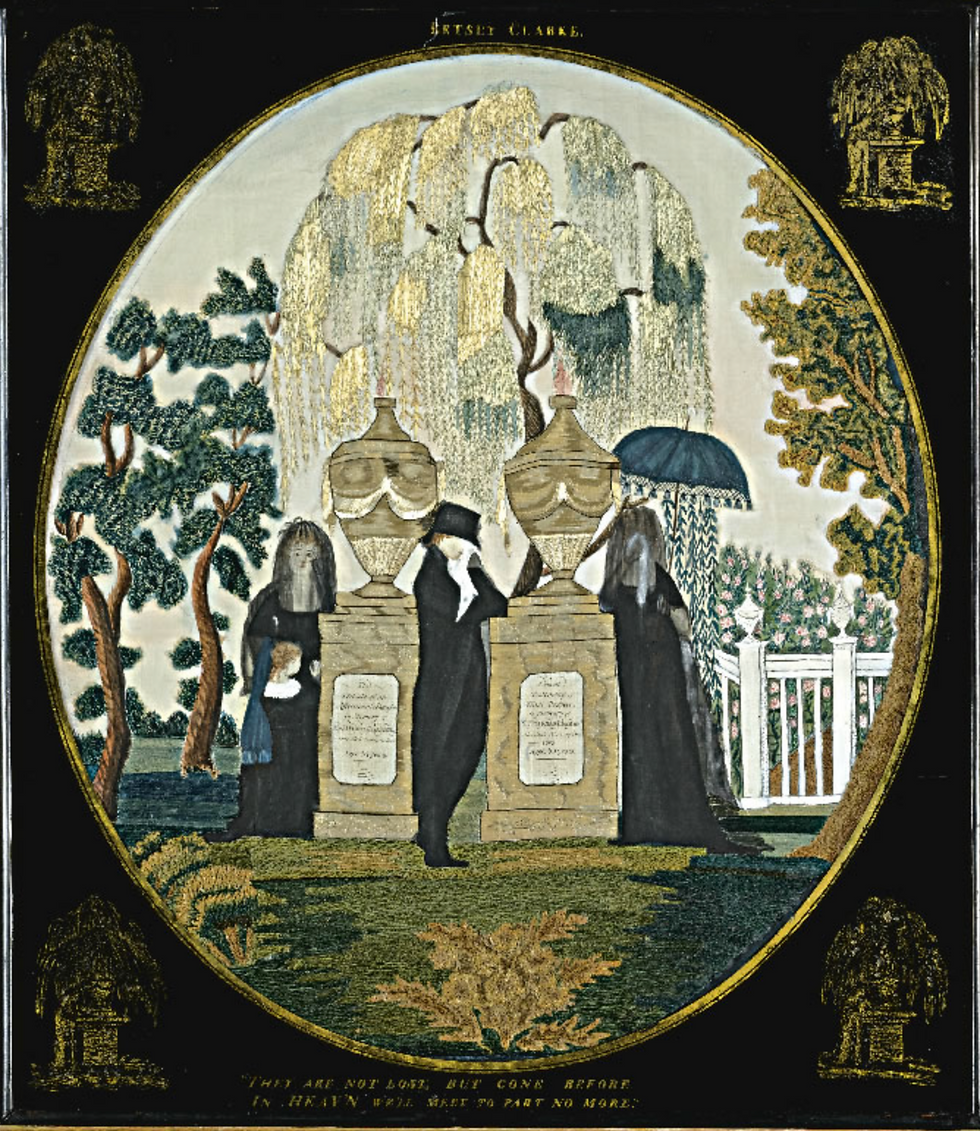
The Liverant Antiques website wrote of the Hartford Academy that "this sophisticated female academy became widely known for the needlework of its students. . .certain allegorical or Biblical subjects were favorites of the Misses Patten. . ." In her article "Lessons Artistic and Useful," Susan P. Schoelwer said that "[t]he Patten School occupies a pivotal position in the history of Connecticut's needle arts and women's education. Founded just four years after the end of the American Revolution, it arguably inspired, and cultivated a market for, the offerings of subsequent girl's schools. . ."
Schoelwer maintains that "[t]he Patten school's persistence was due at least in part to its operation as a family enterprise." William, Jr. was the only one of Ruth's five remaining children to marry and have children of his own. The three girls and the youngest son George devoted their lives to the school. In his memoir, William Jr. writes that the prosperous school,"[t]hough. . .in a sense necessary, it was not undertaken, nor was it conducted, on mercenary principles, but in a disposition to be employed in doing good."
During it's forty years history, the Patten female school reportedly educated as many as four thousand students who came from "the near and most remote parts of the U.S. and even Bermuda, the West Indies, Guyana, South America."
Below are a few of the embroidery works that were created at the school. Some of these pieces now sell for hundreds of thousands of dollars at auction. The first is a coat of arms done by Ruth Patten, Jr.



William Patten, Jr.
Willam and Ruth Wheelock Patten's second born son, William Patten, Jr. (4C7X) was born in 1763. He received a degree from Dartmouth in 1783. Dartmouth was the college founded by his grandfather, Eleazor Wheelock. In his memoir, William relates a story about himself in his last year at Dartmouth. In the book, which is about his mother's life, he always referred to himself in the third person:
He had a narrow escape from death during his last year at college. He was at his aunt's and to get to church on Sunday it was necessary to cross a river much swollen by copious rains. Several of the party crossed in a boat, but William attempted to ford on his horse and lead the other horses, but in the middle of the stream he was thrown from his horse, and it was with much difficulty that he was rescued. After getting him from the river it was fifteen or twenty minutes before he could be brought to consciousness.
Three years after his graduation from Dartmouth, William was ordained minister of the Second Congregational church in Newport, RI, 85 miles from Hartford, CT where his three sisters had just opened the Patten School. He remained at his post in Rhode Island for 48 years.
In his long career, William published many of his sermons. His most notable work, however, was his 174 page Christianity, the True Theology, which he published in 1795 as a rebuttal to Thomas Paine's Age of Reason. In 1807, he received a Doctor of Divinity degree from Brown University and remained as an overseer of the institution until his death.
When William finally retired from the ministry in 1833, he moved back to his home town of Hartford and began his book titled Memoirs of Mrs. Ruth Patten. He also published a book called Interesting Family Letters which contained letters that his mother had written and received during her lifetime.
At his death in 1839, William was characterized as a "distinguished theologian, meek and lowly in heart, most kind and benevolent."
Below is a portrait of Cousin William painted by O.S Freeland.

Boston's great fire of 1787
Our cousin William Patten of Roxbury and Hartford had a third cousin also named William Patten (3C8X) who lived in Boston. William Patten of Boston was a hatter. In 1784 he acquired a malt house from his in-laws. Three years later, this malt house would ignite the largest fire to date in the city's history.
The Massachusetts Gazette had a report on the fire four days after the event:
About sun-set on Friday last, a fire broke out in the malt-house of Mr. William Patten, in Beach Street. . .and it is with real sorrow we announce, that the devastation which ensued, within about three hours time, was never equaled in this place, excepting in the years 1711 and 1760, since its first settlement.
The malt-house, on the discovery of the fire, was almost instantly in flames. . .The wind blowing stretch from the Northward, the coals of fire; burning shingles, &c, were, however, carried, in great quantities and lodged on the roofs of many of the houses in Orange street, some of which were instantly on fire. . .It raged on both sides of this street, with awful fury. . . till an opening of vacant land towards the bay, on the west side of Boston neck prevented further destruction.
. . .the scarcity of water, the tide being down, and but few pumps near at hand were circumstances which baffled the utmost efforts of the citizens for putting a stop to the devouring elements for the space of upwards of three hours.
. . .About one hundred buildings were destroyed, sixty of which were dwelling houses. Most of the latter were handsome, and a number of them elegant and costly edifices. The loss in house furniture, bedding, and other necessary articles, together with goods and effects of various kind, is very great, and with the loss of so many valuable dwellings loudly calls upon the benevolent and humane to afford their aid in alleviating of the distresses unfortunate suffers.
Many persons, at the beginning of the fire, deposited their goods and furniture near the meeting house, which they then deemed from its remote situation, to be a place of safety; but they were unhappily disappointed, great quantities being destroyed before they could be removed a second time.
The inhabitants of Charlestown, Cambridge, Medford, Roxbury, Dorchester and Milton, with several engines, kindly afforded their assistance in helping to extinguish the fire. The light given by the fire was so great that at Watertown a person's countenance could be plainly distinguished at a considerable distance.
Historian and author Jeremy Belknap wrote a letter to a friend about the fire and included a map he had drawn of the affected area. Below are excepts from the letter and the map:
. . .I will give you some account of the fire of Friday eveing. The wind was a dry northeaster and had prevailed two days, the houses, with only one or two exceptions, were wooden and shingled. . .the wind carried the flakes of fire over the dock into some barns and dockhouses. . . and so rapid and irresistible was its progress that between 5 and 7 o'clock in the evening it destroyed between 70 and 80 dwelling houses. . .No lives were lost though much substance. . .

John Quincy Adams, hearing about the fire, wrote in his diary, "I then heard of a terrible fire, which happened in Boston last night and consumed an hundred buildings among which three or four belonging to Mrs. Amory, the mother of an amiable classmate of mine, whose misfortune I peculiarly lament.”
The fire which started in Cousin William's malt house happened only a few months after Shay's Rebellion had been put down. We'll have more on that revolt in a future post. James Bowdoin was governor of Massachusetts at the time. His handling of the rebellion had made him an unpopular man in the state. He hoped to capitalize on the fire disaster with a broadside he had printed asking for aid for the victims. Bowdoin felt his compassionate request would somehow vault him back into the good graces of the populace during the election for governor. The broadside said in part:
Whereas by the permissive Providence of GOD a great number of Families in the town of Boston, have from ease and affluence been suddenly reduced to extreme poverty and distress. . .I do most earnestly recommend to the good People of this Commonwealth, to exercise their Christian benevolence, by contributing to the relief of those who have so greatly suffered by that disastrous event.

Bowdoin's ploy didn't work. John Hancock was duly elected governor in his place.
I can find no account of what happened to Cousin William after the fire. He died in 1803 at the age of 53.


Comments