
REVOLUTIONARY STORIES V
- westmohney

- Dec 17, 2023
- 11 min read
Updated: May 16, 2025
When we illuminate the road back to our ancestors, they have a way of reaching out ~ Raquel Cepeda

the history of a milldam and family tragedy
The Concord River between Sudbury and Billerica had been particularly hard to tame for settlers living along the banks there. Our uncle Roger Toothaker (9U), the pariah of Billerica who died in the Boston jail in 1692 during the witch furor, had settled his family near the river's ever flooding shores. We wrote about Uncle Roger in our "Witches in the Family" post.
In 1710, Christopher Osgood finally managed to control the river for his own purposes with a dam to supply his mill. The dam, however, created nothing but problems for Uncle Roger's son Roger Toothaker, Jr. (1C9X) who had inherited the property after the death of his parents. With the dam so close, his property frequently became inundated with water. To appease him, the town granted Cousin Roger land in East Billerica. The map below shows the approximate location of the dam and Uncle Roger's property in North Billerica.

After Roger Jr.'s exit, thirty years of dam wars followed, lasting until Osgood's death in 1739. The next twenty years saw fulling, grist and saw mills built on the property. Then, in 1757, our grandfather William Kidder (6GGF) purchased 2/3 of the mill privilege. Grandpa William was probably fairly wealthy as he was referred to as William Kidder, gentleman. His interest in the mill was purely financial. According the the article "A short History of the Milldam at North Billerica" by Alec Ingraham, "[i]t is unlikely that Kidder actually participated in the operation of the mills. He was a latter-day entrepreneur who sold his interests in the area to John Carleton two years later."
Grandpa William may have been wealthy but his riches couldn't stave off tragedy. In our "All in the Family" post, we wrote of the series of deaths that plagued William's family. By 1760, he and his wife, Grandma Sarah Ballad Kidder (6GGM), had lost four of their seven children.
Grandpa William's son, William Jr. (5U) married our cousin Mary "Molly" French (2C8X) in 1771. Three children were born to the couple, Molly (1C6X) in 1773, William (1C6X) in 1774 and Sarah (1C6X) in February of 1778. The break in years between the births of William and Sarah represented William Jr.'s stint in the army during the Revolutionary War. He had probably returned home after being wounded in the Battle of White Plains fought in October of 1776. By December of 1778, however, both Uncle William and Cousin Molly were dead, leaving an infant and two children aged 5 and 4. William and Molly obviously died very close to the same day as both probate records are dated December 8, 1778.
The mills on the Concord River eventually came back into the hands of our relatives when our cousin Thomas Richardson (2C8X) purchased the property from Carlton. The area, which went through the hands of Toothakers, Kidders and Richardsons, has ever afterwards, even today, been known as the Richardson Mills District in Billerica.
Thomas Richardson eventually sold the land to the Middlesex Canal Company. That story in a future post.
the pewtersmith and his island
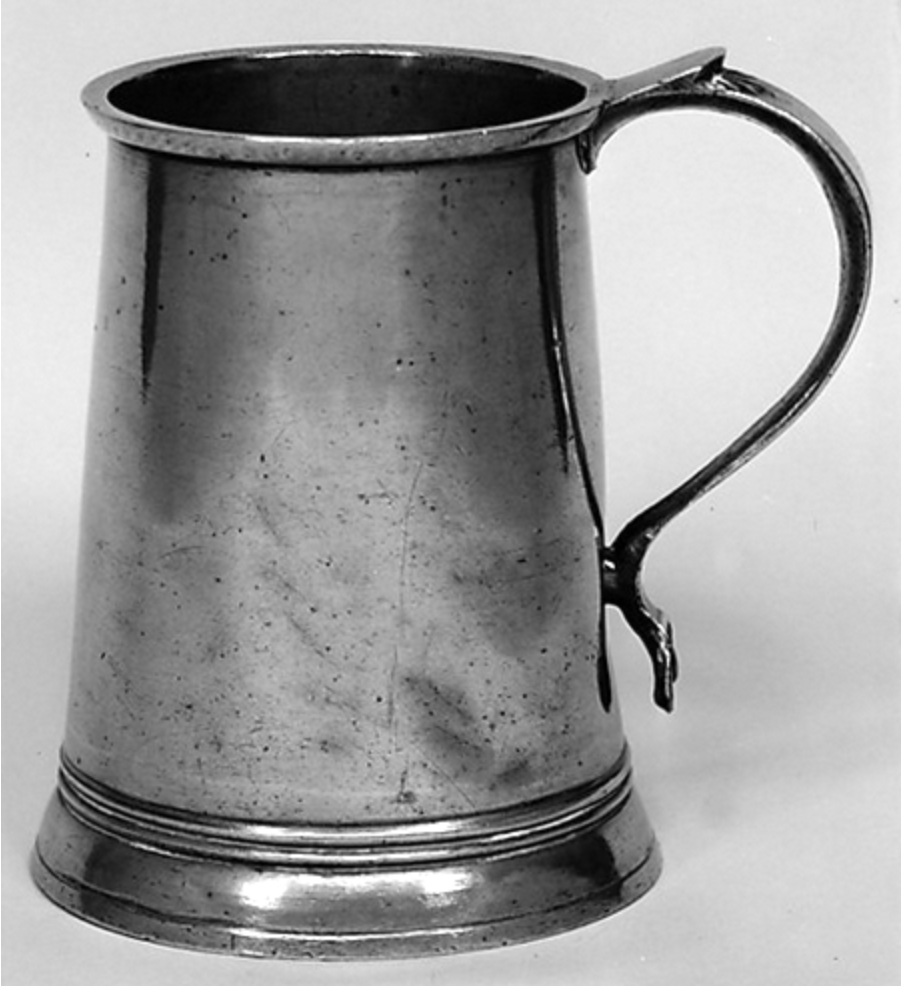
Our cousin Nathaniel Austin (4C8X) was born in 1741 in Charlestown, MA. The Austins of Charleston are related to our Littlefield family of Maine. From 1763 until 1815, a year before his death, Nathaniel worked a pewtersmith. In 1775, he was living in Charlestown when the British took over the city so he relocated his family to Lunenburg. After the war, Nathaniel returned to Charlestown and rebuilt his house and shop.

Below are examples of Nathaniel's work. The first is a pewter "quart cann" that is now housed in the Museum of Fine Arts in Boston. The second is a mug that is part of the collection at the Metropolitan Museum of Art in New York.

Below are a few of Nathaniel's identifying marks:


Then, In 1798, Cousin Nathaniel bought an island! Outer Brewster Island is also known as Outward Island since it is farther from the mainland than either Brewster Island or Middle Brewster Island. Nathaniel was able to buy his island for a mere $400.

Wikipedia has this to say about Nathaniel's Island:
The island "has a permanent size of 20 acres, and consists of exposed bedrock covered by fertile soil bounded by a rocky shore with steep cliffs. It provides a nesting habitat for coastal water birds, including cormorants, gulls, common eider ducks, glossy ibis and American oystercatchers. The birds are aggressive during their nesting season and access by humans, which is by private boat only, is discouraged during this period.
Nathaniel built a harbor on the island hoping to establish a profitable quarry there. In 1822, His son, Nathaniel, Jr. (5C7X) built his house from stone that was mined on Outer Brewster Island. Below is a photograph of the building taken ca. 1900.

Today the building, with its beautifully restored stone from Brewster Island, houses million dollar condos:

Granite from the island has also been used to pave several streets in Boston.
The U.S. government purchased Outer Brewster Island in 1913. During World War II, the island was used for defensive purposes. The Brewster Islands Military Reservation, called Battery Jewell, was built to protect Boston Harbor from possible naval or air attack. No guns were ever fired there and the government abandoned the property in 1947. Today the Island is a State Park.
According to the National Park Service, "[t]his bedrock island supports the most diverse assemblage of breeding waterbirds in Boston Harbor.

a sad exchange
Our cousin Reuben Wyman ( 4C6X) did service for his country and then some. He was born in Lunenburg MA in 1738. In February of 1761 he married Elizabeth Bancroft and, eight months later, they welcomed their first child Silas (5C5X) into their little family. The couple had at least three more sons but I can't find a good accounting of their children. Their last son Elias (5C5X) was born in 1774 and, a year later, the war began. Reuben, like so many other men, marched out to Lexington when the alarm sounded on April 19th, 1775. He served for fourteen days and returned home. Two years later, at age 39, Reuben decided to do real service for his county by joining the recently formed Continental Army.
By March of 1777, Reuben had moved his family 20 miles north from Lunenburg to the community of Marlborough. When he joined up for his three year stint, he was "engaged for the town of Marlborough."

According to Massachusetts Soldiers and Sailors in the Revolutionary War, Reuben served from March 1777 to December 1778, only 21 months of his three year term. That December, however, he became either injured or ill and was unable to continue his service. Reuben returned home and his oldest son Silas, who had just turned 17, took his place.
Since serving in another family members place was a fairly common occurrence in the Revolutionary War, it appears that the United States government expected their full three years, by hook or by crook, when a man signed up for that term. In Silas' case, the exchange turned tragic. Young Silas' service record shows that "Continental Army pay accounts for service from Dec. 1, 1778, to Aug. 5, 1779; reported killed; also reported as having been taken in exchange for his father, Reuben Wyman, and balance of his account made up in said Reuben Wyman's account."
The only battle in the Revolutionary War that I can find listed for August 5 1779 took place in Morrisania, NY, part of New York City. According to Encyclopedia.com:
This engagement is between (British) Lieutenant Colonel James De Lancey's Loyalists and the Connecticut Brigade commanded by William Hull. The patriots destroy numerous buildings and food stores while also capturing several Loyalists, along with some horses and cattle. First-hand accounts give conflicting figures as to the number of casualties incurred by each side.
Silas was killed just two months shy of his 18th birthday and four months shy of his father's mandated three year term. From Reuben's service record which ends with ". . .reported on command at Newtown (an offshoot of Boston)," its unclear if the grieving father had to complete the four months remaining on his three year term.
After the war, Reuben moved to Clinton, Maine where he died in 1790 at age 52.
John Richardson and the Middlesex Hotel
We first wrote about our cousin John Richardson (5C6X) in our "First Alarm"post. That day, he was a bakery apprentice who took needed supplies out the fighting soldiers. After the war, John was able to open his own bakery in Concord which eventually became a dry goods store and tavern. Ca. 1779, he traded his building to the County of Middlesex for another neaby piece of property owned by the county. The old building that he traded became the new County House, where jailers and sheriffs lived. The property behind the new County House, which had also belonged to John, became a county jail and Cousin John was appointed the original jailer. Sixty years later, famous Concord resident, Henry David Thoreau, would spend one night in that jail for refusing to pay a poll tax. Thoreau objected to the fact that some of his tax money might be spent on the Mexican-American War which he opposed.
John's new building was just south of the jailhouse on Main Street. Also shown on the map below is Heywood Meadows, named after our cousin Abiel Heywood (3C6X). We'll have the story of Abiel and his meadow in a future post.

John renovated the house on his new property and expanded his tavern business into what became the Middlesex Hotel.

John's three-story hotel had a barroom, a large dining room, private dining rooms and parlors, a kitchen, and a dance hall. The Middlesex Hotel, shown on the right in the picture below, was included in John Warner Barber's engraving of Monument Square in Concord done in 1839.

As Cousin John was involved in other business ventures as well, he only operated the hotel himself for a short time. He owned a tannery on the Mill Dam near his property and also owned other hotels and stables in both Massachusetts and New Hampshire.
While John didn't sell his hotel, he did hire a series of managers to oversee it. One of those managers was our cousin Colonel Benjamin Symonds (2C8X) who we featured in our "Colonel Benjamin Symonds" post. In 1805, John moved from Concord to Boston where he began an import business in partnership with another man. The pair had import houses in Boston, New York and Baltimore. When his partner died, ca. 1825, John moved to Newton, a suburb of Boston and bought the mansion house that had formerly belonged to General William Hull.
Note: William Hull was infamous for being tricked into surrendering Fort Detroit to the British in the War of 1812. He was subsequently court-martialed, convicted, and sentenced to death for that transgression. He fortuitously received a pardon from President James Madison.
Below is a photograph of the mansion John purchased, taken in the early 20th century.

By 1825, John decided to sell the hotel. He took out an ad in the Boston Columbian Centinal listing everything that went with the sale, including a tan yard and a pew in the Concord Meeting House:

John sold his hotel to Thomas D. Wesson and Gershom Fay. Gershom (4C10X) just happens to be another cousin of ours. We wrote about Gerhom's son Joseph (5C9X) in our "Our Family at Saratoga" post. Joseph had his leg amputated after being wounded in the Battle of Freeman's Farm and subsequently died of his injuries. The Fays are descended from our Brigham family.
Gershom ran the hotel with Wesson for only a few years, then sold his interest in the operation.
Edward Jarvis, a historian of Concord in the 19th century, wrote about the history of the hotel. Jarvis had something of a personal interest in the hotel. His father, Francis Jarvis, had lived for a while with Cousin John. John taught young Francis the baker's trade and also gave him a job helping out in the tavern. Below are Jarvis' handwritten notes on the hotel. Note the name Col. Simonds, our cousin Benjamin Symonds, near the bottom of the second page.

the twins
Twins Edward (5C6X) and Moses Richardson (5C6X) were born in Woburn in 1748. A story about the two is related in the Richardson Memorial written by John Adams Vinton:
He (Edward) resembled his twin brother Moses in person so closely, that one was often taken for the other. Once, in particular, he played off a joke on the young lady who was to marry Moses, presenting himself to her as her accepted swain, and spending the evening with her as such; and she did not discover the substitution till some time after, when she was with great difficulty convinced of it.
Note: The Richardson Memorial is one of the best researched genealogical books I've come across and is certainly unrivaled in organization and ease of use. This is somewhat surprising given that John Vinton was not related to the Richardsons. He married our cousin Laurinda Richardson (6C5X) and set about writing a first class memorial of her family.
The Richardson twins both served their country in the Revolutionary War. Of Edward, Vinton wrote:
When the war of the Revolution commenced, he, with his twin brother, joined the standard of liberty. He was one of those who resisted the inroad of the British troops at Concord Bridge, April 19, 1775, and compelled them to a hasty retreat. At that time he was orderly serjeant of a company of "minute men," living in Concord. He soon after enlisted in the "eight months' service," from May, 1775, to the end of the year. His son Josiah stated. . .that he continued in the military service of his country till the end of the war — eight years — being successively commissioned as ensign, lieutenant, quarter-master, paymaster, and captain. . .At West Point he commanded a company. It is said that he commanded the first company that broke ground at Verplanck's Point.
In 1792, Edward purchased 100 acres of property in Maine. The small settlement of Phips had only three families at the time. Three years later, Phips was incorporated into a regular town and the name was changed to Jay after the first chief justice of the United States, John Jay. We wrote of John Jay and his relationship with our spy cousin Enoch Crosby (4C9X) in our "Revolutionary Stories Part IV" post.

Of Moses, Vinton had far less to say. He wrote that his "information respecting him is vague and unsatisfactory." Vinton did, however relate another story about the twins that, according to him, "is on the best authority:"
[Moses] and his twin brother Edward, who, I suppose, fought by each other's side during the Revolutionary war, were present at the laying of the corner-stone of the Bunker Hill monument, June 17, 1825, just half a century after the battle. Lafayette was present, and assisted in the transaction. The event attracted great attention, and officers and soldiers of the old Continental army, from all parts, were there. These twin brothers, whose united weight was said to exceed five hundred pounds, rode together in an open barouche, " the observed of all observers." These "noble twin brothers of Revolutionary fame" received a conspicuous notice in the account given of the affair in the newspapers immediately after. Their close resemblance to each other has already been mentioned.
In spite of their apparent hefty size, both twins lived to ripe old ages. Edward died in 1834 at age 86 and Moses followed the next year at age 87.
Uncle Daniel Proctor
Our Uncle Daniel Proctor (5U) was born in Chelmsford in 1744. We mentioned Daniel's enlistment agreement of 1776 in our "The War Moves West" post. The agreement, which was signed before the Continental Army was formed, only committed Daniel to two months service. In February of 1777, he was back in Chelmsford and chosen by the town to "see that the Acts of the General Court to prevent Monopoly and oppression be complied with."
The Court's Acts basically mandated fixed prices for certain items. The selectmen in the city of Boston, in order to add extra weight to the Acts, "stated and affixed the following Prices to certain Articles not enumerated in said Act. . ." The city also recommended that other towns follow suit "as they would avoid the Contempt of their Fellow-Countrymen. . ." According to the selectmen's recommendation, "Cod Fish and Haddock, guts and gills out" should go for "Two Pence half-penny per Pound

After his stint helping to "prevent mopopoly and oppression," Uncle Daniel evidently continued his service to the town of Chelmsford. According to the History of the Town of Chelmsford by the Reverend Wilson Waters, in 1781 Daniel Proctor was paid by the town for "one journey to Woburn and horse and expenses to pay money to the agent for beef" possibly for the war effort.


Comments