
REVOLUTIONARY STORIES VI
- westmohney

- Feb 4, 2024
- 11 min read
Updated: Nov 29, 2024
We're all immortal, as long as our stories are told ~ Elizabeth Hunter

Moses Greenleaf's Map of West Point
On October 6 1777, shortly before Burgoyne's surrender at Saratoga, British General Henry Clinton had attacked two American forts, Montgomery and Clinton, which lay along the Hudson River.
After the attacks, both forts were destroyed by the British. Since Fort Ticonderoga had also been destroyed and Crown Point was in British hands, the British basically controlled the Hudson waterway at that moment time.
Two weeks later, General Horatio Gates' success at Saratoga changed everything. By January of 1778, the Americans were emboldened enough to march across the frozen Hudson and, under the command of General Samuel Parsons, establish the groundwork for a new American fort on the river. That fort would become West Point which, today, is the longest continually occupied military post in the United States. Two more forts quickly followed.

In 1779, our cousin Captain Moses Greenleaf (5C8X) was in command of a garrison overlooking West Point. Moses was born in 1755 in Newburyport, MA. We wrote of his father Jonathan (4C7X), a merchant shipbuilder, in our "Continental Navy" post. Moses was one of of the many Greenleafs who enlisted in the army to aid in the defense of the seacoast. He was later commissioned lieutenant and saw action in some of the major conflicts of the war including Bennington and Saratoga. He also suffered through the long winter with George Washington at Valley Forge. Below is the loyalty oath signed by Moses while serving at Valley Forge:
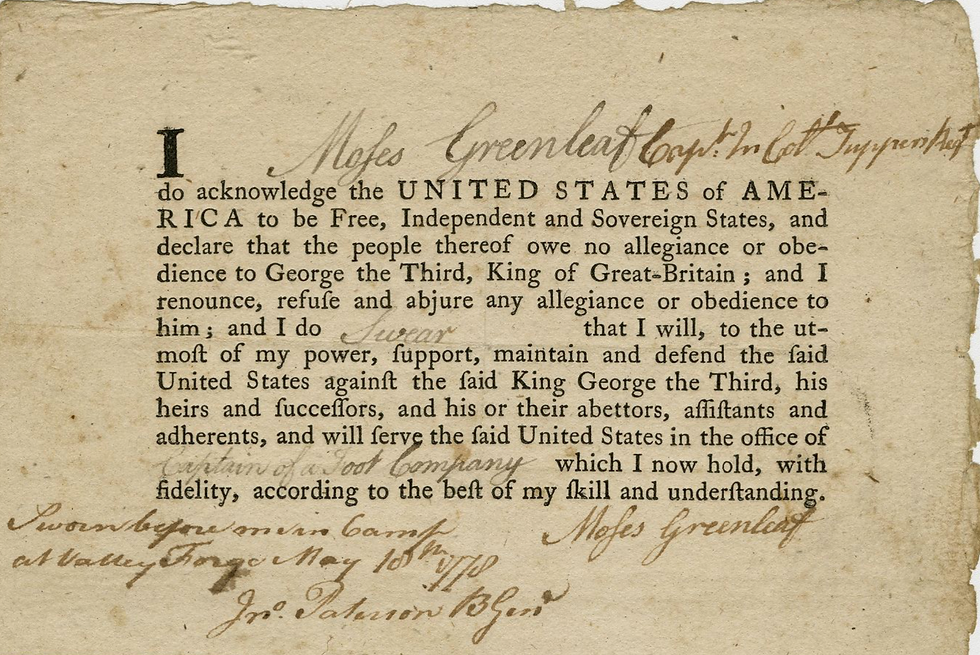
Note: In an interesting side story, Brigadier General John Paterson was the man who witnessed and signed Moses' oath. Later in the war, Paterson would have a Robert Shurtliff on his personal staff. It was later revealed that Shurtliff was actually a woman, Deborah Sampson, who had disguised herself as a man in order to join the army. When Paterson eventually discovered her true identity, he kindly thanked Sampson for her service, gave her an honorable discharge from the army and money to return home. Sampson later became the first woman to receive a pension for serving in the armed forces of the United States.
In 1779, while stationed at West Point, Cousin Moses drew a watercolor map of what he saw before him. The map is now part of the collection of the Massachusetts Historical Society which was founded in 1791. According to the Society, "[m]anuscript maps are unique records that often include detailed graphic information about events and places that otherwise would be lost to history." On the society's site is a description of Moses' map of West Point which, at the time, was "considered the lynchpin that kept New England connected with the rest of the colonies."
Note: In a year's time, Benedict Arnold would attempt to turn the fort at West Point over to the British. The fort bearing his name was then changed to Fort Clinton. That story in a future post.
The detailed map shows the locations of fortifications, Fort Putnam, redoubts, buildings, and paths of the area in and around West Point. Also visible is the great chain, a sixty-ton linked chain stretching from Fort Putnam to Constitution Island created by Brigadier General Thaddeus Kosciusko as a barrier for British ships.

The notation at the bottom of the map reads: "A Plan of West Point. 1779. This plan belonged to Capt. Moses Greenleaf of the 11th Mass. Regt. who commanded Fort Putnam in the year 1779-80. S. Greenleaf."

When the war ended, Moses returned to his shipbuilding roots. In 1790 he retired to a farm in New Gloucester, Maine. There, Moses died in 1812 at age 57. His son, Moses, Jr. (6C7X), also took up the map making trade and became known as "the real state-maker of Maine.” We'll have Moses, Jr.'s story in a future post.
Thomas Greenleaf in Forton Prison
Our cousin Thomas Greenleaf (5C6X) was born in Boston in 1755, the son of publisher Joseph Greenleaf (4C7X). We wrote about Joseph's patriotic spirit in our "Prelude to Revolution" post. Thomas followed in his father's footsteps, both in the publishing business and in his ardent support for the revolutionary cause. Part of that ardent support included a stint on the Brigantine Angelica in 1778. When the ship was captured by the British, Thomas was taken to Forton Prison in Britain.
Forton Prison was about 170 miles from Mill prison where our cousins Cutting (3C8X) and Henry Lunt (5C6X) were held. We wrote about the Lunts in our "The Adventures of Cutting Lunt" and "The Adventures of Henry Lunt" posts.
Both prisons lay on the southern coast of England.

Below are letters from both Thomas and his father Joseph written in an attempt to secure Thomas' release.
The first, written by Thomas, is addressed to “The Honble. John Adams Esqr; Passey near Paris France.” Adams was in France at the time as an ambassador for the two recently allied countries.
Great Britain Forton-Goal, July 16th 1778 Honored Sir
Pardon the presumption of addressing you in this manner at this unhappy Crisis of my life. Considering the distinguish’d nobleness of your sentiments, and your present exalted station as a support and defender of the American, glorious, Cause and persons, I at once resolve that this is an incumbent Duty on my part, and cannot entertain the least doubt but it will be attended too with that sympathy which is an immutable attendant on the hearts of ev’ry Great Man.
On Monday, the 25th. May, 1778, the Brigantine Angelica. . .sail’d from Boston, and on Saturday the 30th. May was Captured by the Andromeda Frigate. The Brigantine was scutled, our treatment ————— ( Thomas left a space here, evidently wary about his British captors reading his letter). . .our Cloathing chiefly lost. . .from thence we were conducted to this abstruce confinement; but, thank God, thro’ the benevolence and generosity of our British friends our spirits we support, notwithstanding our tabernacles are quite enervated and meagre.
I am at present intirely ignorant of what is in the power of our friends in France as to assisting us in our present situation small sums will be of great service to us. . .I preferr’d writing to you, Sir, imagining you will, after seeing my Name, recollect the family of Joseph Greenleaf, Esqr.
If there is nothing allowed us by Congress, in this our distress’d situation, I will obligate myself to return with interest any sum, you may please to send for my relief, when I get to Boston.
I will thank you in a particular manner if you will please to convey in the safest and most expeditious way the inclos’d letter to my father. With the greatest Veneration, I am, Honored Sir, Yr. most Obedient Humble Servant T. Greenleaf
John Adams did write a wordy reply to Thomas offering assistance from his own pocket. Though the letter was never sent, it has been preserved among Adams papers and says in part:
Passi near Paris September 8. 1778
Sir
. . .You are pleased to compliment me, with “Nobleness of Sentiment,” but would you as a virtuous Citizen of America, a young Republic, Struggling under infinite Misfortunes, request or advise me, as a servant of that Republic and a stewart of a small Part of its Treasure, to indulge a “Nobleness” of Sentiment at the Expence of our bleeding, burning impoverished almost ruined Country. . .
. . .I must therefore tell you plainly, that I cannot justify to my Constituents nor to my Self the least degree of Partiality to you on Account of my Acquaintance with your Fathers Family. . . But if you apply to my Supposed “Nobleness of Sentiments” in my private Capacity, and ask me to give you or lend you Money out of my private Pockett, you know, or ought to know that my whole Time and a great Part of my Property and all my Prospects have been Sacrificed to the public service for a Course of years past and that my Family is suffering under the Consequences of it.
After all however, if you will write me an Account of any Necessaries that you want I will Send you the Money out of my private Pocket, if it is a reasonable request and within the Compass of my very small Abilities. I am your Countryman and humble servant John Adams
The letter written by Thomas' father Joseph shows that both Greenleafs went to the very top in their attempt to get Thomas out of prison. Joseph's letter was to to another VIP in American society, Benjamin Franklin:
als: American Philosophical Society
Boston Jany. 9th. 1779
Most hond. Sr
Mr. Williams favours me with an opportunity of addressing a few lines to you upon a subject very interesting to me— I have an only son, by name Thomas, who is now a prisoner in Portsmouth gaol, & has been so for several months. My request to you is, for your Influence to get him exchanged, if possible, & put into such public service as he is capable of; He has served his country in capacity of Capt. in a train of Artilery to good acceptance & I dare pronounce him capable of a higer station. Should he be released, and could return home in some public Vessel, so as to save him the expence of a passage (if he cannot be employ’d) it will be receiv’d as a favour.— Perhaps you may not recollect me, my son is a Nephew of the hon. Robt. T. Paine Esqr. with whome you are acquainted.— I need make no appology for troubling you with this epistle, because, I am well assured, that it always gives you pleasure to have an opportunity to do good.
I am Sr. your most obd. huml. Servt. Jos Greenleaf p.s. I have wrote to Mr. Adams on the same subject.—
Note: Robert Treat Paine, one of the Founding Fathers of the United States, signed the Declaration of Independence and was certainly known to Franklin. He was also Joseph Greenleaf's brother-in-law.
As it turned out, Thomas did not need either Adams or Franklin's help in getting out of Forton. One of Thomas' fellow prisoners, John Kilby, wrote an account of his time in that prison. Kilby spent a good portion of his narrative on the escape attempts of the captives. He wrote that:
The penalty of detection & Brought back, was that they were put in the Black hole, a dungeon, for 40 days and nights, put on bread & water, and put on the list of the last Rebels that was Committed, altho the penalty was so great, many made the attempt and
some actually succeeded in giting away.
One who was able to "git away" was our cousin Thomas. According to Kilby's account, "a Mr. Greenleaf, a printer by trade of Philadelphia, by some means procured lady's Cloths, and actually marched out of the gates in the day time as the turn keys were often passing to & fro."
Note: When John Kilby was eventually released, he joined up with John Paul Jones and was on board the Bon Homme Richard with our cousins Cutting and Henry Lunt.
After his escape, Thomas made his way back to America. It's just possible that, before sailing, he went to France to see John Adams. A notation in Adams' papers says that he "may have been the 'Mr Greenleaf' who carried JA’s letter of 27 Dec. to AA (Abigail Adams) in America.
Upon his return, Thomas returned to his publishing business in Boston. We'll have more on his adventures as a newspaper man in a future post.
The Fays and independence for Vermont
We wrote of our cousin Stephen Fay (4C10X) and his tavern in Bennington, VT. in our "Prelude to Revolution" post. Stephen and two of his sons became intimately involved in Vermont's struggle to become an independent state.
The land dispute in Vermont began in 1749 when both the province of New Hampshire and the province of New York set their sights on the territory that lay between them. When Massachusetts got into the act, the territory found itself assailed on three sides. The struggle for that valuable piece of land continued well into the revolutionary years. We wrote a little about that battle in our "Final Days Before Revolution" post.
In 1772, when William Tyron, the governor of New York, indicated that a some sort of compromise might be worked out, Vermont chose our cousin Stephen Fay and his son Jonas (5C9X) to draft a reply and to negotiate on their behalf. Not surprisingly, a compromise was never reached. Three years later, the Revolutionary War began with the Fays heartily on the side of the Patriots.
All six of Stephen's sons fought at various times in the war. Jonas was a physician for Ethan Allen's Green Mountain Boys during their participation in the Saratoga Campaign. Joseph (5C9X), who served in the 2nd Regiment of Vermont Militia, eventually commanded that regiment with the rank of colonel.
The war, however, didn't quench the Vermonters desire for their own independence. In January, 1776, Jonas helped to write a petition to the Continental Congress asking that Vermont be allowed to join the Revolution as an independent entity. When New Hampshire and New York both objected, Congress decided to refuse Vermont's petition.
In 1777, Cousin Jonas, along with Ethan Allen, drafted a Declaration of Independence which declared Vermont to be a separate republic. When the the three surrounding states, still wanting their piece of the pie, continued to object, the American Congress again refused to acknowledge statehood for the territory. It was then that Vermont's remaining neighbor to the north, Britain, decided to get into the act. In an intrigue which became known as the Haldimond Affair, British Secretary of State, Lord George Germain, opened up the possibility of Vermont becoming a British province.
Below is a map showing Vermont surrounded by its four, much more powerful, neighbors.

While Ethan Allen and the Fays were definitely interested in Germain's proposal, they decided to make one more appeal to Congress. Allen and Cousin Jonas drafted another Declaration of Independence entitled "A Concise Refutation of the Claims of New Hampshire, Massachusetts and New York to the Territory of Vermont." In September of 1780, when Congress once again ignored their appeal, Allen decided the time was right to initiate secret meetings with Britain. He contacted a Loyalist spy, Justus Sherwood.
Allen's report to the Vermont legislature ended on a sour note when Allen became resentful of the wary senators questions about the affair and stormed out of the building. Our cousin Joseph Fay, along with another man, was chosen to take his place. Other events, however, were beginning to muddy the waters. Arnold Benedict's treason and defection, along with his accomplice Andre's execution, had begun to create mutual distrust between Vermont and the British. Joseph's meeting with Sherwood only led to an agreement to postponed any further talks for the time being.
A year later, the British surrender at Yorktown, put a final end to any discussion of Vermont becoming a part of the British Empire. While Vermont would continue her struggle for independence, it wasn't until ten years later, in March of 1791, that the territory finally achieved its goal of statehood in the United States of America. Stephen Fay would not live to see either that happy event or the end of the war. He died in 1781 at age 66.
After the war, Cousin Jonas Fay continued to practice medicine while also serving as a Judge in the Probate Court of Bennington. He died in 1818 at age 81.
In 1791, the same year that Vermont finally achieved statehood, Cousin Joseph Fay was working as a postmaster and farmer in Bennington when Thomas Jefferson decided to take a tour of the northern states. As luck would have it, when Jefferson visited Bennington, the two men became acquainted. They found that they had much in common since both were not only avid Anti-Federalists, but both were also passionate about farming and botany. While he was in Vermont, Jefferson spent hours conversing with Joseph about "mutually interesting subjects" and they later "maintained a long correspondence that covered farming, botany, and politics. . ."
In 1794, Joseph gave up his farming life and made a move to New York City. There he made his living as an import merchant and land speculator. The yellow fever epidemic in New York that killed our publisher cousin Thomas Greenleaf in 1798 was still going strong in 1803. That year, Cousin Joseph Fay died of yellow fever at age 50. Because so many people were buried in mass graves during the height of the epidemic, the location of his grave is unknown.
Obededom Hall and Mary Kimball
Our cousin Obededom Hall (2C8X) was born in Chester, NH in 1744. In 1764, he married our cousin Mary Kimball (4C7X). Both of their families were originally from Bradford, MA. Throughout it life, there was some confusion with Obededom's name. His birth records have "Obedom," his marrieage record lists "Obededom" and his death record has "Mr. Obeedom Hall." Obededom is probably correct since that is the biblical name.
The couple, who moved to Candia, NH in 1776, were the first settlers in the northeastern part of that town. From the History of the Kimball Family by Leonard Morrison and Stephen Sharples comes this story about Mary's fortitude:
On one occasion, when Mr. Hall was confined to the house by sickness, Mrs. Hall threshed sufficient of the newly harvested rye for a grist, caught the horse in the woods, put a saddle, the rye, and herself on the horse, and then, with a child in her arms, she rode to Trickling Falls, a distance of some twenty miles, to mill.
Obededom served in the Revolution in Rhode Island in 1778.


Comments