
Richardson Family of note
- westmohney

- May 10, 2025
- 9 min read
We all carry people inside us, people who came before us.
~ Liam Callahan

Three Richardson brothers, Ezekiel (9U), Samuel (9U) and Thomas (9GGF), came to America in the 1630s. These brothers settled in Woburn, MA and became a powerhouse family there. Our Richardson line ended when our grandfather Thomas' daughter Mary (8GGM) married John Baldwin (8GGF). John and Mary moved to Billerica.
Below are some Richardson family members of note in the 19th century. None of them are our close relatives, but they are all interesting.
the Richardson houses in Dublin, New Hampshire
Our cousin Abijah Richardson (5C6X) was born in Woburn in 1761. He did his duty in the Revolutionary War and, In 1789, married his (and our) cousin Elizabeth Richardson (5C6X). Two years later the couple moved to New Hampshire, finally settling in the town of Dublin. Dublin has the distiction of being the third highest village in New England

From The Richardson Memorial by John Adams Vinton:
The snow was about three feet deep in the woods, it being on the declivity of the Grand Monadnock. His (Abijah's) means of subsistence being very scanty, he took his family into a small log-hut in the woods, the best accommodation he could then obtain. In June following, as he was clearing up a piece of land, a tree which he was cutting down in it fall threw him hight in the air. On coming to the ground his shoulder was broken and he was otherwise severly injured. He was at first completely bewildered, and reached his cabin only by the help of his wife. He was for a long time laid aside from labor. Thus disabled, he could not supply the needs of his children when asking for a piece of bread.
One night there was nothing in the house to eat, and the family went to bed without their supper. The children, the oldest being under five years, thought it rather hard; but their father comforted them with the assurance that they should have their food when he and mother had theirs.
Luckily for the family their neighbor, Mr. Todd, stopped by and, seeing the Richardson's destitute condition, brought bread, milk and other provisions. Unluckily for the family, the first time Abijah went back to his labors after recovering from his injuries, he cut his foot badly with an axe.
Because of his injuries, Abijah's health remained poor throughout his life and he relied heavily on his oldest son, Abijah, Jr. (6C5X), to help around the farm. In spite of his health, Abijah, Sr. had reached the ripe old age of 79 when he met with yet another accident. According to Vinton, Abijah "fell from a load of hay, broke his back and run the pitchfork into his leg. He died within three days afterwards." Vinton also mentioned that "[a]ll these accidents happend on a spot not forty rods square.
Abijah's house, which he built ca. 1795, is one of the oldest in Dublin. It was listed on the National Register of Historic Places in 1983. According to the National Register site, the current Greek Revival features were probably added by Abijah's son Malachi (6C5X). The house remained in the Richardson family until 1968.
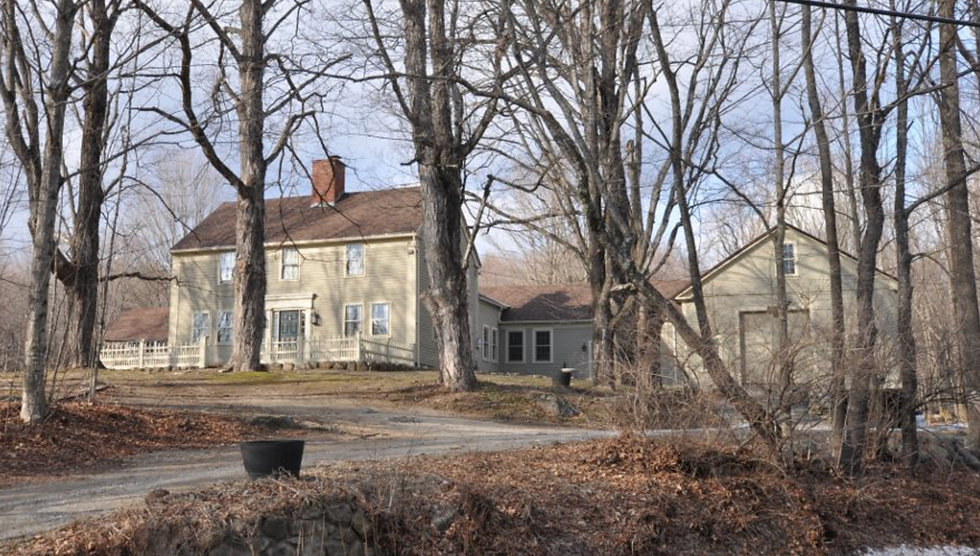
Two of Abijah's sons also built houses in Dublin that are listed on the National Register of Historic Places. Below is John's (6C5X) house:

Below is Abijah, Jr.'s house:

the Richardsons and Cutter's Mill
Joseph Richardson (4C7X) was born in Woburn, MA in 1727. In 1787, Joseph purchased property on the banks of Horn Pond Brook from our cousin Daniel Wyman (5C6X) who was the son of Hezekiah Wyman (4C7X), aka the White Horseman. We wrote about Hezekiah in our "Hezekiah Wyman" post.
The six acres was purchased for £30 with the contingency that "the said Richardson and heirs not subject to pay any damage that may be done to the said Wyman's land below the premises." Daniel, however, may have already had a plan for the Richardson's purchase contingency. Sometime after the sale of the six acres, he sold his own Woburn property and moved to his wife's hometown of Cambridge.
Joseph probably already had ideas for his newly purchased property as well. According to John Adams Vinton in his Richardson Memorial, Joseph "was the first projector, builder and owner of the mill lately known as Cutter's Mill.
On the map below you can see the approximate site of the mill (1) and nearby Richardson Street (2) which was named after our grandfather, Thomas, and his two brothers. Our immigrant grandfather Thomas' property lay near Horn Pond, just east of Richardson Street.

In 1799, Joseph sold his estate, including the mill, to his sons, Caleb (5C6X) and Joshua (5C6X). Two years later, the brothers purchased property from another of our Wyman cousins, Paul (4C7X). Paul was the son of our cousins David Wyman (3C8X) and Phebe Richardson (1C9X). Vinton writes that:
The records show that on October 30, 1801, Paul Wyman sold to Joshua and Caleb Richardson, for $426.25 "nine acres and sixty perch of land, together with the privilege of flowing the water at Howard's dam, so called, in said Wyman's land, so as to flush the water over the premises above mentioned.
The Richardsons continued to improve their property until 1807. That year Joshua "was instantly killed by the falling of the frame of a house which he was assiting to raise. . ." Joshua was thirty at the time of his death. From a newpaper article about the event:
Esquire Clapp's house, July 14, 1807, was raised and fell, killing three and wounding twenty or more persons, some very badly. On the day following were three burials of victims of this disaster — John Lyman, Samuel Wright and Joshua Richardson. When the raising was nearly completed, the whole frame fell, carrying down with it all who were upon it. Two persons were killed outright and another died the night following. The newspaper sets the number of wounded at sixteen, and some, it feared, of these were "wounded mortally." On the frame at the moment of its fall was thirty or more. Richardson and Wright were both about to be married, and their bereaved ladies appeared with the chief mourners at these funeral ceremonies.
In 1810, Three years after the tragedy at Esquire Clapp's house, Caleb sold his property on the river, including the mill, to John Cutter. The mill was ever after known as Cutter's Mill.
Father Joseph died in 1823 at age 96 and son Caleb died in 1864 at age 87.
the elixer-mixing Richardsons
Most of the information I have on our two Richardson cousins, father and son, who manufactured elixer products comes from Ferdinand Mayer V, "a passionate collector of American historical glass specializing in bitters bottles."
Our cousin Nathan Richardson (6C5X) was born in Brookfield, MA in 1781. He spent his boyhood in the public schools, working on his father's farm and reading. According to Mayer's account:
His mother used to relate many anecdotes of his love of reading, as when she sent him to the post-office, several miles distant, he would buy a book with the money given him to purchase his dinner, and on his way home would let the horse stroll leisurely along at will, while he was absorbed in his newly acquired volume. His father, becoming exasperated at his over-fondness for reading, and the neglect of his labor on the farm, threatened to burn every book he possessed. This compelled him to conceal his books in the barn, and while pitching down hay from a loft one day, his father was surprised at the sudden appearance of a shower of books.
This love of reading continued through life. . .Although never a disputant, yet he would not hesitate to measure weapons with any minister who chose to argue with him. His general information was extensive, and he had a large fund of humorous anecdotes in constant readiness.
In what year he commenced the study of medicine it is not recollected; but he was a student of the famous Dr. (Thomas) Kittredge (3C7X), in company with Dr. D. A. Grosvenor, who settled in Reading.
Note: We wrote about our cousin Thomas Kittredge in our "Military Doctors" post.
Nov. 28, 1805, when twenty-four years of age, he married Asenath Rice, of Brookfield, and went to North Reading, where he began the practice of a physician. That he possessed a peculiar aptitude for his calling was immediately apparent. He soon had the custom of that entire community, and also of the neighboring towns. While residing in North Reading, two sons were born, Winslow (7C4X) and Solon Osmond (7C4X). Winslow died at the age of eighteen, in South Reading; and Solon Osmond was educated as a physician. . .
After several years’ residence in North Reading, Dr. Richardson. . .then determined to remove to Cambridge, sold his place and practice. . .and pledged himself in the sum of two hundred dollars not to practice within ten miles of Reading; but on the eve of his departure from Reading, some of the prominent citizens of South Reading, headed by the late Burrage Yale, unwilling to have so excellent a physician leave their neighborhood, prevailed upon him to remove to South Reading, and sacrifice his bonds, offering him, as a special inducement, the large tract of land on a part of which his residence was built; the estimated value of the land, at that time, being $1,500.
About the year 1822, Dr. Nathan Richardson removed from Reading, where he had long been a successful practitioner, and settled in South Reading, now Wakefield. . .Perhaps some of the present inhabitants of Wakefield remember the occasion of the “raising” of the frame-work of the Doctor’s house. It was a general holiday for the town; every man, woman, and child participated, and gave a helping hand. . .Dr. Richardson had been accustomed to prepare sundry articles of medicine, especially sherry wine bitters, which had become justly celebrated for their excellent medical and health-giving properties. After his removal to Wakefield, in connection with his son, Dr. Solon O. Richardson, and subsequently by the son alone, the preparation of these medicines was improved, systematized, and their sale widely extended, and the fame thereof spread the country over; the business in 1868 amounting, it is said, to $100,000 annually.
Nathan's son Solon was born in Reading, MA in 1809. He was famous in Reading not only for his wealth gained from selling elixers, but also for his funding the the Richardson Light Guard militia company which was named in his honor.
From Ferdinand Mayer's account:
In 1821, Solon had moved with his family to Wakefield. . .Young Solon studied in the local public schools, as well as academies in Atkinson and Derry, New Hampshire, and worked in his father’s medical practice as a pharmacist. He later graduated from Dartmouth College with a medical degree in 1831, and also attended lectures at Harvard Medical School. He served as an assistant surgeon at the State Prison and soon became a member of the Massachusetts Medical Society. A major part of the family medical practice was the manufacture and distribution of an herbal health tonic known as “Richardson’s Sherry Wine Bitters.” The product was so popular that Solon took over its production in 1832, and subsequently inherited the business on his father’s death in 1837.
Below is an advertisement for Solon's Concentrated Sherry Wine Bitters:

The year of his father's death, Solon married Susan Barnard and the couple had two children, a daughter who died in infancy and a son, Solon Osmond Richardson, Jr. (8C3X). About the time of his son's birth, Solon's health took a turn for the worse. He retired from his medical practice and focused exclusively on his elixirs. The Richardson elixir bottles that still exist are something of a collector's item. Below is one such bottle:

Solon's other main claim to fame was his generous funding of the South Reading’s local militia company, the Richardson Light Guard. In 1851, the town of Reading needed funding to establish a milita company for the town. Solon donated $500.00 the first year and continued to support the Guard with annual donations for many years. For this contribution to the company, it was named the Richardson Light Guard in Solon's honor.
From the introduction to the book History of the Richardson Light Guard which was published to in honor of the 75th anniversary of the company:
Conspicuous among these friends of the company is the Richardson family. At the inception of the organization in 1851 Dr. Solon O. Richardson, the first of his name, contributed a generous sum of money toward equipping the company. His son, bearing the same name, continued to show substantial interest in the company throughout his long life, and now the third of that name, the grandson, likewise shows evidence of continuous interest. Although living at a distance, he maintains the reputation of his grandfather and father in generosity, influence and integrity. Thus the Richardson family has taken justifiable pride in the organization, and it is a pleasing commentary on American life today to witness such ample evidences of loyalty where worthy sons maintain the ideals of honored ancestors.
The Richardson Light Guard served in the Civil War with our cousin Captain Samuel F. Littlefield (5C6X) leading the company. The Guard also served in Puerto Rico during the Spanish-American War and in World War I.
In 1869, while in Boston, Solon suffered "an attack of paralysis which restricted his activities in the final years of his life." He died four years later in 1873 at the age of 64.
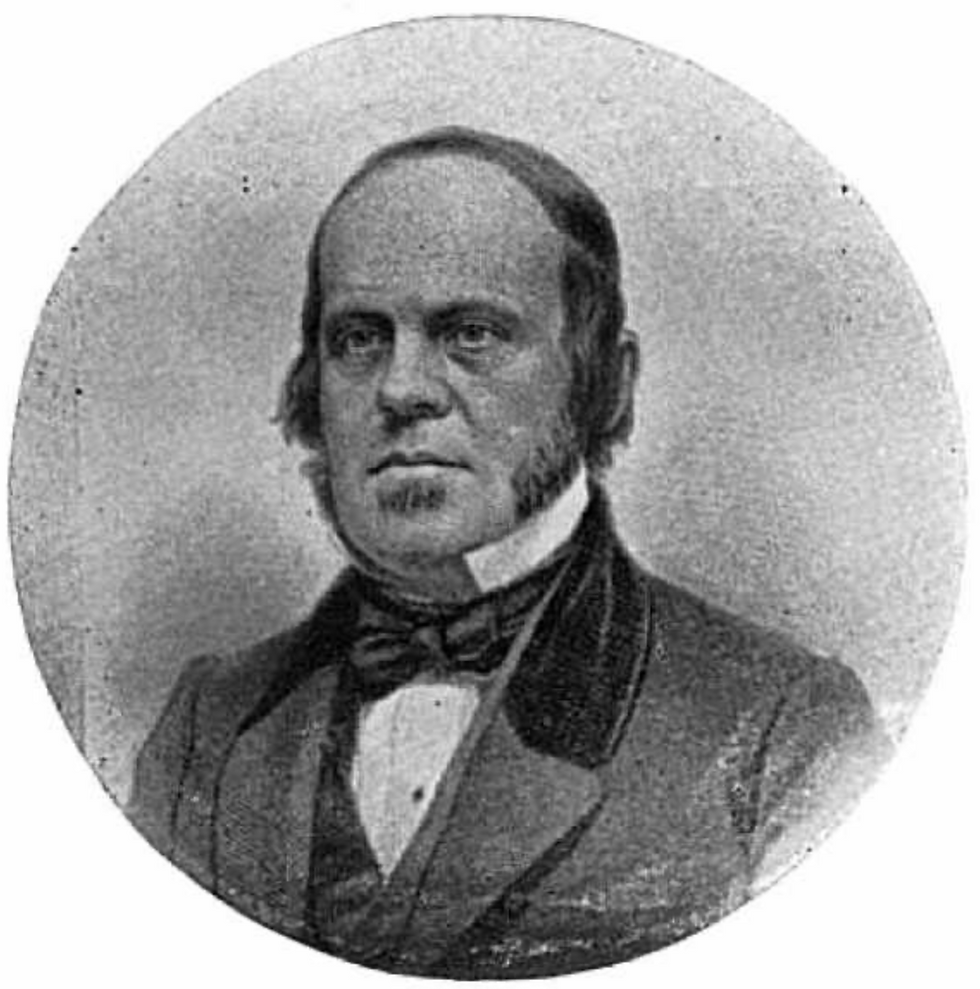
The name of South Reading where the Richardsons lived was officially changed to Wakefield in 1868. Solon's son, Solon Osmond, Jr. continued in his father's footsteps in Wakefield, not only supporting the guard but also running the family elixir business. In 1901, he built a brick commerical building on the site of the family's first house. The building, which sits on the corner of Main Street and Richardson in Wakefield, is still standing.
In the early 1900s:

Today:



Comments