
SAMUEL "RAT-TRAP" ADAMS
- westmohney

- May 5, 2024
- 11 min read
Updated: Dec 17, 2024
Such a clatter sounds in Funnell-Halle, When rat-trap Adams tries to bawle ~ a line from The Rime of the Ancient Peddler
another Samuel Adams
Samuel Adams, one of the founding fathers of our country, and our cousin with the same name, Samuel Adams (4C7X), were born thirty-seven years apart. Both, however, were outspoken orators of their time. Cousin Samuel's father Benjamin (3C8X) was a bookbinder who married Abigial Kendrick in 1747. The couple had seven children. Sadly, tragedy hit the family in 1764 when Samuel was five years old. Town records show that Abigail Adams died that year of smallpox. Abigail's last child, Eunice (4C7X), only lived for seven weeks, probably dying of the same ailment that killed her mother. Though I can find no death date for Eunice, her death must have been within weeks, possibly days, of her mother. Abigail and her child were buried in a common grave in Copp's Hill Burying Ground in Boston.
Abigail's tombstone, shown below, reads "Here Lies Buried the Body of Mrs. ABIGAIL ADAMS wife of Mr BENJAMIN ADAMS who Departed this Life Janry the 17th 1764 In the 35th Year of her Age Eunice her Babe Seven weeks old

Samuel grew up during the revolutionary years. I first read about him in J.L. Bell's Boston 1776 blog. Evidently Samuel became something of a larger than life figure. Bells says that, according to lore:
He was only six years old when the Stamp Act protests occurred, eleven in the year of the Boston Massacre, fourteen during the Tea Party, and sixteen in the first year of the war. He helped the Sons of Liberty, reportedly by guarding the door when they had their meetings...
It's possible that Samuel served his country in the military during the war. He would have been 20 in 1779. Many young men joined up at sixteen or even younger. Since there are three pages of men named Samuel Adams in Massachusetts Soldiers and Sailors in the Revolutionary War, it's difficult to sort them all out.
jack of all trades
Samuel married in 1781 when he was twenty-two. He and his wife had eight children, one of them named for Benjamin Franklin.
Note: In that period there were a whole slew of George Washingtons and Benjamin Franklins born, many in our family.
It appears that Cousin Samuel was something of a jack-of-all-trades. It's possible that, in 1787, he was a constable. There is a record of him conducting a prisoner from Worcester to Boston Jail during Shay's Rebellion.
1796, Samuel was listed in the Boston directory as a "truckman and lighterman." Bell's research said that a truckman "was someone who moved goods either in a truck or small barge. During that time, Samuel even owned his own wharf at the end of Cross St.
Bell further writes:
By his own account, he (Samuel) witnessed the Boston Massacre, the Boston Tea Party, the battles of Lexington, Concord, and Bunker Hill, the British departure from the town, and Washington’s entrance into Boston. He claimed to have been one of the “Boston boys,” young men who acted as sentinels for the Sons of Liberty when they had their secret meetings, and that he even served as the confidential messenger of the patriot Samuel Adams. He stated that he served as a privateer during the Revolution. Thus far it is difficult to confirm these impressive stories.
By 1800 Cousin Samuel was listed as the "town-crier." His address was No. 71 Newbury Street and his brother Abraham (4C7X) lived next door at No. 72. According to Bell, Samuel "printed a number of interesting advertisements announcing things he had found throughout the town." After his stint as town crier, Samuel went into the business he became best known for, wire working. His business making screens and other wire object was known the "Sign of the Flying Man and Fender Manufactory."
Below is one of the many ads Samuel took out to promote his business.

Samuel's work in wire earned him the nickname, “Rat-Trap Adams, by which he was known affectionately (or not, depending on the source)."
outspoken orator
It appears that Cousin Samuel made the rounds at public meetings, always eager to add his two cents. Elizabeth Roscio, who did extensive research on him for her article "Not that Samuel Adams!" calls him an "outspoken fixture" at these gatherings. Samuel evidently supported Thomas Jefferson and the Whig party. He also loved Thomas Paine and, like Paine, was an atheist. Roscio says that "[i]n his later years he became a radical abolitionist, allying himself with men like William Lloyd Garrison and Wendell Phillips."
Samuel became so famous for his orating skills that he was even mentioned in a poem written in London, a parody of Samuel Coleridge's "Rime of the Ancient Mariner. The parody, titled Rime of the Ancient Pedler, contained this stanza:
And then burste out a thundering shout; I thought the earth was quaking. Such a clatter sounds in Funnell-Halle When rat-trap Adams tries to bawle, And the cits for funne immensely squalle, Their sides with laughter shaking.
In 1884, twenty-nine years after Samuel's death, James Mascarene Hubbard mentioned Cousin Samuel in a paper he submitted to the Bostonian Society about Boston’s transition from town to city in the early 1820s:
Finally a hearing was obtained for Mr. Samuel Adams, wire-worker, that is, a maker of rat-traps, and late town-crier, who made a characteristic speech amid malicious “cries of Louder” although the orator appeared to labor excessively at his lungs. His opening words were, “Fellow citizens, you must consider me as on the brink of an eternal world,“ [Adams was then in his early sixties, but he would live three more decades] and the burden of his speech was, “Names is nothing. Only let us have Boston, and I care not what you call it.” Later on in the debate, which from this time took a more serious turn, he “rose and moved that the word ‘Boston’ be added to the word ‘city,’” to the great merriment of the assembly.
In that same meeting Samuel explained his methodology for making decisions: “'I would examine the act,' he exclaimed; 'Like David of old, I would not give sleep to my eyes nor slumber to my eyelids until I had pondered it well. I have done it, have lain awake all night ruminating on these here things.'”
In his orations, Samuel could be something of a card as we can see in the following speech on what to call the mayor of Boston as related by Hubbard:
Mr. Adams made a fresh appearance in the character of a New England Dogberry. “He was opposed to the term Mayor. A mare is a horse, and he had as lief be called a horse or an ass as a mare. He preferred the name President. There was dignity in the sound. He should count it an honor to be called President, but had he the wisdom of Solomon and the riches of the East, he would not accept the office to be called a Mare. . .”
Hubbard, possibly not too impressed with Cousin Samuel, intimated that the famed orator belonged to a group he called ”mushroom town-meeting orators, and weak heads.”
the liberty flag
When the Sons of Liberty wanted to call a meeting, they would raise a flag on a tall flagpole. That flag became known as the Liberty Flag. According to J.L. Bell, Samuel "was honored as a survivor of the Revolution, and he owned a red and white striped flag that he said had been flown from a pole on Essex Street beside Liberty Tree when Boston’s Sons of Liberty had their meetings, which has since become known as the “Sons of Liberty flag.” Bell then wonders "[b]y what means did he become the keeper of the Sons of Liberty’s flag?"
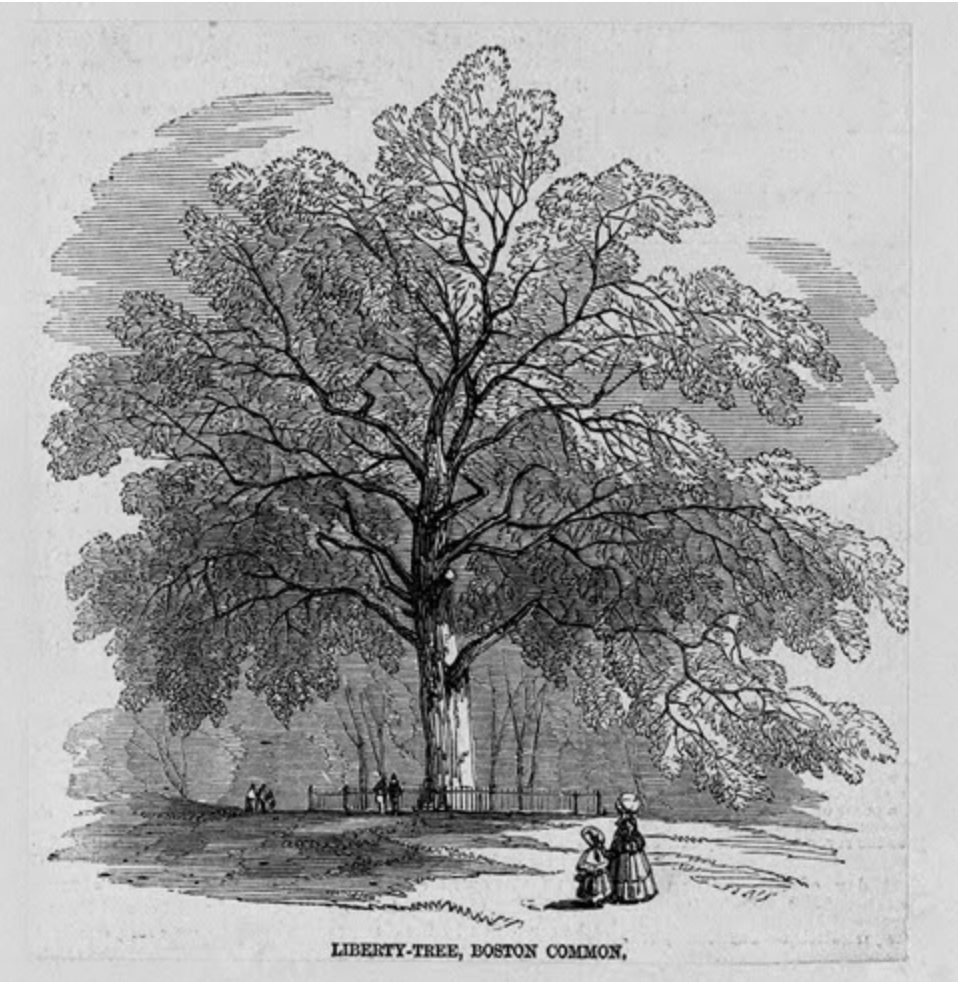
Whether or not Samuel's flag was the actual Liberty Flag, he began displaying it for public occasions including Thomas Paine's birthday celebration hosted by the Free Soil Club in 1852. The general public definitely bought the idea of Samuel's flag as the the real deal. The flag was was handed down through several generations of the Fenno family. Samuel's daughter Catherine (5C6X), who took possession of the flag at her father's death, (5C6X) had married a man named William Fenno.
Bostonian John C. Fernald bought the flag from one of Samuel's great-granddaughters and he lent it to the town of Chicago be flown at the Chicago World's Fair in 1893. Fernald then donated the flag to the Bostonian Society in 1894. Today, the Society has the flag displayed at the Old State House in Boston. The Old State House, built in 1713, has quite a history. The street in front of the building is where the Boston Massacre happened, the Sons of Liberty held many a meeting there and it was from the balcony of the State House that the Declaration of Independence was read for the first time by our cousin Sheriff William Greenleaf (4C7X).
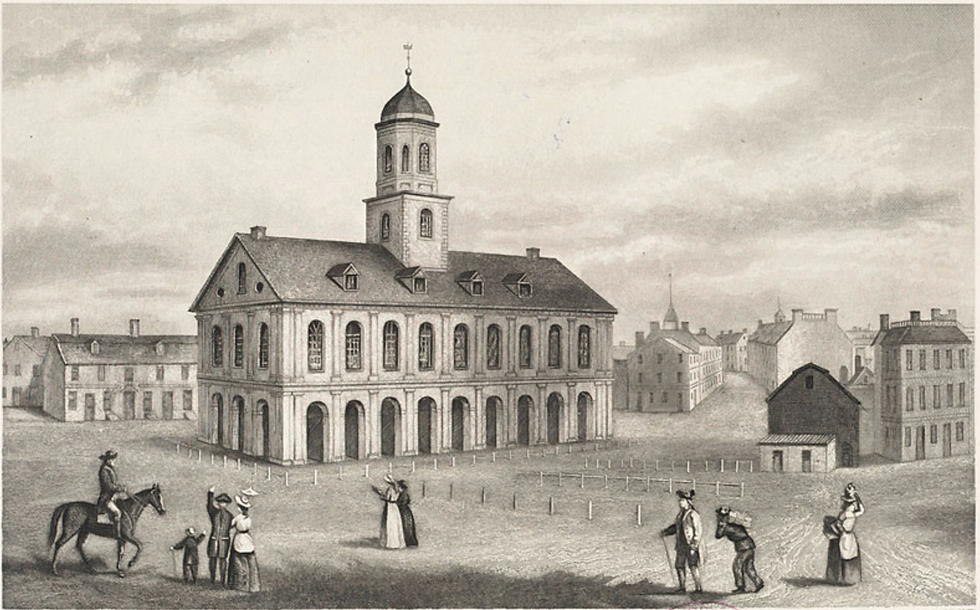
The Old State House, still standing today, is dwarfed on all sides by giant skyscrapers:

The Liberty Flag housed at the State House is made of wool, measures 7x13 feet and has nine alternating red and white stripes. It "can be viewed, folded, in a controlled environment case, along with an original lantern that hung from Liberty Tree on March 18, 1766 to celebrate the repeal of the Stamp Act."

The idea that the flag displayed at the State House could be the actual Liberty Flag continues to captivate the public. In 2004, the Los Angeles Times ran an article titled "Boston Liberty Flag a Survivor." The article said in part:
There’s much about the flag that’s not known. It’s not known, for example, why it had nine alternating white and red stripes -- there were 13 colonies. Historians believe that the stripes on subsequent American flags were inspired by the original liberty flag.
Nor is it known how it eventually came into the possession of a man named Samuel Adams, a wire-worker from the North End who was unrelated to the legendary patriot of the same name. Much of what’s known about the flag was gleaned from Adams’ obituary when he died at 96 in 1855. It passed through the hands of his family members and was eventually donated to the Bostonian Society in 1893.
Samuel's legacy
While Cousin Samuel certainly lived long enough to apply for a federal pension for military service, there is no record of any application being made. Samuel did make application for some support in 1850, but it was for his part in transferring a prisoner during Shay's Rebellion in 1787.
Whether or not he ever served in the army, Samuel was was one of three Revolutionary veterans who rode in a carriage at the 75th anniversary celebration of the Declaration of Independence. And, in newspapers, he was recognized as "one of the last surviving 'relics' of the Revolutionary period" and reported to have an incredible memory of those times.
In 1853, James Spear Loring published a book titled The Hundred Boston Orators. The book profiled town statesmen from the Revolutionary and Federalist periods but failed to mention Cousin Samuel. In a response to the book, an anonymous "Friend of Neglected Genius," took umbrage with Spears choices.
The "Friend's" response to Spears was published in the Boston Transcript:
. . .the able and industrious Editor of “The Hundred Boston Orators” has overlooked two of our public speakers who have high claims on the admiration of posterity. . .As I write the names of William Emmons and Samuel Adams, (not the “Sam Adams” of revolutionary fame,) what a throng of recollections rise to my memory! I seem once more to hear the walls of Faneuil Hall echo with the stirring eloquence of the one, and to catch upon the breeze that floats across our beautiful Common the silver tones of the other. . .
When the roguish boys in the streets impolitely shouted “There goes old Rat-trap Adams,” they unconsciously did reverence to that extraordinary force of logic which in his public efforts attracted and surrounded as with a net-work of iron, whosoever came within the sound of his voice. Like a rat within a trap, the auditor could find no escape. It was easy to enter within the magic circle of his oratorical power, but impossible to escape from its thraldom. . .
the calm steady flow of Rat-trap Adams’s argumentation [suggested that he had]. . .fasted for a day and a night that his mind might be clear and calm. . .the ponderous logic of Adams, like the two-handed sword of the Lion hearted Richard, crushed whatever came in its path.
My memory runs back to the days of my boyhood when I sometimes had the privilege of enjoying the private discourse of Mr. Adams. . .he indulged the mechanical turn of his mind so far as to amuse himself by manufacturing divers articles of wire-work. He had a peculiar fancy for making rat-traps of that material. One of these dangled as a sign in front of the shop in which, for the accommodation of his fellow-citizens, he caused the products of his skill to be vended. This shop was kept in the first story of his mansion, in Federal street, near Milk street; a building which has long since been razed to the ground. Upon such occasions the venerable man (for Mr. Adams has seen the snows of ninety winters) was wont to address us urchins on the political topics of the day. My comrades, as well as myself, were more fond of achieving some practical joke at the good man’s expense than at profiting by his lessons of wisdom; and I have never forgiven myself for the levity which prompted me one warm summer afternoon to place a piece of cobbler’s wax upon the chair, just as he was taking his favorite seat. The consequences, when he endeavored to rise with his subject, were exceedingly embarrassing to Mr. Adams; and his feelings were still further wounded by the personally facetious comments of my thoughtless companions.
According to J. L. Bell in his Boston 1775 blog, even though Loring left Cousin Samuel out of his Hundred Boston Orators book, Loring still thought enough of the old man to interview him about his thoughts on the more famous Patriot Samuel Adams. Cousin Samuel replied that Adams once said to him, “We, the people, are like hens laying eggs; when they hatch, you must take care of the chickens. You are a young man, Samuel, and as you grow old, you must abide by our proceedings.” Cousin Samuel also remarked to Loring that “Samuel Adams did the writing, and John Hancock paid the postage.”
Cousin Samuel died in 1855 at age 96. Abolitionist William Lloyd Garrison’s paper, the Liberator, published a small obituary titled “Death of a Veteran:”
He was a participant in the Boston scenes of the Revolution. He has always been a radical in his political ideas, and an atheist in his religion. Latterly he has been associated with (abolitionist and feminist) Mrs. Abby Folsom, and his venerable form has been conspicuous in spiritual and other conventions. He was a skilful and industrious mechanic, says the Post. Adams’s interest suggests that he wasn’t really “atheist” but just not interested in any existing church.
Samuel was so well known at the time of his death that a copy of his obituary made it across the country to a California newspaper:
Death of a Veteran Citizen.—Mr. Samuel Adams, one of the oldest inhabitants of Boston, died at his residence on the 21st March, at the advanced age of about 96 years. The Traveller says: “He was a witness, and no doubt sometimes a participant, in the many exciting street scenes which occurred in Boston previous to the actual commencement of hostilities. He had in his possession as a relic of those glorious days, a flag which was hoisted on the liberty pole near Essex street, and which has of late been frequently displayed in this city. Mr. Adams was a mechanic—a wire worker by trade, and followed his business until within a few years. In religious matters he was an atheist, and in olden times a close attendant upon all town meetings and public gatherings, where his rather ultra democratic sentiments caused his opponents to taunt him with being a ‘French Jacobin.’”
Our final words on Cousin Samuel will come from Kathryn Griffith:
The impression that emerges from the details of Adams’s life is that of a man who lived through an incredible period of American history: from the last years of British colonial rule to the years leading up to the Civil War. He preserved the Liberty Tree Flag as a living emblem of the radical politics he was caught up in as a young man, and of the reforms he still hoped to bring about.


Comments