
Stephen and Peter Kidder's Depositions on the Globe mutiny
- westmohney

- Jun 19, 2025
- 9 min read
Q. Did you go to the cabin that day and what state was it in?
A. Yes. It was in a very shocking state. Blood all over the place - signs of murder and destitution. ~ Stephen Kidder
Peter's deposition
Peter C. Kidder, Valparaiso June 15, 1724
United States Consulate
Peter C. Kidder examined upon oath touching the mutiny & murder committed on board the Whale Ship Globe in the Pacific Ocean.
Q. Did you leave the United States in the Whaling Ship Globe & as what?
A. Yes, as a foremast hand.
Q. Was there anything like mutiny in the ship till she left Sandwich Islds the last time?
A. No.
Q. What was the Captn's general conduct & general treatment?
A. He was a very man, used the people all well that behaved themselves.
Q. Were the Officers cruel to the people?
A. No - as fine Officers as ever lived.
Q. Was there anything happend on the day the mutiny took place?
A. The Capt. flogged with a Rope end Joseph Thomas that morning because he did not
come when he called him.
Q. Were you present when Thomas was Rope ended?
A. No - I was at the Masthead looking out.
Q. Was there any murmuring during that day or any discontent amongst the crew toward
the evening?
A. None, to my hearing.
Q. Did you perceive any intimacy or provat communicating among the men in the evening?
A. None whatever.
Q. What watch did you keep that night?
A. The first watch till 10 o'clock.
Q. Who was Officer of that watch?
A. Gilbert Smith, Boat steerer.
Q. What Officer relieved that watch?
A. Samuel B. Comstock, Boat steerer. (The chief mutineer)
Q. When did you first hear a noise?
A. The first alarm was given by Mr. Gilbert Smith in the Fore Castle, who waked me up out
of sleep.
Q. What did you do on that occasion?
A. I sprung out of bed & heard a musket as I was putting my trousers on. Soon after I heard
another.
Q. What followed?
A. Mr. Oliver called all hands up to make sail.
Q. When you went on deck what did you learn?
A. I went out to loose the flying Jibb.
Q. When you came in what did you learn?
A. That they killed the Captain & all the Officers. I heard them heaving the Officers
overboard.
Q. Who were the men that committed the murder?
A. Samuel B. Constock who was the head man, Silas Payne, Mr. Oliver & William Humphrey,
Steward.
Q. Do you believe there was any other person on board acquainted with the intention to
murder?
A. Yes - Thomas Lilliston of Virginia.
Q. Who else was acquainted with it?
A. Rowland Coffin of Nantucker & Joseph Thomas, now here.
Q. How did the murderers conduct themselves after they got the ship?
A. In a most barbarous manner generally to those of the Crew that were not of their party.
Q. Did they treat Joseph Thomas no better than the rest?
A. I do not know that there was any diference in his favor.
Q. When did they bring the Ship to anchor and land?
A. At the Mulgrave Islds.
Q. Did they strip the Ship of many things?
A. Yes, of provisions of all kinds, Rigging Sails & Spars.
Q. Did the murderers establish themselves at that Isld?
A. Yes
Q. What became of Comstock?
A. He was shot by Payne & Oliver & buried in the sand on the beach.
Q. When did you, that brought the ship here, get away with her?
A. I think on the night of the 17th of Feby. at about 10 O'clock, Comstock being shot that
day.
Q. Was the plan of retaking the ship conceived on board & when:
A. It was determined on before the ship reached the Isld.
Q. Who was the principal person that projected recapturing the ship?
A. Mr. Gilbert Smith.
Q. Would any more of them have come away could they have and who?
A. Yes. I think Rowland Jones, Columbus Worth, William Lay & Cyrus Hussey would have
come were they not in the power of the murderers & fearful of their lives if they
attempted to swim to the ship.
Q. Did all of you that came away in the ship agree to obey Gilbert Smith as Master &
Navigator?
A. Yes.
Q. Did any of you behave disobediently & turbulently in the passage?
A. None, but Joseph Thomas who presumed to know more than he ought to have done &
told Mr. Smith that he would do as he liked.
Q. Did you hear Thomas say on the passage anything that you considered improper in
relation to the safety of the ship in regards to what happened on board? If so, relate the
same.
A. Yes. I heard him say in the cabin of the ship that he told Capt. Worth if he struck him it
would be.a dear blow to him. It proved so. He also said very often that he would do as
he liked with what was in the ship regardless of Mr. Smith's orders, to whom he was
frequently very insolent and seldom came up when called, always the last.
Q. Did Thomas say that he knew of Comstock's designs.
A. No, but he said that Comstock asked him on the night of the murder whether he would
go down into the cabin with him, to which Thomas said he had told Comstock he would
think of it another time.
Q. Do you think that it was in the Power to Thomas to have saved the lives of the Capt. &
Officers if he had a desire to do so?
A. Yes. I think it was.
Q. Did you hear any person say when the plot of the murder was matured?
A. Yes. About 4 days after they killed the Officers I heard Sam'l B. Comstock say it had
been made up between them a month before the kill the Officers.
(Signed) Peter C. Kidder
The foregoing is a correct copy of the deposition of Peter Kidder made before me.
Michal Hogan, Consul of the United States
Stephen's deposition
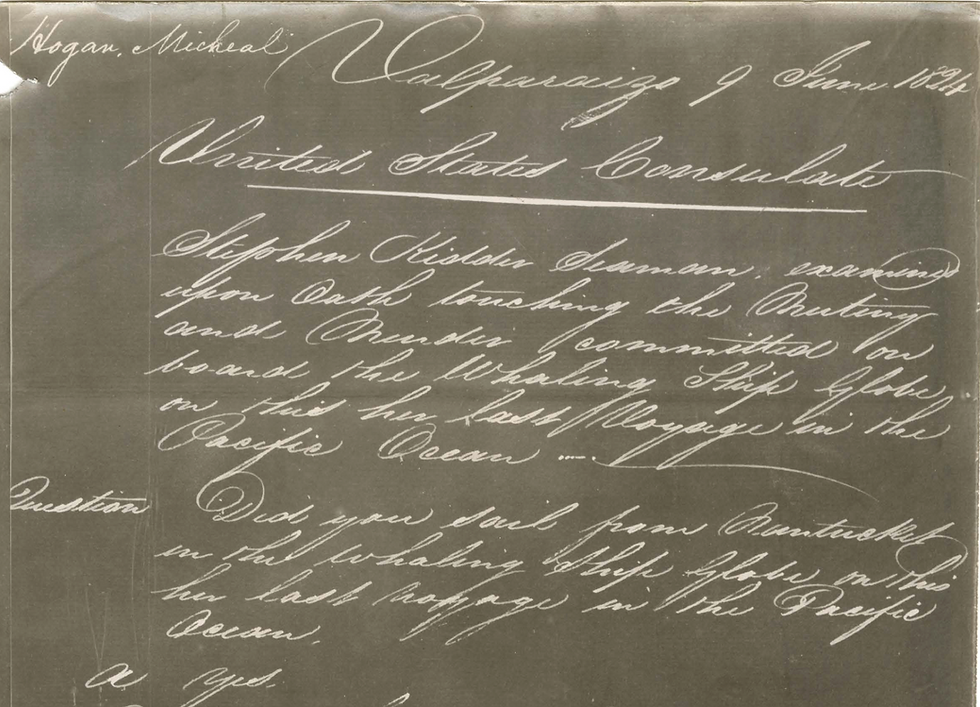
Stephen Kidder, Valparaiso, 9 June, 1824
Hogan, Michael, United States Consulate
Stephen Kidder, Seaman examined upon oath touchin the mutiny and murder committed on board the Whaling Ship Globe on this her last Voyage in the Pacific Ocean.
Q. Did you sail from Nantucket in the Whaling Ship Globe on this her last voyage in the
Pacific Ocean?
A. Yes
Q. Was there anything like mutiny appearing on the ship from the time she left the United
States till she sailed from the Sandwich Islands the second time?
A. No. Constant Lewis was once put in irons for differing with Comstock, the Boatsteerer
and let out the next day and the Captain struck the Cook another time on account of
Comstock also.
Q. What time did the mutiny break out after you left the Sandwich Islands the second time?
A. We sailed from the Islands in Dec. & the mutiny and murder was performed on Sunday
night the 25th, the 26th of January by Log.
Q. Who were the leaders in the mutiny and murders?
A. Sam'l B. Comstock, born at Nantucket Boatsteerer was the principal, Silas Payne of Sag
Harbor next to Comstock, John Oliver of Shields in England next to Payne and Wm.
Humphrey, a black man of Philadelphia, Steward, composed the party that committed
the murder. William Smith said he heard them call for Thomas Lilliston of Virginia.
Q. Do you know if any othr person on the ship knew of it?
A. Joseph Thomas now on board English Ship of Ular said on passage to this place from
the Islands that on the night of the murder Sam'l B. Comstock asked if you are going
down to the Cabin with me tonight to which Thomas replied I will think of it another time.
Q. Did you hear the noise when they were murdering the Officers?
A. Yes. I heard the report of two pistols, say minutes after Mr. Smith came down the the
Forecastle. Mr. Smith had been asleep and awakened by noise which he went up to
enquire about, came down again and said for God's sake what is going on in the Cabin?
I can't hear anything of the Captain or Mate. He awoke all up. Soon after John Oliver
came forward and called us all up to make sail. When we went on Deck I was ordered on
the Fore Topsail yard to let the reef out. They threw a Mr. Lumbard, Second Mate and
Nathaniel Fisher, Third Mate overboard. Mr. Lumbard was able to swim. Fisher was
dead. Comstock ordered the boat lowered down to kill him but afterwards ordered her
hoisted up again fearful she might go up to the Ship Lyra of New Bedford about 3 miles
in the leequarter, just in sight.
Q. What did they do with the Captain & Chief Mate?
A. Comstock said they threw them both out of the Captain's Cabin window being dead.
Q. What was done on the following day?
A. Payne was employed posing as a guard & throwing something overboard.
Q. Did you go to the cabin that day and what state was it in?
A. Yes. It was in a very shocking state. Blood all over the place - signs of murder and
destitution.
Q. Did they promulgate any land on that day?
A. No, but they sent William Lay aloft on that day & Humphries, the black Steward, pointing
a pistol at him telling him that if a sail was seen off Deck by any person before he
reported from aloft that he should be shot and that any other man on board should be
served the same way. On the day after all hands were called and ordered to sit on the
Quarter deck. Comstock brought up the laws he had made - said those who cannot sign
their names to it to go to the other side of the deck. All hands signed it, being in fear
of their lives. Employed in the afternoon throwing casks of oil overboard & many empty
caskes stowed and thrown over in the evening. I am to keep the laws, who was made
Second Mate. Purser the day before was found loading pistols in the cabin which
Comstock questioned him. He answered that Gilbert Smith and Peter Kidder intended
to take the ship away the first opportunity and that he was loading a pistol to kill Smith.
Comstock told him he lied. Comstock, Payne & Oliver walked the deck all night. Next
morning I with five others were called into the cabin and furnished with six muskets and
sent on deck, The black Humphries placed in a chair, Peter Kidder examined as to what
he said about taking the ship. After the had acquitted himself, as did Smith, after which
a Jury composed of Silas Payne, J. Oliver, Geo. Comstock & Rowland Coffin was ordered.
Comstock who found Humphries of intention to kill one of them and he was immediately
hung to the end of the fore top mast steering sail boom rigged out 8 feet. After this the ship was kept on her course - got first to the Kingsmill Group where the natives were
very savage, run to the westward where Comstock ordered the boat to sail to land on
Small Isles where he, Comstock, shot one of the natives. Afterwards steered for
Mulgrave Island, at one of which, a large narrow Island they landed. Comstock brought
off several of the natives, men & women, all very friendly. Kept them on board all night,
gave each of the women one of the Captain's white shirts and the men other articles of
the Captain's. Landed them next day, steered along shore to the westward till 5 o'clock
in the evening when we came to anchor at the back of the Mulgraves. Following day
looked for a better place to run the ship on shore but did not succeed - then made up
their minds to strip the ship and burn her. On following day built one tent of sails and
spars landed, took all the clothes on the ship on shore and continued landing everything
until about three ore four. Payne and Comstock quarrelled about waiting in the boat,
the last went away and returned the day following. When approaching Payne fired a
musket but John Oliver shot him. He was buried in about half an hour, a Chapter read
and several muskets fired over his grave. On that night the men that brought the ship
here made their escape in her, agreeing that Gilbert Smith would conduct her to this
coast.
Q. Was there any difficulty on board during the voyage by any of the people?
A. Yes. Joseph Thomas was very bad & disobedient to Mr. Smith & swore frequently that he
would do what he had a mind to.
Q. Do you know or believe that said Thomas was acquainted with the mutiny before it was
commenced?
A. I cannot say he was. He said on the passage coming here that Comstock asked him on
the night of the mutiny & murder, "Are you going into the cabin with me tonight", to
which he aid "No, I will think of it another time."
Q. Do you think any other persons on board were acquainted with the intention of mutiny
and murder?
A. I never heard anything said by any of them about it.
Q. Do you recollect on what day of the month you anchored at the Mulgrave Group of Isles?
A. No. I do not. It was in February.
Q. Do you recollect on what day you escaped with the ship?
A. On the 17th of February at nigh about half past 9 o'clock.
(signed) Stephen Kidder
The forgoing is a correct copy of the disposition made before me by Stephen Kidder.
Michael Hogan, Consul of the United States.


Comments