
Stephen Austin, Asa Brigham ~ Colonizing Texas
- westmohney

- Nov 14, 2025
- 10 min read
[Stephen] Austin. . . never allowed the settlers to forget the solid benefits that they received through the liberal colonization policy or their obligation to obey the laws and become loyal Mexican citizens. ~ Texas State Historical Society
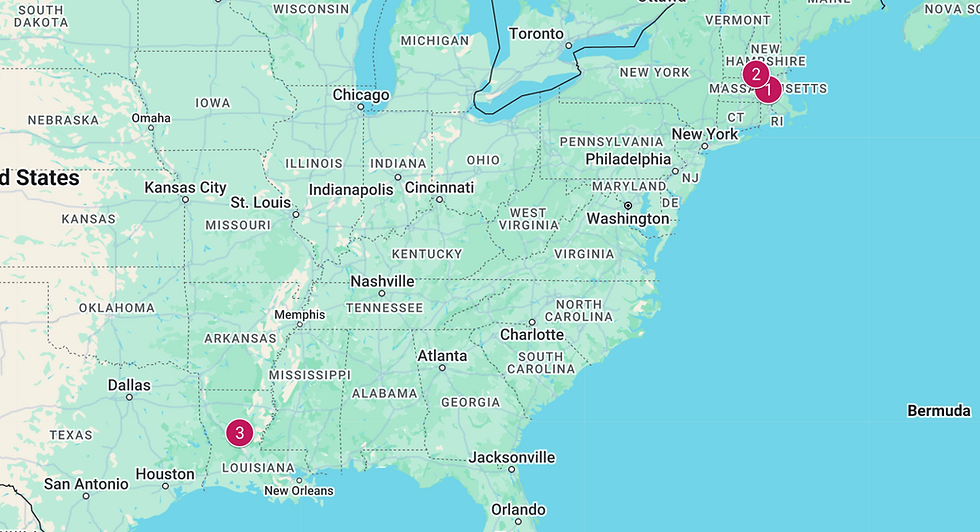
Asa Brigham in Massachusetts and Louisiana
Our cousin Asa Brigham (6C8X) was born in Marlborough, Massachusetts in 1788. His mother, Mary Rice Brigham, died when he was when he was only nine. She left five children for Asa's father, our cousin Lewis Brigham (5C9X), to care for. The children ranged in age from nine year old Asa to a one year old baby. When Lewis died five years after Mary, Asa was apprenticed out to a tailor to learn the trade. He was 14 at the time.
In 1810, when he was 22, Asa married Elizabeth Babcock in Framingham, MA, about ten miles south east of Marlboro. Their first child, Adeliza (7C7X) was born there in 1812. Then it appears that Asa and Elizabeth moved with Elizabeth's mother and two of her sisters to Jaffrey, NH.
Three more sons and another daughter were born in Jaffrey. In 1819, after a fire destroyed his business, Asa decided to join the ever burgeoning pioneer movement and take his family west to Alexandria, Louisiana. This 1,500 mile journey west took place sixteen years after Thomas Jefferson's Louisiana Purchase and at the beginning of a westward expansion in the United States that the History Channel editors call "one of the defining themes of 19th-century American history."
Shortly after arriving in Alexandria, tragedy hit the family. In a letter written to his brother-in-law on November 1, 1819, Asa reported the death of his mother-in-law, his two sisters-in-law and his son George (7C7X), all in the span of three weeks. Alexandria was hit with a wave of highly contagious yellow fever in 1819 so that seems a very likely cause of their deaths.
Asa would remain with his family in Alexandria for another 12 years. Meanwhile, in 1921, our cousin Stephen F. Austin (5C8X) had arrived in the Texas territory to carry out his father's dying wish.
Stephen Austin's early life
Our cousin Stephen Austin (5C8X) was born in Austinville, VA in 1793. We wrote about the adventures of his father, Moses Austin (4C9X) in our last post, "Moses Austin." At 11 years old, Stephen was sent back to Connecticut to be educated and, in 1810, he graduated from Transylvania University in Lexington, Kentucky. After graduation, Stephen returned to Missouri where his family was living at the time. There he studied law, served in the Missouri Legislature and, with his father, participated in the establishment of the Bank of St. Louis.
When the bank failed in the Panic of 1819, Stephen and his father were left finacially ruined. It seemed time for another move. While Moses looked toward the Texas territory to save him from his debts, Stephen moved to the Arkansas territory, near what would become the town of Little Rock.
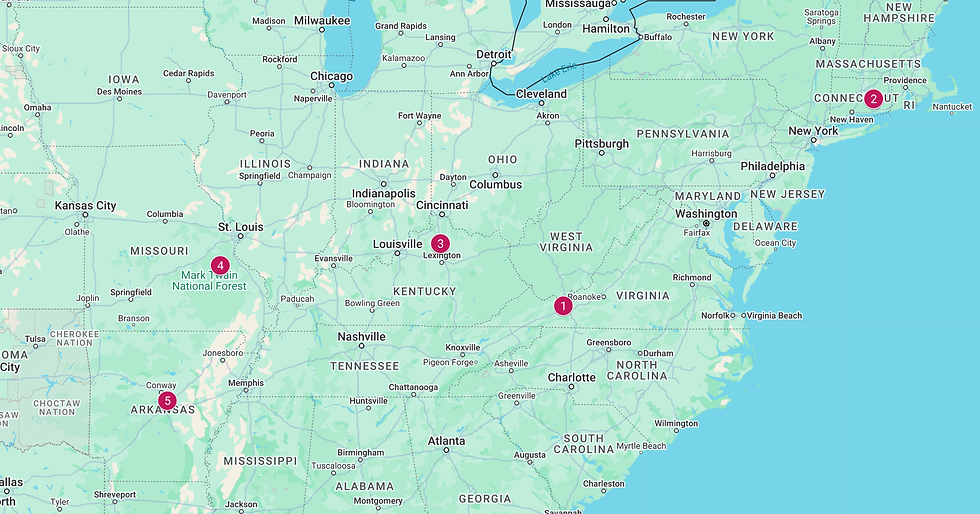
In Arkansas, Stephen attempted to pull his life back together. He acquired land, ran for congress and was appointed a First Circuit Court judge. It appears, however, that the spate of bad luck plaguing him in Missouri had followed him to Arkansas. Stephen's claim to land there was contested and, when the courts ruled against him, it was time for yet another move, this time to New Orleans, LA.
on to Texas
Stephen was still living in Louisiana in 1821 when his father returned to Missouri from his eventful trip to the Texas terriorty. When Moses got the word that he had been granted land there by the Spanish government, Stephen was a little skeptical about the plan, but decided to go along with it. Just where he was when he learned of his father's death is up to question. Most sources say that he was still in Louisiana but a letter written by his mother may be more accurate. In a July 28 letter to a cousin, Mary Austin wrote that "my son S. F. Austin is in Texas waiting the arrival ofhis father and it will be long before he can know the great loss he has met with. . ."
After hearing of his father's death, Stephen got a loan from a friend and arrived in San Antonio in August of 1821. That very month, Mexico finally gained independence from Spain. Moses' empresarial grant which allowed him to bring 300 families to the Texas territory was still valid, however. Below, the four markers define Moses' land grant on the Gulf of Mexico which spanned between the Colorado and Brazos rivers.

Because the size of the land tracts being offered was quite generous, over 4,000 acres per family, Stephen was easily able to round up the 300 allowed by the grant. These first families were later known as the "Old Three Hundred." For his work as empresario, which included recruiting families, managing the land and becoming the de facto government of the settlement, Stephen received an even larger parcel of land. One caveat to recieving so much property, however, was that all of the families that chose to settle in Texas were required to renounce their United States citizenship. Another stipulation was that "[t]he families which are to compose this Colony besides being industrious, as he offers in his petition, must be Cat[ho]lics, and of good morals."
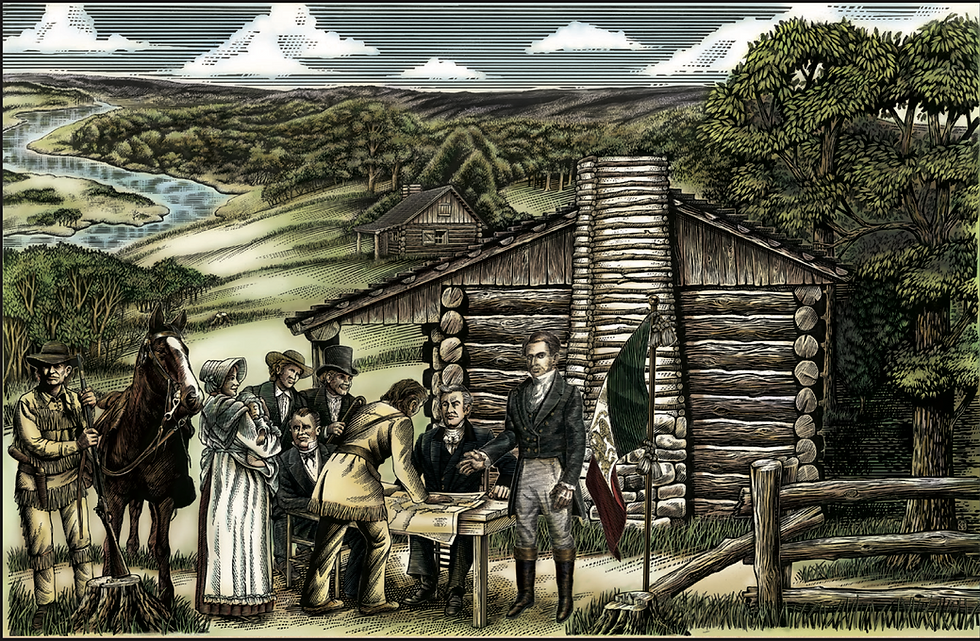
Below is a painting titled The Settlement of Austin's Colony by Henry McArdle. It now hangs in the Texas Capitol building.

recipe for revolution
Most of the families that Stephen recruited for his settlement were southern cotton farmers who brought slaves with them. Although the newly formed Mexican government passed a series of laws in the 1820s which abolished slavery, the new setters were granted temporary exemptions on the slavery issue. To complicate matters further, the bulk of settlers had renounced their American citizenship merely as a means to an end. Their true fidelity lay, naturally, with the United States. From the Texas State Historical Society website:
Harmony with state and federal authorities was indispensable to the success of the colonies. Austin clearly realized this fact and never allowed the settlers to forget the solid benefits that they received through the liberal colonization policy or their obligation to obey the laws and become loyal Mexican citizens.
Stephen, aware of the importance of trade with the U.S. and other countries, encouraged the establishment of ports along the coast and rivers. He especially emphasized the benefit of balancing imports from England with Texas cotton. Mexico allowed the development of ports at Galveston and the Brazos River but ixnayed foreign vessels from using those ports. External trade would have to be confined to the U.S. only.
In spite of Stephen's loyalty to Mexico, many in the colony wanted a certain amount of independece from the federal Mexian government. They wanted Mexio to recognize Texas as an indpendent state of the country. Others wanted to be separate from Mexico altogether. In 1826, a small group of Texas settlers staged a short lived rebellion in an attempt to declare independence from Mexico. Although the effort to establish the Rebublic of Fredonia wasn't supported by the majority of settlers, including Stephen, the failed rebellion did cause Mexico to take notice..
By the early 1830s, Stephen had been instrumental in bringing thousands of American setters into the Mexican province. Realizing that they may have created a monster, the Mexican government tried implementing measures to control the increasingly unruly new faction. Their attemps to end slavery, impose taxes and end all new immigration from the United States only fomented more unrest. When skirmishes between the settlers and Mexican soldiers became increasingly common, all out war seemed the next logical step. It was into this climate of unrest that Asa Brigham brought his family in April of 1830.
Asa in Texas
By the time Asa arrived in Texas from Louisiana, his daughter Adeliza was married and his two sons were in their teen years. He settled in an outskirt of Stephen's colony in what is now Victoria County. Asa immediately became involved in town politics. In December of 1830, he was elected síndico procurador, or city attorney, for the precinct of Victoria. A year later, he was elected comisario for the same precinct. A comisario, like a constable, was authorized to enforce laws and collect taxes. In 1831, Asa was appointed to the Brazoria district Board of Health.
Asa joined early on with his American ex-pats in opposing the Mexican government. By 1832, the unrest had grown to the point that the settlers wanted to break away from what they saw as an oppressive regime. On June 20, 1832, Asa joined a group Texan politicians who signed a petition indicating "their willingness to engage in military actions" to gain independence from Mexico.
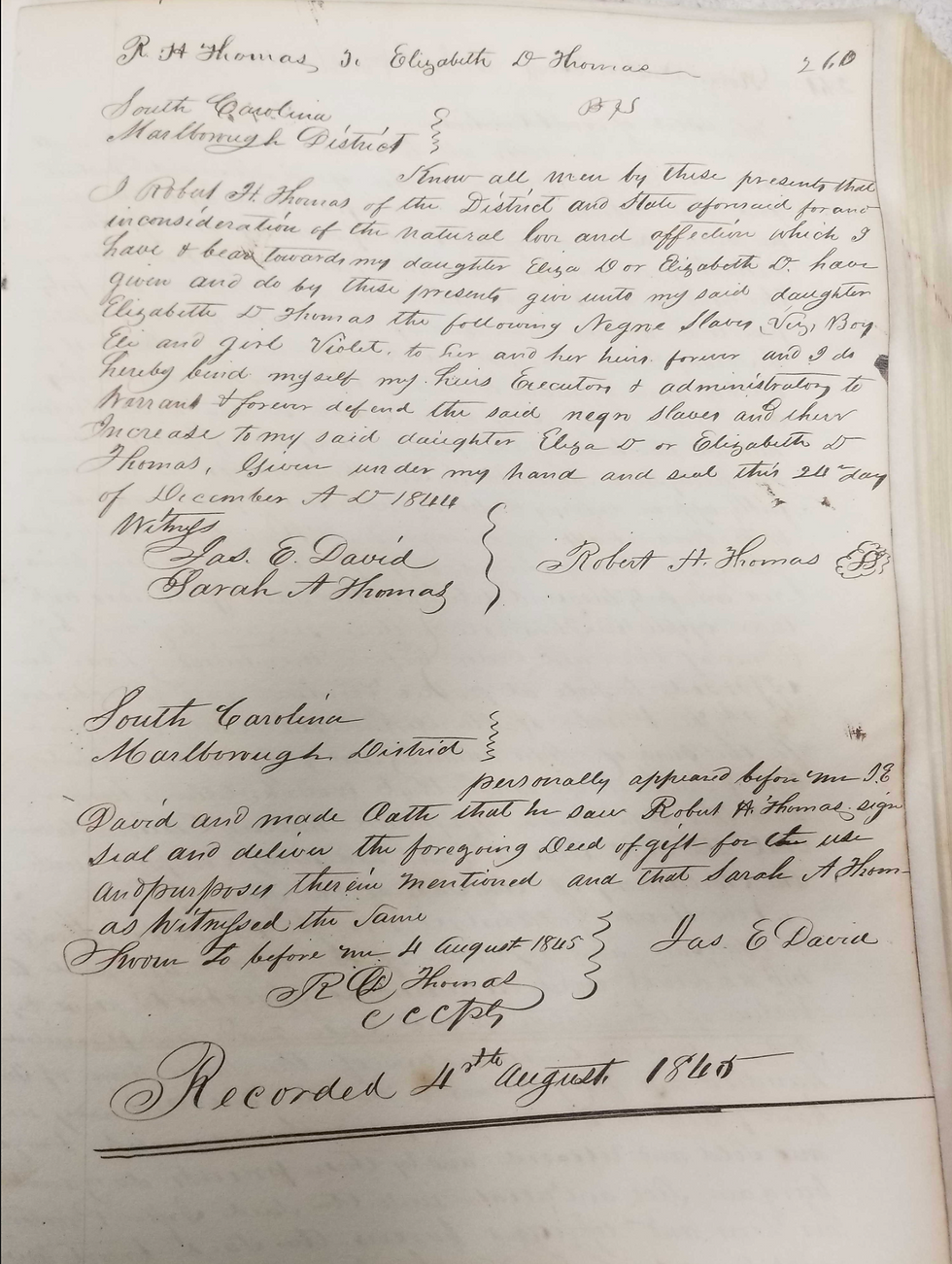
Amidst all the chaos, life in Texas went on swimmingly for Asa. In October of 1832, he was elected treasurer of the Brazoria district. The next year he began a ferry service across the Brazos River at Brazoria and, with his son-in-law, ran a mercantile business. As his wealth grew, so did his business ventures. He bought stock in the San Saba Colonization Company and did work for the Brazos and Galveton Railroad. He bought land in three counties, Brazoria, Galveston and Bastrop, where he raised cattle and grew sugar, cotton and corn. In order to run his many operations, Asa owned slaves. Later in life, however, he would have a change of heart and sign a number of petitions decrying slavery.
Asa's wife and son-in-law died in 1833. Two years later, he was elected alcalde, or mayor, of Brazoria. By this time, tensions between the settlers and the Mexican government had reached the required boiling point.
prelude to war
For many years, Stephen had maintained good relationships with the Mexican government, even joining the Mexican soldiers to put down the minor rebellion in 1826. Over the years he had worked hard to reconcile differences between the colonists and the government. By the early 1830s, however, even his good intentions had begun to sour. Then, in April of 1833, Antonio Lopez de Santa Anna was elected president of Mexico, giving the setters hope that the new restrictions would be eased.
The same day of the election, the Texans held a convention to discuss their demands of the new government. Attending that convention was Sam Houston, a man who would soon play a major role in the looming revolution. It was Stephen, however, who was chosen to work with the Mexicans. He traveled to Mexico City where he was granted certain reforms but, because the population in Texas didn't meet statehood requirements, that request was denied.
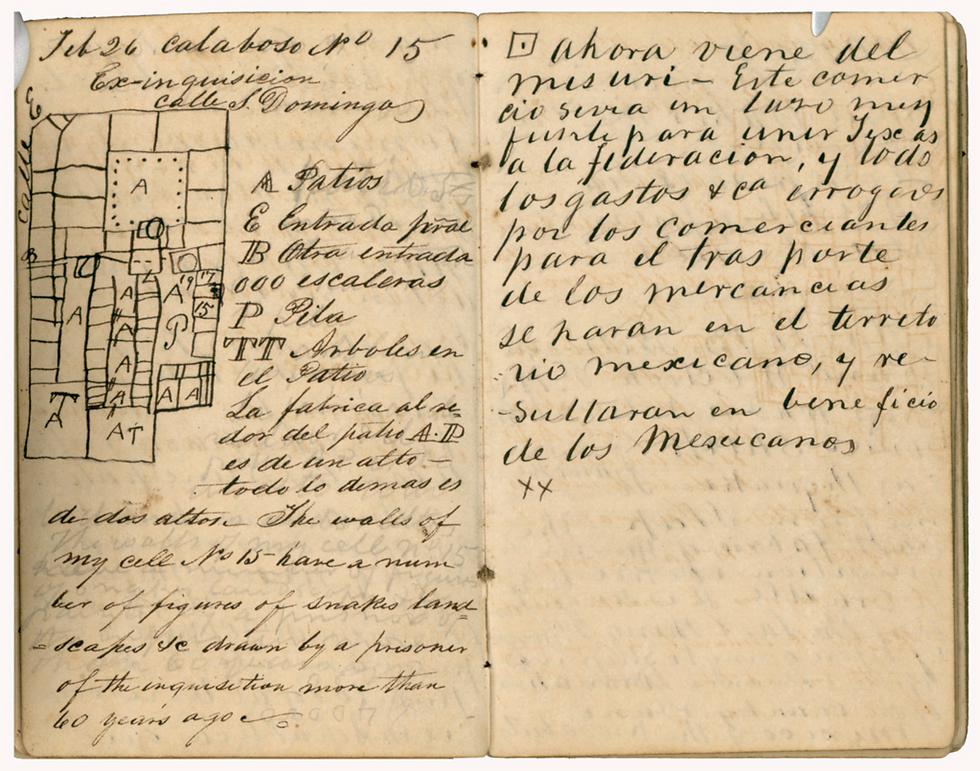
The Mexican governments refusal to grant statehood was a deal breaker for the colonists and, finally, for Stephen. He wrote a letter telling the folks in Texas to act on their plans for rebellion. Unfortunately, his letter was intercepted by Mexican officials and, on January 3, 1834, Stephen was arrested on his journey home and imprisoned in Mexico City. While imprisoned, Stephen kept a diary. His entries are in both English and Spanish. On February 26, 1834, he drew a diagram of the prison. About his cell, he wrote:
The walls of my cell No. 13 have a number of figures of snakes landscapes drawn by a prisoner of the inquisition more than 60 years ago.
Further upehaval took place in Mexico when Valentín Gómez Farías, a champion for the rights of common citizens, was ousted as vice-president. The newly assembled congress granted Santa Anna "extraordinary powers." At the end of March, the passage of the Federal Militia Reduction Act, which disbanded local and state militia, led to outrage all across Mexico. By April, Mexican military commanders in Texas, certain of an impending revolt, began asking for reinforcement.
The first revolt didn't happen in Texas, however. When the state of Zacatecas staged a minor rebellion, Santa Anna's reprisal was quick and "brutally efficent." When the stories of violence reached Texas, the uneasy settlers prepared for the worst. In June, William Travis led a group of men in taking Fort Anahuac, fifty miles east of present day Houston. His action angered both the colonists who were still hoping to resolve the situation and the Mexican government.
the revolution begins
It wasn't until August of 1835 that Stephen, now fully committed to the Texan cause, was finally allowed to leave Mexico City. With that commitment, the Mexican government had "lost their greatest ally." Two months later, the Texas Revolution began with a skirmish over a cannon at the town of Gonzales. Though casualties were light and the Mexicans, in essence, refused to fight, the Battle of Gonzales, as it came to be known, was significant. From Wikipedia:
A large number of Texians had taken an armed stand against the Mexican army, and they had no intention of returning to their neutral stance towards Santa Anna's government. Two days after the battle, Austin wrote to the San Felipe de Austin Committee of Public Safety, "War is declared—public opinion has proclaimed it against a Military despotism—The campaign has commenced."
As a volunteer army was created to take on the Mexican forces, Stephen was elected to take command. 26 days after the Battle of Gonzales, he led his newly formed army to Béxar (now San Antonio). He sent a small scouting group, which included James Bowie, to find a spot closer to the city. While the scouts were camped near Mission Concepción, the Mexican army decided to attack. The result for Mexico was disastrous. Their losses were quite heavy while the Texans lost only one man. The Mexicans retreated back to the town and the siege of Béxar began.
The Texans, realizing they needed a battle plan, called for a "Consulation" which was held on November 3rd and 4th. Stephen, still at the Béxar siege with the troops, was unable to attend. A provisional goverment was formed and Stephen, out of sight, out of mind, was summarily replaced by Sam Houston as commander in chief of the regular army.
The delegates at the convention, however, were not quite ready to commit to full rebellion. While they "affirmed their loyalty to Mexico," they still demanded the reestablishment of the Constitution of 1824 as well as separate statehood for Texas.
The delegates decided that Stephen's new role would be that of commissioner to the US. The hope was that he would be able to win support for their cause through diplomacy. That decision ended Stephen's direct involvement in the revolution.
We will continue the story of the Texas Revolution in our next post.


Comments