
THE ADVENTURES OF CUTTING LUNT
- westmohney

- Jan 2, 2024
- 8 min read
Updated: Sep 25, 2024
...but the Zeal of that Officer Mr. Cutting Lunt induc’d him to pursue too far. . . ~ John Paul Jones
Cutting's back story
Our aunt, Hannah Adams (9A), was the daughter of our immigrant ancestor Robert Adams (10GGF) of Newbury. In 1678, she found herself in the family way without benefit of marriage. The father of Hannah's child was a man named Joseph Mayo who had also impregnated Hannah's step-sister, Sarah Short. A court battle ensued and Hannah's brother, our uncle Abraham (9U), took charge her case. Abraham won not only weekly payments from Mayo but also custody of the child, Joanna Adams (1C10X).
In 1708, Cousin Joanna Adams married Joseph Lunt and the couple had seven children. One of Joanna's grandchildren, Cutting Lunt (3C8X), would go on to find some fame and adventure as a privateer and a sailor for the Continental Navy. He served as third lieutenant on the famed Bon Homme Richard under Captain John Paul Jones.
Before his adventures began, Cutting married Mary Gerrish. Their first son was born in August of 1775. Then, the war got in the way. Cutting and Mary's next child wasn't born until June of 1781.
Cutting's first adventure
On 12 Jan 1776, twenty-seven year old Cutting Lunt was living in the town of Newburyport when the British ship Friends appeared off the coast of that town. The captain of the ship had evidently mistaken Ipswich Bay for Boston Harbor where the British were still holed up.

Seventeen men, one of them Cousin Cutting, embarked in whale boats to meet the ship. One of the Americans, Navy Captain Offin Boardman, quickly took charge of the situation, asking the British captain if he needed a pilot to help get his vessel to shore. Thinking these men were fellow Britains, the grateful Englishman allowed Boardman and his men to board his ship. The Americans easily took possession of the vessel loaded with supplies for the British soldiers in Boston. The booty included, among other provisions, coal, meat, porter, vinegar, sauerkraut and livestock.
Note: One of the men involved in that escapade was Joseph Stanwood who, in 20 years time, would purchase our cousin Tristram Dalton's (2C8X) estate, Dalton Farm.
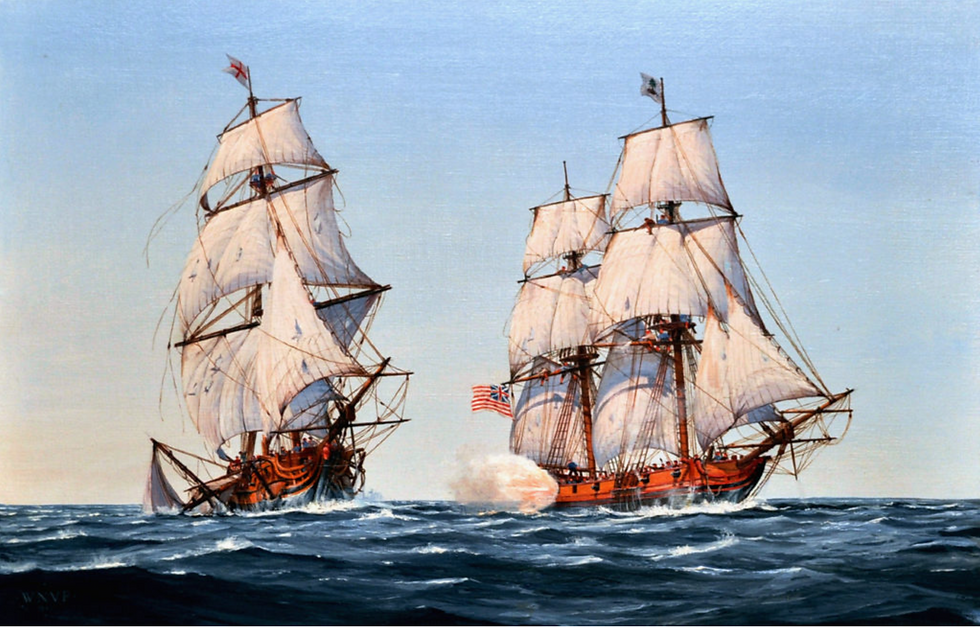
the privateer brigantine Dalton
Cutting's next adventure wasn't quite so much fun. In our "Two Loyalists and a Patriot" post, we wrote of our cousin Tristram Dalton who, like Cutting, lived in Newburyport. In addition to his legislative and mercantile activities, Tristram also dabbled in the privateering business. His eighteen gun brigantine, aptly named Dalton, was completed in October of 1776. Cousin Cutting Lunt was chosen as one of the crew and the ship set out to sea on the 15th of November. Along with Cutting on the Dalton were his brother Richard (3C8X) and two of his (and our) cousins, Henry Lunt (5C6X) and Shipmaster Daniel Lunt (5C6X). Also aboard was our cousin John Stickney (3C8X)
Note: Henry and Daniel Lunt are related to us through our Greenleaf family.
After a brief stop in Portsmouth, NH, the Dalton set sail for Europe. Only a month into the voyage, disaster hit. On Christmas Eve, Dalton captain Eleazor Johnson sighted the sixty-four gun British warship Raisonable in "hot pursuit" of his much smaller vessel. Johnson ordered his crew to try and outrun the warship. The Raisonable gave chase. After an eight hour pursuit, the British ship caught up, fired two warning shots and ran alongside the American privateer. There was nothing for it but to surrender. The men aboard the Dalton, Cousin Cutting included, were herded onto the deck of the Raisonable, stripped of their clothing and thrown into the hold.
Their next stop was Plymouth, England where the crew members were kept aboard prison ships before their transfer to England's Mill Prison.
Mill Prison
Three months after the capture of the Dalton, Benjamin Franklin decided to get into the act, proposing a prisoner exchange. While the English were willing to negotiate, it still took many months for any exchanges to take place. In the meantime, the prisoners were subjected to an "examination" much like the witch trials in America in 1692. From the journal of Dalton crew member Charles Hebert:
3 Jun 1777 - ...the rest of us were carried on shore again, and guarded to the Fountain Tavern, to be tried by judges. . .We told them we were out to fight the enemies of the thirteen United States. After we were examined one by one, the third time. . .our commitments were read to us and delivered to the constable. My commitment read as follows: "Charles Herbert, you are supposed to be guilty of the crime of high treason, and committed to prison for the same until the time of trial." We were then delivered to the constable, and guarded to Old Mill Prison, Plymouth. Alas! I have entered the gates but the Lord only knows when I shall go out of them again."

Mill Prison was built to handle the overflow of prisoners confined to prison ships where conditions were pretty deplorable. It's estimated that between 1777 and 1783, close to 10,000 prisoners passed through Plymouth, either on ships in the harbor or in prisons on shore. The percentage of prisoner death in Mill prison, luckily for Cutting and his relatives, was considerably less than on the prison boats. Still, incarceration in those cells was no picnic. Another Dalton crewman taken prisoner, Samuel Cutler, described conditions in the prison:
We are all committed to the largest - 132 feet by 23 - without any distinction, officers, people and negroes all in the same room. We are treated worse than the French were last war in these prisons. We are debarred pens, ink, paper, rope, candles, &tc. No person is allowed to come into the outer yard to speak to us. We have no communications with any person except Mr. Cowdry, the prison keeper, and the turnkey. Cowdry is as great a tyrant as any in England, and uses us with the greatest severity. Our allowance is 3/4 lb. beef, 1 lb. bread, 1 qt. very ordinary beer, and a few greens per man for 24 hours. . .To sleep upon, we have a hammock, straw bed, and one very thin rug.
In July, some of the prisoners devised an escape plan. On July 18, 1777, they began digging a tunnel underneath the prison. By August 4th, the underground passageway was finished. At eleven o’clock in the evening, thirty two American prisoners escaped from the jail. Over half of them were from the Dalton. Unfortunately, the British eventually caught most of the prisoners over the next week, with the help of a £5 per head reward.
Undaunted, the crew of the Dalton made two more escape attempts in January and February of 1778. No less than twenty crew members and officers successfully broke out of the jail and were never recaptured, Cousin Daniel Lunt among them. Cousins Cutting and Henry Lunt weren't so lucky.
Most of the crew of the Dalton were finally released in prisoner exchanges orchestrated by Benjamin Franklin in late 1778. Henry and Cutting weren't released until March of 1779.
The experience of being captured and imprisoned didn't stop either man from returning to the sea. We'll have Henry's story in our next post.
Richard Lunt
According to a House of Lords Library document, Cutting's brother Richard Lunt was released in the fourth removal of prisoners. His release is recorded as taking place on June 6, 1778. In this same document, Richard Lunt is listed as a "mariner of the Dalton privateer." He returned to America on board the frigate South Carolina with six other Dalton crewmen. James Lewis, in his book Neptune's Militia, wrote that Richard was a gunner's yeoman on the South Carolina.
When the Revolutionary War ended, Richard filed a petition with the state of South Carolina asking compensation for his service aboard the South Carolina. The state awarded him £52.
the Bon Homme Richard
When Cutting and his cousin Henry Lunt were finally released from Mill prison, they were sent on a cartel to L'Orient, France. After Burgoyne's surrender at Saratoga, the French had become wholehearted supporters of the American cause. Cutting and Henry were immediately commissioned officers on the soon to be famous ship Bon Homme Richard under the command of none other than Captain John Paul Jones.

From a list of officers and men for the Bon Homme Richard dated 26 Jul 1779, we find that Henry was 2nd lieutenant of the ship and Cutting was 3rd Lieutenant and shipmaster.
In April, 1779, in a letter to one of his brothers, Cutting wrote:
I have shipped for another cruise, and hope I shall have better success. I am going in a ship called the Poor Richard , commanded by John Paul Jones, esquire, but our expedition is secret, but I hope to be at home next Christmas if my life is spared.
From John Paul Jones manuscripts which are housed in the Library of Congress, we learn that on On July 28, Benjamin Franklin sent a letter to Jones informing him that the French Secretary of Navy was worried about the "mutinous state" of Jones' present crew. Jones decided to remedy that situation by sending Cutting and his cousin Henry Lunt to Nantes to pick up 116 men recently released from British prisons to replace his existing crew. Cutting received orders at L'orient, France from Captain Jones which:
[d]irects him to proceed to Nantes to enlist American seamen, especially those who arrived from England 'in the Cartel'; they are to be given the same 'encouragement and conditions' as other men enlisted from former cartel; is to bring with him all who are 'able and willing to serve America and enrich themselves. . ." When his business was done, Cutting was to "return here and join me without loosing an hour.
So Jones' new expedition was on. After being provided with arms and supplies by the French, Jones set out to engage the British. On 23 Aug, 1779, off the coast of Ireland, the Bon Homme captured the British Brigantine Fortune. Cutting's escapade in this encounter was narrated in a letter from Jones to Benjamin Franklin:
On the 23 we saw Cape Clear and the S. West Part of Ireland that Afternoon it being Calm I sent some Armed Boats to take a Brigantine that appeared in the N.W. Quarter. . .The Ships Boats being absent I sent my own Barge a head to tow the Ship— The Boats took the Brigantine She being called the Fortune and Bound with a Cargo of Oil Blubber & Staves . . . Soon after Sunset the Villains who Towed the Ship cut the tow Rope and Decamped with my Barge.— Sundry Shot were fir’d to bring them too without effect— In the mean time the Master of the Bon homme Richard (Cousin Cutting) without Orders Manned one of the Ships Boats & with 4 Soldiers pursued the Barge in Order to stop the deserters— The Evening was then Clear & Serene—but the Zeal of that Officer Mr. Cutting Lunt induc’d him to pursue too far, and a Fog which came on soon afterwards Prevented the Boat from Rejoyning the Ship altho I caused Signal Guns to be frequently fired. . .
Not only did our poor cousin bear the blame for the the loss of a boat and twenty-three men, but once he reached shore, Cutting was once again captured by the British and thrown back into Mill Prison.
Cutting was finally released from Mill prison sometime in 1780 and, naturally, returned to the sea. Genealogy sites report that Cutting died at sea in 1781 or 1782 after taking a position as sailing master on the privateer America. I haven't been able to find any proof of that, so Cutting's death will remain a mystery.
two items in the Museum of Old Newbury
Since 1877, the Museum of Old Newbury has been "collecting, preserving and presenting" items of interest about Newbury and environs. One article in their collection is a hand-stitched pocketbook that belonged to Cutting. It was donated to the museum by his great grandsons George (5C7X) and John Lunt (6C7X) in 1924.

Also in the museum is an engraved print of the British fleet ship Royal George, shown below The print was on board the British supply vessel Friends that Captain Offin Boardman, along with Cutting and other men, captured in the Ipswich Bay in 1776. According to the museum, "Cutting is suspected of being the one who lifted it from the cabin of (British) Captain Bowie." Cousin Cutting is probably the most famous of the men who boarded the Friends that day and that just might have something to do with why he is credited with the theft.



Comments