
THE ADVENTURES OF HENRY LUNT
- westmohney

- Jan 10, 2024
- 11 min read
Updated: Sep 25, 2024
. . .before I could get on board the Bon homme Richard she commenced the engagement with the Serapis ~ Henry Lunt

Henry's adventure on the Serapis
Our cousin Henry Lunt (5C6X) was born in 1753 in Newbury. We wrote a little about him in our last post about his (and our) cousin, Cutting Lunt (3C8X). The cousins were both on the privateer Dalton when it was taken by the British in December of 1776.
We found much of Henry's story in John James Currier's History of Newburyport. Currier's information about Henry was "principally derived from a written narrative of his (Henry's) son..." According to Currier, Henry remained in Mill Prison for over two years, "suffering the greatest possible privations." Currier further described poor Cousin Henry's situation:
His peculiar rigorous treatment was in consequence of his twice having made the attempt to escape. On one of these occasions he received a severe wound in his thigh, in trying to force himself through the grating of the prison sewer; being caught, he was put into the "black hole," where his wound receiving no attention, mortified so that the flesh was obliged to be cut away, and the bone scraped.
Henry and Cutting were finally released from Mill prison in March of 1779 and almost immediately signed on with John Paul Jones. Cutting was only with Jones for about five months before he was once again captured by the British and thrown back into Mill prison. Henry, who was a second lieutentant on the Bon Homme Richard, continued up the coast of England with Jones to the North Sea off Scotland.
On September 23, one of the lookouts on the Richard spotted a flotilla of ships on the horizon. As the ships drew near, Lt. Henry Lunt was sent out, with fifteen men, to try and capture one of the British brigantines. When two larger British ships approached the Richard, however, Jones gave the signal for Henry to return. Henry later gave his account of the event:
Having, on the 23d of September, 1779, been ordered in a pilot boat with a party of men after a brig, but some time after I set out from alongside, a signal was made for me to return back to the Bon homme Richard, she being then in chase of two British ships-of-war, the Serapis and Countess of Scarborough, and before I could get on board the Bon homme Richard she commenced the engagement with the Serapis. It being night, I thought it not prudent to go alongside in time of action. . .
So it turns out that neither of our Lunt cousins were on board the Richard for what has been called "the most remarkable single ship duel of the American Revolution." While Cousin Henry looked on from afar, the first cannon shot was fired at 7:15 The Bon Homme Richard took three broadsides "causing devastation on the decks" but the crew soldiered on. Then, when the Serapis tried to ram the Bon Homme, the two ships became entangled and the battle raged on at close quarters. Two hours after the confrontation began, the captain of the Serapis asked if Jones was ready to surrender. No one knows Jones' exact words but they have come down in American lore as the famous "I have not yet begun to fight!"

Fire broke out and spread among the two entangled ships. As many men now were engaged in trying to quench the flames as take part the battle. The Richard sustained further damage when it was hit by the friendly fire of an American warship commanded by Frenchman Pierre Landais. While some accounts say that Landais couldn't distinguish between the ships, other's say that his attack on the Richard was purposeful. The two men, Landais and Jones, had taken an instant dislike to each other and their feud would continue on, even after the Serapis incident.
Nearing midnight, just when it appeared the Americans couldn't hold out any longer, one of Jones' men threw a grenade at some British soldiers on the deck of the Serapis. As luck would have it, the grenade ignited loose powder scattered about and a huge explosion followed. The damage to the Serapis was so severe that the British captain had no choice but to surrender.
The Bon Homme Richard had also been badly damaged in the conflict. The next morning, Jones' worthy vessel sank beneath the waves. Jones then took the captured and damaged Serapis as his flagship. With his faithful lieutenant Henry Lunt back on board, the Serapis sailed to the Netherlands for much needed repairs.
the log books
The bulk of the log books for three of Jones' ships, the Serapis, the Alliance and the Ariel have been found without doubt to be in the hand of midshipman Beaumont Groube. It was discovered, however, that there were two pages of the log that had been torn out of the book. Those pages were subsequently found and, after much study, conclusively determined to be in the hand of our cousin Henry Lunt. Those two pages record the events of the day before and the day of the epic battle between and the Serapis.
Since Henry wasn't on board the ship at the time, where did he get the information he wrote in the log? Project Gutenberg is an organization that digitizes books, papers and manuscripts deemed worthy of their effort. In their introduction to Jones' log books, that very question came up:
Who dictated the narrative of the fight which Lunt wrote in the Serapis' log? It is an authentic and truthful narration of the principal occurrences, and corresponds with Jones' own accounts of the battle. It is written in the first person, and must have been written by some one who was on board the Bon Homme Richard, and copied by Lunt into the Serapis' log at some time subsequent to the engagement, in order to have a circumstantial account recorded in the log.
Speculation is that Jones himself, with input from Henry, dictated what was written in those two pages of the log. Henry signed his entry: "[o]n board the Serapis, at the Texel, 25th of October, 1779. Henry Lunt." And it seem that Jones felt that Henry's vantage point as an eyewitness on the scene helped to clarify the events:
This certificate of Lieut. Lunt, who was a mere spectator, is of great weight and importance, it being only in the power of this gentleman to give a true account of the respective positions and manœuvres of the ships engaged.
Below are excerpts of Henry's entries into the log book:
Remarks on Friday 24th Sepr 1779
The first part of this 24 Hours light Breese of Wind and clear Weather At 2 P M sent away the Pilot Boat with the 2d Lieutenant (Henry) and a number of Marines Arm’d. . .At 3 PM saw a Fleet to the leeward among them appear’d to be two Ship’s of War. . .We made Sail gave Chase to the two Ships. . .at 5 P M. . .the two Ships of War hove too ready for engaging of us we Bore away for to meet them & got the Ship ready for engageing (all Hands being at their Quarters). . .One of the Ships hailed us; Answers of no great Consequence return’d. The Capt. Of the Ship that appeard to be the largest said tell me Instantly from whence You came and who You be or i’ll fire a Broad side into You; finding her to be an enemy discharg’d a Broadside into her which She return’d after exchanging three or four Broadsides came to Yard Arm, & Yard Arm, in which posture both ships lay the rest of the engagement; lash’d the Enemies Ship to Ours. . .The engagement was so hot that both Ships got on fire several times; which was put out with as much expedition as possible by the Men belonging to each Ship; all this time the engagement was exceeding warm. Both ships keeping up a heavy fire with Cannon and small Arms. . .the Enemy then crying for Quarters (surrender) Capt. Jones said haul your Colours down then; which was granted immediately & our People took possession of her. . .the latter part of the the Night all employed in putting out the fire in different parts of the Ship and in Pomping (pumping) she having not less than three foot of Water in her Hold; The Carpenters employed in stoping the leeks with the assistance of the Carpenters from the Other Ships; The leek still gaining on us; we were supply’d with Men from the other Ships; who assisted in heaving the Lower Deck Guns overboard & the Dead Men &c
25th. The first part of this 24 Hours Moderate Breeses & Clear Weather. . .The leak still gaining on us Notwithstanding all the Pomps were at work. The Carpenters crying out that it was impossible to stop the leak At 2 P M Capt Jones with the Capt & Lieutenant of the Prize; quitted the Ship & left Orders to keep the Pomps agoing. . .at 7 He return’d and found the leak increasing in Consequence of which He Order’d the wounded to be Carried on Board the different Vessels & things that was most Necessary to be taken out of the Ship. . . 7 P M the Capt left the Ship with several more of the Officers repair’d on Board of the Prize (the Serapis). . .At 4 A M quitted the Pomps the water then being almost up to the lower Deck; At 10 Do every Man left the Ship At 1⁄2 Past 10 A M there was a Boat sent from the Commodore of The Serapis to go on Board the Bon Homme Richard But before the Boat got along side She Sunk which was about 11 A M. . .
the ships Alliance and Ariel
Once In Holland, Jones wanted to have the Serapis repaired and kept by the United States as his flag ship. The French, however, had other ideas and, in the end, the captured ship was claimed by France. Jones was promptly put in command of another ship, the Alliance, which was scheduled to return to America with supplies of arms and clothing. His command of that ship was short-lived, however. Jones' arch enemy, Landais, stirred up the crew of the Alliance to mutiny against their commander. While Jones was in Paris, basking in the laurels of his victory, Landais seized the ship and crew as his own.
Some of the crew remained faithful to Captain Jones, our cousin Henry among them. Jones then took command of the small frigate, Ariel. On the 16th of June, 1780, the Ariel set sail for America. That very night, a gale began to blow which turned into a hurricane the next day. The details of the storm were included in a report by the chief officers (Cousin Henry included) of the Ariel:
. . .but the next night the Ariel was driven by the violent tempest close to the rocks of Penmarque, a terrible ledge between L'Orient and Brest. The ship could show no sail, but was almost buried under water, not having room to run before the wind, and having several feet of water in the hold. Finding the depth of water diminishing fast, Jones in the last extremity cast anchor, but could not bring the ship's head to the wind. Sometimes the lower yard-arms touched the water, and Jones had no remedy left but to cut away the foremast. This had the desired effect, and the ship immediately came head to the wind. The mainmast had got out of the step, and now reeled about like a drunken man. Foreseeing the danger of its either breaking off below the gun-deck or going through the ship's bottom, Jones ordered it to be cut away, but, before this could be done, the chain plates gave way, and the mainmast breaking off by the gun-deck carried with it the mizzenmast, and the mizzenmast carried away the quarter-gallery; two additional cables were spliced and veered out. In that situation the Ariel rode in the open ocean to windward of perhaps the most dangerous ledge of rocks in the world, for two days and two nights, in a tempest that covered the shore with wrecks and dead bodies, and that drove ships ashore from their anchors, even in the port of L'Orient.
The Ariel somehow stayed afloat in the raging storm and the entire crew made it safely back to the shores of France where they stayed for repairs. The ship set sail once again on December 18, 1779 and arrived in Boston in February, 1780. Henry returned to to Newburyport with a letter of recommendation from Jones in hand:
The bearer herof, Mr. Henry Lunt, has served under my command on board the continental ship Bon Homme Richard. He was first employed by me as a midshipman at L'orient, in the summer of 1779. he had been released from an English prison by a cartel. I soon promoted him to the station of a second lieutenant, and he continued with me in that ship as such, and was afterwards with me in the ship Alliance. . .and also from thence with me in the ship Areil to this port, as second lieutenant. Mr. Lunt has been with me in many trying circumstances, and has always behaved like a good officer, for which he has my best wishes. he had not the good fortune to be on board at the time of the engagement with the Seapis til the close of the action. he is included in the vote of thanks which I have been honored with by the Congress since my return to this country. Given under my hand at Phil May 1781 Chevalier Paul Jones.
Henry quickly got a new position on the ship Intrepid. Shortly afterwards, Jones managed to finagle himself a new ship and came round to Newburyport looking for Henry. Moses Davenport of Newburyport gave an account of Jones' visit:
Said John Paul Jones called on me and made inquiry after the said Lunt. On being informed that he was absent by sea, Captain Jones expressed great regret. . . that his object in making inquiry at that time for Captain Lunt, was to ascertain whether the Gov might not avail themselves of his service. . .and remarked that he shuld perfer him as an officer in the service, to any he had ever known.
Henry continued his life at sea, sailing as commander for various firms making about sixty voyages in all. He later joined the Marine Society of Newburyport which was composed of only sea captains. Henry died in 1805 at age 52.
Henry's legacy
In the 1990s, author Tom McNamara wrote three fictional novels about a character named Henry Lunt. It turns out that McNamara, who has since fallen into obscurity, is distantly related to Henry. That means we are distantly related to McNamara. The Historic Naval Fiction site has this to say about the books: "Whilst they are fictional, Lunt was a real person who served under John Paul Jones and was an ancestor of the author so the series has an underlying thread of truth. However they are out of print and hard to find."
The first book, Henry Lunt & the Ranger, is set in 1778. The plot has Henry as a prisoner in Scotland until he and the men with him are freed by John Paul Jones. Ridiculously enough, the cover of the particular edition below says that McNamara is a Pulitzer Prize nominee.

Henry was also mentioned in a novel by an author with much rosier credentials than those of our cousin Tom McNamara. Seaman Henry Lunt is a minor character in James Fenimore Cooper's historical novel about John Paul Jones titled The Pilot: A Tale of the Sea.
And, finally, below is a note by Henry's son Henry, Jr. (6C5X) explaining two watercolor portraits of him and his father. The note says:
6 Oct 1852
This was taken at Philadelphia 1805 by a younger Peale when I was 29 years old - Peale's Father (Charles Wilson Peale) a celebrated miniature Painter in the year 1781 in Philadelphia Painted a miniature likeness of my Father, at the time my father was about leaving the continental service under the commission of the chevalier Paul Jones then of the ship Ariel - Peale Painted also a miniature of Jones about the same time from which several copies by other artists have been taken - at the time my fathers miniature was taken he was only 26 years of age - there are satisfactory documents to show that my father as an Officer was a great favorite of Jones.
H. Lunt
I have not been able to find any copies of the miniature of our cousin Henry by Charles Wilson Peale but below is the one of John Paul Jones, done at about the same time, ca. 1781:

Below is Henry Jr.'s portrait, painted in 1805 by Charles Wilson Peale's son, Raphael Peale. Henry Jr.'s portrait is now housed in the Chazen Museum of Art at the University of Wisconsin in Madison.
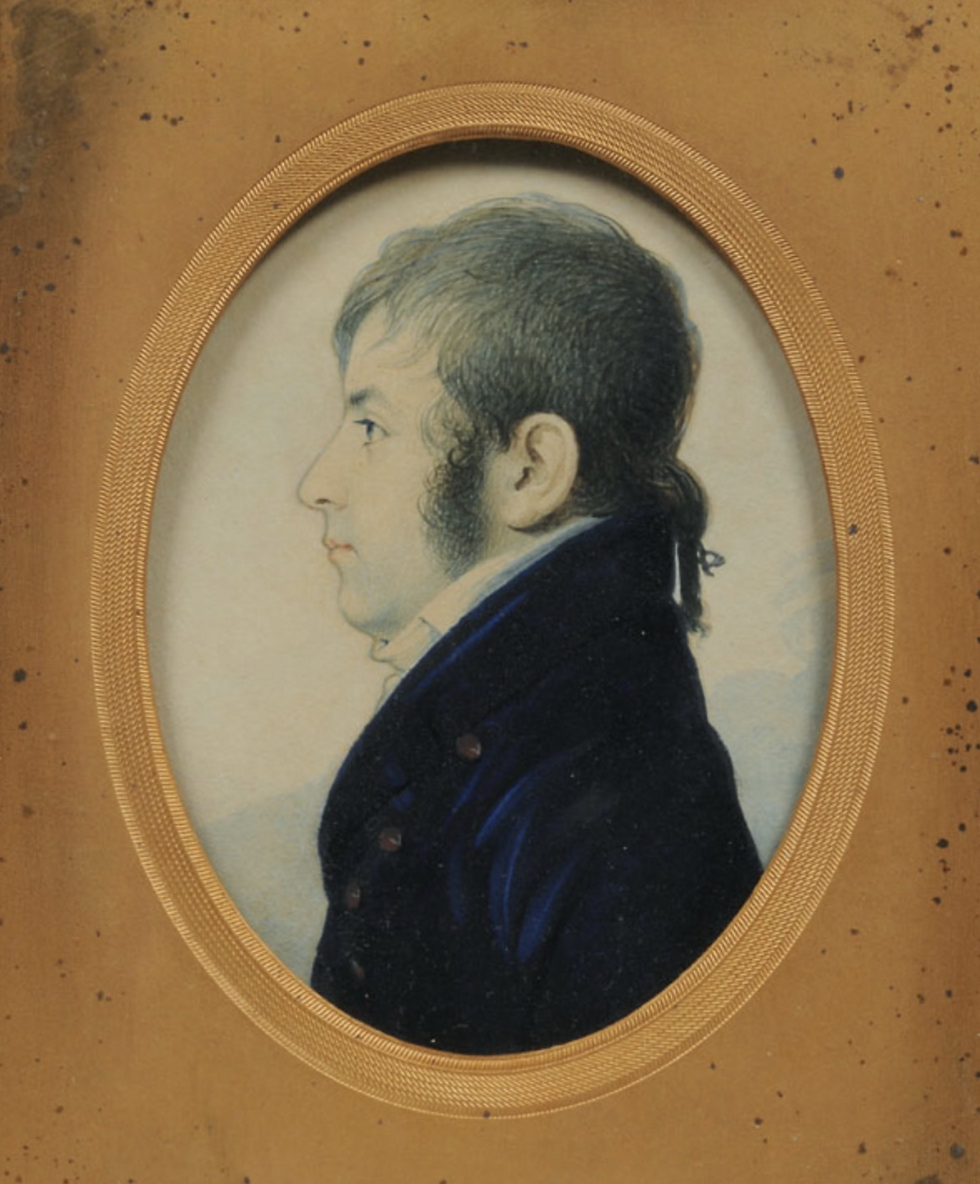
The Museum has a brief description of the importance of the portrait:
This rare portrait is virtually identical to an unsigned portrait of Rubens Peale by Raphaelle Peale, now in the collection of the National Museum of American Art and it is only the second known example of this type of profile portrait made by Raphaelle Peale. . .The locks of hair that accompany this painting were housed within the original Moroccan leather frame; the dark brown lock tied with a similar ribbon as depicted in the portrait is likely to have been taken circa 1805. The gray lock is likely to have been inserted when the portrait was framed along with the note, in 1852.


Comments