
THE BALDWIN FAMILY in the Early 19th Century
- westmohney

- Mar 30, 2025
- 10 min read
Updated: Mar 31, 2025
It was into the sense of promise and plenty that in 1783 Enos Baldwin was born in Cavendish, VT. ~ Mark Thompson

Our Baldwin family first came to America in 1635 when our grandfather John (8GGF) arrived from England in the ship The Pied Cow with his brother Henry (8U). The brothers settled in Woburn where they both married women from the powerful Richardson family. In 1755, 40 year old John married 17 year old Mary Richardson (8GGM), daughter of our grandfather Thomas (9GGF). That same year, John and Mary made a move to Billerica. Our branch of the Baldwin family line ended with John's daughter Susannah (7GGM) who married Joseph Hill (7GGF).
Below are some of our Baldwin family of note. Although most of these men are rather distant cousins, their accomplishments warrant them a spot in our narrative.
Brisco Gerard Baldwin
Our cousin Briscoe Gerard Baldwin (6C5X) descended from the Milford, Connecticut branch of the Baldwin family. We wrote about Briscoe's father Cornelius, who established a military hospital in Bethlehem, PA, in our "Revolutionary Stories Part IV." Sometime In 1777, Cornelius joined the 8th Virginia Regiment as their physician. In 1780, he was captured by the British and confined to a prison ship in Charleston, SC. After his exchange Cornelius still found the South to his liking and stayed, settling in Virginia. His son Briscoe was born in Winchester, VA in 1789.
Briscoe studied law at William and Mary College in Williamsburg, VA, graduating in 1807. During the war of 1812 he was captain of a group of mounted riflemen. Briscoe and his family lived at Spring Farm, in Staunton, VA, a property purchased by his father-in-law. During the Revolutionary War, Hessian soldiers had built the house there for the owner at the time.

The Baldwins embraced the southern life even up to the point of owning slaves. In the 1820 census, Briscoe own six slaves, two boys and two girls under 14 and two adults, one under 28 the other under 44.
In addition to his private law practice, Briscoe was elected to Virginia House of Delegates four times. He also continued his military service begun in the War of 1812, eventually attaining the rank of Major-General in the Virgina militia.
In 1829, Briscoe helped to found the State Colonization Society of Virginia. According to a glowing newspaper article about the event, John Marshall, Chief Justice of the U.S, was chosen president of the Society. Among its members were past U.S. presidents James Madison, James Monroe and future U.S. president John Tyler. The article ended with praise for the "splendid array of names. . .here brought forward to yield countenances and support to this great philanthropic object."

The Colonization Society of Virginia was a branch of the American Colonization Society which was established in 1816 "to address the prevailing view that free people of color could not integrate in U.S. society." Although, in a 40 year period, 15,000 free African Americans did decide to relocate to Africa, the program was widely opposed by both the majority of African Americans and abolitionists. And, according to the Wikipedia article on the Society, "[c]ontrary to claims that their emigration was voluntary, many African Americans, both free and enslaved, were pressured into emigrating."
In 1731, Brisco began a law school at his home in Staunton. In 1842 he was elected judge of the Virginia Court of Appeals, the state's highest court. Briscoe held that office for 10 years until his death in 1852.
His obituary in the Stuanton Reader read:
Our readers in this vicinity will not be surprised to learn that our truly great fellow-citizen, Judge B. G. Baldwin, is no more. . .However long and confidently this melancholy event may have been expected, by all acquainted with the nature and ravages of his painful disease, it cannot be less felt by all who appreciate true greatness, to be a stroke of no common severity on our community and the State.
. . .we leave to some abler hand the melancholy pleasure of testifying to the many noble and excellent qualities which distinguished the deceased while living and call forth from a wide circle of admiring friends the most sincere expressions of mournful regret now that he is no more.

the David Lewis Baldwin house
Another distant Baldwin cousin hailing from Milford, CT was David Lewis Baldwin (7C6X). He was born in Milford in 1785 and descended from his grandfather, Joseph Baldwin (2C11X), who had settled there in the mid 1600s.

David was the town clerk in Milford for 27 years. That, however, is not his main claim to fame today. David's house, which he built ca. 1835, has been a subject of interest to various organizations seeking to save his home from demolition.
I found a little about the origins of the house in an article from the Connecticut Real Estate History site
This Greek Revival style house at 67 Prospect Street has a unique backstory. When a doctor and his wife bought the house in the 1960’s, they discovered a false wall in a closet and stumbled upon a sermon by Reverend Bezaleel Pinneo, a descendant of Huguenots and seventh pastor at First Church of Milford from 1796 to 1840. Then the couple uncovered a note from 1899 in a hollow wood pillar. It was signed by Charlotte Nettleton, widow of Lewis Nettleton, and it reads:
“This house was built in 1839 by Elisha Peck, son of Capt. Nathan Peck, and William Tibbals. The owner was David L. Baldwin, son of Nathan Baldwin and Avis Durand.”
The letter found at the Baldwin House penned by Mrs. Nettleton continues: “The water pipe is being laid on Cherry Street. The railroad has been built since the house was built. What the future is about and what changes there shall be, I shall not be here to know.”
In 1986, the Baldwin House was included in a sweeping list of Milford Homes that became part of National River Park Historic District. Inclusion in the District, however, didn't give the home protected status and, over the years, the house fell into disrepair. The owner of the property wanted to demolish the house and build apartments in its place. In 2018 an article in the Milford Mirror addressed the problem:
Two historic preservation groups and some residents have their eye on an historic house in downtown Milford they fear may be suffering from neglect. The Milford Preservation Trust and the Daughters of the American Revolution (DAR), along with several concerned neighbors, are monitoring the David Baldwin House at 67 Prospect Street “with growing alarm,” said Preservation Trust President Michele Kramer. Kramer said there is speculation that the owner is letting it fall into disrepair so it can be demolished.
According to city historians, the house and property are important to Milford because the lot is the original home lot of the Rev. Peter Prudden (1601-1656), leader of the Hertfordshire Group that founded Milford in 1639 and first pastor of the First United Church of Christ. Also, Milford’s first burying ground was Prudden’s garden and was located at the rear of the lot.
While the current house at 67 Prospect Street is on the Prudden property, it was built more than 100 years after Peter Prudden died. According to the state’s Historic Resources Inventory, on which the house is listed, David L. Baldwin built the house in 1835.
The organization Change.org also got into the act with a petition signed by more than 3,000 people:
We oppose the demolition of the David L Baldwin House, a contributing property to the National River Park Historic District, established in 1986.
It is a late Greek Revival, and part of a notable group of cube-form buildings scattered throughout the River Park Historic District.
The house dates to c.1835.
The River Park Historic District has always comprised the residential and institutional center of Milford, and the layout has remained the same, with only minor changes, since the early Colonial period.
David Lewis Baldwin was the Town Clerk of Milford for 27 years, and Clerk of Probate for 12 years.
The present house rests on the foundation, and is part of the original home lot (7 acres) of the house of Reverend Peter Prudden, founder of Milford in 1639 and first pastor of the First Church on the corner of West Main and West River Streets.
Until very recently it was considered one of Milford's finest homes.
Every early history of Milford, and every early map, indicate the graves of the earliest settlers of Milford are located in Peter Prudden's "garden," approximately 150 feet behind the house.
We support the restoration and reuse of the property.
The organizations that stepped in to stop the demolition prevailed and the Milford Historic Preservation Commission denied the property owner's plan to build apartments on the property. He didn't take the decision lying down, however. From an article in the New Haven Register:
The attorney for a developer seeking to demolish the historic David Baldwin house to build apartments and offices said Tuesday his client will appeal the Milford Historic Preservation Commission’s decision to deny the project a “certificate of appropriateness” to move forward.
The attorney, Dominick J. Thomas Jr. of the firm Cohen Thomas in Derby, said they also are considering “challenging the statutory authority” of the commission, created in March 2015.
2018 developer wanted go ahead to demolish the house to build apartments. Historical committee said no!
A January 13, 2021 article in the Milford Mirror announced that the Historic David Baldwin House would be restored in a new development. Below is the house before restoration:

Whaler George Peters Baldwin
Our cousin George Baldwin (5C5X) was born in 1808 in Bradford, VT. From the History of Bradford Vermont by the Reverand Silas McKeen, we learn something of George's life:
Spent the years of his minority with his parents, engaged chiefly in agricultural and educational pursuits. When in his twenty-fourth year, he determined to leave home and make trial of the business and fortunes of a sailor. In the Summer of 1882 he engaged with Captain Briggs, of the whale ship Frances, and went on a voyage around the Cape of Good Hope, into the Indian Ocean. This voyage was so satisfactory that he went on a second, on board the same ship, and to the same ocean, in search of whales. These voyages occupied about two years. He then shipped aboard the Franklin, Captain Davis, for a voyage around Cape Horn, into the Pacific, in pursuit of sperm whales; visited the Friendly, the Navigator's, the Galapagos, and the Sandwich Islands, the latter group three times, then went to the Northwest Coast, to Columbia River, and thence along the Coast at Cape Horn again, and reached home after an absence of three years and five months. He next went out as Mate, aboard the America, for a cruise in the North Atlantic, especially around the Azores, and off the coast of Guinea. This voyage occupied one year; and the four voyages about six years and a half. On their Pacific cruise they took fifty-three sperm whales, affording two thousand and two hundred barrels of oil.
According to the excellent Baldwin Genealogy by Charles Candee Baldwin (6C5X), George was a whaler for six years. When he returned home to Bradford, he was town clerk for nine years, a representative in Congress for three years and a State Senator in 1851 and 1852. George died in 1877 at age 69.
Enos Baldwin, Toolmaker
Our cousin Enos Baldwin (4C5X) was born in Cavendish, VT in 1829. Ca 1806, he married our cousin Lucy Parker (4C6X) who was born in Westford, MA. Lucy descended from our Hildreth family. The Parkers were among a large contingent of Westford residents, many belonging to our family, that made their way to Cavendish.
Note: Cavendish is in close proximity to Proctorsville, a town founded by our cousin Leonard Proctor (1C7X) who came from Chelmsford. Westford is a offshoot town of Chelmsford. We wrote about Leonard in our "From Chelmsford to Vermont" post.
Enos and Lucy had one child, Austin (5C4X) who was born in June of 1807. Shortly after Austin's birth, the family moved to Albany, NY where Enos set himself up as a toolmaker specializing in planes and toolboxes.
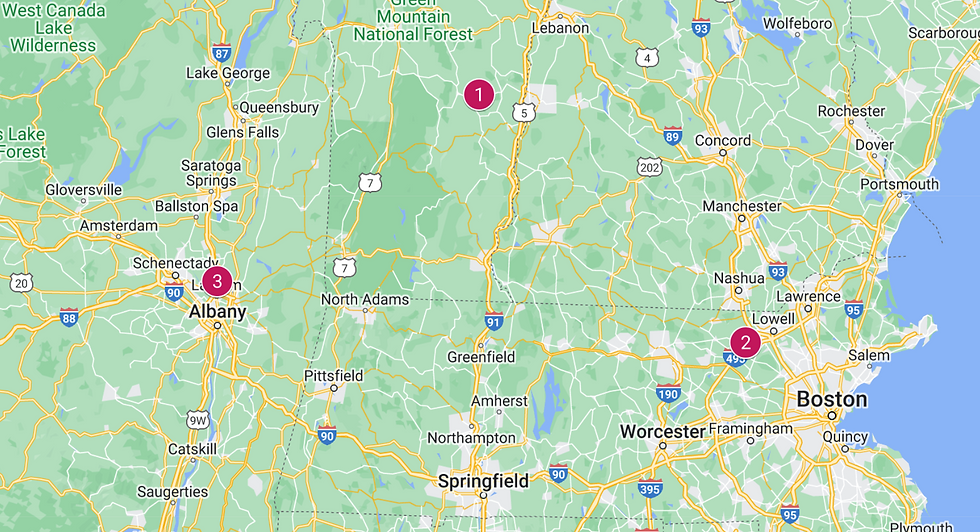
Tragically, Lucy died in Albany in October of 1807, only six months after the birth of her child. She was only 33 years of age. About four years later, Enos married his second wife Hannah Dunnell. Their first child was Elbridge (5C4X) who was born in 1812.
Mark Thompson of The Society for the Preservation and Study of American Wooden Planes had this to say about our cousin Enos and his sons:
It was into the sense of promise and plenty that in 1783 Enos Baldwin was born in Cavendish, VT. It is unclear where Enos received his training but he first appeared on the scene as a toolmaker in Albany, NY in 1807. He moved to Newburg, NY and finally to New York City and opened a shop at 90 Elizabeth Street. At that time, this placed him in the heart of the manufacturing center in what is now lower Manhattan, just north of Wall Street and the Financial District. As was the custom, Enos’ sons, Austin and Eldridge Gerry, worked in the business for their father until 1829, when Enos died at the age of only 45.
E. Baldwin became A&E Baldwin in 1830, with the half-brothers (Austin and Elbridge) working together in the business. Judging from the number of imprints and the quantity of planes still to be found, the brothers built the business into an impressive and prolific concern. They were also probably responsible for training many of the other NYC makers we are familiar with as well as a number of makers who learned their trade with the Baldwins and took their knowledge elsewhere. That was a good idea, as the trade was competitive enough in New York.
As examples of this, we can examine the papers of indenture for J.W. FARR. According to the papers, Farr, age 16 1/2 was to be apprenticed to Enos Baldwin for 4 years, 5 months and 13 days "to learn the art, trade and mystery of a planemaker."
The partnership between the brothers lasted until 1841, when Austin left the firm and moved to Connecticut where he opened The Baldwin Tool Company and later The Arrowmammett Works. He continued in business until about 1860, when he sold his interest in the company to The Globe Manufacturing Company and began a successful career in politics.
Eldridge continued in business, using the familiar E. Baldwin imprint until 1850. However, their legacy was already assured by the quantity and, more importantly, the quality of their tools.
Below are two examples of their work:


Many of the items made by the three Baldwin plane makers can still be found on eBay and at auction houses.
The Baldwin Family of Note continues in our next post.


Comments