
The Diary of Joseph Ballard
- westmohney

- Mar 7
- 12 min read
Updated: Mar 25
On Sunday the twelfth day of March One Thousand Eight Hundred and Fifteen, I sailed from Boston on board the Ship Liverpool Packet. . ., bound for Liverpool, England. ~ Joseph Ballard

All of the information we have on our cousin Joseph Ballard (4C6X) comes from a journal he kept while touring England in 1815. His journal was published in 1913 with the very lengthy title England in 1815 as seen by a Young Boston Merchant being the Reflections and Comments of Joseph Ballard on a Trip Through Great Britain in the Year of Waterloo.
Joseph's early life
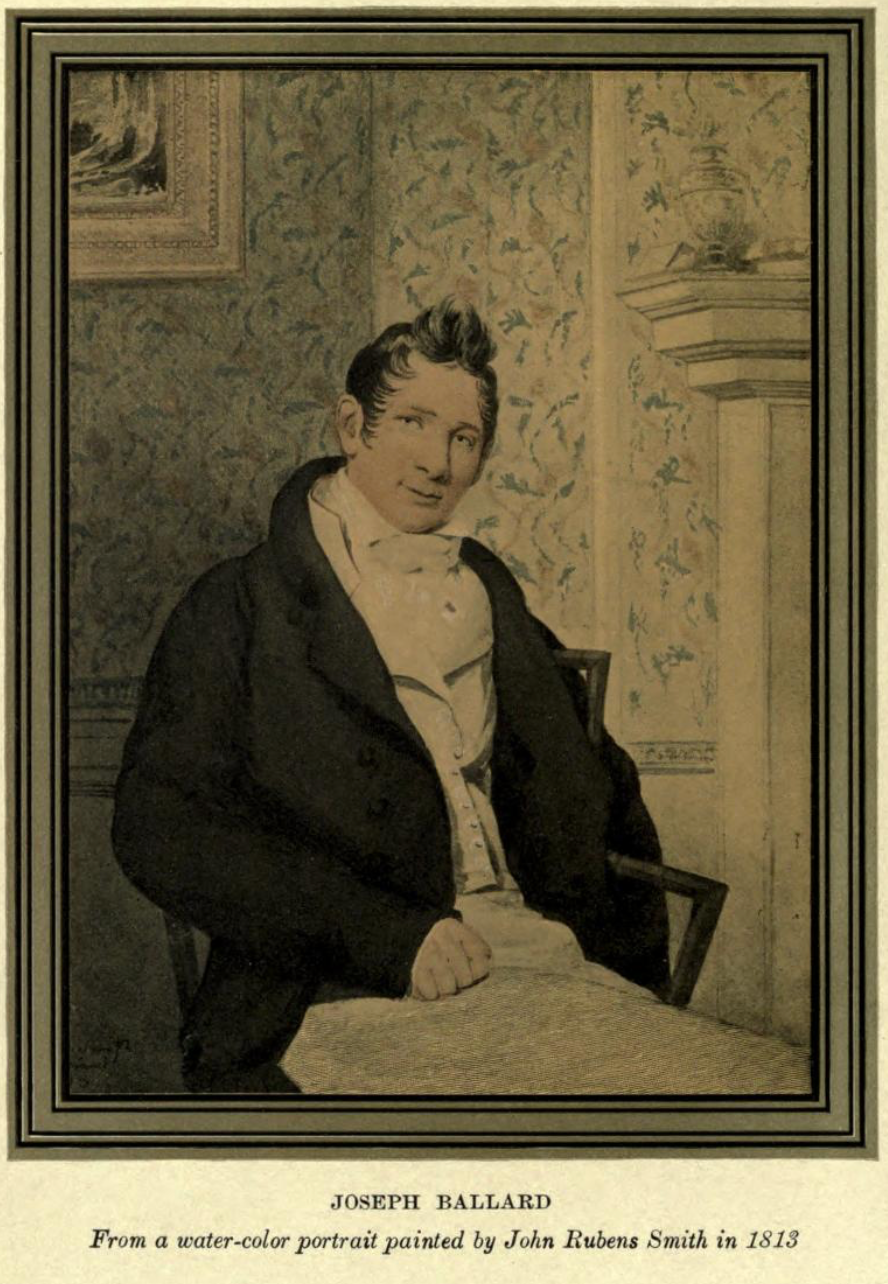
Joseph Ballard (4C6X) was born in Boston in 1789. He descended from our grandmother Elizabeth (last name unknown) (9GGM) who first married William Knight (9GGF). After William's death, Elizabeth married William Ballard. Our subject Joseph was born five generations later. His father, John Ballard (3C7X) "conducted a livery and hack business, having established the first hackney carriage in Boston."
In 1803, when he was fourteen, Joseph finished his education and "received a Franklin Medal at the hands of President John Adams in Faneuil Hall." The medal, as per Benjamin Franklin's will, was given to students who received top honors at their school. After graduation, Joseph became an apprentice to merchant Standfast Smith. One of his boyhood friends and fellow apprentices was Samuel Morse who later developed the Morse telegraph system.
After his apprenticeship was complete, Joseph and his brother John (4C6X) became parters of merchant Smith. When the brothers branched out on their own their firm was called J. and J. Ballard.
In 1811, Joseph married Bathsheba Paine and the couple had three children before Bathsheba's death in 1822. It was during this first marriage that that Joseph left his wife with their two young children and took a nine month tour of England. He was 26 years old at the time.
Joseph's journey
Joseph set out on his journey to England at a time that some might consider to be quite inauspicious. The War of 1812, which was fought between Britain and the United States, had ended a scant two months before.
Below are excerpts from Joseph's journal which covers 181 typewritten pages.
On Sunday the twelfth day of March One Thousand Eight Hundred and Fifteen, I sailed from Boston on board the Ship Liverpool Packet, Samuel Nickels commander, bound for Liverpool, England.
Here Joseph mentioned his fellow passengers. One was Professor J. W. Webster who, 34 years later, was convicted of murdering Dr. George Parkman and later hanged. Our cousin Jeffries Wyman (5C5X) an anatomist at Harvard College, was a key witness in that case. We'll have Jeffries' story in a future post.
For twenty days scarcely a day passed without snow, hail or rain, and none without a gale of wind. . .I suffered more than any other from seasickness, the horrid disagreeable sensations of which I think I shall ever remember.
On the 29th we experienced a tremendous gale of wind. The waves ran mountain high, and presented a scene so terribly grand as to surpass all description: then I would have gladly exchanged our gilded palace of a cabin for the meanest hovel in creation. I do not know a scene in which a man can be placed wherein he appears in one view more insignificant and at the same time in another more powerful, —
At night the gale still continuing we were gratified by a most magnificent and sublime sight. Hundreds of black fish from eighteen to twenty feet in length were sporting amid the "mountain waves." Their appearance when first seen very much resembled a drove of hogs, their bellies being of a dirty white color.
Once in a while we held a court of justice where offences against the dignity of the ship were tried, and the culprits fined in sundry bottles of wine to be paid at Liverpool.
April 4th we fell in with sixty sail of English vessels under convoy of the Musquito, — brig of war from whom we were boarded. They had heard a rumor of peace and the officer appeared highly rejoiced at our confirming it.
landing at Liverpool and traveling to Warrington
At our landing on the wharf at Liverpool we were surrounded by a tribe of girls of the town who welcomed us most cheerfully. These and innumerable others whom we met in going to our lodgings, together with the sombre appearance of the buildings, first by lamplight made visible, gave me no favorable opinion of the place.
A few days after his arrival in Liverpool, Joseph took a trip to the manufacturing town of Warrington, eighteen miles away.
The gardens and fields looked delightful being in quite as forward a state of vegetation as ours in June.
The manufactures consist of glass-houses, iron foundries, cotton works, breweries, &c. It has a gloomy dirty appearance in consequence of these works and the quantity of coal used in them. A large part of its inhabitants subsist by their daily labor in these manufactories. It was late in the evening when I arrived. Opposite the inn were assembled a vast crowd of these workmen having (as it was Saturday night) received their weekly wages. This they were spending in ale which soon intoxicated a greater part and such a scene of riot ensued as I shall not attempt to describe. These men are generally intemperate: were it not for this habit they might live quite comfortably on their wages. As it is, their families are starving for food while they are spending all they can in drink.

The old women seen in the streets are the most shocking looking creatures I ever beheld. I have seen them clothed in a man's hat and a short jacket over their gowns driving a little jackass through the town shewing such a countenance as to bring immediately to one's mind Shakespeare's scene of the witches in Macbeth. There is also an incredible number of children from two to four years of age swarming the street in such a state of nudity and uncleanliness as is quite disgusting. These wretched little beings are at quite an early age buried in the manufactories. I saw some in one who were not seven years of age. They had scarcely a rag to cover them. These poor little wretches earn sixty-seven cents a week! Could but the advocates of the manufactures of our country but witness the misery attached to those in Warrington, Sheffield, & Leeds, I am sure they would not so strenuously argue that it is for our national welfare that they should be established in America.
The farmers all over the county employ old women and children to pick up dung in the streets and roads, and they gain (I am informed) one shilling per day by this miserable employment.
Sheffield
At dusk arrived at Sheffield. . .The inhabitants of this place partake of the misery resulting from manufactures. The poorer classes are worse off for the articles which they immediately manufacture than the inhabitants of the American back settlements are. Many children not eight years of age are at work in these cursed holes, deprived of education; they consequently grow up in ignorance, and all the comfort or pleasure they have is in drunkenness and sensuality. Many of these little wretches are sent from London workhouses to these manufacturing towns. Often has my heart bled to see a poor little sickly being hard at work, deprived of liberty and fresh air, when its situation demanded the indulgent care of a tender nurse.

London
Left Sheffield for London; passed through many fine towns. The country was throughout the whole route highly cultivated. There were three buxon damsels in the coach. After having travelled through the night one of these pulled out a small bottle of rum from her "indispensable " and most kindly asked me to partake with her and her companions.
As we approached London the country became thicker and more highly cultivated. When I entered the great city I was a little disappointed at the narrow streets and lanes, and its appearance generally which struck me as being dirty and gloomy. On visiting the Bank of England I was astonished at its magnitude and the number of clerks employed. Many of the rooms in this great paper-mill of England resembled an extensive school. . .The entrances are guarded by the porters dressed in scarlet coats with badges on their arms denoting their employment, and by Beadles with a curious uniform and huge gold-laced hats.
This evening attended Covent Garden Theatre. . .There is always attending these theatres an immense number of women of the town (prostitutes). . .The streets are also thronged with these miserable wretches who accost every person who passes along. Many of them have not where to lay their heads, and pass the night in the streets in any corner which will afford them a shelter.

At night a good many of the streets and stores are lighted up with gas. The brilliancy of light thrown out this way is astonishing; compared with it the oil lamps look like a " dim candle at noon." It is prepared in some building erected for the purpose and conducted through the streets in pipes like an aqueduct, consequently all the proprietors have to do is to turn a cock and apply a candle and the house or street is lighted.
Within these last few days there has been posted upon the walls and distributed about the city a handbill offering a reward of £1000 to any person who will apprehend and bring to the old Bailey for trial, Seignor Napoleon Buonaparte, accused with the murder of Captain Wright " contrary to the statutes of Geo. &c. &c. in that case made and provided." One of the public papers remarks that Government should look to this handbill, but as it appears so much like catching the devil it is pretty well understood to be a hoax.
The Tower of London is a large pile of buildings surrounded by a deep moat. At my entering within the walls I was joined by one of the yeomen of the guards as a conductor. He was habited in the uniform worn by that corps ever since the reign of Henry the 7th, which is grotesque enough!
Note: Henry VII's reign lasted from 1485 to 1509.

In the first place he conducted me to the Spanish armory where there is an immense collection of the arms used by the Spaniards in their attempts to invade England with the Armada. Queen Elizabeth's effigy dressed in the identical clothes worn by her at that time is in this room, standing by the side of her horse. The horse armoury, where are the seventeen kings from William to George the 2nd on horseback, is next shown. This room also contains a great many suits of very ancient armor preserved in the highest perfection.
They have a wonderful way in this great city of showing off to advantage everything they have to sell. One has at his windows roasting jacks, with shapes of birds, mutton, beef, &c. cut out of wood turning upon them; another a patent hat which (to show that it is water proof) is floating in a vessel of water; another water filtering through a stone; another men's eyes, legs, arms, &c., to supply the loss of those members; in short, there is such an endless variety of objects at the shop windows that it would take a volume to describe them.
March 25 ~ This day went through St. Paul's cathedral. . .It is a source of great regret that it is in so crowded a situation. There should be a large space unencumbered with buildings, around it, to show it to advantage. . .When I descended from the dome, I found that the service had just begun in the chapel. Curiosity led me in and I found eight or ten men and boys dressed in dirty surplices chanting prayers in such a lazy, ridiculous manner that had I not been disgusted with the impropriety of it I should have laughed outright.

n almost every room in the building is a person who demands two-pence for showing it. This is a great disgrace to a nation possessed of the taste to erect such a magnificent pile. It is the fashion, however, in this country to demand a fee for showing all curiosities, either public or private.
In walking the streets in the city a person must always keep upon the right-hand side or he will receive many a knock. The carriages always drive the reverse. There is always an immense number in the street, extending as far as the eye can reach, one line coming and another going, the side paths so full at the same time of foot passengers, that if one makes a full stop he stops fifty behind. . .

I happened to meet in the street the Lord Mayor and sheriffs returning in state from Guildhall. The coach is carved and gilt all over. . .The whole equipage is most plentifully bedaubed with gold. . .the whole escorted by a mob of boys huzzaing!
Note: The Lord Mayor's carriage, shown below, was commissioned in 1857 and has been used continually to the present day. Today it is used generally only once a year.

March 28 ~ Today went to Greenwich. . .The road is over London Bridge. This bridge is esteemed to be quite unsafe and is to be pulled down and another erected in its stead.
Note: The original London Bridge was built across the Thames ca. 1200. Many iterations followed.

Below is a painting by by Herbert Pugh showing the bridge as it looked in 1757 after the bridge had been shored up and the buildings removed. This is the bridge Joseph would have seen but, by that time, was indeed "falling down." A new bridge was completed in 1831.

. . .I found Greenwich hospital to be indeed a " royal institution." Its appearance bespeaks more the magnificence of a palace than a receptacle for the infirm and aged. I saw many old seamen reclining at their ease beneath the piazza. They were clothed in blue clothes and cocked hats. Many of these hardy veterans had lost an arm or leg, and almost all were scarred. Each one has a little cabin fitted up like the stateroom of a ship. These are kept perfectly clean and neat, and many of them are ornamented with little pictures, &c. according to the fancy of the occupant.
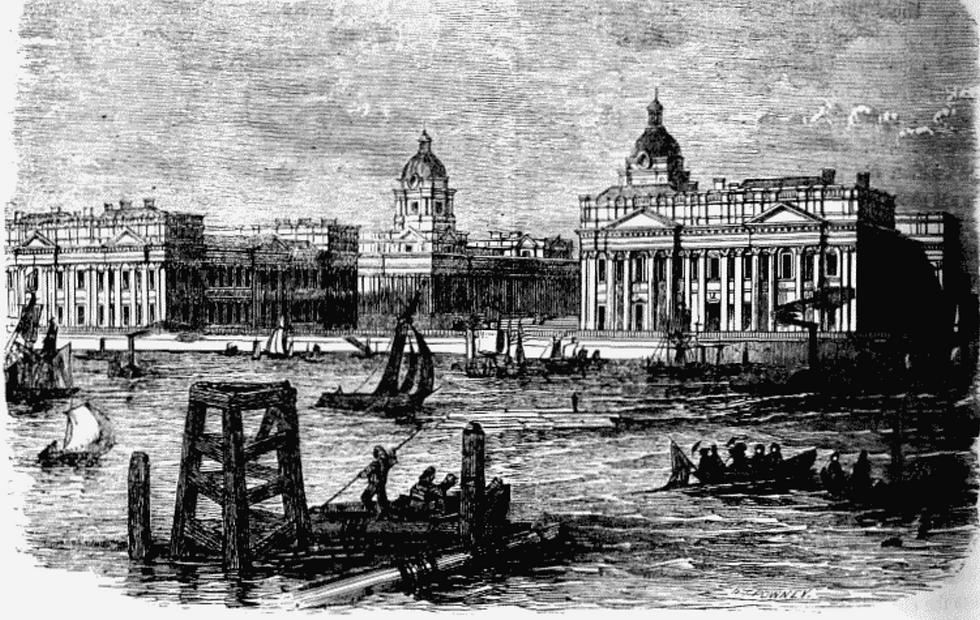
March 30 ~ Chelsea Hospital It is a similar establishment to Greenwich, being for the comfort of decayed soldiers. . . Viewing the ease with which these old soldiers pass the remnant of their days makes me feel not a little ashamed of my native land, nor could I help contrasting the comfort of their lives with many of our old Revolutionary patriots, who bled for the independence of that country which leaves them in old age to indigence and want.

In the evening attended divine service at the Magdalen hospital, a receptacle for penitent prostitutes. . .The "magdalens" were in a gallery, screened from the view of the audience. The choir was composed of the unfortunate girls, whose leader was a woman who formerly received the benefit of this institution, is now reputably married, and is hired for that purpose. When I reflected how many females were rescued from perdition by this admirable institution I could not withhold my prayers in the words of the anthem "that these walls might be with gladness crowned," nor could I help regretting how few of our sex there are "who scorn to plant within the female breast a lasting thorn."

1st May. ~ This day the chimney sweeps have a grand jubilee. These sons of soot parade the streets fantastically dressed out in gilt paper jackets with gaudy wreaths around their heads, their faces besmeared with soot, and their hair powdered. They go from house to house begging money. Lady Montague, who had lost her son, and after a very long search found him apprenticed to a sweep, left by will a sum of money to purchase annually a dinner at Paddington for as many of these sable sons as choose to attend. The hackney coachmen also have abundance of ribbons on their hats in honor of the season.
In the afternoon went to the House of Commons. The room in which the members sit is 40 feet by 80 feet, and not much more elegant than our old court-house at Boston. . .The Commons were debating upon the propriety of accepting a most impudent petition from the city against going to war with Bonaparte. In this petition they called the Parliament a corrupt one, and the ministry wicked, weak and dangerous men. I think, but it is hazarding perhaps a hasty opinion that the talents of our State Legislature would not lose much by a comparison with that of the House of Commons.

The Queen held a levee this morning. The park was crowded with spectators to see the company go into the palace. The equipages were extremely brilliant. Many of the carriages had behind three great fellows with splendid liveries and gold-headed canes in their hands. The gentlemen wore powdered hair and bags; the ladies were elegantly dressed with three ostrich plumes on their heads, in the manner of the Prince Regent's plume. Many of these fair dames had them of such immoderate length that they were obliged to sit stooping for fear the top of the carriage would discompose their head-dress.
May 7. ~ In the evening went to the Foundling Hospital, an institution for the reception of deserted infants. Here they are maintained and educated until of proper age to be apprenticed out. I was fortunate enough to arrive at an interesting period. Sixteen young men and women who had been apprenticed out this evening returned thanks to Almighty God for bringing them to this charity when they were deserted by their natural parents . . .There were upwards of five hundred of the children present, their ages from three to eleven years.

May 8 ~ In the afternoon curiosity led me and two friends to the far-famed King's Bench Prison. It is in the Burrough over London Bridge. The walls around it are very high and capacious. Within, it resembles a small town. There is a market, coffee-house, post-office, bake-house, shops, etc. etc. There were confined here 500 prisoners, a great many of whom were enjoying a game of racket. Some were smoking and drinking and others were promenading the yard.

The story of Joseph's tour through England will continue in our next post.


Comments