
THE FINAL MONTHS of WAR
- westmohney

- Mar 8, 2024
- 8 min read
Updated: Nov 25, 2024
We must take Cornwallis or be all dishonored. ~ General George Washington

an incident at Piney Bottom escalates
In early August, with the main action of the war now in Virginia, Colonel Thomas Wade's North Carolina Militia had decided it was time to go home. Our uncle, Matthew D. Covington (3U) was a member of Wade's company. From Matthew's pension application of 1832:
Declarant states that about this time Colonel Culb (Culp) & Colonel Wade were engaged in removing their property into the interior of North Carolina for safety and were attacked and defeated by the Tories at Piney Bottom in Cumberland County.
The map below shows the location of the Piney Bottom battle. Today that land is home to Fort Liberty, one of the largest military installations in the U.S.

The attack happened in the early morning hours of August 3, 1781 when Wade's men were asleep. Between two and three hundred Tories rushed in and immediately killed seven of the company. As the others fled, "[t]he waggons were then plundered, the officers taking the money and the men whatever else they could carry away." The Piney Bottom Massacre, as it came to be known, led to a bloodbath as "the American militiamen overran the area and committed guerrilla warfare against any Loyalist they could find."
The first course of action for Wade was gather up men the next day and go after the Torys. Toward evening, Wade and his men found a number of them at Beattie's Bridge over Drowning Creek, about 20 miles south of Piney Bottom The two sides exchanged shots until the wee hours of the morning when the Loyalists retreated after suffering twelve men killed and fifteen wounded. Wade's casualties were much less with only four wounded.
Two of our uncles involved in the "guerilla warfare" at Beattie's Bridge were Matthew Covington, who had been at the Piney Bottom massacre, and William Thomas (3U) who was evidently part of the group gathered up the next day.
From Matthew Covington's pension application:
After this Captain Hunter's Company & others perhaps to the amount of 300 from North & South Carolina marched in pursuit of the Tories & crossed Drowning Creek at the widow Cathys at that place some of our party killed four Tories. . .
Note: Captain William Hunter was married to our aunt Mary Covington (4A).
It appears that William Thomas didn't get out of the fracas unscathed. In his pension application, he stated that he was "wounded in a battle at Betty's bridge, and was taken at ? own house by the Tories and chopped in the head with a sword..." Family tradition says that "he was called 'Silver Heel' from the wound he received in his foot at Beattie's Bridge on 4 Aug 1781."
Matthew Covington evidently continued in Captain Hunter's company chasing down Torys. Again, from his pension application:
. . .made a route Drowning Creek & recrossed at Overstreet's ferry our business being entirely with the Tories our routes were in different directions as the emergency of the cases required & without intermission until the 21st July 1781. I was taken prisoner with three others. . .We were removed to Charleston & there remained prisoners until about the middle of February 1782 a period of about seven months.
Matthew must have got the date of his capture mixed up as the Piney Bottom and Beattie's Bridge events happened in early August, not July. But captured he was and it appears he joined our cousin William Kinchen on one of the dreaded prison ships out in Charleston Harbor.
Both of our uncles ultimately survived, however, and we'll have more on both of them in future posts.
The blood bath didn't end with Piney Bottom and Beattie's Bridge. Colonels Wade and Culp weren't quite done with the Torys. According to an account by the Reverend Eli Carruthers:
As soon as Wade and Culp reached home, they collected about one hundred dragoons, or mounted men. . .On Thursday evening they encamped on the premises of Daniel Patterson, the Piper. . .They caught the old man and whipped him until he gave up the names of all who were at Piney Bottom, so far as he knew.
Wade, Culp and their cronies rounded up the ringleaders of the attack and Carruthers wrote that:
All these were carried up, confined and pinioned. . .and there they were all kept under guard through The day while the rest were going and coming, apparently in search of others. They tortured the old man Black, very much, by beating him or slapping him with their swords, and screwing his thumb in a gun-lock, but they could get nothing out of him.
Eventually, all of the men captured by Wade and Culp were tortured and brutally killed.
Washington moves south
Meanwhile back in New York, General George Washington and his French counterpart, the Comte de Rochambeau, were having a little argument about whether to besiege the British still ensconced in New York or go after Cornwallis in Yorktown. The decision was finally made by French Admiral Francois de Grasse who informed Washington that he planned to sail from his position in the West Indies to the Chesapeake Bay in Virginia.
That set in motion Washington and Rochambeau's "celebrated march" to Yorktown which commenced on August 19, 1781. 7,000 soldiers, 4,000 French and 3,000 American, left Newport, RI to begin the almost 600 mile march. The Marquis de Lafayette, whose army had been shadowing Cornwallis in Virginia, awaited their arrival.

After de Grasse's arrival in the Chesapeake, British Admiral Thomas Graves sailed with a fleet from New York to attack the French navy. Graves, severely underestimating the size of de Grasse's fleet, was soundly defeated in the Battle of the Chesapeake on September 5 and was forced back to New York with his tail between his legs.
The stage was set for the final confrontation in October.
another encounter at Beattie's Bridge
The ongoing "civil war" in North Carolina only got worse as the war neared its end. The region in North Carolina near the town of Fayetteville was a hotbed of Tory activity. A month after the horrific events following Piney Bottom, our uncle William Wall (4U) was on hand for another battle between the Whigs and Tories at Beattie's Bridge. Also at that battle was our cousin Hannah Pickett Leak's (1C6X) husband Walter Leak.
This action at Beattie's pitted Loyalist David Fanning, who had captured our cousin William Kinchen at the Chatham Courthouse, against Colonel Thomas Wade of the Piney Bottom debacle. When Wade heard of a Loyalist contingent at the bridge, he rounded up about 450 men to give battle to Fanning's much smaller force. An account of the battle by Lindley S. Butler and Henry A. McKinnon Jr. says that:
Vigorous assaults over 90 minutes finally unnerved the Whig line, and it broke into a headlong, confused flight. Fanning's men pursued the Whigs for seven miles, taking 50 prisoners and 250 horses. The battle was superbly conducted by Fanning and would have resulted in the total destruction of Wade's force had McNeil succeeded in blocking the retreat as he was ordered. Fanning had 4 wounded and 1 man killed. He counted 23 Whig dead. This victory suppressed the Whigs in southeastern North Carolina and emboldened the Loyalists under Fanning to attack the temporary state capital at Hillsborough 12 days later.
Today, A commemorative marker stand at the location of the battle:

Battle of Eutaw Springs
General Nathaniel Green's Continental army, after slowly gnawing away at Cornwallis' force, had rested through most of the summer. In late August, Green was on the move again. Our uncle Stephen Thomas (3U), brother of William "Silver Heel," was with Green's army for the last major battle of the war before the British surrender at Yorktown.
Note: The Thomas brothers' sister, our grandmother Jane (3GGM), married Thomas B. Covington (3GGF). Thomas and Jane's son, William Wall Covington (2GGF), would leave North Carolina sometime before 1850 for a migration across the United States which finally ended in San Bernardino, CA.
The Battle of Eutaw Springs was the culmination of Greene's efforts to drive the British out of interior North and South Carolina back to the coast. The resulting contest, on September 8, was evenly matched with 2,200 Americans to 2,000 British.

The result of the clash turned out to be oddly predictable. The battle ended with an American retreat, but the British suffered more substantial losses. Through disappointed in the outcome, Greene achieved his goal. The British retreated back to Charleston.
The battle was rough on our uncle Stephen Thomas whose thigh bone was broken when he was hit by a musket ball. Six years later, he received a disability pension as a result of his wound.
the seige of Yorktown
On September 14, 1781,Washington and Rochambeau arrived in Williamsburg, VA, a scant 13 miles from Yorktown where Cornwallis was holed up with his army.

On September 26, when more men and artillery arrived, Washington was in command of a sizable army with 7,800 Frenchmen, 3,100 militia, and 8,000 Continentals. By September 28, the American and French forces were ready to lay siege to Yorktown by surrounding the city. Washington's plan was to "bombard" the British into "submission."
In his Siege of Yorktown, below, Auguste Couder depicts Washington standing in front of a tent with the Comte de Rochambeau to his left and the Marquis de Lafayette to his right.

By October 7, Washington's men had completed rows of defensive trenches "just out reach of (British) musket range." Artillery was placed in the trenches over the next two days and firing began in earnest on the 9th. Washington himself had the honor of firing the first shot to begin the bombardment.

As if the shelling from Washington's camp wasn't bad enough for the British, Admiral de Grasse also began an attack from the sea with his fleet of 37 ships, forcing Cornwallis to sink more than a dozen of his own ships to keep them out of enemy hands. By then, the British commander could see the handwriting on the wall. When British General Clinton in New York sent word that he could be in Yorktown with reinforcements by the 12th, Cornwallis replied, in essence, don't bother.
Below is a depiction of Cornwallis' plight by an unknown artist:
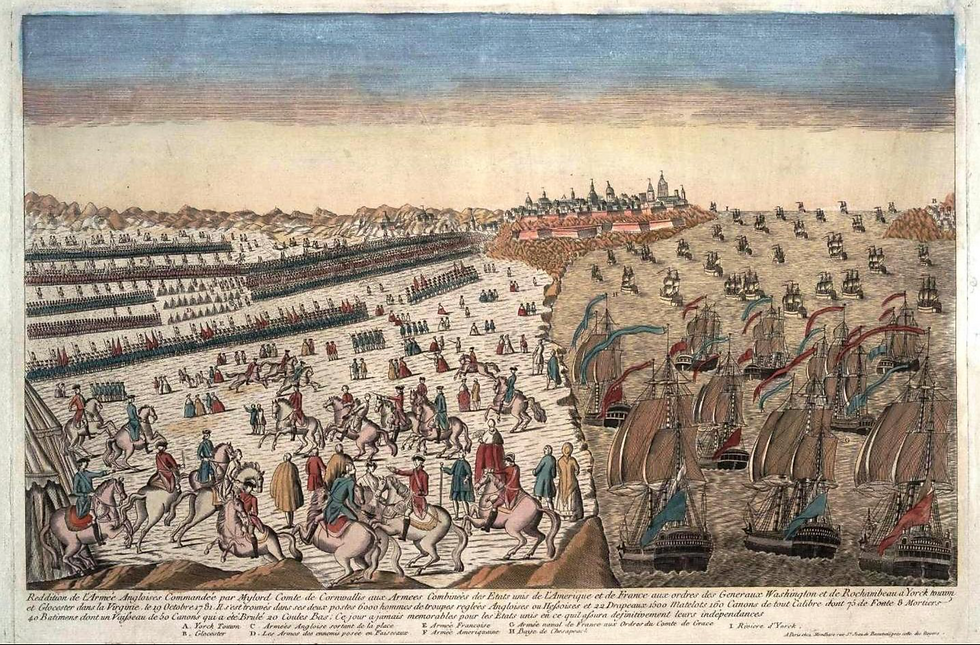
By October 14 the American trenches were within 150 yards of two of the British redoubts. When redoubts 9 and 10 had been captured, Washington was able to shell the town from three directions on land with de Grasse completing the circle at sea.

On the morning of October 16, a desperate Cornwallis tried to take a page from George Washington's book and evacuate his troops across the York River. One group of small boats actually made it across but, fortuitously for the Americans, a sudden storm made it impossible for more men to cross. The subsequent shelling only intensified.
Early on October 17, the Americans watched as a British drummer walked out of the city with an officer waving a white handkerchief close behind him. Negotiations began the next day with representatives for the British, Americans and French all present. Washington, knowing that the victory would not have been possible without Rochambeau and de Grasse, made sure that the French would "be given an equal share in every step of the surrender process."
Washington refused the British any honors of war in retaliation for the British refusal at the siege of Charleston. The humiliated Cornwallis was not at the surrender ceremony, claiming illness. In all, "8,000 soldiers, 214 artillery pieces, thousands of muskets, 24 transport ships, wagons, and horses" were captured. The blow was more than the British could withstand and, with the surrender at Yorktown, the Revolutionary War was effectively over.

We probably had more, but I can only find two definitive relatives of ours at the surrender:
Kirby Poythress (2C6X)
Richard Harris (3C6X)
Negotiating peace
Sporadic fighting would continue for the next two years while a peace treaty was being hashed out. The British didn't leave Savannah, GA until July 11, 1782. On November 30th of that year, the preliminary articles of peace were signed. The British left Charleston, SC on December 14. It wasn't until September 3, 1783, almost two years after the surrender at Yorktown, that the Treaty of Paris was signed.
When the last British contingent left New York City on November 25, 1783, the British rule in America was finally and irrevocably over.


Comments