
The Isaac Baldwin Family
- westmohney

- Jan 18, 2024
- 10 min read
Updated: Dec 17, 2024
It became a deadly race from which only about 60 escaped. . . ~ Wikipedia on the Battle of Wyoming Valley

the Isaac Baldwin family
Our cousin Isaac Baldwin (3C7X) was born in Canterbury, CT in 1730. He and his wife Patience had eleven children. Below is a page from the Baldwin family bible which records the births of all of Isaac and Patience's children, Rufus, Thomas, Watterman, Affa, Adah, Isaac, Jr., William, Henry, Polly, Silas, Ichabod and William, shown at the top of the page. All of Isaac's children are our (4C6X).

A year prior to the breakout of the Revolutionary War, Isaac and Patience moved with their twelve children to Exeter, PA. At the time of the move, the couple had three grown sons, Rufus (4C6X), 20, Thomas (4C6X), 19 and Waterman (4C6X), 17.

The Baldwin's new home was in an area of Pennsylvania known as the Wyoming Valley. Shortly after settling there, Isaac and his three older boys found themselves caught up in the fierce conflict raging between Connecticut and Pennsylvania over land titles. The Baldwins, coming as they did from Connecticut, were definitely among those not welcome in the Valley. This dispute over land became known as the Yankee-Pennamite Wars. While violent skirmishes between the two sides had been common for over twenty years, the revolution put a halt to the fighting. With the onset of the war, tensions only increased with the Yankees and Pennamites fighting not only each other, but the British to boot.
Answering the call to arms against the British were Issac and his sons. Waterman began his service with George Washington's army, first in New York and then New Jersey. He was still with the company during the harsh winter at Valley Forge in the winter of 1777-8. Thomas also served throughout the war, most noticeably at the Battle of Bound Brook on 12 Apr 1777. Bound Brook was an outpost in New Jersey that was responsible for protecting three bridges on the Raritan River that led to Washington's winter quarters in Morristown. British general Charles Cornwallis sent troops in to harass the defenders at Bound Brook, though he was not really interested in an attack on Morristown. The battle was short and sweet for the British who were in and out of the outpost with confiscated arms, ammunition and supplies before Washington could send reinforcements.
the Battle of Wyoming Valley
After Burgoyne's surrender, the French, finally confident that the Americans might actually win the war, threw their lot wholeheartedly in with the revolutionaries. The British, now worried that the French might try to retake Canada, had stepped up border defense with the aid of Loyalist and Native allies. The Wyoming Valley, where our Baldwin family lived, was a particularly hot spot, and the Baldwins found themselves in the thick of it. British major John Butler decided to exploit the Pennsylvanian's hatred for the Yankees. He recruited not only Native warriors but also Loyalist Pennamites.
Butler arrived in the Wyoming Valley on 30 Jun 1778 with 110 Loyalists and 464 Seneca and Cayuga Natives. The Yankees living in the area fled to forts scattered around the valley. The forts, however, were woefully undermanned. On July 1, Fort Wintermoot surrendered without a shot being fired. Then Fort Jenkins did the same. That left the inhabitants of Forty Fort who decided they would fight to try and save their homes and crops. According to the inscription on the Wyoming Monument this remaining group is described as being "chiefly the undisciplined, the youthful, and the aged." Among the men was our cousin Isaac Baldwin, Sr. and probably one or more his sons.
On the morning of July 3, American Colonel Zebulon Butler (no relation to British General John Butler) sent Isaac to Philadelphia, 113 miles away, hoping the War Board would send reinforcements. The Yankees left in the fort, however, were "overwhelmingly in favor of marching out to meet the enemy." Butler capitulated, and 375 men went out to fight.
The 30 minute battle turned into a rout. According to Wikipedia, the "inexperienced militiamen panicked and ran. It became a deadly race from which only about 60 escaped. . . Many of those overtaken by the Seneca and Cayuga were killed and scalped immediately, however, some were taken captive and were later tortured and executed."

In the battle that became known as the Wyoming Massacre, British Major Butler reported that his indigenous allies had taken 227 scalps and five prisoners. American Colonel Denison gave the casualty numbers at 302 killed. Our cousin Isaac, on his way to Philadelphia, had been spared. His sons, possibly not in the fort, all survived the onslaught as well.
In a side story, the Elmira Advertiser reported that Isaac's daughter Adah (4C6X) was taken captive by Natives during the "massacre." Charles Candee Baldwin (6C5X) in his Baldwin Genealogy took his information straight from the paper and wrote:
the Advertiser said she was taken in 1778, at the age of sixteen, shaved, painted, and sent on foot, over the mountains and through the swamps, to the Delaware, at Easton. The paper proceeds to say that her experience, during her captivity among the Indians, was startling and remarkable, but I am unable to relate to it.
Unable to relate probably means that Charles was unable to substantiate the story.
Son Rufus' flight
Rufus Baldwin (4C6X) was Isaac's first born child. When the violence broke out in the Wyoming Valley, Rufus was 25 and the father of a son only days old. A story about him fleeing from one of the forts has been passed down in family lore and related by Charles Candee Baldwin:
He (Rufus) settled in the Wyoming Valley where his son John (5C5X) was born. It is said that a few days after John was born, Rufus shot an Indian and fled (the Indians being too strong) from the fort to Connecticut with only a piece of raw salt pork for food. He returned, and some months afterward carried his wife and his son East on horseback, the last securely carried in a pillow case.
Whether or not this story of Rufus is true, it is true that he left the Wyoming Valley shortly after the battle and settled in Connecticut where all his other children were born.
the battle of Newtown
Isaac and his entire family were able to survive the spate of violence that took place in the Wyoming Valley in 1778 but they didn't stay there long. Isaac decided to move north with most of his family just across the New York border to a village called Newtown. Even there, however, they weren't safe from Native raids which continued on for an entire year after the Wyoming Valley conflict. By the summer of 1779, General Washington decided it was time to put a stop to the attacks. He sent 6,000 soldiers under General John Sullivan to remedy the situation.
Known as the Sullivan Expedition, the campaign's aim was "the total destruction and devastation of their (the Iroquois) settlements." General Washingtons orders to Sullivan stipulated that "you will not by any means listen to overture of peace before the total ruin of their settlements is effected." The expedition was on of the largest campaigns carried out by the Continental Army, with more one third of its soldiers participating. On their march south from New York City, the American troops took made sure to lay waste to any Native towns they encountered along the way. Homes were razed and crops and orchards burned in an effort to destroy Native morale.
Sullivan's army arrived at Tioga, NY on August 11, 1779 where they began construction of a temporary fort named Fort Sullivan. With the American forces at the fort was our cousin Benjamin Kimball (4C7X). Benjamin had joined the Continenal Army in May of 1775. He served at Ticonderoga in 1776 and was later commissioned paymaster. On August 25, four days before the Newtown battle, Benjmain "was shot through the heart. . .by the accidental discharge of a soldier's musket." He was buried at Tioga.
On August 29, 1779, British Loyalists and their Native allies decided to stand their ground against Sullivan's army. Much of the resulting Battle of Newtown took place on property that belonged to our cousin Isaac. Fittingly, he and three of his sons, Thomas, Waterman and Isaac, Jr., all took part in the battle.
General John Sullivan described the Native defense before the battle:
The enemy had (about a mile in front of town) a very extensive breast-work erected on a rising ground, which commanded the road in which we were to pass with our artillery, and which would enable them to fire upon our flank and front at the same time. This breast-work they had endeavored to masque in a very artful manner, and had concealed themselves behind it in large numbers.
In spite of all the "breast-work," the battle turned out to be no contest with 4,000 Americans taking on a mere 1,200 British Loyalists and Native allies. While casualties were slight on both sides, the confrontation and its aftermath left a trail of destruction to Native villages that effectively broke the spirit of the Iroquois. Most left the area in search of new homes.
The intent and effects of the battle as reported in Wikipedia:
The expedition was largely successful, with 40 Iroquois villages razed and their crops and food stores destroyed. The campaign drove just over 5,000 Iroquois to Fort Niagara seeking British protection, and depopulated the area for post-war settlement. Some scholars argue that it was an attempt to annihilate the Iroquois and describe the campaign as a genocide, although this term is disputed. Historian Fred Anderson, describes the expedition as "close to ethnic cleansing" instead. Some historians have also related this campaign to the concept of total war, in the sense that the total destruction of the enemy was on the table. Today this area is the heartland of Upstate New York, with thirty-five monoliths marking the path of Sullivan's troops and the locations of the Iroquois villages they razed dotting the region, having been erected by the New York State Education Department in 1929 to commemorate the 150th anniversary of the expedition.
Our cousin Thomas Baldwin was wounded in the battle. Most probably in accounts gleaned from family lore, The History of Genesee Country, published in 1925, had this to say about him:
Thomas was a sergeant in the Continental army and was wounded in the battle of Newton. During the fight he stole alone to a hiding place behind a clump of small trees and bushes and fired upon the fleeing savages as they passed his place of concealment. He was finally discovered by an Indian, who aimed and fired at him as he ran. The ball hit him in the knee, breaking his kneecap and crippling him for life. Shortly afterward he was pursued by a fleet-footed warrior, and seeing that flight was impossible, he dropped suddenly to the ground and laid himself lengthwise behind a large log. The Indian approached cautiously until within a few rods of the log, when the sergeant slowly raised his hat upon a stick in order that the crown might be seen above the top of the log. The Indian, supposing that the hat covered Mr. Baldwin's head, fired and struck it. As he jumped forward in great glee to claim the scalp of the paleface the sergeant discharged his gun and the redskin dropped to the ground dead.
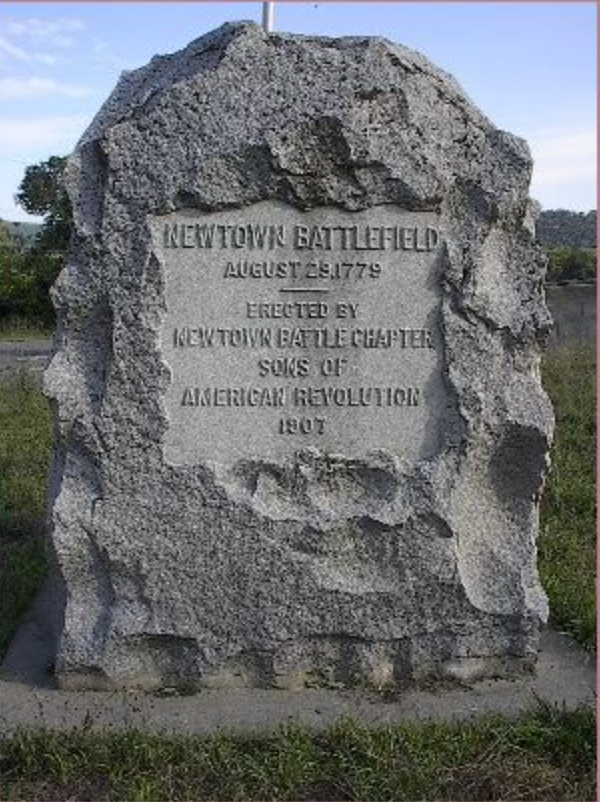
In 1807, a marker commemorating the Battle of Newtown was erected not far from the Baldwin homestead.
archaelogical excavations at the Baldwin Farm
In 1997, The Binghamton University Public Archaeology Facility chose Isaac Baldwin's homestead as a "site of interest." The property, which was situated within the Newtown Battle grounds, was excavated by the Achaeology Facility for "culteral resources" in 1997, 2002 and 2005.
According to the Archaeology Facility:
The homestead is eligible for the National Register of Historic Places, and was built in two stages. The eastern wing of the house was built ca. 1789, with a larger, Federal-style addition reputedly built around 1819. As such, the house represents one of the oldest framed structures in the region, and the associated site affords us an opportunity to examine the development of a frontier farm lot.
Below is a photograph of the house taken while excavations were taking place:

In Phase 1 of the excavations conducted in 1997, archaeologists "recovered 204 historic artifacts from 15 Shovel Test Pits (STPs) excavated within the front and side yards of the house. These artifacts included a minimum of 24 ceramic and glass vessels dating to the 19th and early 20th centuries, as well as animal bones, architectural debris, and other household objects."
In Phase 2 which was undertaken in 2002, the team discovered what appeared to be the remains of a summer, or outdoor, kitchen. The kitchen "contained features that were generally intact beneath the surface of the ground and artifacts in good contexts that were associated with the Baldwins, Lowmans, and other occupants of the property."
Below is a photo of remains of the kitchen wall:

All of the excavations took place in the front yard of the house. Below is a picture of the archaeologists at work:

The artifacts discovered on site have been preserved by the University and the property was deemed worthy of a place in the National Register of Historic Places.
Knoll Cemetery
Knoll Cemetery, also known as Baldwin Cemetery, is located on land in Chemung, N.Y. that was originally owned by Cousin Issac Baldwin and his family. Many of the identified graves are members of Isaac's family or their direct descendants. Below is a photo of the marker pointing to the cemetery:

The cemetery contains a fenced portion that is the Baldwin plot.

Also among those buried there are soldiers who died in the Battle of Newtown. The journals of officers in Sullivan's army indicate that the men who were killed in the battle were buried "near where they fell."
Isaac Baldwin, Sr. died in 1791 and was buried near to the fallen soldiers. Below is a photo of his grave marker which reads: "In memory of Isaac Baldwin who was born in the CO of Norwich Connecticut June 12 1730. He was one of the first settlers of the County, and died in the town of Chemung, Tioga, Co. N.Y. June 9 1791."

After Isaac's death, his son Isaac, Jr. inherited the homestead. In addition to his farming, census and tax rolls indicate that Issac, Jr. operated an inn, a store and a sawmill. Isaac died in 1815 and was buried near his father. I haven't been able to locate a photo of his gravestone.
Thomas and Waterman, who both died in 1810, have stones which were placed by the United States government. Local lore maintains that one of the stones next to Waterman's is that of Chief Cornplanter's daughter Falling Feather who came to care for him and his children after the death of Waterman's wife. We'll have more about Waterman and his relationship to Cornplanter in a future post. Below is a photo of Waterman's gravestone:

Below is Thomas' gravestone:

Another grave marker in the Knoll Cemetery is of particular interest. I can't get any information on when it was placed but probably not too long after the battle. The stone remembers the fallen British soldiers and Native warriors who died in the Newtown Battle who were also buried where they fell. The marker reads: "Our Foe, Redman and British, who fell, Aug 29, 1779, lie here:

We'll have more on Isaac's sons Rufus, Thomas and Waterman in a future post.


Comments