
The Kentucky Covington Clan

About twenty five years after Daniel Boone had laid out the trail from North Carolina to Harrodstown (KY), Benjamin Covington. . .led his entire family. . .to Warren County, Kentucky. ~ Elbert Covington

Benjamin Covington
Our grandfather John Covington (5GGF) and grandmother Mary Airey (5GGM) had ten children. All except one of these children moved to North Carolina, including our grandfather John Covington, Jr. (4GGF). His brother, our uncle Benjamin (4U) lived in North Carolina until ca. 1790 when he and all but two of his children followed his son Elijah (1C5X) to Bowling Green, Kentucky. We wrote about Benjamin Covington in our "Siblings of John Covington part II" post.
Below are stories about some of our Bowling Green Covington relatives.
Elijah Moorman Covington
Our cousin Elijah (1C5X) was born in 1773 near Rockingham, NC. While still in his early twenties, he decided to travel west to Kentucky. 1792, the Kentucky territory had entered the new United States as the 15th state, and within four years, land grants had skyrocketed.
Elijah's entire family with the exeption of two siblings followed him to the newly formed state. In his book Covington and Kin, Elbert Covington (5C1X) gives a description of the move:
About twenty five years after Daniel Boone had laid out the trail from North Carolina to Harrodstown (KY), Benjamin Covington with his wife, Frances Moorman, led his entire family with ten children (save two) to Warren County, Kentucky. Already the eldest son, Elijah M. Covington had preceded them. . .Benjamin may have had a wagon or they may have come on foot and on horseback, but they came through Cumberland Gap and along the old Boone Trace until they got on the north side of the headwaters of Green River. They then pursued the trace ordinarily followed between the Kentucky settlements and Cumberland settlements (Nashville) until they reached the old station of Greensburg. . .they crossed Barren River just below the mouth of Drake's Creek and found spread before their eyes what was to be the home of the Covington clan for many generations.
The area where the Covingtons settled was a "level, slightly rolling country then known as the Barrens." Though called the Barrens, the land that would become Bowling Green, KY was full of vegetation and the Covingtons "appreciated the springs and streams which fed the lush grass in the area."

Elijah first settled along the Gaspar River and, today, is credited, along with the Moore brothers, with founding the town of Bowling Green which lies about 13 miles from the river. Ca. 1812, he moved his family into town and by 1820, his plantation had grown to more than 15,000 acres. Elbert Covington says that "[t]heir home was typical of Kentucky pioneer days - broad acres, many slaves, a good spring walled in with stone. . .a good orchard and family burying ground."
Shortly after his arrival in the area Elijah was elected the first sheriff of Warren County. He held that office from 1797-1798. In 1804, he married our cousin Harriet Baldwin (6C5X). Harriet's uncle was Dr. Cornelius Baldwin (5C6X) who served as a surgeon for George Washington's army. We wrote about Cornelius in our "Revolutionary Stories IV" post. That branch of the Baldwin family was from New Jersey. Ca. 1802, Harriet went with her two brothers, Cornelius (6C5X) (named after his uncle) and Isaac (6C5X), to visit their uncle Cornelius in Virginia.
The two brothers eventually ended up in Louisiana but, along the way, must have made a stop in Bowling Green Kentucky where Harriet was fortunate enough to meet and marry Elijah.

Elijah and Harriet had five children when they made the move into town in 1812. Five more children would be born in Bowling Green. There, Elijah was heavily involved in community affairs. On one of his numerous pieces of property, Elijah built a home which he called Elm Grove. Elbert Covington says that "[t]heir home was typical of Kentucky pioneer days - broad acres, many slaves, a good spring walled in with stone. . .a good orchard and family burying ground."
Harriet died in 1826 at the age of 45. It's possible she died giving birth to her last child Clinton (2C4X) who was born in 1826.

When Harriet died, the oldest of her ten children was Euclid at 21 and the youngest, of course, was baby Clinton. Without their mother, as the five daughters came "of age," they were sent to New Orleans to stay with their uncle (and our cousin), Judge Isaac Baldwin, in order to be "brought out." The plan evidently worked as four of the daughters married there. Daughter Caroline (2C4X) died when in her late teens. We'll have more on these families in a future post.
Elijah died 22 years after his wife Harriet in 1848 at age 75.

various Covington graveyards in Bowling Green
Elijah and Harriet were not buried in the Covington family cemetery, choosing instead the more prestigious Fairview Cemetery, about 5 miles across town. There are about 28 graves in the family cemetery, 10 of which are Covington family members including Elijah's father and mother Benjamin and Fannie. Only one of Benjamin and Fannie's children, Isaac (1C5X), is buried there. Also in the family cemetery are Isaac's daughter Fannie Covington Scobee (2C4X) and her two children. Fannie's Daughter Maggie (3C3X) died at age four. Son Ben (3C3X) tragically murdered one of his friends and shortly afterwards committed suicide. We'll have Ben's story in a future post.
The Covington family cemetery is part of land donated to the city in the modern day residential area of Lois Lane. In 2019, local Bowling Green news station WNKY reported on the unique way the city cleared weeds from the cemetery:
BOWLING GREEN, Ky.- The upkeep of a graveyard isn’t something you would normally hear about, but you have goat to see this cemetery. The goats are back at Covington family cemetery on Lois Lane in Bowling Green. Since bringing mowing machinery into a nearly 200-year-old graveyard would endanger the head stones, goats are used to clear the overgrowth instead. Foliage growth can get out of hand during the summer months but not to worry, some friendly mammals take care of the problem at a local cemetery. The goats eat all the overgrown plants for 12 hours a day on average. This little trick is not only much more cost efficient, but it’s also environmentally friendly. The goats even have names given to them by city workers. A cemetery in grave condition and some hungry goats make a pretty great team.
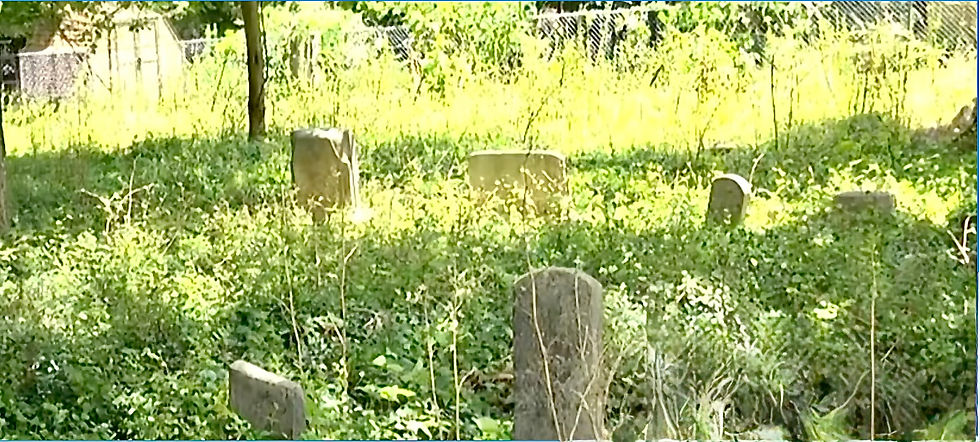
There is another Covington Cemetery in Bowling Green. This one has only African Americans buried there, some who were former slaves in the Covington family. This cemetery has 34 graves, 12 of them with Covington names. Belle Hines Covington was born in 1855 when still a slave. She died a free woman in 1921. James M. Covington was born in a slave in 1834. He died 100 years later in 1924. Leila Covington Dickerson was born in 1860, just befor emancipation. She died in 1937.
This Covington Cemetery is located behind a house on Smallhouse Rd. in Bowling Green:

Elm Grove
Four generations of Covington family members lived at Elm Grove until 1926 when they sold the property to the Smith family. The first to inherit was bachelor son Euclid (2C4X) "who had his hands in all types of land scemes." One of them was the Portage Railroad which was build on land owned by Euclid, which is said to be only the second railroad in Kentucky. The property then passed to the only male heir with the Covington name, Elijah's grandson Robert Wells Covington (3C3X).
In 1907, Robert built a log cabin studio for his artist wife. Near the cabin were the ruins of an old ice house. The slave cabins, which no long exist, were behind the ice house.
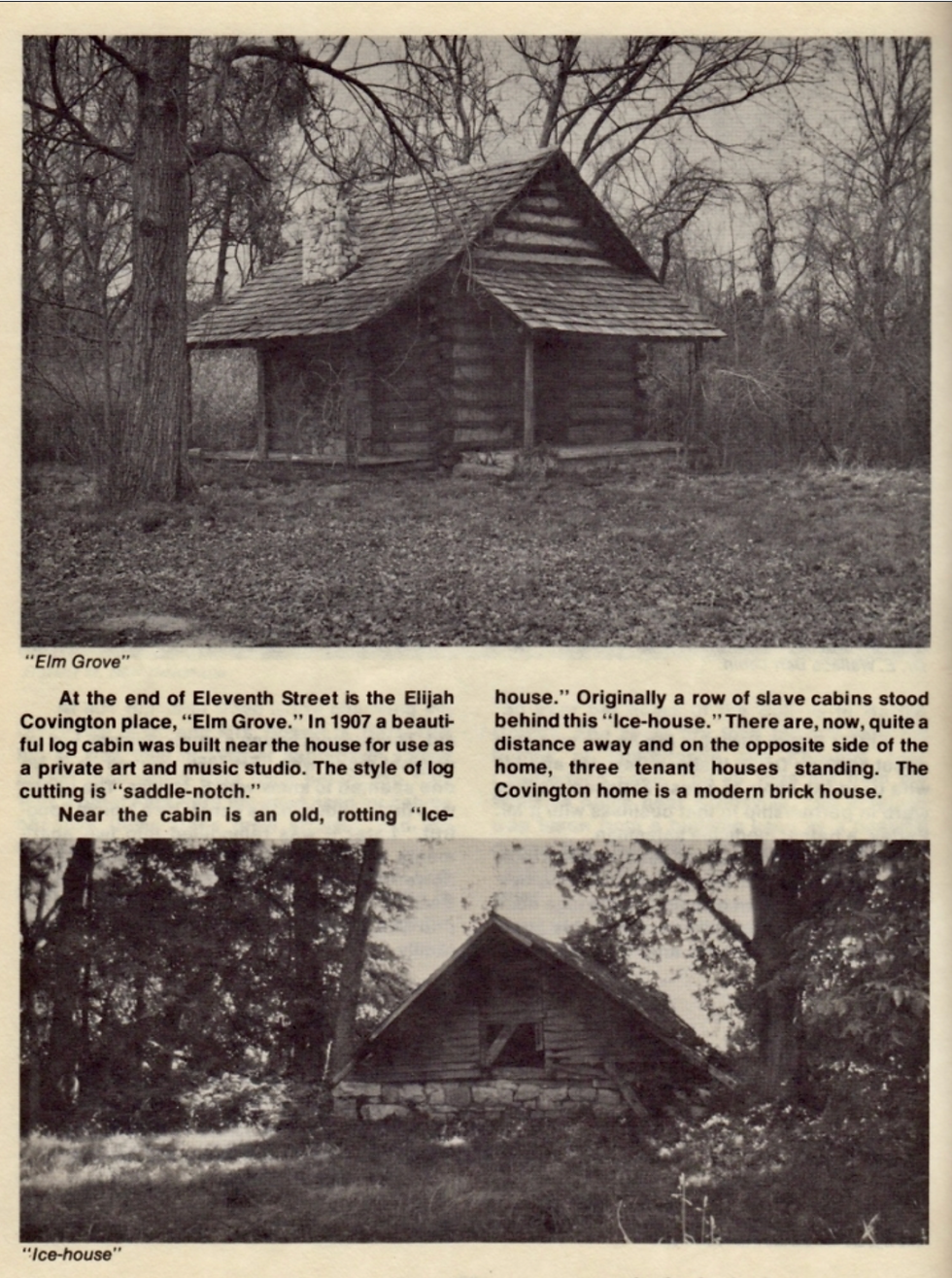
Sometime before 2014, The Snodgrass family purchased a portion of the property which used to be Elm Grove and refurbished the cabin. Their home on Park Lane is across the street from Covington Woods Park.

There are two stories about fires at the original Elm Grove house built by Elijah. Our cousin Elise Dulaney, a great-granddaughter of Elijah's wrote series of recollections of Bowling Green. She included a story about a fire:
Many years ago Uncle (Robert) Wells Covington's home "Elm Grove" burned. Aunt Maria and Aunt Harriet, the colored women, were helping carry things out of the house. Aunt Maria said, "Throw the china wash bowl down." Aunt Harriet said, "No, it'll break." Aunt Maria yelled, "That doesn't make any difference. Just throw it down."
If the fire described by Elise actually happened, it wasn't the one that destroyed the house. According to a University of Kentucky publication "The Landmark Report," the house burned to the ground in 1939.

When the Elm Grove house burned it belonged to the Smith family who ran the Elm Grove Dairy on the property. The Smith's managed to keep the dairy open and built a new house, this time a brick structure. The dairy, in operation from 1926 to 1973, has been fondly remembered by many Bowling Green residents:

Today, nothing remains of the Smith's home or the dairy.
Covington Woods Park
Most of the 15,000 acres that Elijah owned became neighborhoods in Bowling Green. A certain portion, however, was purchased by the city in 1933 to be used as a park. Now called Covington Woods Park, the 61 acres include a 9 hole golf course, clubhouse, 2 tennis courts, 1 basketball goal, 1 ball field, 2 picnic shelters and playground equipment. The original 45 acres was purchased for $40,000 through funds provided by the Kentucky Relief Commission. 16 acres were later added to make the full 61. City jail prisoners were used to help construct the nine hole golf course.

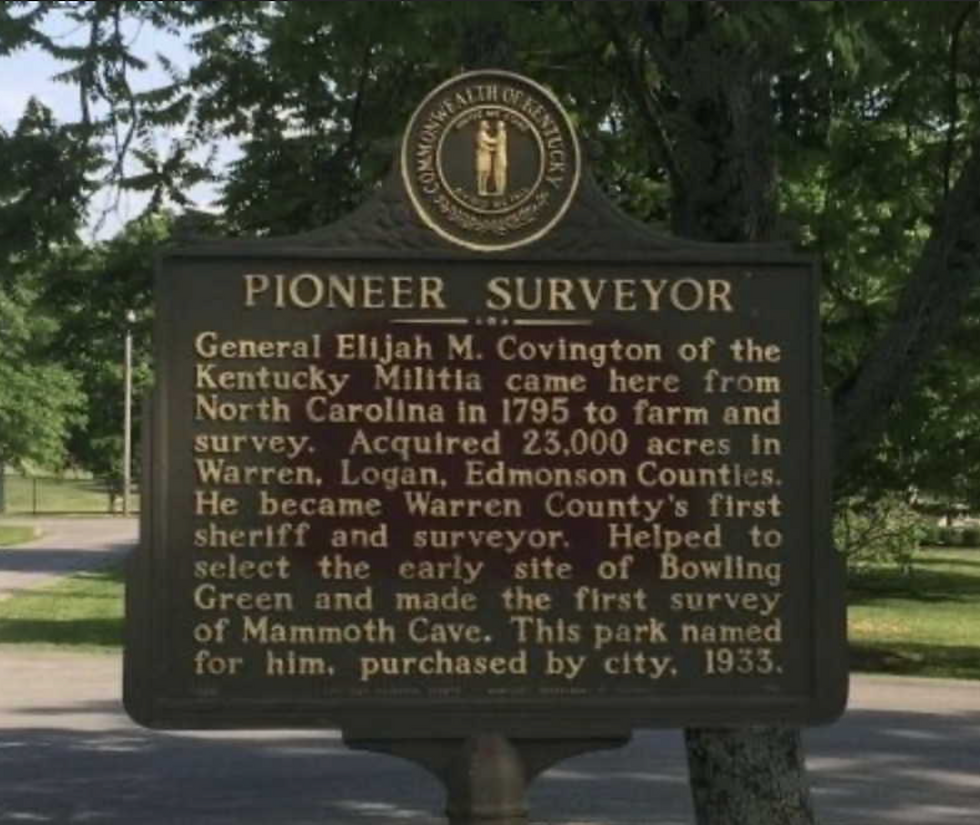
In 1968, The Kentucky Historical Society placed a marker commemorating Elijah inside the Covington Woods Park.
The Kentucky Covington Clan by John Rodes
Below is a profile of the Covingtons in Bowling Green written by John Rodes. Judge Rodes graduated with a degree in law from Ogden College. He practiced law in Bowling Green for 42 years and presided as circuit judge for 16 years.
"THE COVINGTON CLAN"
BY JOHN RODES
They first came to Warren County about 1795 - nearly one and one-half centuries ago, and here they remained for four generations. Only the fifth generation are wandering. During this time none have ever been in jail - certainly none behind the walls or bars of a State Reformatory. None, of whom I have ever heard, committed a serious crime - save one, Benjamin Scobee (3C3X), poor boy, only seventeen years of age who while drinking killed a fellow man. Before coming to trial, brooding and sensitive, he killed himself on his grandfather's farm where Albert Covington (3C3X) now lives.
Note: We'll have Benjamin Scobee's story in a future post.
They were never bitter men--these Covingtons. Nor have there ever been any reformers among them. They took the world as they found it and it was good. There was never a fanatic in the whole tribe - nor a puritan. My grandfather, Henry Grider (married Rachel Covington [1C5X]) had an earnest piety (Methodist). . .The usual Covington respected piety and conformed in religion, though he was never cramped by it. It was a good world, and all the good things were never made solely for the sinners. They loved good liquor but drank seldom to excess, had a gentle weakness for women but usually kept out of trouble, except once which I will later relate. They never became absorbed in causes. Even in the Civil War none were deeply involved.
This rnay be because of their Southern sympathy yet loyalty to Kentucky which did not secede from the Union. Judging from the many Covingtons on the roster of North and South Carolina Confederate companies there was no division of feeling among their relatives east of the mountains.
They owned their slaves and were sympathetic with the South, but none engaged in battle except Colonel Benjamin Covington Grider (2C4X), grandson of the pioneer Benjamin, who was a gallant Federal soldier.
Note: Our cousin Benjamin Grider was an attorney. In 1860 he owned 25 slaves. He served in the Civil War as a colonel from Nov, 1861 to Feb, 1863. Below is a photograph of him.

After the Civil War the Covington negroes hung around and usually acquired a few acres of land for a home. Above all they loved to be hospitable, friendly and kindly, and these same qualities characterized the large family of Smiths who multiplied in the County - the offspring of Joseph and Sally Covington (1C5X) Smith.
And they did know good land and took the best in the county - in the first half century owning thousands of acres. The largest landowner of them all was Elijah M. Covington oldest son of the pioneer Benjamin who accumulated some twenty thousand acres in Warren and adjoining counties. I saw at one time an assessment sheet for taxes against him where he was charged with the Ownership of twenty-two thousand acres. But the land in Warren County was the most valuable. Generally they were well-to-do, acquiring land while it was cheap and holding on to it. There was never a genius among them and therefore they were generally a happy people. Their domestic lives were particularly happy, and I know of but one divorce in three generations, They seldom sought for fame or public office,
Euclid Covington (2C4X) (bachelor grandson of the pioneer Benjamin) was several times in the Legislature of the State. . .In l808 he made a survey of the whole county for the purpose of fixing the seat of government - that is to say the county seat.
Joseph G. Covington (3C3X) (great grandson of the pioneer Benjamin) was a lawyer of ability and of oratorical talents but died too young for his abilities to flower. He was prominent in the life of the city--in legal and civic affairs. He was City Attorney of Bowling Green, a director of its most prominent bank and president of the then Board of Trustees of Ogden College of which he was himself a graduate. Attending the Law School of the University of Virginia he captured a medal for oratory at that institution. He had the Covington trait of geniality and good humor as well as a * certain strain of broad humor which likewise characterized many of the Smith line,
Euclid Covington was also a lawyer but practiced very little. His brother, Albert (2C4X) was a doctor and graduated in medicine of the University of Pennsylvania but never practiced his profession, Benjamin Covington Grider, a talented member of the legal profession and his son Judge Loving Grider, (of Wichita, Kansas) possessed like oratorical talents as Joseph Covington.
As for the rest of the family, they were farmers - lovers of the land, with good homes where they loved to practice the virtue of Kentucky hospitality. When I was a little boy I would drive with my mother (daughter of Rachel Covington Grider (1C5X)) on her annual summer visits to the kinsfolk. We would remain away from home at Bowling Green sometimes a week. First I drove out the Nashville Pike to Lost River to visit Cousin Reed Watt (2C4X) (daughter of Isaac Covington (1C5X)). . .The welcome was real and unrestrained. The best was not good enough for cousin Mary, and Cousin Reed's teacakes were ready for me at all times.
Next day we would go over to Cousin Kate's (Edward Covington's (2C4X) wife where Albert (3C3X) now lives). I remember the cool house, the stalking pea fowls, the orchard and the old stone spring house with its running branch down through grove of walnuts. Next day over to Fanny Berry's (2C4X) (daughter of Sally Covington Smith (1C5X)) on Three Springs Road, where the same joyful hospitality was dispensed. I felt like my mother must be doing them an honor to visit them. On on leaving were were always pressed to stay just one more day.
Then to Cousin Fanny Smith's (3C3X) who married Benjamin H. Covington (2C4X). There I remember the cade and the blackberry cordial - sixty years have not dimmed its flavor nor my membories. Then on our way to visit Cousin Naomi (Dockery Smith) (2C4X). Here was the same story. The great trees and the old fashioned gardens are gone, but again the little boy remebers tea cakes on the hot summer afternoons, Cousin Florence (3C3X) the daughter, would make ice cream in the old way -- pond ice from the ice house, crushed in a bucket within which was set a smaller bucket of cream and frozen by being rapidly turned by hand.
What a land and people! There were no barbed tongues, though the news was passed around, and no evil ways, for all the women were vituuous and none ever degraded. This strain of tribal qualities prsisted .among the Smiths who in like manner were genial, friendly and proud of their good fellowship and hospitality. For three genrations they kept out of law sutis of any serious character except in that one instance and that instance stirred the whole county. (Susan M. Ray vs. Benjamin H. Covington 1856.)
I must also mention that the Covintons and the Smiths were unusually happy in the physical proportions and agreeable countenances. They were men of no unusual size and yet handsome in a large way and well formed and were generally good company among both men and women.

Comments