
The Thomas Family IV

We don’t own our family history. We simply preserve it for the next generation.” Rosemary Alva

the Thomas House in Queen Anne's County
The Thomas House was built on land originally owned by our immigrant grandfather Tristram Thomas (7GGF). The history of ownership of the property follows a fairly convoluted succession of Thomas, and other, family members. Tristram's son Thomas (6U) left his portion of inherited property to his son Thomas, Jr. (1C7X). Thomas Thomas, Jr. married our cousin Susannah Mary Clothier, (1C6X) granddaughter of our grandparents, Robert (6GGF) and Jane Kemp Clothier (6GGM). We learn about Thomas' connection to the property from a National Register of Historic Places nomination form:
Thomas Thomas, of the third generation to be born in Maryland, was a planter resident in Queen Anne's County. In 1755 he received a patented certificate for part of a tract called "Winfield" containing 297.5 acres. On this property were twelve cultivated acres, "one new framed Dwelling house, 20 by 16 foot, one old Rotton Log house-one old milk house, 8 by 8 foot, Eight apple trees, Eleven Cherry trees, one peach tree, and 370 panels of old Rotton fence. Three years later, Thomas was granted another certificate for 275 more acres of Winfield.
When Thomas died in 1770, he left the property to his sons James (2C5X) and Thomas III. (2C5X). Thomas III, who had moved with many of his cousins to North Carolina, sold his portion to James who died in 1807 leaving the property to his son James (3C4X).
150 acres of the property finally came into the hands of Dr. John Thomas (2C5X) when James, who was his third cousin, sold him the property in 1813. John, born in 1765, married Elizabeth Baynard in 1796. I can't trace Elizabeth's family but she belongs, no doubt, to our Baynard family which begins with our immigrant grandfather John Baynard (7GGF) who came to Maryland in 1676.
According to the National Register form, since a tax assessment for 1798 showed "no dwelling" on the property, "the Thomas House was thus built after 1798, either by James Thomas, Sr., between 1798 and 1807; James Thomas, Jr., between 1807 and 1813; or (Dr.) John Thomas, between 1813 and 1821."
The Thomases were typical members of Tidewater Maryland's eighteenth and early nineteenth century society. All of the men mentioned above were planters, with the possible exception of Dr. John Thomas, although it is likely that he farmed also. James Thomas held four slaves according to the 1790 federal census, which was about the average number for that half of the population who owned slaves. Thomas' home, as described in the 1798 tax assessment, was a framed dwelling with two brick chimneys, 34' X 18', with three windows, valued at $200. This was again an average, sized house for a person of his economic position, i.e., although by no means wealthy, comfortable and better off than the majority of planters at the time.
From this economic background came, with the economic stabilization after the formation of the new nation, the means and desire to build a dwelling such as the Thomas House. Quite a larger building than the frame one of the eighteenth century, it is also constructed of the more durable building material of brick. Its style is that of a Federal townhouse popular in the towns and cities of that day, reflecting an effort on the part of its builder to be fashionable.
This latter fact may be one clue pointing to Dr. John Thomas as the builder of the house. A well-known man in the county from the third quarter of the eighteenth century, he owned several lots in Centreville and may have desired to move to a country home whose style
would reflect his position.
John died in 1820 and Elizabeth in 1821. In her will Elizabeth left the "arable or cleared land purchased of James Thomas now deceased," to her son, John Baynard Thomas (3C4X), who purchased 106 additional acres of "Winfield."
Note: Though the National Register credits John Thomas with building the home on the property, Elizabeth metions only "arable or cleared land" left to her son making it quite likely that he built the house.
John B. Thomas, mid-nineteenth century occupant of the house, was also an active resident of Queen Anne's County. He was a trustee of the county almshouse, an inspector- of primary schools, a commissioner for a railroad to be built from Queen Anne's to Cecil County, and a commissioner for the organization of a bank in Centreville. He also served several terms in the state legislature and was a member of the county committee appointed to take charge in the secession crisis of 1861. The Thomas House property remained in his family until 1928.


Elizabeth Thomas and her son James Lewis Mcdowell
Our cousin Elizabeth Thomas (1C5X), daughter of Philemon (4U), was a niece of our grandfather William "Billy Ram" Thomas (4GGF). She was born in Richmond County, NC in 1780. In 1810, Elizabeth married Joseph McDowell. Shortly after their marriage, the couple moved to Robertson County, Tennessee where all seven of their children were born before Joseph's untimely death in 1822 at age 34.
Joseph left his plantation, most of the household goods and a "negro girl named Sam" to Elizabeth.
It is also my desire that my brother James McDowell furnish my family with a years provision out of my part of my partnership property and the balance of said property I wish him to dispose of in that way he may think best that is to assay the present years crop stock of hogs and the distillery the house mill stoves and Irons and as soon as he can with safety turn the property into money to make a return of the same to the Executors after making himself whole for his trouble.
After Elizabeth's death the entire estate was to be divided equally among the seven children. In June of 1824, Joseph's brother James was named guardian of Elizabeth's six children. Daughter Martha (2C4X) had died a month before at age 2.

Elizabeth's brother-in-law, James McDowell, was a traveling preacher. He wrote that "[f]rom April 20th to November 12th I rode one thousand, seven hundred and thirty-eight miles; preached one hundred and sixty-one times. . .I received by way of remuneration $27.25; my expenses, $3.62." He was described as a man "full of faith and of the Holy Ghost."
It may have been his uncle James that sparked Elizabeth's son James' (2C4X) interest in religion. In 1832, when he was 14, James "professed religion at a camp meeting 'holden at old Mt. Carmel Church, on the water of Red River.'"
In 1830, Elizabeth's brother-in-law James moved to Illinois and, in 1837, she followed with most of her children and their families. They settled in Camden, IL. We learn about her son James' life of religion from a sketch of the McCowell family by S. W. McDowell:
There (in Camden) he joined Shiloh Cumberland Presbyterian Church. . .was licensed to preach September 30, 1843; was ordained April 5, 1845.
He entered Cumberland University at Lebanon, Tennessee, October 22, 1845. . .and was graduated some time after 1847. In order to reach Lebanon he boarded a steamer at Quincy, Illinois for St. Louis; changed steamers and continued via Mississippi and Ohio Rivers to Smithland, Kentucky; thence, after changing steamers, via Cumberland River to Nashville. The trip consumed ten days.
From 1843 until his death he preached whenever he had opportunity. He rode horseback almost constantly for many years to reach his appointments.
He was unusually pious. His diary, while he was in college, abounds with such expressions as: "Resolved to spend more time in secret devotions, morning and evening" - "At candle lighting, applied myself to meditation and prayer" - years later, on one occasion his two small sons set a rabbit trap on Saturday evening. When they hurried to the trap next morning, to their great joy they found the trigger sprung and a rabbit inside; but their father made them release their catch because it was the Sabbath Day.
He did not think it right for him to own slaves, but did not condemn those did own them. Although he owned and lived on a farm near McLemorseville at the time of the War between the States, he had no slaves and did not consider himself called upon to fight for the Confederacy. He did not want to bear arms against his neighbors, which precluded his espousing the Northern cause. He therefore remained neutral.
It was his custom to conduct weekly prayer meeting services in church. During the hectic reconstruction period which followed the war, a leader of a band of ruffians in the community, having developed a great antipathy for him, sent him word that if he conducted another prayer meeting service there, it would be his last one. The warning was ignored and the next meeting held as usual. The next day he purchased rifles and ammunition for four--himself and wife and their two sons, Frank and Arthur, who were mere lads. For four days they practiced shooting at targets before anything happened. On the fourth night, at midnight, the band of ruffians rode up to the front gate and called the father out. Each night since the forbidden meeting either the father, mother or one of the two boys was on watch at one of the four upstairs windows, the understanding being that the watcher would awaken the other three if anything unusual happened, and that, if necessary to protect the father's life, they would shoot to kill, each from his or her window from which a pane of glass had been removed for the purpose. On that night it was the turn of the younger son, Arthur, to be on watch, but without waiting to determine whether Arthur was awake and would carry out the agreement, the unarmed father calmly walked out to meet the callers, and by diplomacy succeeded in persuading them to abandon their sinister intentions. What a father, to rear such a boy! And what a boy, in whom such confidence could be placed!
John McDowell and his wife had eight children. Below is an obituary for his son Abner (3C3X) who died in 1893:
Quincy Daily Herald Saturday, December 02, 1893 Page 1
ATE DINNER AND DIED
The Sudden Ending of a Well Known Clayton Man
Clayton, Dec. 1.- Abner McDowell, an old and well-known citizen of this place was found dead in his yard yesterday. He had evidentaly been there all night. He lived alone, his wife being in the insane asylum for a number of years. The direct cause of death was not determined at the inquest. He ate a hearty dinner Thursday at the home of a friend and was doubtlessly prepairing to saw wood after returning home and fell dead in the effort.
Robert H. Thomas
Our cousin Robert H. Thomas (1C5X) was a nephew of our grandfather Billy Ram (4GGF). He was born in Marlboro County, South Carolina in 1773. In 1800, he took out a marriage bond in preparation for his wedding to our aunt Ann Nancy Covington (3A) , daughter of our grandfather John Covington (4GGF).
Robert and Nancy's first and only child John Covington Thomas (1C4X) was born in 1801. Nancy, who died young, may have died in childbirth or shortly afterwards. Robert didn't marry again until ca. 1818. His new wife, Dinah David, who was 20 years younger than him, gave birth to their first child Mary (2C4X) in 1819.
The last census record I found for Robert was 1840. Only four people were listed in the household: Robert, Dinah and two daughters between 15 and 19. Robert owned nine slaves at the time and five years later would give two of them to his daughter Eliza.
Know all men by these presents that I Robert H. Thomas. . .for and in consideration of the natural love and affection which I have & bear towards my daughter Eliza. . .have given and do by these presents give unto my said daughter Elizabeth D. Thomas the following Negro Slaves viz Boy Eli and girl Violet. . .
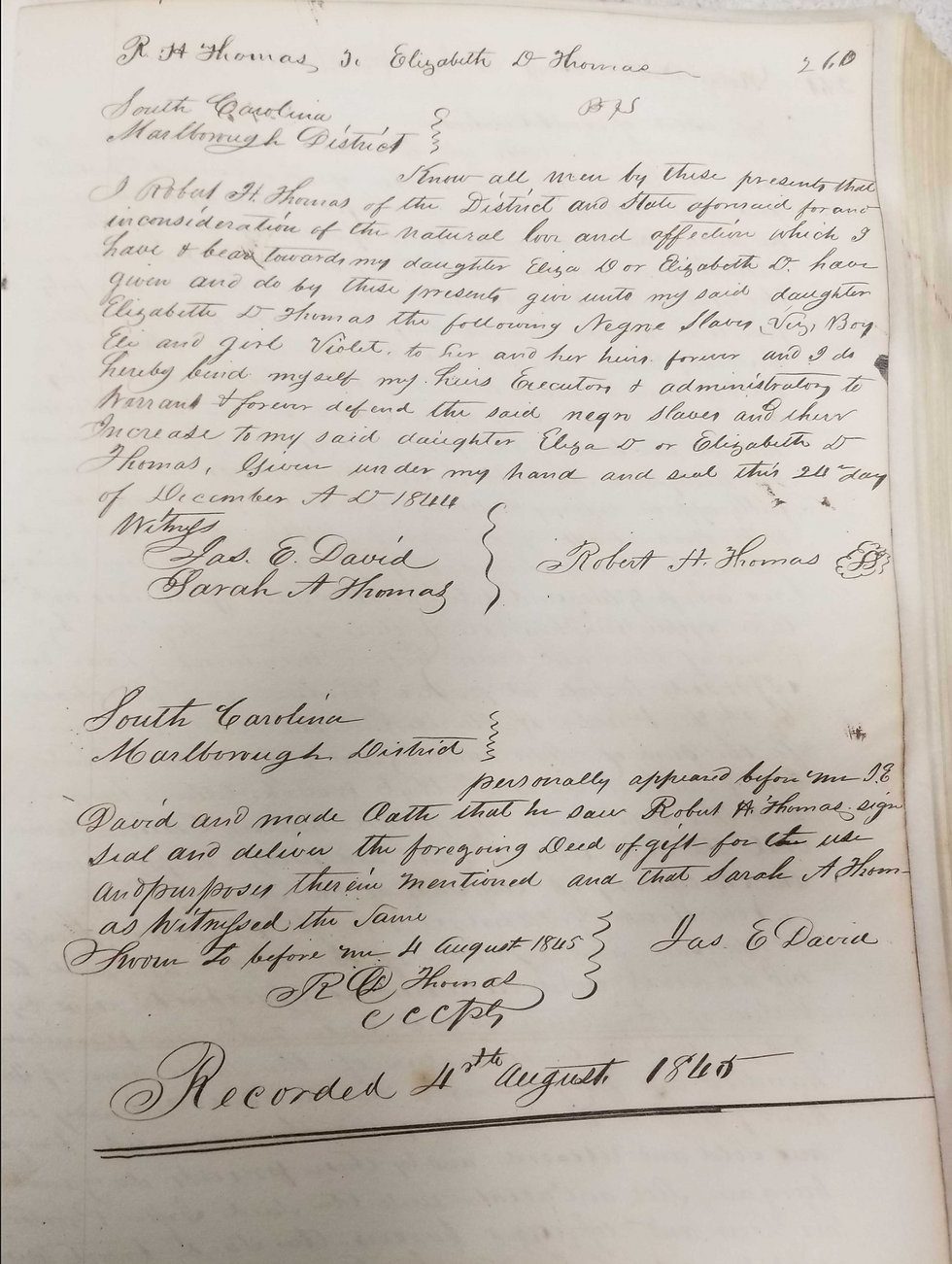
In 1847, Robert would give his daughter Mary Thomas Covington a slave. Ca. 1845, Mary had married our cousin Preston Covington (3C3X)
Know all men that I Robert H. Thomas. . .do give to my daughter Mary Covington a negro girl eight months old the daughter of Sarah. This negro girl Tamar I give to Mary Covington and her bodyly heirs forever and Tamar's increase. . .
Witnessing the deed of gift were our cousins Thomas S. Covington (2C4X) and Colonel John Covington (3C3X).

It's possible that Robert was in ill health when he gifted these slaves to his daughters. He probably died sometime between 1847 and the 1850 census. He would have been about 75 years of age at the time.


Comments