
THE PROCTOR FAMILY OF PROCTORSVILLE ~ PART II
- westmohney

- Jul 30, 2025
- 12 min read
One of the traditions of the quiet village of Proctorsville, Vt., in which Redfield was born, has to do with "how Jabez Proctor run the tollgate." ~ New York Times Magazine, 1898

In this post, we continue the story of Leonard Proctor's (1C7X) children. All of the children profiled in this post are sons and daughters of Leonard and his second wife, Mary Keep.
Thomas
We know very little about Thomas Proctor (2C6X,) Leonard's third child with Mary Keep. Thomas was born in 1776 in Westford, MA. We know from Cavendish town records that he married Abigail Atwood Serle in 1799. Abigail had been married before but I can find no record of children from her first marriage. The person who married them was our cousin, Dr. Asaph Fletcher (5C6X).

It appears that the couple only had one child, Moody Stickney Proctor (3C5X). Stickney is one of our family names but I can't find any link to that family that would warrant giving Moody that middle name. Abigail died in 1851and, eight years later at age 83, Thomas married Sally Hemenway. Sadly, Sally died only a month after the marriage. Thomas died eight years after that at age 91.
Below are portraits of Thomas, Abigail and Moody painted by Zedekiah Belnap. According to a vido I saw on PBS's Antiques Roadshow, Belnap's signature style was to paint one side of the nose with the other side heavily outlined, a style you will see in all three paintings.


Hannah
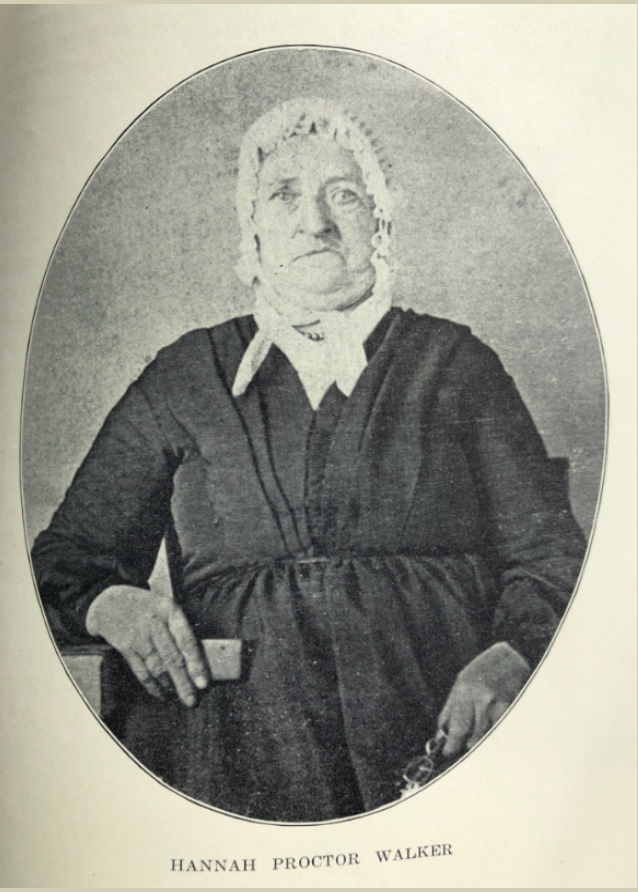
Our cousin Hannah Proctor (2C6X) was born in Westford, MA in 1778. She was the fourth child of Leonard and Mary Keep. Ca. 1795, Hannah married our distant cousin Billings Walker (6C8X). Billings mother was Hannah Fay (5C9X) who is related to us through our Brigham family of Marlborough, MA
By 1814, Hannah and Billings had eight children, all born in the town of Weathersfield, about 15 miles from Proctorsville. Sometime at the end of that year, the couple, along with seven of their children, were evidently visiting relatives or friends in Proctorsville. They somehow managed to make themselves undesirable in the town. A "warning out" was issued by the town clerk and given to Hannah's brother Solomon Proctor (2C6X), one of the constables of Cavendish at the time, to serve to the unwelcome family. Below is the text of the "warning out." All of the children named are our (3C5X).
To either constable of Cavendish in the County of Windsor
Greeting - by the authority of the State of Vermont you are hereby required to summon Billings Walker and Hannah Walker his wife and Hannah Walker, Thomas Walker, John W. Walker, Mary K. Walker, Gideon D. Walker, Experience P. Walker, Artemas B. Walker his children now visiting in Cavendish to depart said Town. Hereof fail not but of this precept and your doing hereon make due return according to law. Given under our hands at Cavendish Dec. 1814
Solomon served the paper to his sister and her family and duly replied to the town clerk:
At Cavendish in this County on twenty third day of January A.D 1815 I served this precept on the within named persons by putting into their hand.

I wasn't able to find out if the family removed themselves from the town at that time. Some towns, however, seem to be of an extremely forgiving nature. Three years later, Billings was back in Cavendish and elected Justice of the Peace along with Hannah's brother Jabez.
Somewhere down the road, the Walker family moved to the state of New York. Billings died in 1852 in Farmerville, NY at age 84.

After Billings' death, Hannah moved to Rushford, NY, about 25 miles from her sister Lydia. We profiled Lydia in our last post. Hannah died in Rushford in 1868 at age 90.
Jabez
Our cousin Jabez Proctor (2C6X) was born in Westfield, MA in 1780, the fifth child of Leonard and Mary Keep. In 1817, Jabez married our cousin Betsy Parker (4C6X) who was a great-great grandaughter of our aunt Abigail Hildreth (8A).
Probably sometime before his marriage, Jabez went in business with his brother John (2C6X). Their initial venture was a tavern and general store that was located in the first house their father Leonard had built after moving to Proctorsville. That building is known today as the Page House. Ca. 1840, the house was cut in half to make way for a Methodist Church. One half was moved across the street and the other still sits next to the church. Below is a picture of the house as it looks today. You can see a small portion of the St. James Methodist Church to the right.

The half of the house that was moved across the street was razed in 1959 to provide extra land for the construction of the Proctorsville Grade School, now known as the Cavendish Town Elementary School. Shown on the map below are the locations of the Page House and the elementary school in Proctorsville today along with Leonard's second house and the Proctor Cemetery.

Jabez and John expanded their business to include the first hotel in Proctorsville. After 20 years of working together, they decided to separate the business with Jabez keeping the hotel and John running the tavern and store.
From an 1898 article in the New York Times Magazine on Jabez' son Redfield Proctor (3C5X), who became a senator, we learn a little more about Jabez:
Redfield Proctor inherited honesty, energy and sagacity from his New England ancestors. His father, Jabez Proctor, was a man of uncommon force of character, and some Vermont local historians have written that the elder Proctor's chief characteristics have attained full development in the Senator. Jabez Proctor was a man of few words, but when an idea had matured in his mind he acted upon it was singleness of purpose and agressive determination. One of the traditions of the quiet village of Proctorsville, Vt., in which Redfield was born, has to do with "how Jabez Proctor run the tollgate."
In our "From Chelmsford to Vermont" post we wrote about the fued between the Proctors and the Dutton family of Cavendish owing to a toll road the Duttons had built. The Proctors countered by building their own road that bypassed the Dutton's toll road. From the New York Times Magazine article:
The construction of the new road, which was a shorter and cheaper route than the old one, was chiefly due to the instrumentality of Jabez Proctor. . .The rival vilaage of Duttonsville was much disturbed over the change, and after a few hasty conferences the old turnpike gate was staked up and placed directly across the new road and tolls demanded. Jabez Proctor had occasion to go to Chester on business. . .He hitched up a team of large and powerful horses to a heavy Dutch wagon and started on his way. The horses increased their speed and the old Dutch wagon its momentum as they apporached the gate. They plunged through it with the velocity of a connon ball, and small fragments of that ancient barrier were strewn along the highway for many rods. The toll gatherer stood in conternation. The news was carried to Duttonsville, and for a while a great excitement prevailed. With becoming pride the good people of Proctorsville commented on the event in this wise: "They do say that our Jabez had run the gate in a mighty vigorous manner!" The road became free, and there was no further occasion for "running" the gate."
Jabez died in Proctorsville in 1839 at age 59. He is buried in the Proctor Cemetery.
Experience
Our cousin Experience Proctor (2C6X) was born in 1783, the sixth child born to Leonard and Mary Keep and their first child born after the move to Cavendish. In 1805, Experience married Zaccheus Blood and their first child, Albin (3C5X), was born in 1806. The couple had nine children. Five of these children died young. Albin died at age 9 and, shortly after his death, Zaccheus and Experience welcomed another little Albin.
Zaccheus ran a saddlery shop in Cavendish until his death in 1841 at age 65. Expenience lived for another 29 years after he husband's death and never remarried. The 1850 census shows her living by herself a few houses down from her son Albin. Albin's profession is listed as "Farmer." In 1860, it appears that Experience and her son had moved to new homes and she the lived right next door to Albin and his family. By the 1870 census, Experience was 86 years old and now living with her son's family. The census shows her as "Boarding." Experience died a year later at age 87
Below is a picture of Experience that "was wrapped up in cloth and stored in an old trunk the the old French house in Proctorsville and saved by Barbara Gammon." Barbara (5C3X) was a great-granddaughter of Experience.

John
John Proctor (2C6X) was the seventh and last child born to Leonard and Mary Keep. John went into business with his brother Jabez, running a tavern and store in the building that was their father Leonard's first house in Proctorsville. When the brothers split their business, Jabez took the hotel and John kept the store and tavern.
In 1814, John married Sarah Smith and the couple had seven children, the last one born in 1833. John died in 1837 at age 51, only four years after his last child was born. He left his wife with seven children between the ages of 18 and 4. From diary entries of Jabez' daughter Harriet (3C5X) we learn that John probably died of consumption:
On 24 March 1837, Harriet wrote in her journal, "Uncle John much worse today has been spitting blood father has been there all the time since we know not the day of our death." On 25 March she wrote, "Uncle better. Aunt S. came home." On 28 March she wrote, "Uncle John not quite as well." On 30 March she wrote, "Uncle John not as well." On 31 March she wrote, "Uncle J taken this morning puking blood again much distressed and faint died about 10. said but little seem'd & said he was perfectly reconciled he had given himself to Jesus bid his wife and friends farewell." On 8 April she wrote, "staid with Aunt Sarah all night; poor widow and fatherless children."
granddaughter Harriet
Harriet Proctor (3C5X) was the daughter of Jabez and the granddaughter of Leonard and Mary Keep. She was born in 1819 in Cavendish. In 1831, when she was 12, Harriet made a tapestry of her family, made of silk on linen and watercolor on paper:

In January 1837, just 2 months before her uncle John died, Harriet began the diary that recorded his death:
Her first entry was typical of what she wrote, "Redfield [her brother] sick, attended church this afternoon, partook of the communion for the 5th time. 'Let brotherly love continue.'" In this journal she records her terrible headaches, religious thoughts, visits with friends and relatives. . . and letters from "SBC" (Stoddard B. Colby).
In 1840, Harriet married attorney Stoddard Colby and, over the next 11 years, they had four children. She died 28 Jul 1852 in the tragic steamship fire aboard the Henry Clay, which was credited to the aftermath of a race the steamship was involved in. From Wikipedia:
As the Henry Clay passed Yonkers shortly before 3 p.m., the call of fire on board was heard. It roared up from the engine room and quickly engulfed the midsection. The pilot, Edward Hubbard, an experienced forty-three-year-old seaman, quickly turned the burning ship eastward to travel the mile distance to reach shore. Hubbard crashed the boat bow first onto the sands at Riverdale, New York, hoping to save his passengers. Those near the bow were easily able to jump to shore. However, the passengers aft of the fire were still in deep water and blocked from fleeing. Many could not swim and drowned either due to their heavy clothing or pulled below by others seeking to save their own lives. People that remained on the boat were burned to death.
Three days later, Stoddard wrote a letter to a friend about the tragedy:
Proctorsville, Vt.July 31, 1852
Friend ___:
The last sad service to the remains of my dear, dear Harriet was attended yesterday at 2 o'clock, afternoon. . .I will write the particulars of that fatal scene as my crushed heart will permit.
Our party, consisting of myself and wife, J.W. Ellis, wife and sister, left Albany, for N.Y. city by the steamer Henry Clay (on the Hudson River) about 7, a.m., on Wednesday morning. We went upon the promenade deck for the better view of villages and scenery along the shore. We were not many miles out before I discovered the "Armenia", a rival boat, coming down behind and apparently gaining upon us. I then feared racing, but had been strongly assured at Albany, by reliable persons, as we supposed, that no racing would be allowed and I hoped it was so. But not long after, I noticed that the landings of our boat were effected withgreat haste, and passengers were passed off and on with dangerous rapidity. At one of our landings, the third one, I think, the Armenia passed us. Our boat was behind for some distance and only got along side the other as were were nearing Kingston - then the two boats ran side by side, at times very close, and at length the bows were in contact. A hand on the Henry Clay put out a fender against the wheel-house of the Armenia to prevent closer collision, and, in that position, we ran for some distance. The passengers were greatly disturbed, and were generally standing up on the upper decks, when some official of the boat came up and passed around them saying "there was no danger," and that they were "not racing," and urging all to step to the opposite side of the deck to ease off the boat. I then appealed to him to stop this and not run us into danger. He repeated with greater emphasis, we were "perfectly safe," "no danger," and "all would be right if he passengers stepped to the other side as he requested," - this was done and the Henry Clay went ahead. After this occurrence we concluded to leave the boat and go ashore; but the other boat did not come up with us afterward and was finally lost sight of. The circumstance quieted our fears and we felt quite secure for some hours before the fire, - in the meantime many of the passengers took dinner.
About the time we passed Yonkers, I left my wife sitting in the ladies' saloon where she had been most of the day, and went on the promenade deck where were the others, Mr. Ellis and his ladies. Within 20 minutes I think, after I went up, there was a cry and smoke forward - about the center of the boat - and at once I started to go below for my wife, and alas! she was gone!! I screamed for her, - in vain, the saloon which was filled with ladies when I left it - was empty - and the hot flames and smoke were pouring through it, in a torrent. I ran outside on the guard - there was the whole horror of a hundred deaths at once - all who had left the saloon had gone over the sides in utter panic and despair. My wife was not to be found, and it was plain that the alarm and the fire were felt in the saloon before those on the upper deck were aroused; and it now seems that many had gone overboard before the boat struck. I hoped that she might have gone forward and reached the shore. That hope prevented me from plunging into that cauldron of death. It only remained for me to get off the boat. The fire below prevented going forward from the lower deck where I then was. I went up the stairs on the promenade deck - it was then cleared of people - the fire had nearly covered it - but a space on the starboard side allowed me to pass it and to reach the shore - the last one who escaped by going forward, I think, for the fire, at that instant, enveloped the whole width of the boat.
There was no small boat on the Henry Clay, I am sure, or if there was, it was not used, nor was it in sight. Help came after some time from some vessels in the river; two boats came but the fire allowed no near approach to the wreck. The bodies of those who went over before the boat stopped were doubtless first found. My wife was found some rods from the stern of the boat and up the stream from the boat. She must have fallen in at the first fright, as her position would have been down the stream if she fell after the boat stopped. Her seat in the saloon was next to the door, and it was but a few steps from that to the guard out of which so many rushed to perish. Her dress and person were in no way touched by the fire or heat. She seemed as if life was not gone - but all effort to restore her was made that could be, on such a shore, away from houses and accommodations. The precious spark had fled and with it, in a moment, all my earthly hopes. Could I but have been with her, and died with her, or heard her last word, it had seemed a milder fate. I had left her, at her request, to have me to go on deck and lose the views of the shores as we neared N. York. She preferred not to go up as the breeze was strong and she had some headache; besides, I think the fright in the morning really induced her to prefer the Saloon.
That the managers of the boat were grossly, culpable, nay criminal, can be demonstrated, and whatever shall be the verdict of the coroner's jury, upon their conduct, I shall ever blame myself for periling that dear life in the control of such reckless men.
. . .It is with great difficulty that I am writing this sorrowful, heart rending narrative but suppose many of our friends will be anxious to hear more directly than through the newspapers.
Your affectionate friend




Comments