
The Southern War Continues
- westmohney

- Feb 12, 2024
- 11 min read
Updated: Nov 19, 2024
. . .shout like Hell and fight like devils. . . ~ Colonel William Campbell at the Battle of King's Mountain

the siege of Charleston
In December, 1779, while Washington hunkered down in his Morristown winter quarters, British General Henry Clinton left the colder climes of the Connecticut coast and headed south with over 100 ships and 13,500 soldiers and sailors. His destination was the British-held Savannah, GA with his sights set on capturing Charleston, SC. Awaiting the onslaught in Charleston were the outnumbered men of the American army under the command of General Benjamin Lincoln.

Three months after arriving in Savannah, in March of 1780, Clinton's troops descended on Charleston to begin a two month siege of the city. By April, the British had effectively encircled Charleston by land and sea, trapping the Americans inside. Our cousin Francis Poythress (3C5X) was part of a contingent from Virginia sent in defense of the beleaguered city.
Francis had joined the army in 1778 as a private. He then served in the 3rd Troop of Horsemen as a corporal and later in the 1st Regiment of Light Dragoons as a sergeant. That Francis would be drawn to the Troop of Horse and the Dragoons made sense as the Poythress family were noted horse breeders, riders and racers.
In March, Francis' company of Dragoons under the command of Col. William Washington was stationed at Bacon's Bridge, about 20 miles northwest of Charleston. In a series of minor skirmishes with the British, the Dragoons were able to drive the enemy back and effectively hold their defensive position. Their luck held out until the night of April 14 when their company of 300 was badly defeated with 15 dead, 17 wounded and 100 captured. 83 horses were lost as well. Colonel Washington managed to escape with his remaining troops across the Santee River.
The British bombardment of Charleston had continued unabated for over a month. By April 21, General Lincoln could see the handwriting on the wall. Hoping to preserve his army, he offered to surrender the city if his men were allowed to leave unharmed. Clinton, knowing he had the upper hand, refused to accept those terms and the assault continued. Finally, on May 12, Lincoln conceded. In a severe blow to the American cause, Lincoln and his entire army of 5,000 men were taken prisoner.

Another of our relatives at Charleston at the time of the siege was our uncle Henry Covington (4U), brother of our grandfather, John Covington (4GGF). Henry, who also served at the earlier siege of Savannah, was listed as a private in Captain John Caldwell's South Carolina 3rd regiment.
The fall of Charleston was a disastrous event not only to the war effort but also to the state of South Carolina. Walter Leak of North Carolina, the husband of our cousin Hannah Pickett (1C6X), was in South Carolina defending Charlestown when it was taken. In his pension application, Walter said the taking of that city "emboldened the disaffected & Tories, who immediately overran this Section of the State and forced the Whigs off. . ."
Note: Hannah Pickett was the daughter of our aunt Mourning Raiford Pickett (5A).
After Charleston was taken, Walter's company left the area for Virginia for a three month sojourn. When released from the army, he returned to his home in Rockingham, NC near the Pee Dee River. Shortly after his arrival, Walter "was immediately taken prisoner by the British. . .charged with having been a Spy. . . he was told if he did not take the oath, that he would be sent on to Charleston and there placed on board of a Prison Ship that being quite young and much alarmed for his Personal Safety he was forced to take the oath."
Waxhaws and Camden
Early in the war, Our uncle Matthew Dockery Covington (3U) had participated in the Cherokee Wars. We wrote about him in our "The War Moves South" post. Matthew returned home to Rockingham, NC, in 1776 and lived there until Charleston was taken. Even though Rockingham was almost 200 miles north of Charleston, according to Matthew's pension application, it wasn't safe to stay in Rockingham after the city fell:
In May 1780 the Tories became so troublesome in the Country where declarant lived that it was unsafe for any man who was a friend to his Country to stay at home. Sometime after Charleston was taken declarant had to leave his Country on account of the Tories & went into Wake County that there volunteered under Captain William Hunter Junior & joined Colonel Davie’s Regiment at the Waxhaw settlement in this Regiment he served three months while the British were in possession of Camden.

It appears that Matthew arrived at Waxhaws shortly after two devastating battles for the Americans had taken place. The Battle of Waxhaws, fought on May 29, 1780, pitted 150 British against 420 Americans under the command of Colonel Abraham Buford. The Americans only managed to get off a single volley of fire before being overwhelmed. According to the American Battlefield Trust:
The British columns broke through positions, cutting down soldiers left and right. Many American survivors of the battle claimed that their comrades were massacred while trying to surrender. Buford managed to escape from the slaughter. The Battle of Waxhaws became known as “Buford’s Massacre. . .”
The only bright spot to that battle was that "Continental forces in the South turned this stunning loss into a propaganda victory, stirring up anti-British sentiment throughout the colonies."
Three months later, the Battle of Camden was a clash between two high profile Generals, American General Horatio Gates, hero of the Saratoga Campaign, against British General Charles Cornwallis. This battle was really no contest. "When the British advanced and presented bayonets, the Virginians immediately turned and ran."
In the Camden debacle, 900 Americans were killed or wounded and 1,000 taken prisoner. In addition, French General Johann de Kalb, fighting with Gates' forces, was unfortunately killed that day.

Corwallis's victory at Camden "cleared South Carolina of organized American resistance and opened the way for Cornwallis to invade North Carolina." Another consequence of the Camden rout was that Gates would soon lose his position as commander of the Southern theater to General Nathaniel Green. According to the American Battlefield Trust, "Greene went on to play a critical role in the Carolinas, directing operations that eventually led to the American victory."
the Americans soldier on
Even after their series of devastating losses, particularly Savannah and Charleston, the American's weren't ready to throw in the towel. Warfare in the south turned into a series of "guerrilla" skirmishes which helped the Americans to keep their heads above water.
One example of the grassroots guerrilla-type warfare happened on June 25, 1780 at Hunt's Bluff, SC. In July of 1780, 106 of British Major Archibald McArthur's troops had come down with malaria. They were stationed at Cheraw, SC and McArthur wanted to take his sick men for treatment down the Pee Dee River to Georgetown, SC. Our uncle, Major Tristram Thomas (4U), who was in command of a militia company at Bennettsville, 16 miles from Cheraw, got wind of McArthur's plan.
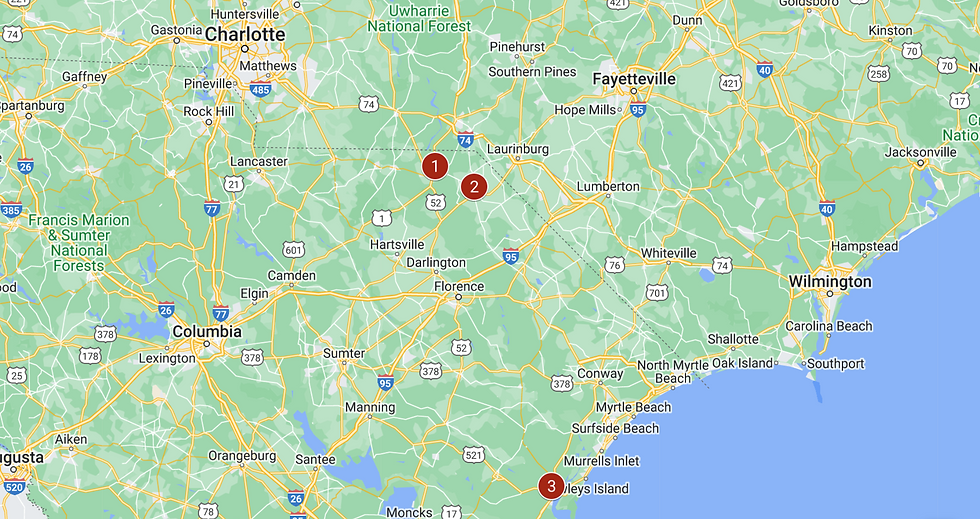
On July 25th, when British captain John Nairne began the trip down river with his ailing men and a militia escort of 100 Loyalists, our uncle Tristram wasted no time. He led 25 soldiers to a bluff overlooking the river. Outnumbered and with no effective artillery, Tristram got creative. He had his men set up "Quaker cannon," logs that looked similar to cannon, pointing down toward the river. When the British approached, the Americans pretended to load their fake weapons.
The ruse proved enough to fool the Loyalist escort. When Tristram called down for surrender, the escort immediately complied. They took control of the British boats and turned both themselves and the sick soldiers in to Cousin Tristram.
Below is a marker commemorating the event:

Intrigue in the North
While the war heated up on the southern front, Washington was quietly running the show from various locations in New York and New Jersey. Unbeknownst to him, however, treason was in the air. As early as the spring of 1779, British General Henry Clinton has set his sights on West Point, the most important American outpost on the Hudson. With the majority of British soldiers now fighting in the South, that goal had been put on hold. A bright spot in Clinton's plan to take the American fort, however, began to take shape in the fall of 1779 when an extremely unhappy Benedict Arnold came into contact with Clinton aide John André who also happened to be head of the British spy network.
Arnold, who had been passed over for promotion time and time again and slighted in reports of his role at Saratoga, was now facing court martial spearheaded by one of Washington's overzealous adjutant generals. The only thing Arnold had going for him, it seemed, was the support of Washington himself. Arnold's first inclination had been to resign from the army. After beginning secret talks with André, however, he saw a way to not only relieve his increasing debt problems, but get revenge on the Americans who had treated him so poorly.
Arnold's first step was to finagle from Washington the command at West Point. In a series of secret coded communications, André and Arnold worked out a plan that would have the fort in British hands before the end of the year. As an extra added bonus, Arnold had even offered up the capture of George Washington who was planning a visit to West Point. For his services, Arnold was promised £20,000 and a British military command.
On the 14th of September, twelve British ships and four frigates arrived at Sandy Hook, New Jersey, poised to sail up the Hudson on the night of the planned attack.

On the 16th, the HMS Vulture with Major André aboard anchored 20 miles downriver from West Point. On the night of the 20th, André slipped off the ship for a rendezvous on shore with Arnold to finalize negotiations. The men talked through the night and, as dawn approached, waited for the two men hired to take André back to the ship.
The failure of those men to return for André set up what would be a disastrous turn of events for the conspirators who had no choice but retire to the house of a sympathizer. Shortly after their arrival at the house of Joshua Smith, wary American militia fired on the anchored Vulture still awaiting André's return, causing the British to abandon their position.
Now there was nothing for it. André was encouraged by Arnold to return to New York, 40 miles south, on horseback. After a series of narrow escapes, André was only a few miles from safety when he fell into the unlikeliest of scenarios. An American militiaman being held in a British prison had escaped using a Hessian officer's uniform as a disguise. After rejoining his American company, he was still wearing that uniform when he was sent out with two companions to monitor the road.
André, coming upon the three men, was relieved to finally be among what he thought were friends again. He told the supposed Hessian soldier that he was a British officer on important business and should not be detained any longer. As it turned out, he would be detained unto his death. The militiamen found three unsealed letter in his socks that proved beyond doubt that he was a spy.
The papers André carried clearly implicated Arnold in the scheme. Luckily for Arnold, he learned early of André's capture and managed to flee West Point and find the HMS Vulture which readily took him on board.
A livid Washington, who had always supported Arnold, proposed an exchange of André for Arnold. The British refused. André was summarily hanged and Arnold took up the rank of a British brigadier general, spending the rest of the war in their service.
Our relatives at West Point at the time of the intrigue:
Samuel Kidder (3C6X)
Ben Richardson (3C7X)
John Richardson (3C7X)
Joseph Stickney (4C7X)
Richard Richardson (2C8X)
Josiah Stickney (3C8X)
Samuel Stickney (3C8X)
John Wyman (4C7X)
family member I can't place:
Simon Crosby
John Ballard
the skirmish at Bear Swamp
William Easterling was the husband of our cousin Elizabeth Sands Covington (1C5X). William first enlisted in March of 1776 for two months and at various times in 1778, 1779 and 1780. William and Elizabeth lived in the Rockingham area of North Carolina. In October of 1780 William was involved in a battle with the Tories that took place at Bear Swamp in South Carolina.

In his pension application in 1832, William said that "[h]e was engaged in one battle with the Tories on Bear Swamp between Drowning Creek and Little Pee Dee River." William named the officers at the skirmish. One of them was our cousin, Adjutant Robert Raiford (2C5X). In a further statement about Bear Swamp from 1834 William said:
When under Colonel Brown in the County of Bladen in North Carolina, sometime after dark, we heard one of our sentinels cry out - who came there? He then fired and ran into the line of fire. Another sentinel stood near who thought it was cattle. He hailed Captain Barfield who commanded the Tories shoot and hit the sentinel in the back. The Tories continued their fire until they came so near that I could see their faces by the flash of their guns. Our men were in confusion.
The Colonel ordered one side of the line of fire, the Adjutant on the other - Our officers succeeded in forming us and commencing fire. We had not fired more than four rounds before the Tories retreated. We were commanded by Colonel Brown, Lt. Col. Richardson, Adjutant Robert Raiford & Captain Anderson. . .
During the engagement Captain Anderson (a brave man and true Whig) was shot down by my side. He cried out - Oh Lord, I'm a dead man; what shall I do? - Adjutant Raiford who was as brave as ever lived, but who stuttered very badly, replied - Gu Gu_d in it l-l-lye close... poor Anderson's wound was mortal -- we were ordered [illegible], set out sentinels, and lay on our arms till morning.
This engagement was short and only Captain Anderson was killed in the melee. Swamp Creek, however, is an example of the constant skirmishes going on between the Patriots and the Tories throughout the course of the war in North and South Carolina.
the Battle of King's Mountain
Meanwhile, back further south, the war had been going so well for the British that, by October of 1780, British General Cornwallis wanted to further improve his position from South Carolina into North Carolina. He sent Major Patrick Ferguson with 1,125 men to ensure that this would happen.
The last major battle of 1780 happened at King's Mountain, SC. Unfortunately for Ferguson, he had the bad fortune to come up against the rough and ready "Overmountain Men" who had been recruited by the American army from the backcountry of the Carolinas and of territory that would eventually become the states of Tennessee and Kentucky. American cavalry commander “Light Horse” Harry Lee described them as “[a] race of hardy men who were familiar with the use of the horse and the rifle, stout, active, patient under privation, and brave.”
On October 7th, Ferguson fortified his defensive position on a hill two miles south of the North Carolina border. The Americans, 910 strong, were led by Colonel William Campbell whose plan was to assault the hill from all sides. He told his men to "shout like Hell and fight like devils” and that is exactly what they did.
A British Loyalist later recalled that the Overmountain men looked “like devils from the infernal regions… tall, raw-boned, sinewy with long matted hair.” As the Americans surrounded the defended hill, Ferguson attempted to lead his men out of danger. Mounted on his horse, riding into the fray, the major proved to be a perfect target. He was shot multiple times as he attempted to lead his men down the hill. With their fearless leader gone, the surviving British quickly surrendered.
Casualties were high at King's Mountain with 90 dead and wounded for the Americans and 1,018 dead, wounded and captured for the British. One of the Overmountain Men later recalled, that “[t]he dead lay in heaps on all sides, while the groans of the wounded were heard in every direction. I could not help turning away from the scene before me, with horror, and though exalting in the victory, could not refrain from shedding tears.”
The Battle of King's Mountain effectively halted Cornwallis' northward charge for the time being. As Washington hunkered into his winter quarters in New Windsor, NY, about 10 miles north of West Point, hostilities in the warmer southern climes would continue, heating up in January of 1781.


Comments