
The Stickney Family of Note
- westmohney

- Feb 6, 2025
- 9 min read
Updated: Mar 6, 2025
Our bodies hold the memories of those who came before us. . . ~ Alyson Richman

Our grandfather William Stickney (10GGF) came to America from Yorkshire England in 1638. He was one of the first settlers of Rowley, MA. Our branch of the family lived first in Rowley then, by the early 1700s, had moved to the Tewksbury area of Billerica. Our Stickney line ended when our grandmother, Sarah Stickney (5GGM), married Isaac Kidder (5GGF) in Billerica. Their marriage took place on 1 Jun 1775, less than two weeks after Isaac marched on the alarm of April 19. Three weeks later, he fought at Bunker Hill and then had an eight month stint in Cambridge during the siege of Boston.
Below are some of our Stickney family members of note.
Uncle Jeremiah Stickney
Jeremiah Stickney (5U) was the son of our grandparents Abraham (6GGF) and Sarah Kittredge Stickney (6GGM). He was born in Tewksbury in 1783.
We learn about Jeremiah's life from Matthew Adam Stickney's memoir of the Stickney family:
From this gentleman, when at the advanced age of 80 years, I received valuable information respecting himself and father's family, in a letter of twenty pages, written by him with a pencil, he having received, about ten years, before, a shock of palsy, which deprived him of the use of his limbs to a great degree.
Jeremiah wrote that "he early felt an inclination to obtain an education, and with the consent of his parents left Tewksbury, when about sixteen years of age, to live with Dr. Zephaniah Kittredge (3C7X) at Mount Vernon. . ." to work a part of the time, to provide the means, and to attend school the remainder, until he had acquired a suitable education for the study of Physic.
Note: Our couisn Zephaniah Kittredge was the husband of Jeremiah's older sister Elizabeth (5A).
Jeremiah split his time between work and school in order to get enough money and education "for the study of Physic."
He. . .then went to school at Hancock, and boarded with Dr. Stephen Kittredge (3C7X), brother of Zephaniah. When the term ended he returned to Mt. Vernon, and went from thence to his home in Tewksbury. During his absence his father had sold his farm and most of his outlands, and with his son James (5U), had bought a farm about a mile and a half distant, near the centre of three districts. . .here he attended school. . .and continued to work on the farm in the best of the season.
Matthew Stickney's account continues with some of Jeremiah's handwritten account:
In the fall of 1803 I attended Westford Academy, and at the close of the term received a certificate certifying to my moral character and qualifications for school-teaching. Having a pretty good smattering of Latin, and a very little of Greek, I commenced the study of Physic . . .Was m. Feb. 9, 1807, to Susannah Atwood. Kept school about thirteen weeks, then bought a good horse, bridle, saddle, saddle bags and valise, and thus equipt went to Mount Vernon, and agreed with my brother-in-law, Dr. Zephaniah Kittredge, to ride with him, and for him, until I should find a suitable place to practice for myself.
On the 16th of April following intelligence came that Dr. Cleaves, of Antrim, was dead, and the 21st of April I went with my nephew Zephaniah Kittredge (1C6X), to Antrim, and engaged board with Mrs. Cleaves, the widow of my predecessor; went immediately into practice, and had as much as I could perform. The middle of June hired a tenement in the North Branch situated on a small river called North Branch, Contoocook. This little place contained a Saw and Grist-Mill, a Carding-Machine, and Cabinet-maker, and seven dwellinghouses, and bid fair to become a place of business. I brought my wife here about the 10th of July 1807, and commenced keeping house; we lived together more than forty seven years, enjoying as much connubial happiness as falls to the common lot of mankind."
Dr. Jeremiah Stickney, died in Antrim, N. H., Aug. 24, 1865, at his daughter's, Mrs. Mary Mcllvin (1C6X), with whom he lived the latter part of his life.
Jeremiah died in at his daughter's house in Antrim at age 82.
George Stickney's "Spirit House"
I found much of my information on our cousin George Stickney (5C6X) from a paper titled "House with the Round Corners" by Kaaren Dodge, a graduate student in the Master of Science in Historic Preservation program at the Art Institute of Chicago.
Cousin George was born in Jaffrey, NH in 1809. He spent his early adulthood working on farms and in the lumber business. In 1835, when he was 26, George beat Horace Greeley to punch when he decided to "go west, young man, and grow up with the country."
According to Dodge's research:
He built a small, round, wooden trunk. . .and started out for Buffalo, NY. He took the canal steamer, the Daniel Webster, down the Erie Canal to Detroit. From there he strapped the trunk on his back and began his journey to Michigan. After two weeks of traveling on foot he changed his plans, boarded a schooner. . .and sailed for Chicago. . .There he bought a compass and set out on an Indian trail to the Fox River Valley area. He made a land claim in Nunda township. . .three years before the government surveyed the area. George Stickney built the first house in the township using logs and pegs.
George's westward journey had taken him almost 1,000 miles from his hometown of Jaffrey.

In Nunda George was a mover and a shaker. He helped to organize the town government as its first supervisor and was instrumental in building the first school house there.
In 1839, George married Sylvia Beckley and, a few years later, they built a house in the wilderness area a little outside of Nunda. Over the course of 17 years, the couple had nine children. The first three, Orange, Adeline and Rosina would die before seeing their first birthday. Only three of of George and Sylvia's nine children would live to adulthood.
It may have been because of these early tragedies that the Stickneys became enamored of in a newly founded religion called Spiritualism in which believers embraced the notion that "dead spirits existed and that they had the ability and inclination to communicate with the living."
In 1849, the Stickneys began work on a larger house, this one better suited to their Spiritualist beliefs. The most unique aspect of the house was the fact that it was built with all rounded corners both inside and out. The prevailing opinion on the construction style was that Sylvia, who was a medium, would be be better able to summon spirits who could "float freely in the corners." The entire upper floor of the two story home was a large ballroom used for the many séances orchestrated by Sylvia.
The Stickney House, shown below, is one of the oldest brick buildings located in Bull Valley, Illinois. It has been on the National Register of Historic Places since 1979 and is currently being used as the Bull Valley Police Headquarters.

George and Sylvia's marriage lasted 40 years and ended with Sylvia's death in 1879. Below are photos of George and Sylvia and a drawing of George.


The family photo below was taken in 1865. Four of the couple's nine children had already died. In this photo, Edmund (6C5X) was 21, Ellen (6C5X), 19 and Jeanette (6C5X), 14. Those were the three children that lived into adulthood. Adella (6C5X), 12 at the time, would die five years later at 17. Saloma (6C5X), 8 at the time, would die three years later at age 11.

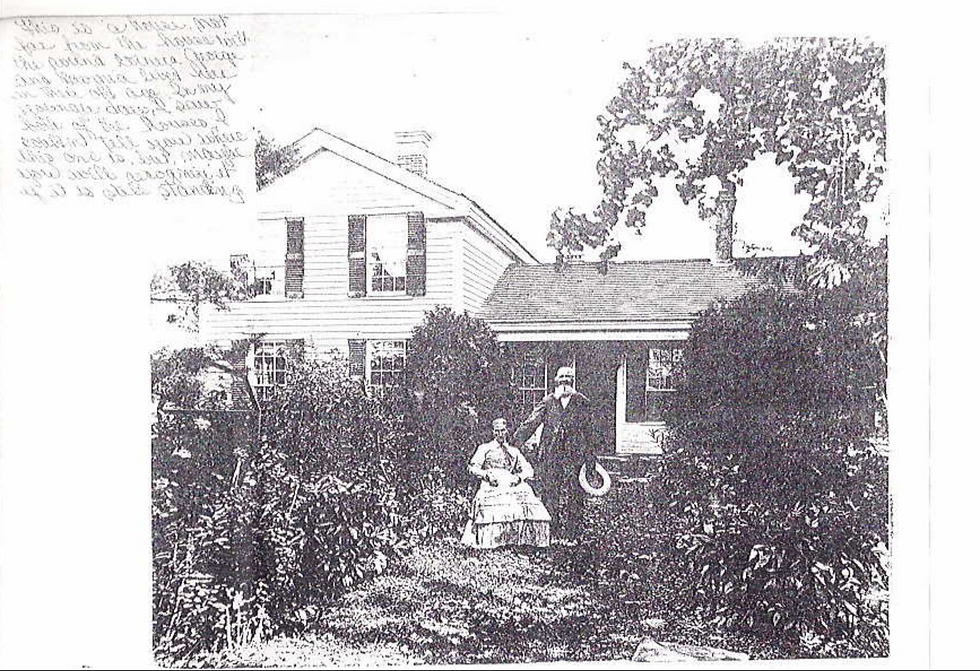
George remarried sometime before his death in 1797 and he and his new wife moved to a smaller house nearby. Below is a picture of George and his second wife Lavinia in front of their home:
Finally, below is a picture of the Stickney Run Conservation Area about seven miles east of George's "Spirit House." The park is 568 acres.

Jonathan Stickney, silversmith
Our cousin Jonathan Stickney (4C7X) was born in Newbury, MA in 1760. He married Elizabeth Chipman in 1783 in Newburyport and the couple had seven children. Jonathan might have begun his silversmith business in Newburyport shortly after his marriage. In 1787 he took on his younger brother, David (4C7X) as an apprentice. David is listed on the American Silversmith site but I can find no examples of his work.
Jonathan's 1796 advertisement in the Newburyport Herald describes himself as a "Silversmith and Jeweler" who makes silverware "in the newest fashion." The only examples of his work I could find were teapots, all made ca. 1790, shown below:


When Jonathan's wife Elizabeth died in 1796, he married Hannah Peck a year later. It seems that either the silversmith business wasn't paying off as well as Jonathan liked, or his new wife was a very religious woman. In any case, ca. 1800 he became an ordained minister and moved to Raymond, NH.
According to his will, Jonathan died in Raymond but it appears he was buried in the Old Hill Burying Ground in Newburyport. He probably died with little to his name. He left $10 to each of his seven children and the rest of the estate went to his wife.
Jonathan had two children with his second wife and one of those, his son Moses (5C6X), also became a silversmith. I can find no examples of his work but did find a few examples of his mark:


Numismatist Matthew Adams Stickney
Our cousin Matthew Stickney (5C6X) was born in Rowley, MA in 1805. He got his start as a collector of things early in life. By the age of ten he had amassed a collection of nearly 2,000 bird's eggs. While still in his teens, he discovered a love of coins after receiving a large cache of Continental Currency from his grandfather.
Matthew married Mary Smith in 1833. The following year, a son was born but Mary died two days after the birth. In 1838, Matthew married again and, with his second wife Lucy, had three daughters. While raising his family, Matthew worked for a company that dealt in West India goods but, all the while, he never forgot his numismatic interests.
Note: Numismatics is is the study of coins and other currency units.
Matthew evidently had a good relationship with William DuBois, an Assistant Assayer at the U.S.Mint. It appears that many a coin trade went on between the two men. The U.S Coin Forum has a story about Matthew's "famed 1804 dollar:"
Numismatic lore has it that Stickney said he visited the Mint on May 9, 1843 and traded a gold 1785 Immune Columbia. . .for an 1804 dollar. Now, there is such a coin in the National Numismatic Collection, so Stickney's tale seems to be true.
Another article, this one from the Newman Numismatic Portal, has information about Matthew's "standing want-list" with coin brokers Beebee & Co. In 1851, Matthew was able to obtain a rare 1815 half eagle which made him "the earliest-known numismatic owner of an 1815 in this country."
In 1847, Matthew commissioned a portrait of himself by artist Charles Osgood which today is part of the Peabody Essex Museum collection in Salem.

Matthew retired from the trade business in 1754, but kept himself busy. In 1863, his numismatic skills were put to use when he assisted our distant cousin Sylvester Sage Crosby (7C6X) on his well regarded book, Early Coins of America. We'll have more on Sylvester in a future post. Then, in 1769, Matthew's genealogical work on his ancestors, The Stickney Family: A Genealogical Memoir of the Descendants of William and Elizabeth Stickney, was published. This book has been extremely helpful in my research on our Stickney family. The frontpiece of the book has this description of Matthew:
Corresponding member of the New England Historic-Genealogical Society, The Vermont and Wisconsin Historical Societies, The American Numismatic and Arch.eological Society, Honorary member of the New England Numismatic and Arch.eological Society, Curator in the Historical Department of the Essex Institute, Etc., Etc.
When Matthew died in Salem in 1894, his coin collection was sold to Henry Chapman who sold it at auction over ten years later, in 1907. The 1804 dollar sold for $3,600, the 1815 Half Eagle for $2,000 and a 1787 Brasher Doubloon netted a whopping $6,200. The total gross for the entire collection was over $37,000. Below is one plate of 20 from Henry Chapman's catalogue of Matthew's collection.

Henry Chapman sold at least fifty collections over a 25 year period. Kolbe and Fanning, auctioneers, had this to say about our cousin Matthew's collection.
Many would argue, however, that he (Chapman) never sold a finer collection of American coins. Adams terms it a “Famous early collection, perhaps the best. Replete with history and great rarities in all metals.” Truly it is a magnificent collection, featuring colonials, pioneer gold, patterns Washingtonia and United States coins in all metals.
Below is a drawing of Matthew that Chapman included in his catalogue of Matthew's coins:



Comments