
THE WAR MOVES SOUTH
- westmohney

- Jan 26, 2024
- 12 min read
Updated: Oct 3, 2024
Our officers and men behaved like men who are determined to be free. ~ General "Mad Anthony" Wayne

the Battle of Monmouth
Spring of 1778 found General George Washington still at Valley Forge ruminating on his next course of action. Many in Congress were still calling for a change, favoring General Horatio Gates, the hero of the Saratoga Campaign, over Washington. Washington's counterpart, British general William Howe was in equally hot water. He had come under increasing criticism from Parliament over his decision to abandon Burgoyne and take Philadelphia instead, a scheme which had not benefited the British cause in the least. Under fire, Howe resigned his position in April and General Henry Clinton took his place.
One of Clinton's first decisions was to leave Philadelphia and return to the more strategically important New York. When Washington, sorely needing a victory, caught wind of Clinton's plans, he saw a golden opportunity to engage the British in battle and once again redeem himself.
General Charles Lee, who had been captured by the British in December of 1776, was released in a prisoner exchange in April of 1778. Washington put Lee in charge of the initial attack which began on the morning of June 28, 1778. Even though the Americans outnumbered the British two to one, Clinton's forces proved stronger than Lee had bargained for and his troops fell into disarray. When Washington came on the scene at noon he found "panic stricken troops fleeing the enemy." Enraged, he rode in and took command, encouraging the men back into battle.

Washington's action saved his own skin. The battle see-sawed back and forth for several hours. By 6:00 p.m., both sides had had enough. The British retreated to continue their march to New York and Washington made the decision not to pursue them.
Though The Battle of Monmouth proved, in reality, to be "tactically inconclusive and strategically irrelevant," Washington and his officers were able to spin it as a spectacular victory for the Americans. George Washington would keep his position as commander in chief until the end of the war.
our relatives at Monmouth
Though many of our relatives probably took part in this battle, I have been able to find evidence of only three who fought at Monmouth.
Our cousin Ezra Lunt (5C6C) was a brother of Henry Lunt (5C6X) who we wrote about in our "The Adventures Henry Lunt" post.
Our uncle Robert Raiford (5U) of North Carolina served in the Continental Army with Washington and fought at Monmouth before returning to service in the South.
There is also a record of one of our relatives who probably died at Monmouth. Our cousin Thomas Kidder (3C6X) of Billerica is mentioned in Massachusetts Soldiers and Sailors of the Revolutionary War as having mustered into the Continental Army on April 27, 1777 for a term of three years. He served for a little over a year before he was reported killed on June 28, 1778, the exact date of the Monmouth Battle. Thomas died at age 23.
Note: We wrote about two of Thomas' brothers, in our "Privateering" post. Jonathan (3C6X) and Francis Kidder (3C6X) were serving on the sloop G Pickering when it was captured by the British in 1780.
the Regulator Movement in North Carolina
The only major battle, other than Monmouth, fought in the north was in Rhode Island in August of 1778. We covered that battle in our "The War in Rhode Island" post. By fall of 1778, all of the main action of the war had moved to the southern states. One main reason for moving south was the British belief that there were far more Loyalists in the southern states than the northern. In the case of North Carolina, that certainly proved to be true.
In future posts, we'll cover the migration of four of our Southern families to North Carolina.
The Covington, Raiford, Thomas and Wall families had all made the move before 1775. As war loomed large, many of our North Carolina relatives were fervent about the Patriot cause but, most likely, there were those who remained loyal to the king. The struggle there began early with the Regulator Movement.
The Regulator Movement was a five year uprising which lasted from 1766 to 1771, coinciding with the upheaval in Boston over the Stamp and Townsend Acts. Many North Carolinians, unhappy with royal officials who were considered "cruel, arbitrary, tyrannical and corrupt," took up arms against the powers that be. Seen by some historians as a precursor of the war to come, the uprising eventually escalated into "plundering, property destruction, violence, and murder."
I have no way of knowing how deeply three of our relatives delved into the Regulator Movement, but all three had at least singed their hands in the fire. Our uncle Matthew Raiford (5U), his son Matthew, Jr. (1C6X) and our uncle Benjamin Covington (4U) all signed petitions supporting the movement.
From May 1 to June 20, 1771, Governor William Tyron called for an all out war against the insurgents. Tyron was particularly detested by the Regulators for using tax funds to build a new home that became known as "Tyron Palace."

The movement came to a bloody end at the Battle of Alamance when Tyron's forces defeated 2,000 Regulators. Seven men were executed. The rest were pardoned and released. The events of April 19, 1775 in Lexington and Concord must have been welcomed ecstatically by all the former Regulators, our two Matthews and Benjamin included.
Note: During the military campaign against the insurgents, William Tyron was appointed Governor of New York, a post he held when the Revolutionary War began. In 1776, he was part of an unsuccessful plot to kidnap and assassinate George Washington. When General William Howe arrived in New York after the evacuation of Boston, Tyron remained governor in name only.
the Cherokee Campaign
The Cherokees, who had suffered numerous abuses under the Americans, were quick to join southern Loyalists in the fight against the Revolutionaries. In early 1776, war parties began leaving their homes in Tennessee to attack frontier towns in South Carolina. The raids soon expanded into North Carolina. As usual, where Natives were concerned, American retribution was both speedy and devastating. From the Wikipedia account:
The affected colonies of Virginia, North Carolina, South Carolina, and Georgia conferred and decided that swift and massive retaliation was the only way to preserve peace on the frontier. . .North Carolina sent Griffith Rutherford with 2,400 militia to scour the Oconaluftee and Tuckasegee river valleys, and the headwaters of the Little Tennessee and Hiwassee. South Carolina sent 1,800 men to the Savannah, and Georgia sent 200 to attack Cherokee settlements along the Chattahoochee and Tugaloo rivers.
Our uncle Matthew Dockery Covington (3U) of North Carolina was the son of our grandfather John Covington (4GGF) and his first wife Hannah Dockery. From Matthew's pension application we learn that he volunteered for the army when he was 15 and first served as guard at the Anson Courthouse for two months in April of 1775. In his application he also wrote about his role in curbing the Cherokee attacks:
for the period of two months in the year 1776 about the month of April declarant states that he was drafted to march against the Cherokee Indians. . .we marched across the Blue Ridge thence crossed French Broad River and on to the Cherokee towns & burnt a considerable number of the towns and destroyed their corn &c these towns were on a prong of French Brevard called Tennessee.
Note: In 1828, Matthew would return to that area that had once belonged to the Cherokee. He died in 1839 in Carrol County, Tennessee.
After destroying these towns General Rutherford proposed for 1200 volunteers to go on to Hiwassee a distance of about 30 miles further to the Overhill or Valley towns. I again volunteered. We killed a few Indians and burnt their towns the day after we marched for Hiwassee the South Carolina troops had a battle with and defeated the Indians.
Also involved in the Cherokee Campaign was our cousin Joseph Terry Williams (2C6X) of Virginia. Joseph was the son of Lucy Terry (1C7X) and William Williams. From Joseph's pension application:
That in the year 1776 as near as he the deponant can recollect, he was a resident of Pittsylvania County in the State of Virginia and on the 2nd day of April of said year he turned out as a volunteer to go against the Cherokee Indians. . .The force marched to the Long Islands in the River Holston. To this place a great many of the Cherokees came and there they made a treaty with the Americans, then the force was discharged and sent home. In this expedition against the Indians his assignment was an orderly sergent.
Joseph evidently got the year wrong in his testimony. It was in April of 1777, after a year of almost constant warfare, that the Cherokee finally capitulated and signed treaties with the states of Georgia, Virginia and North Carolina. These treaties, however, did not hold up. When the action in the war moved south, the Cherokee once again actively threw their lot in with the British.
conflicts escalate in North Carolina
As the war heated up, so did conflicts between the Whigs and the Tories (Loyalists) in North Carolina. In his article "Archibald Maclaine and the Politics of Moderation in Revolutionary North Carolina," John R. Maass maintains that "[a]lmost nowhere in British North America did Whigs go to war with less support than in North Carolina." Maass even referred to the struggle there as basically a "civil war."
Our cousin Thomas Ratliff (1C5X), who lived in Anson County, NC, was the son of our aunt Susannah Thomas Ratliff (4A). Even though Thomas was a practicing Quaker, he joined the militia to help quell the Loyalists. In February of 1776, he participated in the Battle of Moore's Creek Bridge.

From the Wikipedia account of the scuffle:
In a brief early-morning engagement, a Highland charge across the bridge by sword wielding loyalists shouting in Scottish Gaelic was met by a barrage of musket and artillery fire. Two loyalist leaders were killed, another captured, and the whole force was scattered. In the following days, many loyalists were arrested, putting a damper on further recruiting efforts. North Carolina was not militarily threatened again until 1780, and memories of the battle and its aftermath negated efforts by Charles Cornwallis to recruit loyalists in the area in 1781.
Animosity toward the Loyalists only heated up in the days following the Moore's Creek battle. Many non-Patriots were forced out of North Carolina to prevent "the Dangers which may arise from persons disaffected to the State. . ." It was reported that so many Loyalists were ousted that, by the end of 1777, there weren't enough "Vessels to transport all such Recusants beyond the Sea. . ."
When these "disaffected persons" had been summarily thrown out, their property was consficated and sold to the true Patriots remaining in the state. Frederick B. Tolles in his article "The American Revolution Considered as a Social Movement" cites our uncle Robert Raiford (5U) as one of the lucky ones to profit from others misfortune. Robert was able to purchase five different parcels, creating an estate of more than a thousand acres.
Sadly, enmity toward Loyalists, wouldn't end even when war was over. Bitter vindictiveness remained. In April of 1783 the state legislature passed an "Act of Pardon and Oblivion" that was supposed to forgive the Tories transgressions. There were so many exceptions to the pardon, however, that few of the banished Loyalists returned. For those who did choose to return, new laws made them ineligible to vote or hold office in the state.
Our cousin Thomas Poythress (2C7X) worked as an Impressment Officer for the County Commissary after the war. It appears that he was involved in allocating property that had "been taken for public service," most probably from the Tories. Thomas died ca. 1800 but, for his service in the war, his sons were eligible to participate in the Georgia Land Lotteries created to redistribute confiscated Cherokee lands.
war in the South begins in earnest
The British began their southern campaign in earnest in Georgia, 800 miles from George Washington's troops who were spending the winter keeping an eye on British General Henry Clinton, headquartered in New York City. On 29 Dec 1778, in a surprise attack on the city, Colonel Archibald Campbell easily occupied the coastal city of Savannah. His army of about 3,000 troops overwhelmed American General Robert Howe who was defending the city with less than 900 men.
Our uncle Henry Covington (4U), in his early forties at the time, was listed at the siege in Captain John Caldwell's 3rd South Carolina Regiment. Henry was the brother of our grandfather, John Covington (4GGF)

The early months of 1779 then saw a series of seesawing skirmishes between the British and Americans in South Carolina and Georgia, mainly in the 100 mile stretch between Savannah and Charleston, SC. The Battle of Stono Ferry, about 15 miles from Charleston, took place on June 20. Our cousin Joseph Terry Williams (2C6X), who had also participated in the Cherokee wars, was again in the thick of the action. From his pension application:
In the month of February 1779 this deponant was called out for a five months tour as a drafted militia man in a company commanded by Captain William Witcher in a regiment commanded by David Mason and was immediately marched down south and joined the continental troops under General Linkhon (Benjamin Lincoln) at a place called Stono a place South West of Charleston not long before the battle at Stono. He and the militia with him were attached to and served with the regular troops during the whole campaign.
The Stono battle, which took place on June 20, began well for the rebels but British reinforcements forced Lincoln to order an American retreat. The battle ended as mostly a draw with casualties on the American side at 34 killed, 113 wounded and 155 missing to the British 26 killed, 93 wounded and 1 missing. In spite of an inconclusive victory on either side, the British scuttled their attempt to take Charleston for the time being. It would be almost a year before the British were finally able to march into that city.
the Battle of Stony Point, NY
While the war in the south heated up, the northern faction of the British army under General Henry Clinton was headquartered in New York. After a summer of futile attempts to draw George Washington into battle, Clinton decided it was time to move his army south into the main action. He left with the majority of his men out to the coast of Connecticut, leaving a small contingent of 600 men at Stony Point to defend their position there on the Hudson River.
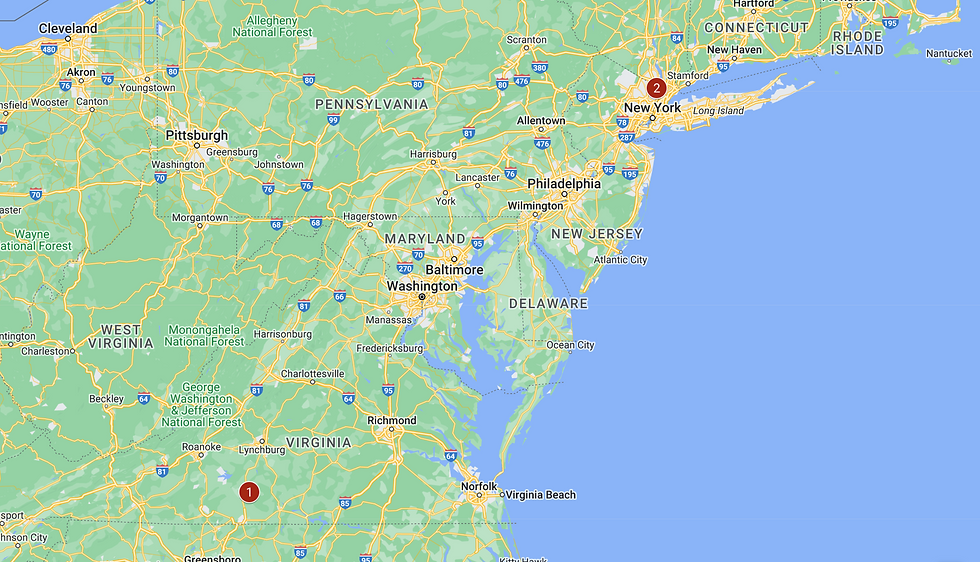
Washington, ever watchful for small opportunities, decided to take the outpost back into American hands. For the mission he chose the "fiery" General Anthony Wayne. Wayne had orders "to take Stony Point in a midnight bayonet charge." Wayne's force of 1,200 Light Infantrymen were "hand-picked men from various Continental regiments that formed an elite corps of some of the best American soldiers." Included as one these "hand-picked" men was our cousin, Joseph Terry (2C6X), who had come 500 miles from Pittsylvania County, Virginia to join Wayne's company.
According to the American Battlefield Trust:
The Battle of Stony Point was one of the more dramatic battles in the Revolutionary War. Much of the combat was brutal hand to hand fighting at the point of the bayonet. While the battle itself played a minor role in the outcome of the war, it displayed to the world the prowess and bravery of American troops and served as a much-needed morale boost for the young American army.
The battle took place in the early hours of July 16. Shortly after midnight, three American columns moved out, slogging through water up to their chests. As they surged up the hill toward the British outpost, "musket flashes illuminated the dark night as whizzing musket balls screeched through the air." The action soon reverted to close combat with axes and bayonets.

General Wayne was temporarily incapacitated when a musket ball grazed his head, but he encouraged his men to fight on.
After 25 minutes of fierce battle, British Lt. Col. Henry Johnson surrendered. American casualties were 15 killed and 83 wounded to the British 20 killed, 74 wounded and 472 captured. Wayne's note to Washington after the battle said in part, “The fort and garrison with Col. Johnston are ours. Our officers and men behaved like men who are determined to be free.”
General Wayne, who had continued to inspire his men even after his injury, would later be dubbed "Mad Anthony" for his "zeal in battle." His success at Stony Point turned out to be a moral victory only. Washington determined the Americans would not be able to hold their position there and the British reclaimed the outpost on July 19.
Our cousin Joseph Terry made it through the battle of Stoney Point but his luck didn't hold out. His capture by the British shortly afterwards was featured in Charles W. Sanders' book While in the Hands of the Enemy as well as in an obituary in the Lynchburg Virginian:
He (Joseph) was soon after this affair taken prisoner by the enemy, and experienced all the horrors and miseries of the British prison-ships, and the cruelty and tyranny of their commanders. His situation soon became intolerable, and to preserve existence he was compelled to enter the British service. In this situation, he was a spectator of the attack made by the French and Americans on the port of Savannah, and of their repulse. Being too weak, from his complicated sufferings, to render the British any service, he had a fair opportunity of observing the engagement. Soon after this affair, when his strength was somewhat improved, he made good his escape to the American camp.
The action that our cousin Joseph witnessed while in the British service was the American's failed attempt to recapture Savannah in October of 1779. The Savannah fiasco effectively ended the war action for the year as both sides then hunkered down into winter quarters. Washington would spend another winter with his troops in Morristown, NJ in what would prove to be the harshest winter of the 18th century.


Comments