
Tristram Dalton
- westmohney

- Jul 10, 2024
- 7 min read
Updated: Jul 7, 2025
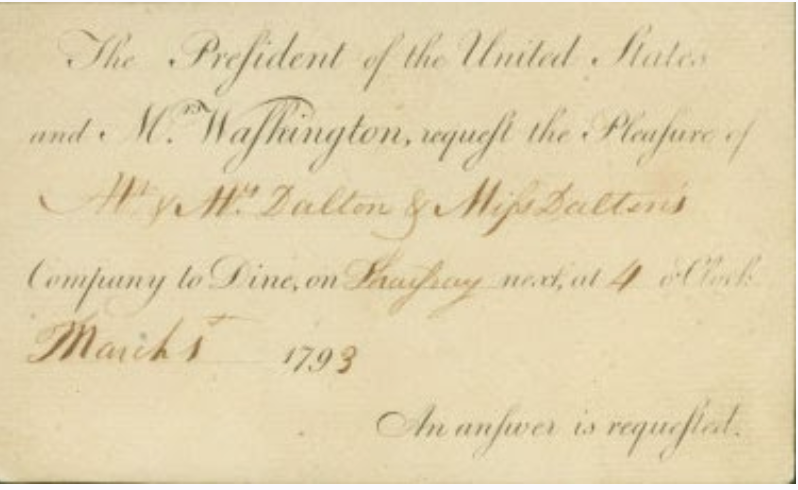
The President of the United States and Mrs. Washington request the pleasure of Mr. & Mrs. Dalton & Miss Dalton's Company to Dine on Thursday next at 4 o'clock ~ invite from the president

We wrote a little about our cousin Tristram Dalton (2C8X) in our "Two Loyalists and a Patriot" post. Here we continue his story.
the American Academy of Arts and Sciences
As the war for independence was winding down, John Adams, John Hancock and sixty other "scholar-patriots" found the time to create an organization dedicated to the "development of knowledge—historical, natural, physical, and medical—and its applications for the improvement of society." Cousin Tristram was a charter member of that organization, the American Academy of Arts and Sciences, founded in 1780.
The organization has continued strong until today. The mission statement on the Academy's website on the internet is a follows:
Founded in 1780, the American Academy of Arts and Sciences honors excellence and convenes leaders from every field of human endeavor to examine new ideas, address issues of importance to the nation and the world, and work together “to cultivate every art and science which may tend to advance the interest, honor, dignity, and happiness of a free, independent, and virtuous people.
Since that time, over 13,000 people have been invited into the Academy's membership including Thomas Jefferson, John James Audubon, J. Robert Oppenheimer, Charles Darwin, Albert Einstein and our distant cousin T.S. Eliot (9C2X), to name a few.
Two other members of our family to have joined the Academy are the lifelong friends Loammi Baldwin (3C7X) and Benjamin Thompson (3C7X), aka Count Rumford.
the Massachusetts senate
Before the federal government was organized in 1789, Cousin Tristram served as a member of the Massachusetts House of Representatives from 1782 to 1785 and as a Massachusetts state senator from 1786 to 1788. When Tristram served in the House of Representatives, he often had dealings with his old pal, John Adams, who was serving in the Massachusetts State Senate. In 1783, when John Hancock was Governor of the state of Massachusetts, Tristram Dalton was Speaker of the House and John Adams was President of the Senate. A document signed by Tristram and Adams in those capacities "concerns an apparent dispute between Hancock and the sitting of the Suffolk County Supreme Judicial Court." It appears that both the House and the Senate did not agree with Hancock's ideas on how to sit the Judicial Court.
The document states that a committee, including our cousin Artemas Ward (4C10X), former commander in chief of the United State Army, was being sent to Hancock with the bad news. At the top of the page, Tristram wrote:
Ordered that Mr. Lowell Gen'l [Artemas] Ward & Mr. Dwight with such as the Hon:ble Senate may join be a Committee to wait on his Excellency the Governor [John Hancock] with the following Message. . .
Next, Adams chimed in that he and other members of the Senate concurred with the decision included in the message.
Finally, the message stated that the legislature had decided they could not sit judges "in the way proposed by your Excellency. . ."
In 2021, the document, shown below, sold at auction for $1,900.

first national elections in the United States
Tristram participated in the very first elections for the United States which took place in 1789 and concluded with the election of George Washington as our first president.
Members of the House of Representatives were to be elected by the general populace. Senators, however, were chosen by state legislatures. It was decided that they would serve a six year term with the years of election staggered. To accomplish this, seats were divided into three classes. Those in Class One would serve a two year term, Class two, four years and Class three, six years. A lottery systems was set up to divide the twenty-six senators into these classes. As luck would have it, Cousin Tristram was the very first man to choose from the small slips of paper designating the class. Richards A. Baker, Senate historian describes Tristram's experience in his book 200 Notable Days; Senate Stories 1787 to 2002:
On the morning of May 15, 1789, Tristram Dalton climbed the steep stairs to the Senate chamber in New York City's Federal Hall. At a few minutes after 11 a.m., the recently elected Massachusetts senator placed his hand into a small wooden box. With Vice President John Adams presiding and 12 of the Senate's 20 members looking on, Dalton grasped a small slip of paper and lifted it for all to see. He then read its brief notation: "Number One." With that ritual act, seven senators became members of "Class One" and learned that their terms of office would expire within two years.
Sadly, those two were Tristram's only years in the Senate. He was never re-elected for a full six year term.
Shortly after his election, however, Tristram found himself able to be of some small service to his friend, Vice President John Adams. Debates had been raging in Congress about the ability of the president alone to remove Cabinet members from office. William Maclay felt the Senate should be involved in such removals while John Adams felt it should be at the president's discretion. According to historian David McCullough in his Pulitzer Prize winning biography of John Adams:
Adams finally convinced Tristram Dalton of Massachusetts to withdraw his support for Maclay's proposal. . .When the Senate decided the question on July 18 in a 9-to-9 vote, Adams performed his sole legislative function by casting a tie-breaking vote against Maclay's proposal.
The ability of the president to remove cabinet members was again challenged in 1926. Postmaster Frank S. Myers brought suit against the United States when he was removed from office by Woodrow Wilson. The Supreme Court decided, 6-3, "that the power to remove appointed officials rests solely with the president."
robbed!
In 1786, while still serving in the Massachusetts State Senate, Tristram's home was robbed. He took out the following add in both the Essex Journal and the New Hampshire Packet:
FIFTY DOLLARS REWARD.
THE Subscriber's Dwelling House in Newbury was broken Open this morning and a considerable sum of money stolen, with about 40 pieces of remarkable copper coin, some of very ancient date and characters. Some Silver Table Spoons marked D over F with the maker's name, J. Moulton stamped on the handle, and a pair of square silver shoe buckles open work, with two rows of small holes.
city life
Cousin Tristram, who had "a deep interest in agriculture and horticulture," had a lovely home in Newburyport with "extensive and stately" gardens. But after his election to the U.S. Congress in 1789, Tristram became increasingly fond of city life. He moved his family to New York City which was the seat of the government at that time. Even after his term as senator ended in 1892, it seems that Tristram was still part of the inner circle at the Capitol. Below is an invitation for Tristram along with his wife and his daughter to dine to with President Washington on March 1, 1793.
According to research done by The Washington Post, it seems that our cousin Tristram was one of only two members of Congress from Massachusetts who owned slaves. Tristram did, however, think enough of his slave, Fortune, to have him buried in the all white Old Burying Hill Cemetery in Newburyport. That feat must have taken some finagling because most slaves were buried in "communal, unmarked graveyards in wooded areas." Fortune's gravestone reads, "In Memory of Fortune a faithful servant who died July 16th, 1804." The Post article goes on to say that "[t]his was a bold act for the time. . . just think, only one citizen of our community dared to honor a slave that way in that day. Fortune is the only slave buried there among all the other graves, belonging to white citizens."
In 1790, the final decision for the location of the nations's capitol was made in a secret meeting held by only three men, Thomas Jefferson, Alexander Hamilton and James Madison. Cousin Tristram immediately saw dollar signs in that decision. He sold most of his property in Newburyport and "speculatively purchased land in Washington D.C." His household goods were packed and sent by ship to Georgtown. Unhappily for Cousin Tristram, the vessel carrying his possessions was wrecked along the way and a large portion of his belongings was destroyed.
But that wasn't the worst of it. According to Rodney C. Dalton in The First Daltons in the New World :
The anticipated rise in value of real estate at Washington did not take place. His agent was dishonest. The speculation proved a failure; and Dalton, with nearly all the others engaged in the enterprise, lost his property, and was reduced to such a condition that he was forced to accept a situation in the Boston custom-house for his support. He removed to Boston in 1815, and died very suddenly, two years after, on the 30th of May, 1817.
Tristram was seventy-nine when he died. He is buried in his hometown of Newbury.
Cousin Tristram has two American towns named after him, Dalton, Massachusetts and Dalton, New Hampshire. Both towns were incorporated in 1784 while Tristram was serving as Speaker of the Massachusetts House of Representatives.

From "A Sketch of Tristram Dalton" by U.S. Representative Eben F. Stone:
His moral nature was of the higher order. Kind, generous, temperate, upright, truthful and unselfish, in the social and domestic relations he was a model man, a dutiful son, a kind father, a good citizen and an ardent patriot. A man of emotions rather than ideas, the warmth and depth of sincerity of he feelings lifted him above all personal considerations, and gave to him that elevation and nobility of character which appeal so strongly to our regard and affection. Take him for all in all, he was a fine specimen of an accomplished Christian gentleman of the old school--of the class which was the best product of the colonial period, and which perished under the influence of the democratic ideas introduced by the Revolution.
Below is a miniature of Tristram painted by artist John Trumball:



Comments