
Winchester, Massachussets
- westmohney

- May 18, 2025
- 6 min read
Meanwhile, other Richardsons settled along the road to Woburn now called Washington Street but early known as Richardson Row. ~ Ellen Knight
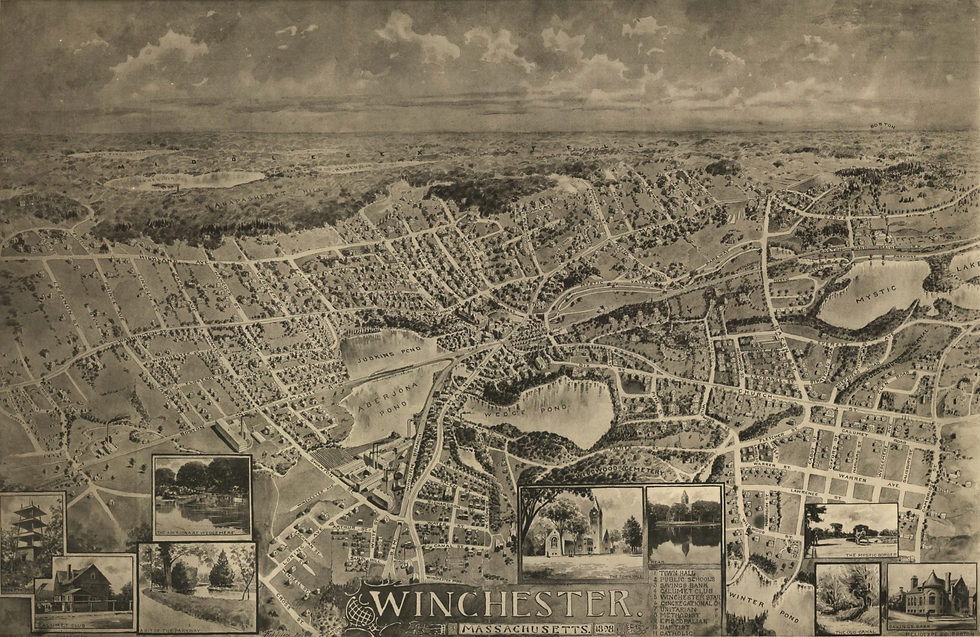
Winchester, Massachusetts
The area of Woburn where our grandfather Thomas Richardson (9GGF) and his two brothers, Ezekiel (9U) and Samuel (9U) settled in the early 1630s later became the town of Winchester. Winchester archivist and historian Ellen Knight wrote about the history of the area:
The village of South Woburn began when Edward Converse built a house and mill along the
Aberjona River by today’s Converse Bridge. In 1773, much of the Converse farm, including the mill and the land near it (from today’s parkway up to Judkins Pond), was purchased by Abel Richardson (4C7X). Meanwhile, other Richardsons settled along the road to Woburn now called Washington Street but early known as Richardson Row.
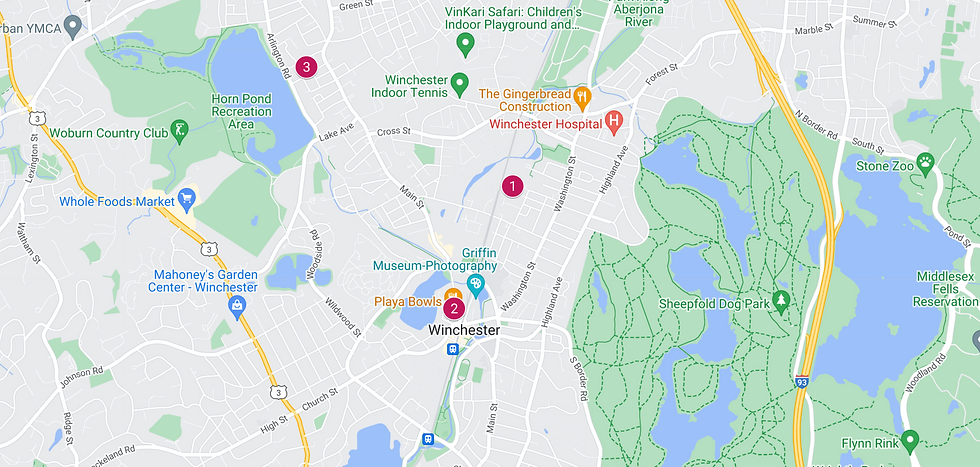
From the early 1630s, our uncles Samuel and Ezekiel Richardson owned most of the land west of Washington Street. Our grandfather Thomas owned land near Horn Pond. The Converse farm which our cousin Abel purchased wasn't far from the other Richardson properties.
Note: We wrote about Abel and his wife Mary in our "Another Hodgepodge" post.
According to Ellen Knight, during Abel's ownership of the property "the mill went into a decline." The town of Winchester itself saw a general downturn of fortune in the years that followed. What managed to turn the decline around was the combination of the railroad and our distant cousin Samuel Steele Richardson (7C4X). We'll have more on that later in this post.
Not far from Abel's property, our cousin Paul Wyman (4C7X) "operated the first known store" in the area. This store was run by Paul and then his son Jesse (5C6X) from 1775 until 1840.
Our cousin Nathaniel Richardson (4C4X), who turned out to be the family storyteller, had a few tales to tell about Abel's daughter Molly (5C6X). Molly, born in 1765, never married. She lived with her parents until their deaths in 1830 and 1832. According to Nathaniel these particular Richardsons may have been a tad "hog eccentric." Abel once beat his wife Mary with a bible because she forgot to feed the hogs. Another day, "Molly threw a half dozen good sized cheeses into the pigpen to be devoured by the pigs 'in revenge for her father locking up her best dress to keep her from going to a dance in the old Black Horse Tavern.'''
Note: We wrote about the Black Horse Tavern in our "Around Woburn" post. In the course of a hundred years, that tavern passed through the hands of many a Richardson and Wyman.
Molly was evidently a familiar figure in the village especially since she was the resident nurse when there was no doctor in the town. Nathaniel wrote about what he called her "odd ways:"
She had a hatred for paper money, but kept a little silver on hand which she stowed away in a bowl of molasses, so that it could not be found if the house was broken into; when she had occasion to use money, she would pick it out with her fingers, lick the molasses off, and pay it away.
And, sadly for Molly, it appears that she hadn't managed her money well.
The old farm house was long gone by 1864. At the time of her death in the Woburn poorhouse, she owned only a small wood lot that the city used for her support. After Molly’s parents died in 1831 and 1832, she herself lived on to 1864, dying at the age of 99. She did not live out her days on the family farm but ironically (considering the value of the former farmland today) in the Woburn poorhouse. Reportedly, she owned a wood lot located in the rear of Mt. Vernon Street that Woburn took for her support.
Below is a painting titled "South Woburn" by Dr. Richard Piper, painted ca. 1845. Mill Pond is in the foreground and behind the pond is the property formerly owned by Abel. This property, briefly owned by poor Molly who died in the poorhouse, would become prime real estate in Winchester. Abel's house would have been located to the left of the yellow building by the pond. On the far left is the home built by Samuel Steele Richardson.

In 1773, when Abel bought the property, there were about 35 houses in the Winchester area. At the time of Winchester's incorporation in 1850, there were about 260.
Revitalizing Winchester
Abel Richardson died in 1830 and his wife Mary in 1832. The property then reverted to Molly who lost it only a few years later to Samuel Steele Richardson. Below is a map of the Abel Richardson Farm, surveyed and drawn by our cousin Loammi Baldwin, Jr. (4C6X). The map is dated 1735 and the property is clearly owned at that time by Samuel for whom the survey was done.
Note that the Boston and Lowell Railroad goes horizontally directly through the propety. The railroad was completed the same year that Loammi made his map. The land for the railroad was surveyed by Loammi's brother, James Fowle Baldwin (4C6X). We wrote about the Baldwin brothers in our "Loammi's Sons" post.

In 1835, Winchester got a railroad! Ellen Knight notes that the happy event had nothing to do Winchester being an important destination but rather it lay between two other important destinations, Boston and Lowell. However it happened, the railroad was the boost in the arm the town needed and one man took advantage of that fact.
But then there came a man whose eagle eye saw the advantages of that spot as a good locality for business and the founding of a new town. That person was Samuel Steele Richardson. Having already established a prosperous shoe-making business in Woburn and seeing the possibilities of South Woburn at the site of the railroad stop, he bought the old Converse/Abel Richardson mill site, rebuilt the mill, built several houses, and a new shoe shop. He bought the Black Horse Tavern site.
Below is the building that housed Samuel's shoe shop:

Samuel's reign as the "father of South Woburn" was short lived. The panic of 1737, a major recession in the county which lasted nearly a decade, left him "financially embarrassed." Ellen Knight says that Samuel's downfall "might have been the undoing of the fledgling village," but another knight in shining armor showed up. Benjamin F. Thompson (5C6X) who just happened to be another cousin of our was the son of Abigail Wyman (4C7X). Benjamin also happened to be the 2nd cousin of another more famous Benjamin Thompson (3C7X), Loammi's good buddy aka Count Rumford. We wrote about both those men in numerous posts.
Benjamin built a tannery, refurbished the mill and created jobs in the area. He also "purchased the Black Horse Farm, including the old tavern thus called and the land on which most of the houses are built on that extensive hillside."
Below is a photo of Benjamin's house and the road leading to his tannery:

Then, in the 1880's, "the next significant step" in the development of the town "was to build in brick and stone." The first to go up was the Richardson building which was built by our cousin Sumner Richardson (5C6X). The multi-use Richardson building was the tallest in town. It not only housed the library, but had a long hall at the top which was "the site of dancing parties and meetings of social and fraternal organizations." The building was later converted into the Hotel Winchestor.
Ellen Knight wrote about the bricks used for Sumner's building:
Legend has it that the bricks were salvaged from the great Boston Fire. According to a newspaper story printed in 1941, “old timers contended that some of them were picked up and brought to Winchester by the late Jim Mulligan. . .On his trips hauling lumber past the Somerville Brick Yards, Mr. Mulligan was accustomed to pick up the bricks which fell from teams leaving the yard and were left for anyone who wanted them. For a long time Mr. Mulligan brought the bricks to Winchester and as he passed his home on upper Main Street, threw them into his yard. When Richardson’s Block was built he sold the lot to the builder and they were used in the building."
On the other hand, in 1944, Patrick Croughwell related the story told him by his father that Boston’s Mayor William Gaston gave Richardson the bricks to help clean up after the great fire of 1872. After being hauled out in Samuel Richardson’s ox cart, (Sumner) Richardson hired a group of boys living on Swanton Street to clean off the mortar, for which they earned 50 cents for a day’s labor.
The Richardson family remained influential in Winchester for many years to come. We'll have more of their stories in future posts.


Comments